| Author |
 Replies: 18 / Views: 3,378 Replies: 18 / Views: 3,378 |
|
Pillar of the Community
United States
5362 Posts |
I just purchased a nice coin, one I have not encountered in such a high grade before. Starting hopefully with beginners to the series - What if anything is wrong with this coin? 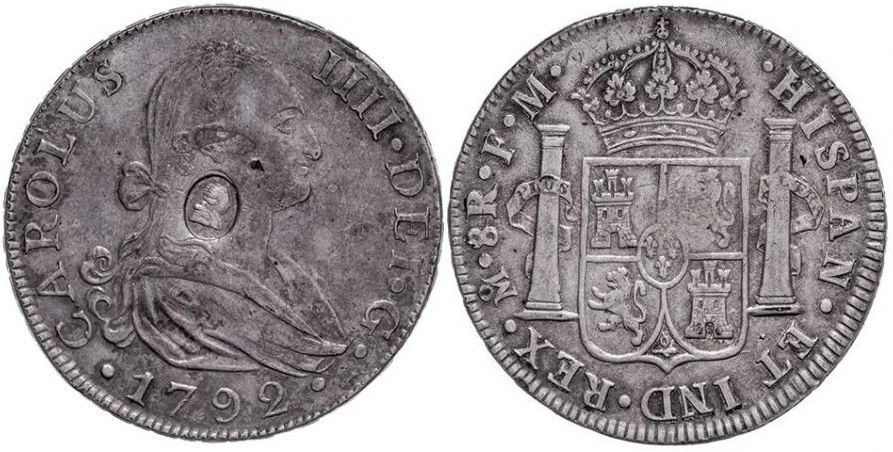 |
|
|
|
Pillar of the Community
 United States
1949 Posts |
|
|
Pillar of the Community
United States
731 Posts |
Isn't the obverse a copy of a Spanish type linked to a Mexican reverse?
|
|
Pillar of the Community
United States
2243 Posts |
Nothing that screams fake to me.
|
|
Pillar of the Community
United Kingdom
709 Posts |
"The bank, to make their Spanish dollars pass, stamped the head of a fool on the neck of an ass".
( UK "ass" = donkey, meaning a stupid person, not US meaning somebody's butt )
"Two kings heads not worth a crown".
Contemporary jingles mocking the issue of these counterstamped coins.
Cant help you with authenticity, but thought I would share these as they amused me.
Edited by Anaximander
08/25/2015 6:16 pm
|
|
Pillar of the Community
France
1591 Posts |
Portrait side is continental type (madrid), pillar side is from Mexico.
|
|
Pillar of the Community
United States
1156 Posts |
Nice pick up, Bob! As others have commented the obverse is patterned after the design from Spain (Madrid and Seville) but the reverse is patterned after the colonial design (addition of the Pillars of Hercules) with the Mexico City mintmark.
So is it type I, II or III?
|
|
Pillar of the Community
 United States
5362 Posts |
The coin is a Class 1 coin that first appeared in print in 1903 in the Bordeaux report (French Numismatic Society) about the counterfeiting effort at Birmingham. It is therefore one of the very first coins to be identified as belonging to that issue of counterfeits to appear in a numismatic publication other than Riddell's book.
Up to this point in time I owned only one very low grade example of this Sheffield Plate issue. The coin that appears in my book on page 542 belongs to Gordon Nichols.
Those who recognized that the coin is a mule of two different types are entirely correct. The Portrait die is the type that appeared on Spanish issues and the reverse is the typical Mexican colonial issue. The mule is of course impossible since the dies were prepared and used in different mints.
For those who merely thought the ordinals were placed on the wrong side of the King's head - don't be disturbed because you are in good company. The 1903 edition of Bordeaux and the 1915 translation into English (Spink) made the identical error believing it was some sort of die cutting error. Neither the author nor two sets of editors in France and England made the obvious connection that two different coin types were involved.
For the novices that saw nothing wrong with this coin, you can add your names to the long list of anonymous private citizens and merchants that were fooled by this coin from 1797 to 1820.
The Geo III counter stamp is a very well made counterfeit stamp applied after the coin was struck.
Hope you found it interesting.
|
|
Pillar of the Community
Hong Kong
1270 Posts |
Yes, this is a mule coin. Is it silver and is the weight correct?
|
|
Pillar of the Community
United States
5362 Posts |
Correct weight is typical of the type. The one I have is thicker than an original about 1/4 mm. The coin is 90% silver layers over nearly pure copper. It is a typical pre-1820 Sheffield Plate struck coin.
|
|
Pillar of the Community
France
1591 Posts |
Wow, the quality of that one is impressive. Congratulation for that catch Robert !!
Can you post a close-up of the stamp ? It indeed appears to be very well done.
|
|
Pillar of the Community
Hong Kong
1270 Posts |
I just don't understand why produced a mule coin to deceive those regular coin users but not a decent formal silver dollar.
|
|
Pillar of the Community
United States
5362 Posts |
MathieuMa I will post a higher quality photo of the stamp as soon as I get the coin in hand. wonghinghi I think you mean why the forgers produced a mule? I would say that the audience for the coin would be critical. I expect that the group targeted for passing was unfamiliar with the specifics of the coin. During the English silver shortage of 1797 - there were relatively few Spanish 8Rs in circulation in England. Most were removed from circulation rapidly because at face value they contained too much silver. So most 8 reales were in bank vaults. The average banker outside of London did not see many of these and would go by weight and surface acid tests. Specific Gravity testing used at the Bank of England and The Royal Mint (but rarely elsewhere) would have worked for detection. The extent of circulation of actual copies show that the average copy did remain in actual circulation for some significant time.
|
|
Pillar of the Community
United States
5362 Posts |
Here is a picture of my older heavily circulated version. I think there is no doubt that this coin circulated long after it became obvious that it was a forgery. I believe that once identified that these often became tokens that continued to be used. Some were stamped with workhouse or other logos. 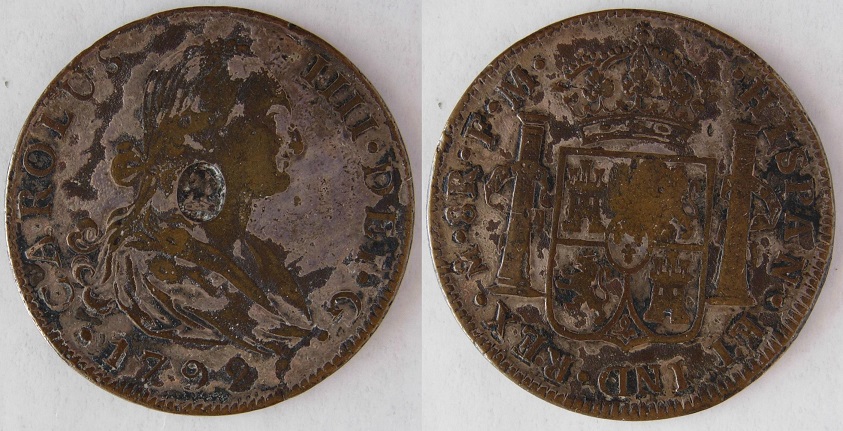 |
|
Pillar of the Community
United Kingdom
709 Posts |
There is an interesting little booklet which gives some of the social/economic background to these coins. This kind of detail interests me as much as the technical aspect of the coins.
The Token money of the Bank of England 1797-1816
By Maberly PHILLIPS
I have a digital copy. The date of publication is not immediately obvious, but from the style it appears to be towards the end of the 19th century. Any further info out there would be gratefully received.
In 1797 there was an enormous shortage of silver coin in Britain. I read elsewhere that it has been estimated that there was only about 10 shillings worth of coins for each person in the country. With the emerging industrial revolution there was a huge demand for coin. The lowest banknote allowed by law to be issued was £5, a huge sum then. I have read accounts of groups of ordinary workmen being paid by one £5 note, which they then had to find some way of splitting. Usually this involved a trip to the local alehouse, who would sometimes want a premium for splitting the note, as well as expecting the workmen to buy something.
In 1797 the bank of England advertised that they were going to issue counterstamped Spanish dollars valued at 4s6d each. Before they were issued it was realised that the bullion value was 4s8d. Had they continued with their plan, it would have seen large numbers of these coins being melted down for scrap instead of helping with the lack of change. Shortly before release, it was revalued at 4s9d. The book states some 2,325,099 dollars were issued.
Some sources I have read state that unscrupulous dealers were obtaining genuine Spanish dollars and forging the counterstamp, thereby gaining value of 1d at the expense of the Bank of England. This is as well as complete forgeries being made.
In 1804 the dollars were being passed at 5s. In 1811 the bank is noted as receiving dollars at 5s6d, which had a bullion value of 5s5d.
I have heard of officially sanctioned forgeries of the 8R produced at Birmingham, which were intended to be used abroad. Is it possible that this coin is one of those which somehow escaped into domestic circulation? I have also read of licensed coin producers secretly making extra coins for their own use. Does anyone have more information on this?
|
|
Pillar of the Community
United States
5362 Posts |
Anaximander Much of the information you are relating is contained in the 1903 and 1915 articles written by Paul Bordeaux. The book you cite was printed in 1900 and has been recently reprinted (2015) since the original is out of copyright. It is available on Amazon for under $12. It is only 53 pages long. Spink has issued a rather definitive work on the subject of the Emergeny Issues and Bank Tokens which is worth reading. But I want to address your last comment: Quote:
I have heard of officially sanctioned forgeries of the 8R produced at Birmingham, which were intended to be used abroad. Is it possible that this coin is one of those which somehow escaped into domestic circulation? I have also read of licensed coin producers secretly making extra coins for their own use. Does anyone have more information on this? The coins made in 1796 as part of the War effort against Spain were NOT issued with the Bank of England counterstamps. The initial war effort had already failed before the start of the Emergency. Some authors have theorized that left-over counterfeit coins from the first effort were later stamped for domestic use. This is of course possible but there is simply no proof one way or the other that it really happened. Some of the identical counterfeit die types are known to exist with and without counterstamps (both oval and octagonal). It is however easy to prove that there are more counterfeit version of BofE emergency money than early Birmingham issues with no counterstamp. I presented the coin because it was the same type of mule that Bordeaux mistakenly identified as part of the 1796 effort in his 1903 work, even though the George III privy stamp was not used until 1797.
|
| |
Replies: 18 / Views: 3,378 |






 Posted 08/25/2015 5:03 pm





