



Coin Community Family of Web Sites Join Thousands of Coin, Bullion, & Money Collectors
Coin, Banknote and Medal Collectors's Online Mall Specializing in Modern Numismatics Shop for APMEX Bullion on eBay!300,000 items to help build your collection! Join Thousands of Coin, Bullion, & Money Collectors Vancouvers #1 Coin and Paper Money Dealer Royal Canadian Mint products, Canadian, Polish, American, and world coins and banknotes.


Username:
Password:
Save Password
Forgot your Password?


This page may contain links that result in small commissions to keep this free site up and running.

Welcome Guest! Registering and/or logging in will remove the anchor (bottom) ads. It's Free!

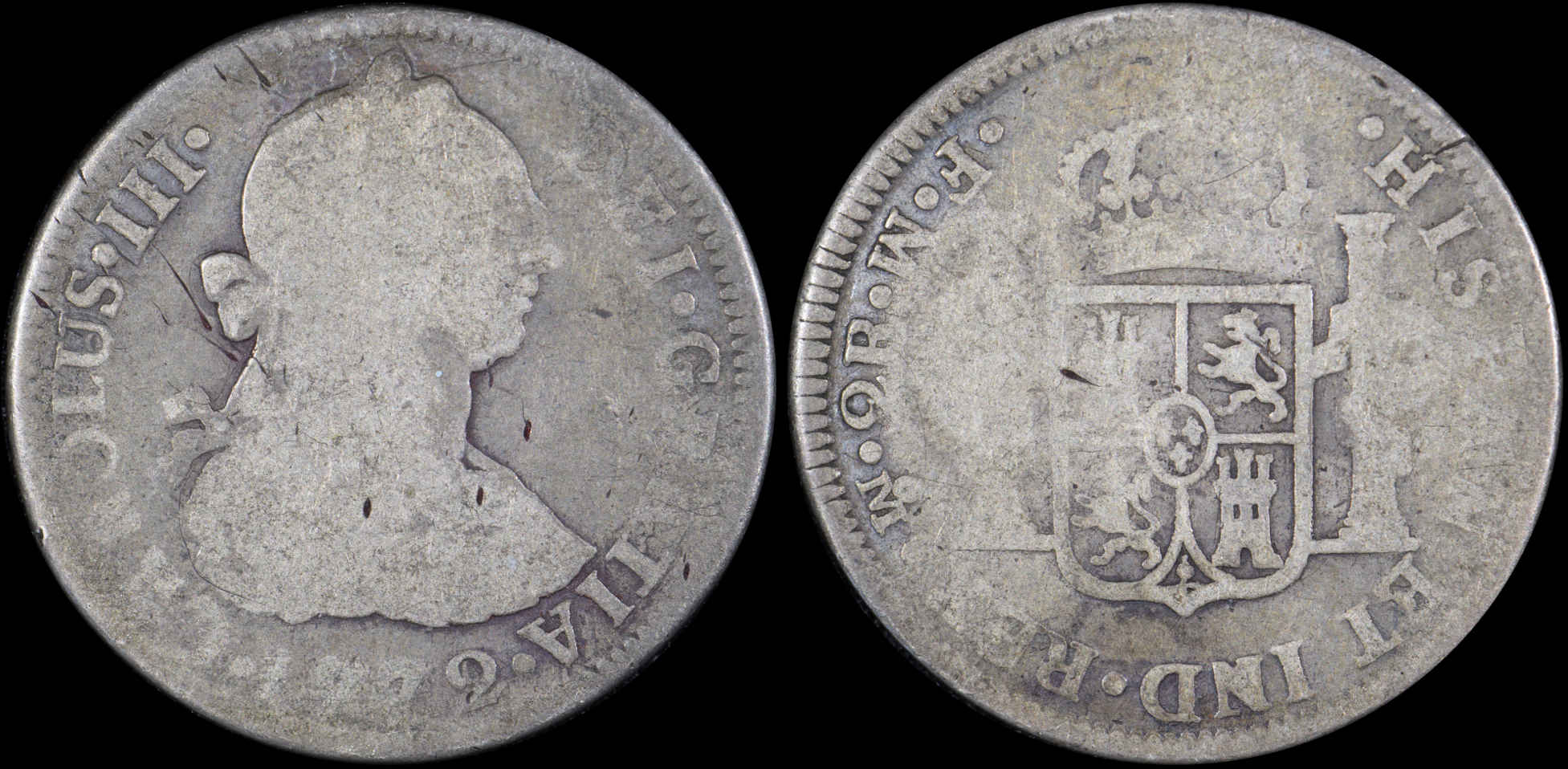
1772 2 Reales - Mexico Mint - Overdate?

To participate in the forum you must log in or register.
Author Previous TopicReplies: 3 / Views: 1,098Next Topic  
Pillar of the Community
EFLargeCents's Avatar
United States
1304 Posts
 Posted 09/09/2015  1:13 pm Show Profile   Bookmark this topic Add EFLargeCents to your friends list Get a Link to this Message Number of Subscribers
I have this low grade 2 Reales that appears to have a 2 struck over an inverted 3. I have not had any luck finding a similar coin on the internet that shows the date digit like this. I am in no way an expert on these coins so hopefully someone can clear this up! It is also the inverted assayer type.

1772-2-Reales---Mexico-Mint---Overdate?
Pillar of the Community
swamperbob's Avatar
United States
5362 Posts
 Posted 09/09/2015  8:41 pm  Show Profile   Bookmark this reply Add swamperbob to your friends list Get a Link to this Reply
Worn coins are never the best to establish varieties. The problem I see here is the shape of the curl within the loop of the 2. The 3 in use in 1773 had a flat top and NO curl on the tail. BY 1778 and 1780 there were curls on the numerals 8 and 0 so it is theoretically possible that incorrect punches were already produced and in the die sinker's tool kits before they were needed - but that would be a hard sell.

Also possible, and perhaps an easier sell, would be a numeral 2 with a curl at the upper termination. I think there would be a better case for a 2 over a rotated 2 than for a 2 over 3 in any event.

Pillar of the Community
EFLargeCents's Avatar
United States
1304 Posts
 Posted 09/10/2015  10:05 am  Show Profile   Bookmark this reply Add EFLargeCents to your friends list Get a Link to this Reply
Thanks for the reply! I agree it's tough in low grades, but at least you see something under the 2 as well and I'm not crazy. I'll keep looking for other images of this series, but surprisingly that has been tough, to see if I can match this up with a higher grade specimen.
Pillar of the Community
swamperbob's Avatar
United States
5362 Posts
 Posted 09/10/2015  1:15 pm  Show Profile   Bookmark this reply Add swamperbob to your friends list Get a Link to this Reply
Perhaps some background information for the series would be helpful. It is generally well known that Spain actually provided a matrix block for each colonial mint. It is also generally believed that there were matrix blocks for each denomination - creating one set of "standard" numbers and letters for each denomination.

This matrix block was a large steel block from which individual die punches were made. The block contained one or more positive impressions of each die feature. The procedure started with a negative master punch being created for each feature. This negative punch was then used to create the positive working punch that cut the individual working dies (negatives).

This procedure allowed literally hundreds of working punches to be created for each element. The King's portrait was the largest individual die punch that was used. Matrix blocks were issued for each new King.

Since the individual punches were made by the mint blacksmith there was slight variation possible based on how deeply it was set. If (and this is conjecture) a punch was set too weakly set for the liking of the die sinker, who was also an engraver, he could modify the punch by engraving it. The die sinker could also "touch up" individual die impressions. So it is theoretically possible that the die sinker could have added a curl to one or more dies or die punches.

My collection is focused on 8R coins only. I have recreated the appearance of the standard 8R blocks for my research but have never done the same for the other denominations. To do so I first located photographs of between 10 and 25 completely identical genuine coins made from different dies for each year of production. By comparing these photos feature by feature I recreated the appearance of each standard letter.

The same could be done for each denomination - but since 8Rs were made in the greatest numbers it was easy to do the project for that denomination for Mexico City.

The number two is used on all 2 reales so it should be easier to determine the shape of the standard 2 than to determine the standard 6.

Good luck in your search.
  Previous TopicReplies: 3 / Views: 1,098Next Topic  

To participate in the forum you must log in or register.


Disclaimer: While a tremendous amount of effort goes into ensuring the accuracy of the information contained in this site, Coin Community assumes no liability for errors. Copyright 2005 - 2026 Coin Community Family- all rights reserved worldwide. Use of any images or content on this website without prior written permission of Coin Community or the original lender is strictly prohibited.
Contact Us  |  Advertise Here  |  Privacy Policy / Terms of Use

Coin Community Forum © 2005 - 2026 Coin Community Forums
It took 0.19 seconds to rattle this change. Forums