|
This page may contain links that result in small commissions to keep this free site up and running.

Welcome Guest! Registering and/or logging in will remove the anchor (bottom) ads and the security checks. It's Free!
To participate in the forum you must log in or register. | Author |
 Replies: 26 / Views: 7,264 Replies: 26 / Views: 7,264 |
|
|
|
Pillar of the Community
United States
949 Posts |
Based on what Albert was saying about an altered Persian (Persic) standard for these coins rather than an Attic standard, here is a revised table of weights for the drachm and fractions of these coins:
................Attic...Persic
drachm..........4.3.....5.702
tetrobol........2.85....3.8
triobol.........2.15....2.85
diobol..........1.43....1.90
trihemiobol.....1.07....1.43
obol............0.72....0.95
hemiobol........0.36....0.48
I cannot yet account for examples of all these denominations in the revised standard.
But on the basis of this it would appear that the OP coin, at 1.07 grams, is neither a diobol nor a trihemiobol, but is closest to the weight of an obol. If these numbers are correct, then the coin Albert posted is actually an obol too, since it is much closer to .95g than 1.43.
The coin I posted just comes in at 1.43, the revised weight of a trihemiobol.
How does this look to you Albert?
|
|
Pillar of the Community
Belgium
1194 Posts |
First , here is a table with the different most used weight standards and denominations.It is a scan from Seaby's Greek coins and theur values , 2nd edition,1966. 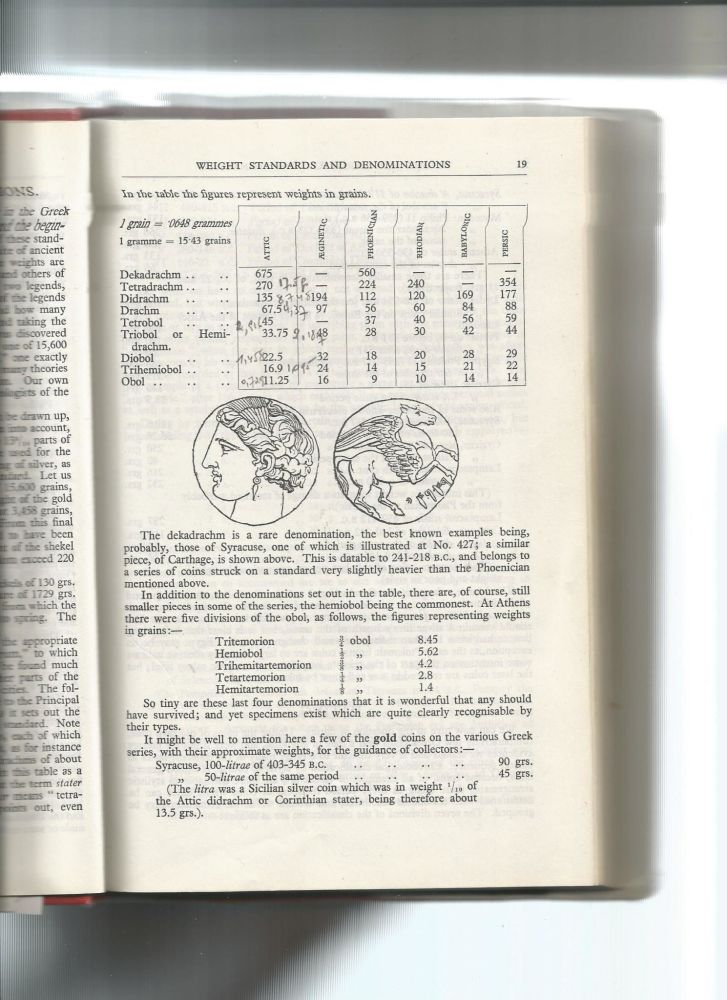 At the end of each BM Catalogue of Greek coins , you find a table to make the conversion inch - mm . For the weight standard ; I think it is evident it is not the Attic standard , so ,as colony from Milete , maybe they used first this standard .I found only the Milete standard for electron denominations : 1 stater = 14.10gr and a hemistater (= also called drachme) : 7.05 gr . This accords with the Phoenician standard . Considering the geographical situation of Sinope , it is normal they used a standard from Asia Minor ,so it is possible that Sinope , situated in Paphlagonia under Persian rule , adopted the Persic standard , and made a mixture of the two.I suppose this could be a possible explanation the standard and the drachm-name . For the error tollerance : I don t think there are rules for it .It is a question of common sence , I suppose . For the denominations : I was checking Wildwinds and found only drachms, except one 1/4 drachm or diobol (sic)(SNGBMC250) and one hemiobol : 0.44 gr (correct : 1 obol 0.72 gr).In the auctions that I follow and where I bought my coin , it is only drachm or trihemiobol. I was checking my coin , the weight is right :so it is more a obol than a trihemiobol,as you said .I was verifiing the invoice , and there is marked : selten (rare in German).I think they resolved the weight/denomination problem in this way .albert |
|
Pillar of the Community
United States
949 Posts |
I like the comparative chart you gave, which was done by Seaby and Kozolubski for the second edition. When David Sear took over he replaced it with the chart I gave earlier from the third edition. Thanks for the tables suggestion, but I've been using the conversion tables in Historia Nummorum. They are identical to the BMC tables. Barclay Head devotes a great deal of time to discussing the weight standards by region and municipality. For Sinope he proposed a reduced Phoenician standard, with a stater of 100-80 grains, so for the period 453-375 he describes a silver piece with the eagle and dolphin reverse at 93-80 grains. For Istros he prefers the same standard as Sinope, but with a stater of 108 grains and a fraction at 22 grains. Not sure when the shift to seeing it as a modified Persic standard came about, but he and Gardner both mention that there is a complex connection between the Phoenician and Persic standards. I just picked up a fraction at 16 1/2 grains (1.07g) from a seller on Vcoins, but I am a little worried about the graininess/pitting of the surfaces: 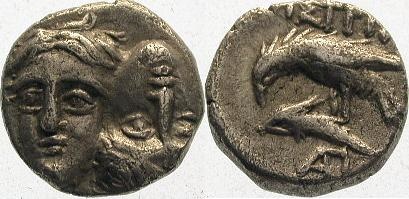 A few days ago I picked up a small fractional of 6.75 grains (0.43g) which will now give me examples of a hemiobol, obol, trihemiobol, and drachm. I have seen one example that weighs correctly for a diobol (1.9g) but it looks like a fake to me. Care to take a look? |
|
Pillar of the Community
Belgium
1194 Posts |
I am happy for you ,.How is your hemiobol , I am curious to see a picture .It is a good idea to make the collection of one coin and his fractions ,I never thinked at this.A few years ago , I bought different same coins of Gordianus III to compare the different faces and the different details in the reverse .It is very interesting to see on how many ways the coins differs.albert
|
|
Pillar of the Community
United States
949 Posts |
Quote:
How is your hemiobol , I am curious to see a picture Nothing to be proud of, I'm afraid, and I have some doubts about the pitting of the surfaces. I will see when it arrives, but here is the seller's pic, slightly enlarged: 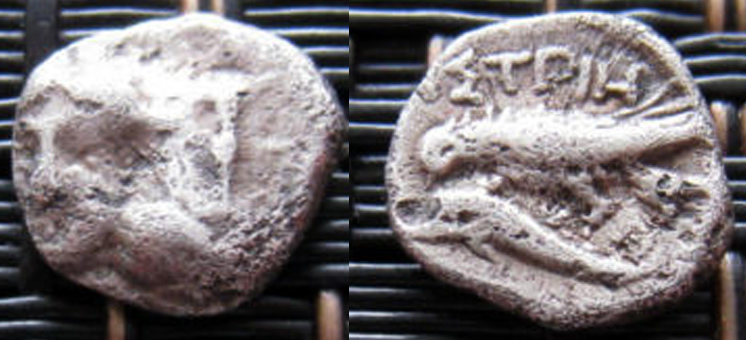 It looks like the eagle has made some headway "eating" the head of the dolphin (corrosion, of course) and I am curious about the emblem below the eagle at right. A theta, I expect. At least the size and weight are correct. I also picked up two other coins that were offered as hemiobols, but this seller did not give the sizes. Both were very inexpensive, and for good reason, but appear to be in good silver. The first has very rough surfaces, which may appear worse in a close up image than they do in hand. But if the weight is correct, then it's better than nothing (maybe). 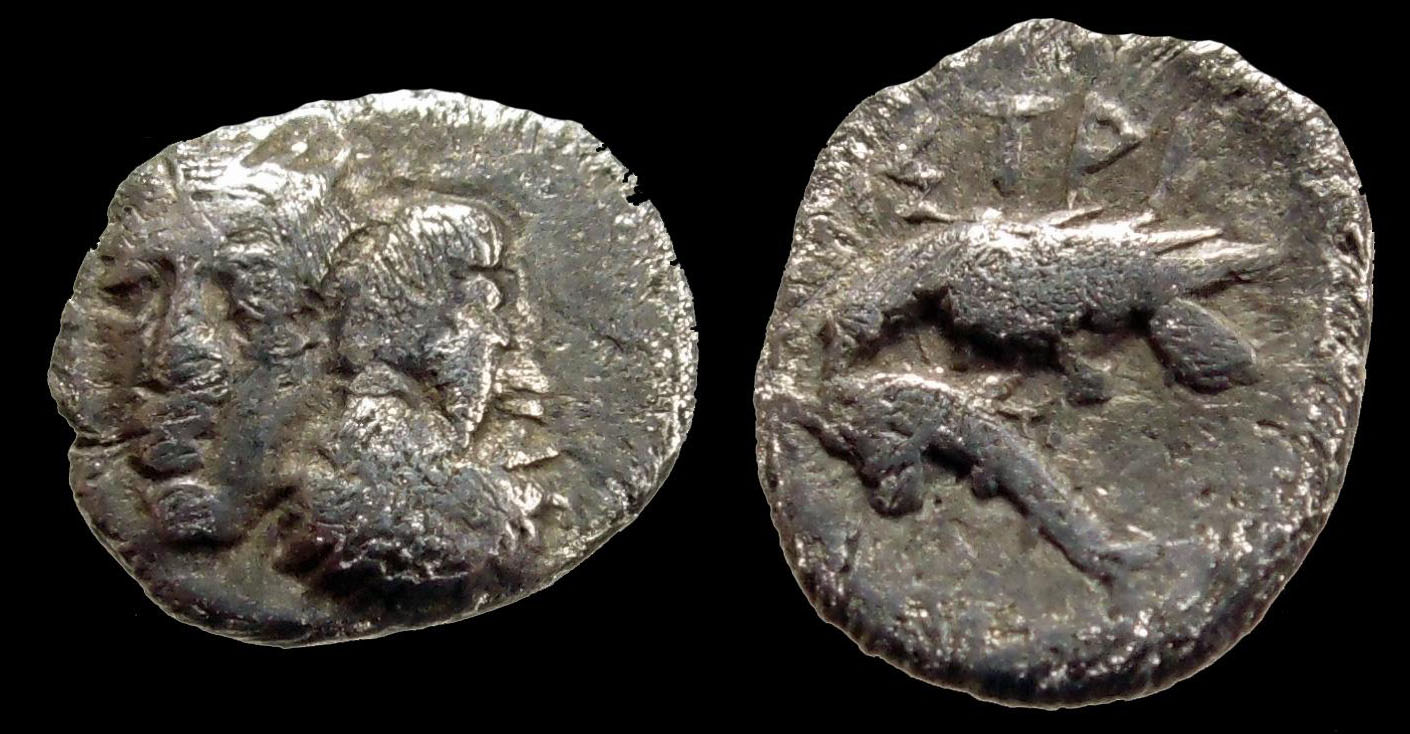 The third coin is the best of the three, but I suspect that it is too large for a hemiobol. If it is correct for a hemiobol, then it will have to do. But if it is too heavy, then I have my eye on a very presentable example. 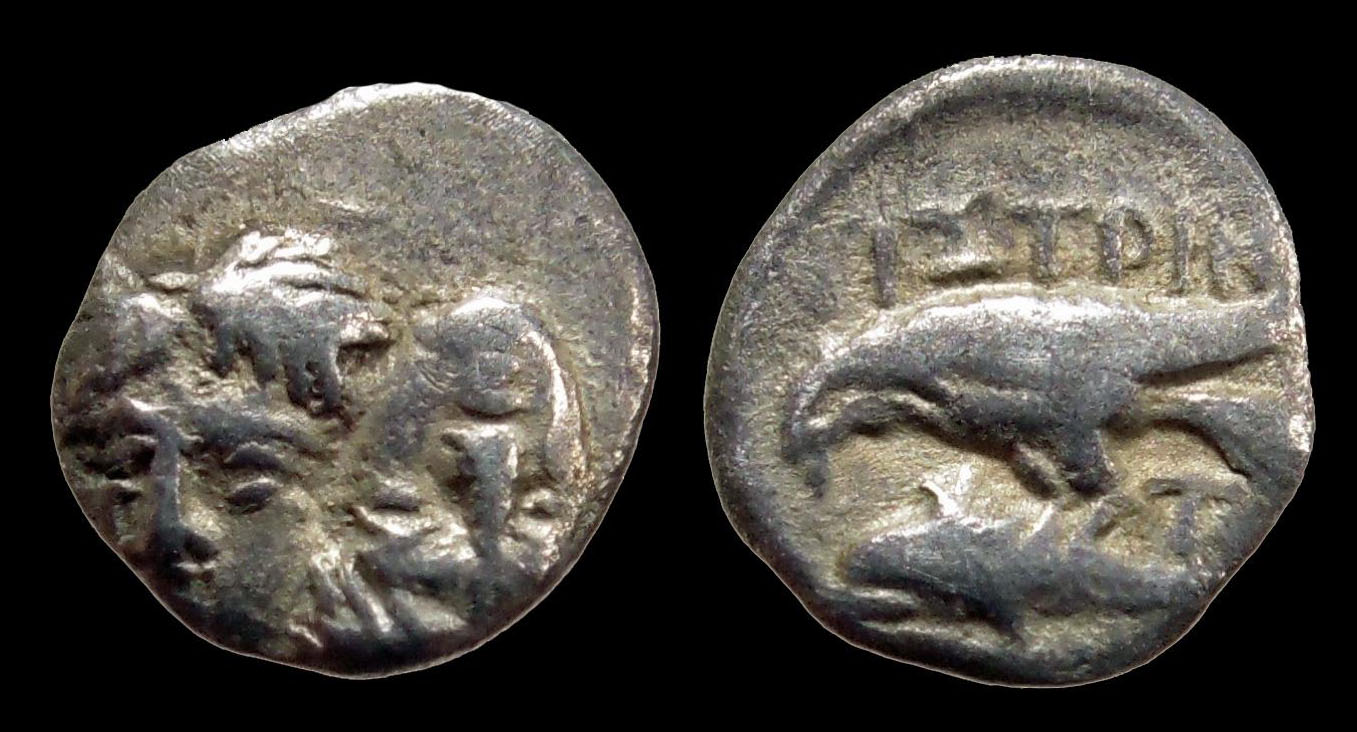 Those are the hemiobols. I am starting to work on getting examples of the parallel stater and its predecessor from Sinope. I will let you know what comes of that. Here is a remarkable example of the earliest stater of 93 grains (6.02g) that Head regards as the beginning of the eagle and dolphin motif. The seller wants $5000 for it, which is way out of range, but the coin is a showpiece. 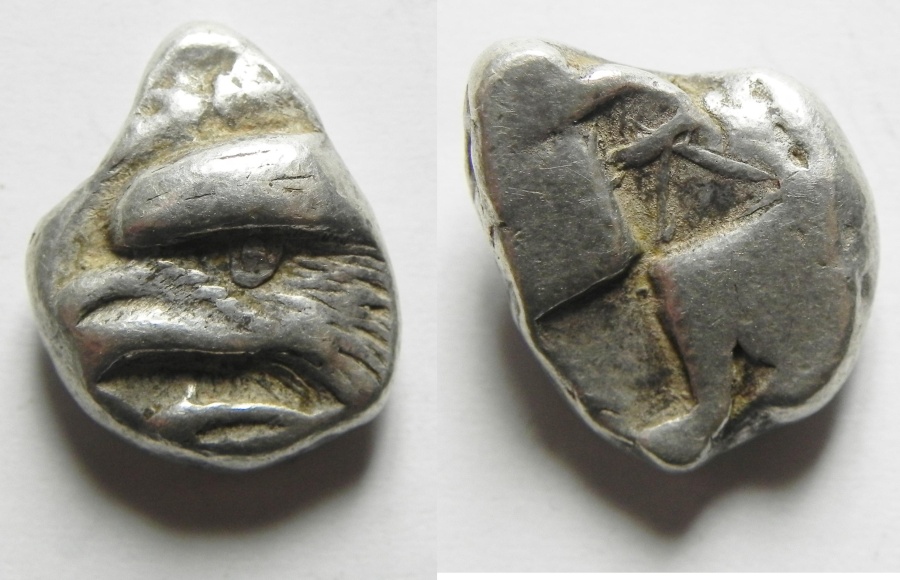 In his description of the obverse for this early type, Head notes, "Eagle's head, often of very rude work." However, this example of the coin shows the type as it was meant to look. The head of the eagle dominates the flan, with a tiny dolphin beneath it. In this example the beak, eye and feathers are easily recognizable. The reverse is supposed to be a quadripartite incuse square in which two opposing quarters are deeply sunk. But even in this well preserved coin, the punch looks to me more like a bipartite incuse punch of squares, with a monogram or letter lambda in one quadrant. The example I acquired is much more modest in appearance and more typical of what one finds. This example weighs 94 grains (6.09g). 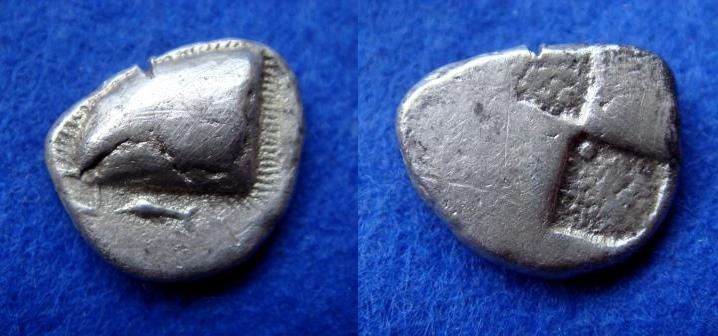 Here the feathering surrounds the shape corresponding to the eagle's head, and the line of the beak is the only clear feature. But a well defined, diminutive dolphin is clearly visible below. As before the reverse incuse punch appears bipartite with a pellet in one of the squares. Presumably, the eagle and dolphin motif was descended from this, since it is the next type encountered in the staters of Sinope. These later examples, in the range 93-80 grains, are what first appear as silver staters at Istros. |
|
Pillar of the Community
Belgium
1194 Posts |
sorry for responding so late , but I was out for one week .Will come back later.albert
|
|
Pillar of the Community
United Kingdom
2624 Posts |
Just came back to look at this post and see it has turned into a fascinating thread, full of information.
Maybe we should take some of the information and make a sticky thread explaining the weights, denominations and standards of ancient coinage?
|
|
Pillar of the Community
United States
949 Posts |
Welcome back Albert. The coins I ordered have mostly arrived and I can report the weights on the two above that were missing. The group of three hemiobols are indeed all hemiobols. The first one of the three has not arrived, but the seller gave the weight as 6.75 grains (0.43g). The second one, with porous surfaces as well, weighs 7.4 grains (.48g). The third has clear surfaces and weighs 5.7 grains (.36g) which is actually light for a hemiobol based on an average weight of .44 -.43 grams.
Thanks for the good word David. Stay tuned, because this study is really a work in progress. I have another item or two that should prove interesting, one of which is rather speculative. But I am waiting for some things to arrive before I open up about it. All in good time.
|
|
Pillar of the Community
Belgium
1194 Posts |
your first coin has a very nice reverse .Can the Theta not be an italic epsilon ? for my old eyes , lower right it seems open to me ,upper right is doubtful .
The two others coins are very intersting in the way it completes your collection and you can always later replace them .
For the Sinope coin , it is a very nice coin you have there.You were very luckly to find it so soon.The reverse makes me think at the coins of Chersonesos,with the lion forepart on the obverse, and the incuse quadripartite incuse with two quarters deeply sunk ,and different signs or monograms .How are the smaller denominations ?
Istros was situated in the delta of the Danube river,at the Black Sea . The first Greek name for the sea was Pontos axeinos and it changed when they began to found cities in Pontas euxeinos = a sea where everybody is welcome (euxeinos) and where before the sea was not hospitable (I don t know a better English word) .I don t know why it is called now the Black Sea , for me the color is the color of a normal sea with white sand ,but maybe I was there in Roumenia in the wrong season (summer 1967).albert
|
|
Pillar of the Community
United Kingdom
2624 Posts |
A couple of notes about the derivation of black sea. It was considered hard to navigate and the shorelines hosted an array of savage tribes. Perhaps Black came from "unlit" or "dark"
"Another theory states that the colour red signifies "south." Some Asiatic languages use colours to refer to directions. The same theory applies to the Black Sea; the colour "black" may refer to the direction "north" in Medieval Turkish, or the dark, sudden storms that would strike and cloud over the skies.."
|
|
Pillar of the Community
Belgium
1194 Posts |
thanks David for the explanation on the colours .It is all new for me.Do you think there is an interest for a thread explaining weights ...? albert
|
| |
Replies: 26 / Views: 7,264 |
To participate in the forum you must log in or register.
Disclaimer: While a tremendous amount of effort goes into ensuring the accuracy of the information contained in this site, Coin Community assumes no liability for errors. Copyright 2005 - 2026 Coin Community Family- all rights reserved worldwide. Use of any images or content on this website without prior written permission of Coin Community or the original lender is strictly prohibited.
Contact Us | Advertise Here | Privacy Policy / Terms of Use
|
| Coin Community Forum |
© 2005 - 2026 Coin Community Forums |
| It took 0.42 seconds to rattle this change. |
 |
|
| |
| |







 First Page


 Posted 09/18/2015 10:28 am


