| Author |
 Replies: 186 / Views: 37,196 Replies: 186 / Views: 37,196 |
|
|
|
Valued Member
United States
411 Posts |
Last month the Riksbank introduced 5.1 SEK billion of new notes and destroyed 5.4 SEK billion of old notes, continuing the practice of destroying more notes than they introduce almost every month.
After this summer, the Riksbank will presumably have to introduce replacement banknotes for the smallest denomination like the 20kr banknote which should become tattered within 2-3 years.
But would someone like to speculate if the Riksbank will replace the new 500kr and 1000kr banknotes or simply destroy them as they get old? At the expected rate of use, it could take many years for them to wear out.
On a side note, "The Handmaid's Tale" was just released on Hulu based on the 30+ year old novel of repression in a future society. One of the techniques used by the powerful was the removal of money from society to keep women under control. I know that is considered extreme, and Swedish society is not repressive, but it is always interesting aspect to consider for the cashless society.
Edited by PacoMartin
04/30/2017 8:35 pm
|
|
Pillar of the Community
Germany
995 Posts |
In my opinion, 500kr and 1000kr notes will continue to be replaced -- if necessary. But I also think, that ''demand'' will continue to drop so that there will be less 500kr and 1000kr in circulation than before the introduction of the new notes.
By the way, I still can only see the Riksbank numbers of 2017-02-28. If someone can see newer figures, please let me know. Perhaps, I need to adjust my browser.
Norways's numbers for their new notes (and the number of replacements) will be highly interesting.
|
|
Valued Member
United States
411 Posts |
Your browser is not broken. The webmaster at the Riksbank put the new statistics in for March, but forgot to change the date on the title. The Riksbank is increasing the net number of 1000kr banknotes by smaller amounts. I have no idea how they are being distributed, unless there are a handful of ATM's that dispense that denomination.
Month |Thousands of NEW banknotes (net change) 1000kr and 500kr denomination
Oct 31, 15	|	398
Nov 30, 15	|	320
Dec 31, 15	|	355
Jan 31, 16	|	155
Feb 29, 16	|	149
Mar 31, 16	|	275
Apr 30, 16	|	180
May 31, 16	|	245
Jun 30, 16	|	260
Jul 31, 16	|	210
Aug 31, 16	|	125
Sep 30, 16	|	149
Oct 31, 16	|	139	 5,140
Nov 30, 16	|	124	 6,676
Dec 31, 16	|	215	 7,270
Jan 31, 17	|	 39	 4,616
Feb 28, 17	|	 55	 6,272
Mar 31, 17	|	 68	 8,870
While these are nominally "net increases" I can't imagine any of the notes being destroyed because of wear and tear, although I suppose accidents happen. Frankly, it seems almost ridiculous to produce the denomination with such small numbers of banknotes. They are at 3.46 million of these banknotes for a population of 10 million My only thought is that keeping the denomination (1) avoids a focal point for politics, and (2) the denomination is a "backup" in case of unforseen economic disaster. But the net number of 20kr and 50kr banknotes seems to have stopped increasing at roughly one SEK billion for each denomination. Since these notes are handled a lot more, I imagine some are being replaced. But it occurred to me that the 1000kr banknotes may not be replaced in the future until they simply vanish and are eventually declared invalid. Obviously there are a lot more 500kr banknotes being distributed compared to the 1000kr banknote, so they may need to be replaced. As of Mar 31,2017 there are over eleven new 500kr banknotes circulating for every 1000kr banknote. Edited by PacoMartin
05/01/2017 09:40 am
|
|
Pillar of the Community
Germany
995 Posts |
Quote:
Your browser is not broken. The webmaster at the Riksbank put the new statistics in for March, but forgot to change the date on the title. Ah, Thanks. I was pretty busy lately. So I only checked the date and not the numbers when I visited the site. Regarding the 1000kr note. I think point ''2'' (back-up) seems likely. Also, lets not forget this Sweden. So six denoms with three men/three women on the notes is ''political correctness'' at work. Besides, there is no much harm or danger in the 1000kr note itself. I highly doubt that criminal elements are hoarding this note. |
|
Pillar of the Community
 Sweden
1078 Posts |
Today I visited a cashpoint on my way back home, and guess what note I got! 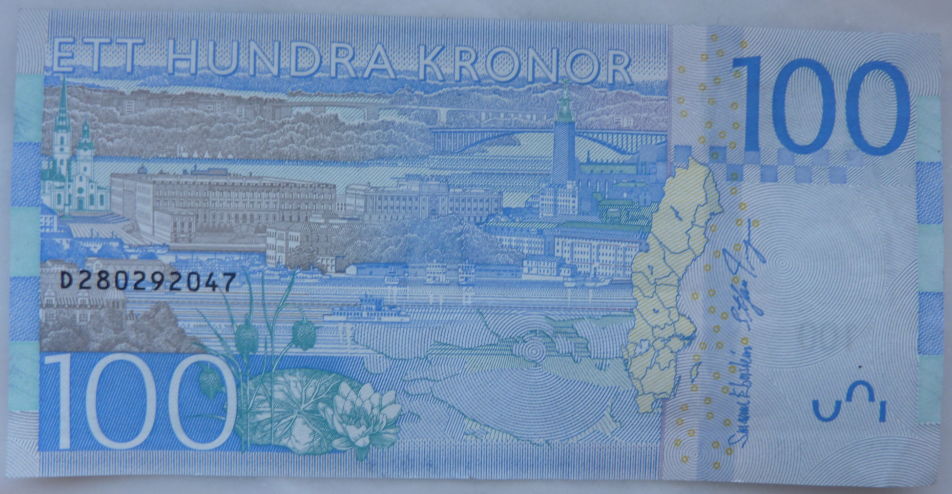 A lovely new D-prefix 100-kr note, from the ATM in my little community centre. A bit of stuff I haven't seen that I feel like I need to comment on: Quote:
the Riksbank will presumably have to introduce replacement banknotes for the smallest denomination like the 20kr banknote which should become tattered within 2-3 years. I see many 20-kr notes that are beginning to look very worn and ugly, so I'm not surprised if new dates start popping up very soon. Quote:
But would someone like to speculate if the Riksbank will replace the new 500kr and 1000kr banknotes or simply destroy them as they get old? At the expected rate of use, it could take many years for them to wear out. Very sure these will be replaced, just in fewer numbers. Quote:
Sweden didn't actually demonetize it's 1892 1000kr banknotes until 31 December 1987. But since then they have demonetized every series. The Riksbank must've changed their policy on legal tender banknotes at the time, since on that date pretty much all notes issued between 1875 and the 1980's when a new note series was introduced. Long defunct notes like the 1-kr notes and 10'000-kr notes were denometized then. Kind of like the Riksbank's move to demonetize the original 2-kr coin despite it not seeing production and proper circulation for well over 40 years. Quote:
Is the extremely low number of circulating 1000kr banknotes (3.4 million) a sign that the banknote is going to be declared invalid in a few years? Quote:
The Riksbank is increasing the net number of 1000kr banknotes by smaller amounts. I have no idea how they are being distributed, unless there are a handful of ATM's that dispense that denomination. These are connected. I too, other people and even the Riksbank ask the same. The only place I know of where to get these are at bank offices that handle cash, mainly foreign exchange offices that also do cash errands for other larger commercial banks that don't handle cash themselves. One can do a cash withdrawal there but of course it isn't feeless. Strangely enough I've seen some shops around Stockohlm that have signs up explicitly denying 1000-kr notes, and the image featured is the new note. So somehow these notes are hitting circulation, but the only likely way I see is foreigners exchanging money to SEK and get one of these notes as part of their transaction. If anyone out there has any better insight as to where these 1000-kr notes can be acquired, please inform us. |
|
Valued Member
United States
411 Posts |
In 1999 Canada was circulating 3.792 million CAD$1000 banknotes. The next year they decided to stop producing the denomination, but the existing notes are still legal tender. As of the latest annual report for 2016 there are 765,274 still in circulation. Their collector value is not very high, and it is popularly believed that the remaining notes are used by gangsters to "tip" one another for a job well done. The USA produced 3.943 million banknotes of the $500 denomination before WWII and 284,000 are still circulating. They also produced 2.675 million banknotes worth $1000 before WWII and 165,000 are still circulating. The assumption is that these are all in the hands of collectors. While they are certainly sold for above face value, a $1,000 in 1945 has the same buying power as over $13,000 today. A thousand dollar banknote certainly is not worth $13K today. A much smaller number of $1000 and $5000 banknotes were also produced, and roughly 350 of each denomination is still in circulation today. In contrast circulating 3.461 million 1000kr banknotes in Sweden is a ridiculously small number. At current exchange rates 1,000SEK ~ CAD$155. Riksbank is circulating 38.8 million new and 27.8 million old 500kr banknotes. The old banknotes will no longer be legal tender as of 30 June. Instead of a 1000kr banknote, it would be easier to circulate an extra 7 million 500kr banknotes. If the new 1000kr banknote is a backup in case real estate value plummet or banks start declaring bankruptcy (or solar flares), it would be interesting to know how many were produced. But Sweden treats production quantities as a state secret. Most central banks report production quantities as well as circulation quantities. It took Iceland over 4 years after the banks crashed to introduce a new banknote worth double the value of the previous highest denomination. Of course by then the Icelandic crown had lost half it's value relative to the Euro. The top Icelandic denomination, 10,000ISK ~ 830SEK. I am sure that it was part of Sweden's thought process that they should keep the 1000SEK denomination, and circulate just enough of them so that people would know they exist and are legal tender, even if they never see them. In September of 1992, Sweden raised it's marginal lending rate to 500% in one of the worst financial crisis to hit an industrial nation since the 1930's. While no one expects that to happen again, a central bank must consider all possibilities. http://www.nytimes.com/1992/09/17/n...ht-perc.htmlEdited by PacoMartin
05/02/2017 4:54 pm
|
|
Valued Member
United States
411 Posts |
I am quoting a post I made last February because I made the statement that the elimination of cash coincides with the introduction of negative interest rates. The Riksbank Deputy Governor Cecilia Skingsley denies that there is a grand design of the government. The reduction is entirely a result of market forces. Skingsley believes that cash should be complemented with an e-krona that will counter the existing market forces. She is vehement that the objective of e-krona is not to completely eliminate cash, but to allow more individuals to have direct control of central bank money. It looks like circulation is going to peak at five or six 500kr banknotes per capita. Do you think that Skingsley is accurate in her assessment? Quote:
My Post from February 2016
I don't want to completely lose sight of my main point. The so called "cashless" society is necessary if the central government is ever going to institute negative interest rates which are increasingly seen by governments as the only way to propel economic activity.
Sweden is leading the charge for the world. Some aspects of the transition are:
(1) Time! They are in a decades long process. If you move faster you might cause panic
(2) Tokenism! Sweden removed the mega 10,000SEK banknote from circulation in the early 1990s. At the time it was worth about US$1800. It is completely invalid currency today. But with the 1000SEK banknote they chose a different tactic. They have reduced circulation so low, that the most logical thing would be to simply terminate the denomination. But it is better public relations to produce a design,show it off in the media, and then produce so few notes that most people will never see such a banknote.
(3) Secrecy! Most countries have Freedom of Information laws that would force a central bank to publish production figures. Sweden seems exempt.
(4) Distraction! Confusing the two primary purposes of cash, anonymous transactions and "store of value". If Sweden really wanted to discourage cash transactions they would turn the 20-kr and possibly the 50-kr banknote into a coin. The more cumbersome it is to do cash transactions the more likely you are to go to electronic means even for small purchases. Instead they have destroyed circulation of the 1000SEK banknote, and they appear to have eyes set on the 500SEK banknote. So they are making the banknote a less convenient "store of value".
(5) Availability! While ATMs are the primary means of getting cash in most countries, they are increasingly the only way to get cash in Sweden. Since cash held by banks has been reduced to 370SEK per capita (about 40 Euros) the odds are that the ATMs will run out of cash in even a small increase in conversion to cash.
(6) Slight of Hand! The Riksbank has removed 22.16 million 500SEK banknotes from circulation in past 13 months. They have added 5.71 brand new 200SEK banknotes. It is reasonable to assume that they will continue this process for the next 11 months until the new 500SEK banknotes are issued. While people are looking at the new banknote (the first of this denomination in Sweden's history), they won't notice that most of the higher value banknotes are gone. Presumably they won't be replaced.
The reduction of banknotes to purely "petty cash" won't necessarily allow the government Orwellian power. I am not a fear-monger. But it will permit banks to reduce interest rates to zero and institute fees on top of that. For most people the difficulties of converting to another currency and the inherent unknowns regarding future exchange rates will not make that a viable option. As studies have shown even banks will accept small negative interest rates because other options are too expensive.
It will be interesting if this experiment in Sweden will be repeated elsewhere. Norway is a good candidate with their new banknotes upcoming. The UK is planning new polymer banknotes as well. Canada, New Zealand and Australia are also possibilities.
Russia? Japan? I think that USA and EURO zone are less likely possibilities because they enjoy so much benefit from people outside of their region using their banknotes.
Last February I could have not foreseen that India would make over 85% of their banknotes invalid at a stroke of the pen. Digital wallets have since made huge advances. Edited by PacoMartin
05/03/2017 10:35 am
|
|
Valued Member
United States
411 Posts |
With only two months left to go, there are 12.238 SEK billion left in the old banknotes (40.9 million pieces)and 38.247 SEK billion in new banknotes (184.2 million pieces).
So it looks like Sweden will end up with 45-50 SEK billion circulating by the end of the summer (or less than 500 Euros per capita).
I am still not convinced that the Riksbank won't simply remove the 500kr and 1000kr banknotes from circulation when they wear out, and simply never replace them. But other than collecting serial numbers there is no way to know for certain.
The Riksbank has circulated 35.5 million 200kr banknotes over the last 19 months. They could just simply increase the number of these to satisfy future cash requirements for ATMs.
Keep in mind that 35.5 million 200SEK banknotes means 3.5 banknotes per capita. In comparison USA and Canada circulate 27.3 and 25.5 US$20 and CAD$20 banknotes per capita. If your goal was to reduce cash to only petty purchases, the $20 or 200kr banknotes would probably suffice. The UK may decide to stop producing banknotes worth more than £20. Right now they have a £50 nationwide and a £100 in Scotland.
My personal feeling is that the Riksbank will begin circulating the e-krona by the end of 2018.
Edited by PacoMartin
05/06/2017 3:44 pm
|
|
Valued Member
United States
411 Posts |
With only one month left to go, there are 8.841 SEK billion left in the old banknotes (32 million pieces)and 41.323 SEK billion in new banknotes (192.8 million pieces).
So it looks like Sweden will end up with about the same amount of crowns as 44.73 NOK billion circulating in Norway. It is remarkable considering that Norway has a much smaller population and there is no 20 NOK banknote.
Still a fairly sizeable number of old Swedish 500kr banknotes left in circulation (1.4 per capita). Being relatively valuable you would think that people would make a greater effort to get rid of them as they will not be legal tender in less than three weeks.
Edited by PacoMartin
06/12/2017 11:45 am
|
|
Valued Member
Canada
83 Posts |
Paco, one of the 'thought leaders' for e-money in the U.S. is an ivy league professor, Kenneth Rogoff. He has pontificated on this topic on Bloomberg. It is archived. He got 'schooled' imo by a female blockchain coder in an 'unofficial' back-and-forth in the _Opinion_ column on the same site. I forget her name, but could find it. In any case, a search on Bloomberg should turn up some of the relevant materials. Very interesting stuff. Rogoff publicly assumes that anyone with anything over a $20 is doing something on the spectrum between shameful and illegal. But he doesn't want to eliminate cash. So nothing to get alarmed about. Just move along.
|
|
Valued Member
United States
411 Posts |
Quote:Rogoff says he doesn't want to get rid of cash all at once. First, he would phase out 100s, then 50s, then 20s, leaving smaller bills in circulation for the foreseeable future. "I want to have a less-cash society, not a cashless society," he said. https://www.bloomberg.com/news/arti...to-kill-cash Well 70% (by value) of the new Swedish banknotes are 500kr and 1000kr denomination. So that country has not taken such an extreme position like Rogoff. So far the Riksbank has circulated 36.0 million new 200kr banknotes and 51.2 million 500kr banknote. When the changeover began I thought the smaller denominations might outnumber the larger denomination. Articles proposing the elimination of the $100 banknote in the USA can easily be traced back to 1976 when there was less than one c-note per capita. The US government only pledged to destroy all the banknotes worth $500 or more that came into their possession in 1969. Actually South Korea's efforts may prove more valuable than Sweden. Korea is declaring that coins will no longer be legal tender in three years. As the smallest banknote is worth less than 90 cents USA, it will become costly to use cash and forego your change every transaction. The entire country will have to adopt some kind of digital wallet. Moving all small transactions to digital format may ultimately have a greater effect on an improved economy than in eliminating the large value banknotes. Many businesses will presumably stop taking cash altogether, thus saving them security costs. Edited by PacoMartin
06/12/2017 12:07 pm
|
|
Valued Member
United States
411 Posts |
Riksbank posted a press release that said they had 10 million old 500kr banknotes and 16 million old 100kr banknotes outstanding with 2 days left for them to be legal tender. Many will be turned into banks in the next few months as they can no longer be spent in stores.
Although there were 40 million 20kr notes not turned in last year, the presumption is many were saved as souvenirs. Its a lot more expensive to save an invalid 500kr banknote as a souvenir.
Edited by PacoMartin
06/30/2017 01:48 am
|
|
Valued Member
United States
411 Posts |
Final numbers are in for Swedish currency. In 2.5 years the smallest denomination banknote has been reduced by 40%. Combined 100kr and 200kr are 12% more than just the 100kr banknotes. The 500kr banknotes in circulation were reduced by half. Statistics are for millions of banknotes Jun 2017: Denom : Dec 2014
52.2 : 20 kr : 86.9 -40%
21.6 : 50 kr : 21.9 -1%
31.0 : 100 kr : 92.2 +12%
36.2 : 200 kr : 0
56.6 : 500 kr : 114.4 -51%
3.5 : 1000 kr : 6.2 -43%
201.0 : TOTAL : 321.6 -37%
Coins are down to about 42 coins per capita. In total they are worth 2.611 SEK billion. Banknotes are circulating at 20 per capita. Banknotes and coins circulating in Sweden are worth less than 500 Euros per capita. Still, 68% of the total value of banknotes and coins are in the 500kr and 1000kr banknote. So the only question is if Sweden introduces a digital currency next year, will the 500kr banknote survive, or will it be reduced to token quantities like the 1000kr banknote. As 25% of the circulating banknotes are 20kr, if Sweden follows Denmark and Norway and introduces a new 20kr coin, they could significantly cut the cost of producing banknotes. That is a remarkably small amount of cash. The Euro zone has 60 banknotes per capita in circulation worth €3,312. They also have 230 Copper-covered steel coins and 130 Nordic gold and nickel brass coins per capita. In the USA in six years from 2010 to 2016 the US mint produced 48,548,270,000 Copper-plated Zinc pennies. That is roughly 150 per capita. And that is just pennies! Edited by PacoMartin
07/03/2017 7:08 pm
|
|
Pillar of the Community
Sweden
1078 Posts |
These are cash 'out in the wild' statistics, right?
I'm making this conclusion kind of late, but considering the Riksbank's statistics of coins in circulation, it has been mostly stable without any notable dip presumably until now whem most coins were demonetized, finally. The fact that so many coins are out there does not reflect the ones that are long forgotten in jars, mug or piggy bank stashed away in attics or in plain sight, just forgotten about.
If that is the case, it all makes sense to me, since cash usage has dropped off, most old notes, but especially coins have been noted as 'in circulation' but not in active circulation. Now that there's been a massive withdrawal of pretty much all that's out there, I'm confident the current figures are more in line with actual, active circulation and cash usage today.
Also an interesting yet important side note: The Eurozone has plenty of more denominations in coins, including many low-denomination 1, 2 and 5 Cent coins that I imagine are commonly forgotten about and stashed away. We haven't had such equvalently low-value since the withdrawal of the 10-Öre coin in 1992, despite that being before the Eurozone.
I imagine the evident almost 40% decrease in circulating notes has to do with the 'forgotten' notes either never making it to the Riksbank or going to be cashed in in the future. Remember that there's a 1-year window to deposit these notes at banks without any official fees. Same thing with coins, though only two months until September 1st.
Considering the way the 500-kr notes are distributed, I highly doubt their demise soon, even if the e-krona get launched. They are widely avalible at cashpoints, ATMs and all, whereas where the 1000-kr notes come from seems to be a mystery.
From a cash-handling perspective, I feel the slight increase in new 100-kr notes. Not only where they quickly introduced but the sheer amount of new notes seem to compensate for the lack of 200-kr notes. It is still more common for me to get several 100-kr notes instead of 200-kr notes.
In addition, it seems like more ATMs only give out 200- and 500-kr notes, not 100-kr. These ATMs I've seen are exclusively located at busy streets in Stockholm city.
|
|
Valued Member
United States
411 Posts |
I think you are correct, that most of the new notes are in "active circulation" as opposed to in drawers somewhere.
I thought Sweden may follow in Korea's example and simply demonetize coins. I suppose reducing them to such low levels will have the same end affect as they will be difficult to find. End production of only 200 million new coins is incredibly low.
96 million 1 kr
59 million 2 kr
45 million 5 kr
200 million total new coins
That is 20 coins per capita. The US produces an average of 25 pennies per capita every year.
=================
It is interesting that you perceive the 100kr banknote to be more common, when the statistics say there are 31.0 million pieces circulating, down from 92.2 million 2.5 years ago
The US$10 is a relatively unpopular note, possibly because we have so many US$20 banknotes in circulation.
Circulation (notes per capita) as of end of 2016
36.1 $1
3.5 $2
8.8 $5
5.9 $10
27.3 $20
5.1 $50
35.6 $100
=================
With only 3.5 million 1000kr banknotes, you've effectively eliminated them, but you don't have to take out a press release to explain yourself. I still think that maybe there are tonnes of them in reserve in case of a real estate crash or something similar.
The last BIS report says that Swedes take an average of slightly over 1000kr at an ATM visit, which they do 15 times per year. I was wondering if that changed in the last 2.5 years as the 500kr notes were cut in half. I expected more ATMs with 1000kr-2000kr withdrawal limits.
Surprisingly enough the Swedish ATM behavior was not that much different than Americans who withdraw slightly over $100 for 18 visits per year (I'm doing this from memory). But of course for Americans they also go to the bank teller where withdrawals average over $700.
Most ATMs have 1000 banknote cartridges that are almost stocked with $20 banknotes. They seem reluctant to stock them with $50s as it would motivate thieves.
Edited by PacoMartin
07/03/2017 9:23 pm
|
| |
Replies: 186 / Views: 37,196 |
To participate in the forum you must log in or register.
Disclaimer: While a tremendous amount of effort goes into ensuring the accuracy of the information contained in this site, Coin Community assumes no liability for errors. Copyright 2005 - 2026 Coin Community Family- all rights reserved worldwide. Use of any images or content on this website without prior written permission of Coin Community or the original lender is strictly prohibited.
Contact Us | Advertise Here | Privacy Policy / Terms of Use
|
| Coin Community Forum |
© 2005 - 2026 Coin Community Forums |
| It took 0.45 seconds to rattle this change. |
 |
|








 First Page
 Previous Page


 Posted 05/01/2017 04:02 am


