Coin Community Family of Web Sites Join Thousands of Coin, Bullion, & Money Collectors
Coin, Banknote and Medal Collectors's Online Mall 300,000 items to help build your collection! Vancouvers #1 Coin and Paper Money Dealer Join Thousands of Coin, Bullion, & Money Collectors Royal Canadian Mint products, Canadian, Polish, American, and world coins and banknotes. Specializing in Modern Numismatics Shop for APMEX Bullion on eBay!


Username:
Password:
Save Password
Forgot your Password?


This page may contain links that result in small commissions to keep this free site up and running.

Welcome Guest! Registering and/or logging in will remove the anchor (bottom) ads. It's Free!

Hair On RCM Coin?

To participate in the forum you must log in or register.
Author Previous TopicReplies: 4 / Views: 1,714Next Topic  
New Member

United States
2 Posts
 Posted 10/22/2015  2:44 pm Show Profile   Bookmark this topic Add CoinageJohn to your friends list Get a Link to this Message Number of Subscribers
Howdy,

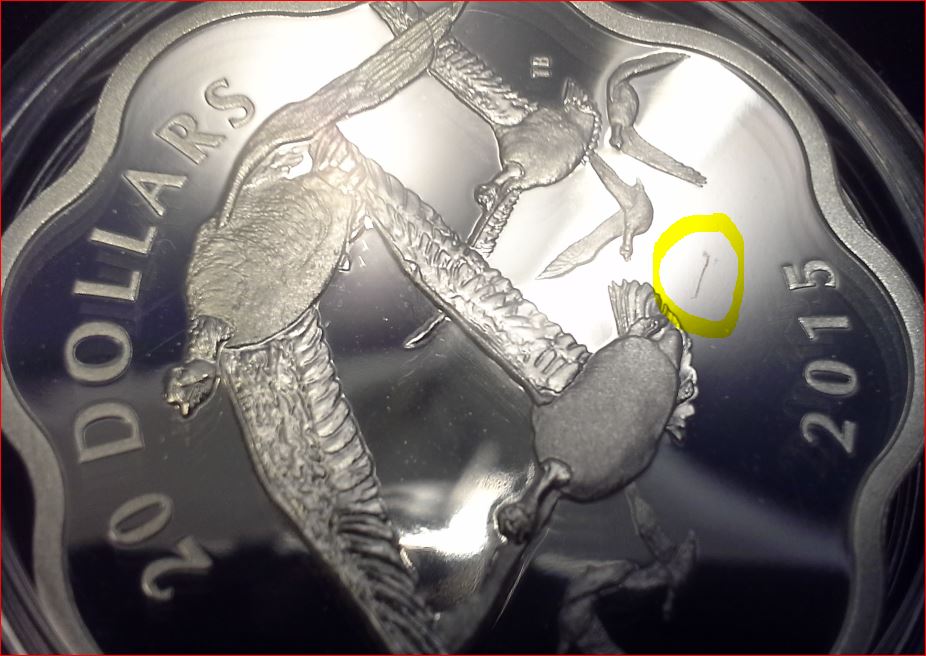
New to coin collected but have dove right in, recently purchased this lovely Exclusive RCM Master Club Canada Goose coin.

But to my surprise I found what looks to be a hair logged in the coin. I gently tried to remove it but it's actually fused to the coin, like a hair fell in it when the metal cooled or was stamped when the die pressed the coin. Either way, it's very odd.

Now my question is:
Does this devalue the coin as an error OR does it make it a unique piece, thus possible making it a one-of-a-kind and therefore actually making it more valuable, I wouldn't go so far a to call it a mule but it's not everyday one see this coming directly from the mint.

Any thoughts anyone has would be appreciated.

Thanks
John


Hair-On-RCM-Coin?
Pillar of the Community
Canada
5324 Posts
 Posted 10/22/2015  4:05 pm  Show Profile   Bookmark this reply Add john100 to your friends list Get a Link to this Reply
Keep it for future RCM, DNA authentication.
Edited by john100
10/22/2015 4:27 pm
Pillar of the Community
Canada
6768 Posts
 Posted 10/22/2015  4:22 pm  Show Profile   Bookmark this reply Add Silveroid to your friends list Get a Link to this Reply
to CCF John , and to the NCLT collecting.


Quote:
New to coin collected but have dove right in, recently purchased this lovely Exclusive RCM Master Club Canada Goose coin.


I wouldn't say this 2 years ago, but now agree with the collectors who stated it from the beginning:

yes, the coin with the hair is unique I it's way, but IMO, this piece of hair devalues the coin. It could be oily - so expect something like "milk spot" after couple of months. And maybe not.
But the advise - call RCM and return the coin as "defective". Get it cheaper after half a year, or just forget about it , since many new items will be issued.
Pillar of the Community
qbvbsite's Avatar
Canada
849 Posts
 Posted 10/22/2015  7:06 pm  Show Profile   Bookmark this reply Add qbvbsite to your friends list Get a Link to this Reply
I would return it to the RCM as well, With proof's like that I want the pristine.
CCF Master Historian of USA Commemoratives
Learn More...
commems's Avatar
United States
12271 Posts
 Posted 10/23/2015  3:04 pm  Show Profile   Bookmark this reply Add commems to your friends list Get a Link to this Reply
@CoinageJohn: Your image does not provide enough of a close-up view for me to give a definitive answer regarding what has happened with your coin but I'll offer a couple of possibilities.

Is the "hair" raised on the surface of the coin or is recessed into it? If it is a raised line, it is possible that the coin was struck with a scratched die. In this case, the scratch in the die would be filled with silver when the blank planchet was struck by the die.

It is also possible that you have what is called a "retained struck-through" error. This type of error involves a piece of debris (in your case, a small piece of thread is more likely than a hair) that finds its way into the striking chamber and is pressed into the surface of the coin when it is struck; a portion of the material is retained in the planchet after striking.

Without better pictures of the area in question, I can't say much more with any certainty.

While error coin collecting is very popular among circulation issues, such minor errors as what appears to be shown on your coin are not collected as avidly. As a result, selling the coin at much of a premium might prove difficult.


Quote:
I wouldn't go so far a to call it a mule.

It seems as if you are confused about what a "mule" coin is. The term "mule" is used to describe a coin that has obverse and reverse designs that are not supposed to be paired together. One of the most popular mules is New Zealand's 1967 two-cent coin. It was struck with the correct New Zealand reverse die, but featured an obverse struck with a die intended for a Bahamas coin. Two popular mule coins from Canada are the September and November 1999 versions of the commemorative "Millennium" 25-cent coins. They were each struck with an obverse die that was supposed to be paired with a die featuring the standard Caribou reverse design; as a result, the coins do not include the "25 Cents" denomination.

Here's a link to an informative page on Canadian mules: http://www.coinscan.com/err/mmd.html

Hope this all helps! Additional questions are welcome.


Collecting history one coin or medal at a time! (c) commems. All rights reserved.

  Previous TopicReplies: 4 / Views: 1,714Next Topic  

To participate in the forum you must log in or register.


Disclaimer: While a tremendous amount of effort goes into ensuring the accuracy of the information contained in this site, Coin Community assumes no liability for errors. Copyright 2005 - 2026 Coin Community Family- all rights reserved worldwide. Use of any images or content on this website without prior written permission of Coin Community or the original lender is strictly prohibited.
Contact Us  |  Advertise Here  |  Privacy Policy / Terms of Use

Coin Community Forum © 2005 - 2026 Coin Community Forums
It took 0.23 seconds to rattle this change. Forums