| Author |
 Replies: 13 / Views: 22,282 Replies: 13 / Views: 22,282 |
|
|
Pillar of the Community
United States
3546 Posts |
Please opine on whether this bill is real or not. If real, I'd like to see some grades. Btw, the bill itself feels softer with a texture somewhat similar to a heavier duty brand such like Brauny. It has no crispness at all. It does have just one obvious hole under the 'o' of Confederate on the light brown colored side. 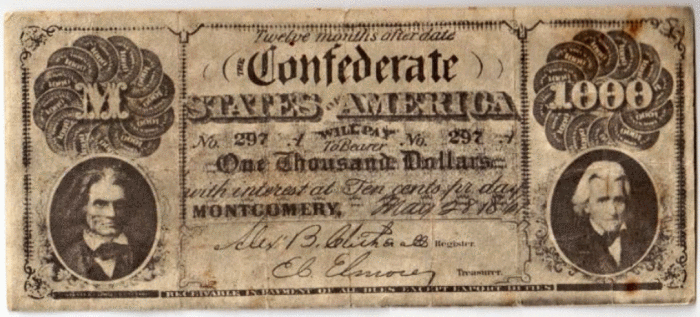  |
|
|
|
Pillar of the Community
United States
757 Posts |
|
|
Valued Member
United States
214 Posts |
Serial number 297 was a common replica sold in Woolworth stores.
|
|
Moderator
 United States
195203 Posts |
I brought the image in from the other thread. Please continue discussion here.  |
|
Pillar of the Community
United States
7730 Posts |
These replicas were packaged up and sold in five and dime stores during the 1960's during the anniversary of the Civil War. They were also sold as souvenirs at Civil War site gift shops in the 1960's, too.
|
|
Pillar of the Community
 United States
3546 Posts |
Quote:
...brought the image in from the other thread Thanks for the transfer jbuck. |
|
Pillar of the Community
United States
3546 Posts |
In reference to the aforementioned URL that's great that a fake bill can be ID'd by a telltale serial #. But if I were a counterfeiter I would never take the time to create a fake bill with one of these numbers on it; it just does not make sense. How then, does one differentiate a counterfeit Confederate bill that does NOT have one of these above serial #s printed on it? That's the real challenge since I'm positive that they exist out there somewhere. |
|
Valued Member
United States
214 Posts |
With the $1, 000.00 notes there were only around 600 issued, they were all hand signed and all unredeemed notes are probably accounted for by now. It is to small a series to be successfully counterfeited.
|
|
Pillar of the Community
United States
3546 Posts |
Quote:
...only around 600 issued, they were all hand signed. That's all fine but what about the poor smuck at an auction who has no idea of the details of this kind of info... This concern leads me pose a couple of applicable questions: 1) Do the fake bills exhibit certain visual(color shades/fake signatures) or tactile(touch/feel/texture/smell) characteristics that any ordinary Joe can rely upon to quickly avoid being taken to the cleaners at a fast paced auction? 2) Where does this up-to-date info.(# printed and # hand-signed) reside? |
|
Pillar of the Community
United States
7730 Posts |
The fake bills are usually (but not always) printed on parchment type paper that feels thick to the touch. Fake bills usually have signatures and serial numbers in black ink and were printed the same time the bill was printed. Signatures on most genuine bills are hand signed in brown (or sepia) colored ink. Most serial numbers were hand printed usually in the same color ink as the signatures.
A lot of the replica Confederate notes from the 1960's have the word "facsimile" printed on the reverse.
If you don't know who you are buying from then at least know WHAT you are buying. The more you research this stuff the more you learn.
|
|
Pillar of the Community
United States
2857 Posts |
Confederate currency is one of those areas of collecting where you need to know your stuff or you are going to get burned. It's probably not an exaggeration to say there's the same amount, if not more, fakes out there than there are genuine. With that being said, I could tell right off that this was a fake even without looking up serials. The first thing that jumps out is the details and color. If you take a genuine and fake bill and put them side by side, you can see that all of the design is a lot more clear and sharp on the genuine bill. On genuine notes, signatures should be a reddish-brown and they often bleed through on the back of the note. The signatures on fakes are usually black and looked printed/stamped. Third thing is the feel of the paper. Genuine notes have the feel of tissue paper. A lot of times the fakes have rigid and stiff paper that is washed to look old.
Like always, there are exceptions to this because there ARE fakes out there that fool even the best enthusiasts, but for the most part, what I listed above is what you should be on the lookout for if you're trying to determine a fake from a genuine bill.
|
|
Pillar of the Community
United States
3546 Posts |
@ westernsky, wheatback
This is exactly the type of basic info. I was after.
------------------------
- Does the internet have a URL with statistical data of:
a) the 'number' of these type bills minted along with
b) which were well known to be 'hand-signed in black ink'
with both of the above two recorded for each denomination...
c) what is the equivalent terminology for the word 'mintage' when referring to currency of any type?
Essentially, fooling with one having a 600 mintage would be a waste of time and good to know in advance etc.
|
|
Valued Member
United States
214 Posts |
There are 72 different types of Confederate currency that are generally recognized. In addition to the Confederate States, individual southern states issued currency as did individual southern banks, so there are possibly more than 72 depending how you define "confederate currency". An internet source that defines the 72 types, provides statistics on issuance (mintage), and describes the issues is: https://en.wikipedia.org/wiki/Confe...tates_dollarPCGS also uses the 72 types for identidfication purposes, and you can use the T number to find PCGS graded samples and grading standards. The replica you have is a T-1 (the first series issued by the Confederate State). That series was issued on actual bank note paper, and the engraving and printing done by the National Bank Note Company in New York City. That source dried up as the war started. The paper thereafter went from standard bank note paper, to watermarked linen/cotton paper, to cheap wood pulp paper (that some might describe as tissue paper). The original T-1 notes were signed by the official, then later types started to be signed by clerks using the officials' names, and eventually just a facsimally printed signature. Printing went from engraved to lithograph. In order to know what type of paper, signature, or quality to expect from a real confederate note, you need to obtain the Type ("T") number of that note and then research that type. As a general rule they went from a high quality in 1861 to a very low quality in 1864. On the subject of counterfeits, the North printed a large amount of counterfeits and flooded the South with them in order to collapse the Southern economy. These counterfeits are as collectable as the actual notes, so accidentally buying one of them is not a complete loss. |
|
Pillar of the Community
United States
2130 Posts |
Another thing to pay close attention to when thinking about purchasing a CSA note is the cut. VERY rarely will you ever find a genuine CSA note that is cut perfectly. Genuine notes are almost always cut off centered. I have seen a few genuine notes where the signature was almost cut completely off. These were not cut by machine rather by hand. This was a person's job during the war. If I ever see a near perfect cut CSA note I would almost always question the authenticity.
I agree with Wheatback that the signatures should almost always have the reddish brown look to them. Black ink screams counterfeit..usually. Almost all signatures "bleed" through on a genuine note. A lot of genuine notes from this era are printed on very thin paper.
Once you touch, feel, see several true CSA notes most counterfiets are pretty easy to spot.
|
| |
Replies: 13 / Views: 22,282 |
|






 Posted 10/26/2015 08:11 am





