| Author |
 Replies: 6 / Views: 4,206 Replies: 6 / Views: 4,206 |
|
|
Pillar of the Community
 United States
5828 Posts |
Hello! Bought this sucker off of ebay for $18... Just arrived today, in a BRAND NEW PCGS slab, free of marks and still in the PCGS baggy. What do you guys thing the variety is? The seller mentioned it could possibly be a miller-13. 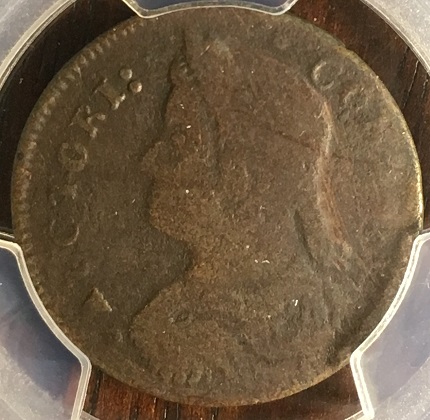 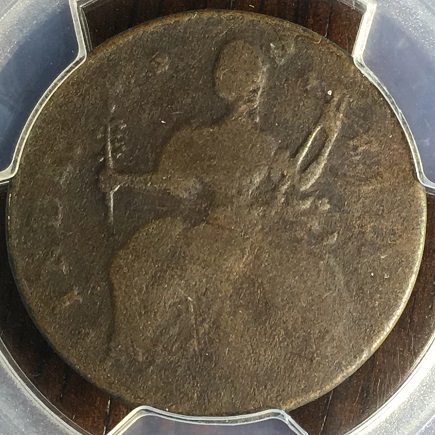 Thanks  |
|
|
|
Pillar of the Community
United States
4932 Posts |
What'd it grade? AG-03 details?
|
|
Pillar of the Community
 United States
5828 Posts |
Nope, it graded VG Details, Environmental Damage
|
|
Pillar of the Community
United States
1677 Posts |
It is not even remotely close to a Miller 13 obverse. The number would only be the obverse variety, the reverse would be a letter possibly with a decimal and a number. It may end up being one of the 33 obverses, which if correct only narrows it down to about close to 100 possible varieties! It is actually possible to spend days, or even longer on a single coin IDing the variety! Yours has pretty good detail although some of the identifying details are faint or non existent. You should be able to get a positive ID.
|
|
Pillar of the Community
United States
4809 Posts |
Interesting! I hope you can ID that coin then. The process might be frustrating for some, but getting to an answer should prove interesting. I hope lcutler is correct on this. Being a CT Yank, I enjoy it when coins like this one pop up.
Good luck Child!
|
|
Bedrock of the Community
United States
12057 Posts |
General attribution of a CT copper can be done fairly easily; narrowing it down to a particular, 100% correct attribution is much more difficult especially in worn specimens.
Let's start with the obverse. We're going to look at three main things:
1. Does the bust face right or left?
2. Is it draped (robed) or mailed (wearing mail armor)?
3. What, if any, punctuation is present in the legend?
In your case:
- The bust is LEFT (excludes all of 1785 except 2 dies)
- The bust is DRAPED (excludes the other 2 1785 dies and the 1786 counterfeits)
- The legend has punctuation: (cinquefoil) AUCTORI: (cinquefoil)/(cinquefoil) CON
Left, draped bust makes it a 1787 or 1788 dated example; the use of cinquefoils in the legend and a : after AUCTORI narrows it down to a 1787.
The most common Connecticut coins for 1787 were of this type; the obverse was called Miller 33, which has 45-50 possible obverse variations. These variations are distinguished by, among other things, the location of the punctuation in the legend, the position of the legend, the shape of the head, the shape of the nose, die breaks, planchet flaws, etc.
The reverse is a bit more difficult to deal with given its condition! Miller 33 had many die pairs, each of those reverse dies had its own sub-varieties as well.
Like the obverse, the reverse dies are usually diagnosed by the punctuation, the position of the punctuation, the position of the legend relative to the hand holding the branch, whether or not the pole has a cap on the end, and how many lines define the exergue (the area with the date below the seated portrait.)
All I can tell from yours is the legend: (cinq) INDE: <branch> (cinq) (cinq) <head> (cinc) ET LIB:
The I in INDE is evenly spaced relative to NDE
The exergue has been obliterated.
In addition, the branch hand is pointing to the E in INDE, and that E is higher than IND.
The olive branch leaves appear to be intact, not separated.
That should help you narrow it down on the reverse with the coin in hand; I haven't got a reference book here to go by, but hopefully this gives you some information and a "starting point."
Member ANA - EAC - TNA - SSDC - CCT #890 "Most of the things worth doing in the world had been declared impossible before they were done." -- Louis D. Brandeis |
|
Pillar of the Community
United States
4809 Posts |
Very neat! Hopefully the coin in hand will reveal a bit more.
|
| |
Replies: 6 / Views: 4,206 |
|







 Posted 12/12/2015 7:59 pm





