| Author |
 Replies: 45 / Views: 9,217 Replies: 45 / Views: 9,217 |
|
|
|
Pillar of the Community
Belgium
506 Posts |
@X2an Quote:
French/LMU-standard coins. Basically any 1/100 Currency unit being 1 gram of bronze (up to 1/10 currency unit) and 1 Currency unit being 5 grams of .835 silver (fineness varies), and scaling with value. I don't remember how much the gold coins weigh but I think it wasn't as simply put in metric mesurements. Most gold coins issued were 20 Francs (or Lire/Leu/Corona/Peseta...) A 20 Francs gold coin under the LMU standard weighs 6.45g with a 0.900 gold fineness. There have been smaller and larger denominations, but those were rarely found in circulation. Bullion 'stackers' will be surprised that those 19th-early 20th century gold coins most often sell for a lower premium than their more familiar gold-eagles. Edited by Gwyde
02/01/2016 05:56 am
|
|
New Member
Germany
12 Posts |
As given away by my first posts, I am collecting the Republic of Ragusa, which was historically a large annoyance of the Serenissima. 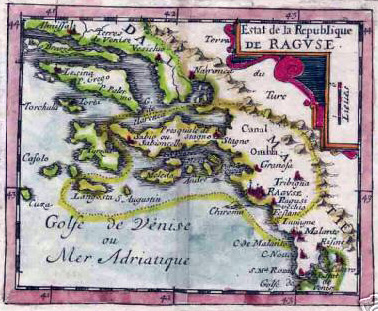  Short political summary from Wikipedia: Quote:
The Republic of Ragusa, or Republic of Dubrovnik, was a maritime republic centered on the city of Dubrovnik (Ragusa in Italian and Latin) in Dalmatia (today in southernmost Croatia), that existed from 1358 to 1808. It reached its commercial peak in the 15th and the 16th centuries, before being conquered by Napoleon's French Empire and formally annexed by the Napoleonic Kingdom of Italy in 1808. It had a population of about 30,000 people, out of whom 5,000 lived within the city walls. Its motto was "Non bene pro toto libertas venditur auro", which translated from Latin means "Liberty is not well sold for all the gold". Some coin types (looked up good fotos online, I do not have such image quality) I find quite beautiful: Libertina (silver, 2 ducats, 1794)  Copper coin "Minca" (circa 1464)  Bradan / Old Ragusa Thaler (restrike, silver, 1.5 ducats)  |
|
Pillar of the Community
United States
6370 Posts |
I collect ancient Chinese. In an auction setting, it seems they are very popular, but I seem to be the only one in a retail setting.
|
|
Valued Member
United States
123 Posts |
For me, I'd say Italy, Ukraine, & France. (NO Euros.)
|
|
Pillar of the Community
United States
1871 Posts |
I know this is kind of an old thread, but I wanted to thank @X2an for introducing me to LMU coins through his post in this thread. I have wanted to branch out into world coins but didn't know really what to collect. I think I'm going to look into doing some sort of LMU type set or something (starting with silvers)!
|
|
Pillar of the Community
Norway
1358 Posts |
Iceland has some of the most stunning designs, I'm especially fond of the commemorative series of 1930. Those might be among the nicest coins ever made. I'm about to complete my Icelandic type set, but some coins are just hard to get hold of. It's not a very expensive country to collect though. With a bit of patience and good search and negotiation skills, you should be able to find all circulation coins at bargain bin prices and all silver and gold for spot plus a few percent.
Other curiosities in my collection include quite some ECU tokens, as in the pre-Euro try out coins. Mind, a lot of those have been struck in silver and gold, and I have never paid more than spot. Sometimes less, in fact.
There's a lot of world stuff out there that's not expensive at all. For us here, American coins also just go at spot or for very good prices compared to buying them in the US. Only local coinage is usually quite expensive: old Norwegian Kroner and Skilling coins go for huge premiums.
|
|
Pillar of the Community
Sweden
1078 Posts |
Quote:
I know this is kind of an old thread, but I wanted to thank @X2an for introducing me to LMU coins through his post in this thread. I have wanted to branch out into world coins but didn't know really what to collect. I think I'm going to look into doing some sort of LMU type set or something (starting with silvers)! I do my best  In fact, the way I noticed it was looking through the online database Numista where I soon started noticing these similarities. Some coins are very cheap (Swiss silver 1/2-, 1- and 2-Frank, they were minted up until 1967 in full LMU standard) and some are not (Liechtenstein and Greece, don't forget Crete!) I should also add that my interest is not limited to LMU coins, the Scandinavian Monetary Union had a similar system with identical specification coins, and do not forget the silver system the US dollar had up until the end of silver that Panama, Dominican Republic, Colombia and more countries followed. |
|
Pillar of the Community
Russian Federation
5186 Posts |
Meanwhile, I'm still working on the Romanian and Mongolian type sets (not really trying for the Icelandic one, don't like many of the 1970s coins and the 1920s coins are too darn uncommon).
My current Numista count is Romania - 44 types, Mongolia - 16 types (and 8 for Iceland, but I know I have more).
Just bought a 50 bani from the LMU series a few weeks ago (was pretty cheap too, surprisingly).
Looking at Numista, I think I'll do Turkey next (though a few of those seem pretty rare).
|
|
Pillar of the Community
United States
1871 Posts |
Quote:
I do my best
In fact, the way I noticed it was looking through the online database Numista where I soon started noticing these similarities. Some coins are very cheap (Swiss silver 1/2-, 1- and 2-Frank, they were minted up until 1967 in full LMU standard) and some are not (Liechtenstein and Greece, don't forget Crete!)
I should also add that my interest is not limited to LMU coins, the Scandinavian Monetary Union had a similar system with identical specification coins, and do not forget the silver system the US dollar had up until the end of silver that Panama, Dominican Republic, Colombia and more countries followed.
I already discovered that I had some pre-1967 Swiss silver (I think I only need a 2 Fr. IIRC). Those came from a bunch of foreign coins I have which are still only somewhat sorted. When I was younger and not really interested in world coins, I got some from my grandparents (lived in Germany until 1960), and some from a friend of theirs who is well traveled. The majority of the coins are 1930-1980. Maybe I'll have to do a Scandinavian Monetary Union set too. Or maybe just include it as "LMU-like" coins. I have to be careful, otherwise this will turn into a "small and medium European silver coins from the late 19th century to early 20th century" set. I do have a LMU question. Supposedly (according to the LMU Wikipedia article) the Grand Duchy of Finland Made coins to the LMU standard, but just from a little looking around, it seems that most of their silver was .750 or .900. What's up with that? And they have a 25 pennia instead of the expected 20 pennia. |
|
Bedrock of the Community
United Kingdom
18936 Posts |
I like Costa Rican coins, especially the series from 1935 to 1982 when the same denominations were issued to the same basic designs, with intriguing changes of metal and dies. The country has also tried to keep on top of inflation by regularly issuing new high-value coins.
|
|
Pillar of the Community
Sweden
1078 Posts |
Quote:
I do have a LMU question. Supposedly (according to the LMU Wikipedia article) the Grand Duchy of Finland Made coins to the LMU standard, but just from a little looking around, it seems that most of their silver was .750 or .900. What's up with that? And they have a 25 pennia instead of the expected 20 pennia. Fact of the matter is that they did, but only for the gold coins (10 & 20 Markkaa), since the currencies went on the gold standard, the LMU's primary reason to exist was to facilitate the circulation of gold coins, giving the the same denominations the same specifications. Even Sweden issued a 10-Franc coin, though with an odd denomination for the Riksdaler Riksmynt in use at that time. The 0.20-denomination is acually somewhat rare to see. Especially in the later years of the LMU, many countries like France, Belgium and Italy issued 0.25 denominations in Nickel or similar materials. A true LMU-standard such coin would be 1 gram of .900 silver, which for many would be too small of a coin for the value. France issued these for a short while. A coin easy to lose. Unfortunately for people then, the 0.10 large copper/bronze coins were much more common and like the US Large Cent, wasn't quite liked from the public from what I understand because of its large size. The LMU did extend to the silver coins of 0.5 (mostly), 1, 2 and 5. Lower denominations were free for the countries to regulate however they wanted, as to why Belgium and Switzerland never had "proper" lower denominations. Again, it's definitely a wide collecting range with plenty of history, as to why it's so fun to collect  Edited by X2an
03/07/2017 06:02 am
|
|
Pillar of the Community
United States
1871 Posts |
That clears things up a bit. Thanks X2an  |
|
Pillar of the Community
Canada
5296 Posts |
@MoonRock,I am glad that other people get a kick over the "little" man with her majesty on the other side!
|
|
Moderator
 United States
54297 Posts |
|
|
Pillar of the Community
Sweden
1078 Posts |
Looking though what I wrote earlier but now in a different setting, for future readers I feel I need to correct this: Quote:
A true LMU-standard such coin would be 1 gram of .900 silver True LMU-standard coins were almost always .835 silver, including these. The only .900 coins were the 5.00 coins, or crowns if you wish, weighing 25 grams. The reason for this is was to "negate" the increased costs of production for the lower denominations, by debasing the lower denominations. Why exactly .835 I don't know. The US (and the countries' using the same specifications) had more weight added in on their 1.00 coins (26.73 grams instead of 25) but the purity remained the same (.900 for all coins following the standard) Of course, this silver content standard was sometimes broken, some examples being French coinage with .900 1/2-, 1- and 2-Franc silver coins up until the 1860's, Swiss 1/2, 1- and 2-Frank coins between 1850 and 1875 and post-LMU Latvian 5-Lati consisting of .835 silver. Again, this series is so interesting because of things like these, but I've never seen any large discussion on this subject apart from the "heavier" dollars and the .900 5.00 coins. Kind of a shmae that this "series" is somewhat unheard of and forgotten among most collectors, but hey, I suppose that's lower prices and more quantity for me  |
| |
Replies: 45 / Views: 9,217 |







 First Page
 Previous Page


 Posted 02/02/2016 08:34 am


