| Author |
 Replies: 37 / Views: 7,735 Replies: 37 / Views: 7,735 |
|
New Member
United States
10 Posts |
I've had this coin for many years. I do not remember where I got it. When I first got a reference book for Mexican coins I noticed that the assayer's initials for 1843 are M.M., but this coin is M.L. I also noticed that M.M. and M.L. bounced back and forth in previous years. Is it possible that this coin is genuine and that M.L. did work in 1843? I posted the coin with bad pictures about 10 years ago on some forum somewhere and was told that it is most likely fake, but then I put it away and haven't really thought of it much until recently. I have not weighed the coin yet. That's the only possible diagnostic that anyone ever suggested. How else can I tell? The lettering looks good. It rings like a silver coin. It is coin-aligned, not medal-aligned. It has wear on it so I would say it definitely circulated for a time. Any expert opinions out there? Many years ago I showed the coin to someone at one of the major auction houses and he said it is a contemporary counterfeit, but he didn't tell me how he concluded that. 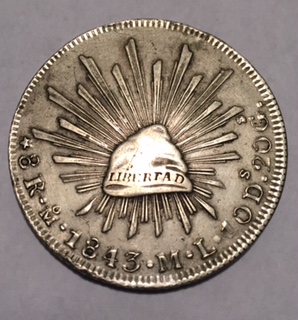 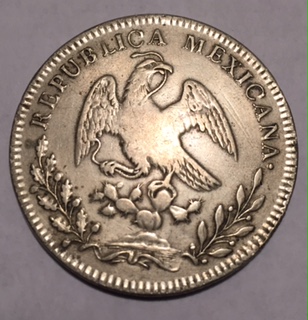 |
|
|
|
Pillar of the Community
United States
1758 Posts |
The expert Robert Gurney is always lurking in the shadows. He will be here soon. In the interim provide the weight in grams and if you own a micrometer its diameter.
JPL
|
|
New Member
 United States
10 Posts |
Thank you. I will have to figure out how to weigh it accurately. These pictures may be better: 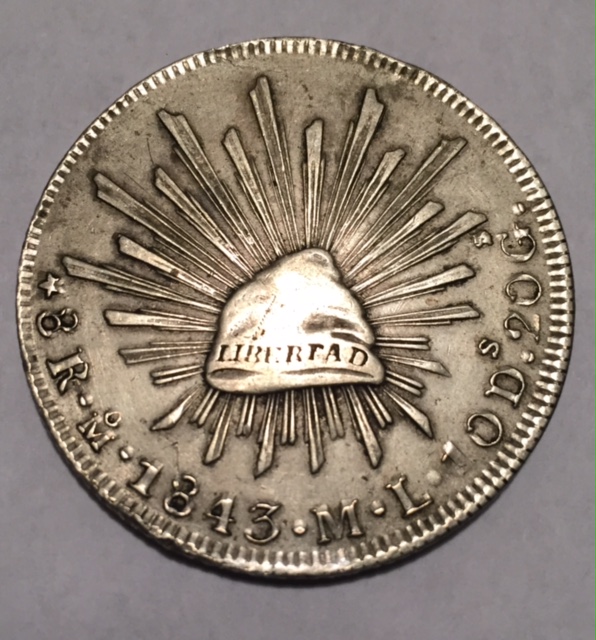 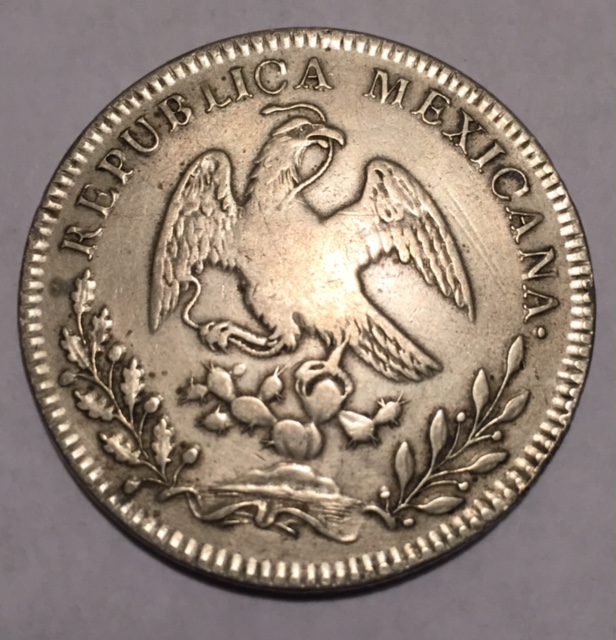 |
|
Pillar of the Community
United States
4883 Posts |
First off, welcome.
I concur that Bob Gurney's observations and opinions will be the most valuable in an instance such as this.
That said, a couple things stand out to me as wrong about this specimen, besides the assayer marking discrepancy you mention.
First, the eagle side looks like an incomplete strike with severe weakness in the center. However, the cap side shows no corresponding weakness.
Second, there's a disparity in the size of the superscript "s" following the "D" and the "G" which simply shouldn't be.
I'll remark that some contemporary counterfeits from this period can exhibit close to a correct weight. In such a case, a determination of the coin's specific gravity ought to give it away.
A look at the edge might also be enlightening.
Colligo ergo sum
Edited by Lucky Cuss
02/23/2017 08:14 am
|
|
New Member
United States
10 Posts |
Good morning. Thank you for your reply as well. I also feel there's something "off" about the reverse. I have not seen too many of these coins, but it seems the snake should have more detail (it looks like a skinny worm) and, like you pointed out about the breast area, the eagle's claws look sloppy. And you're right, those superscript "s's" do look a little strange. But, this is one of very few that I have examined closely. I've looked at some pictures of others online for comparison. I know coin dies were hand-punched then so there can always be little differences. That's one of the things I love about old coins. How common is that in this series? Based on some of the other posts I've read on this site it seems there is interest in studying 8 Reales die varieties. Here's the best I can do with the edge: 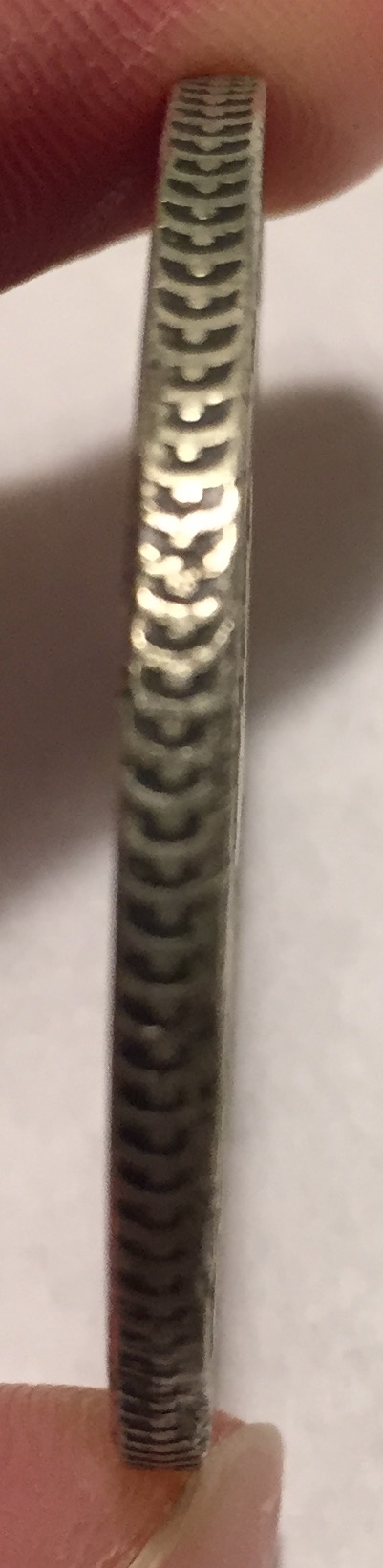 |
|
Pillar of the Community
United States
1962 Posts |
Contemporary counterfeit... non-matching relief (raised detail) elements for the date/mint and just look at the metal!
As you seem to have noticed, numerous threads in the topic archives on this site discussing, specifically, contemporary counterfeit Cap & Ray 8R and the diagnosis thereof.
|
|
Pillar of the Community
United States
5362 Posts |
thous  This is a well known (to myself anyway) contemporary circulating counterfeit. The eagle is similar to the standard eight escudo eagle. That same type of bird is seen on several Riddell coins some are better engravings than others, but see for example 224 1832 Zs OM - crude but in the posture of the 8E. 247 1836 Zs OM 286 1830 Go MJ - crude but in the posture of the 8E. 293 1831 Go JM 306 1833 Go PJ 313 1834 Go PJ 366 1832 Do RM 375 1838 Do OM - crude but in the posture of the 8E. 378 1839 Do OM - crude but in the posture of the 8E. 383 1829 Pi RL - crude but in the posture of the 8E. 390 1835 Pi JS - crude but in the posture of the 8E. 415 1832 Ds RL - crude but in the posture of the 8E. In addition I own at least 6 other varieties using a very similar eagle design. So this error was rather common. Otherwise the dies were very well made in this case. The example here is actually a very nice grade I own one higher in grade but this is a close second. I personally love the 8E bird and would value the coin between $75 and $125. This same Cap design 1843 Mo ML is usually seen with a Mexico City style eagle which I call the "beautiful eagle" because the design is so well executed. Here is an example of the beautiful eagle - in this case seen with the Cap die 1844 Go PM. 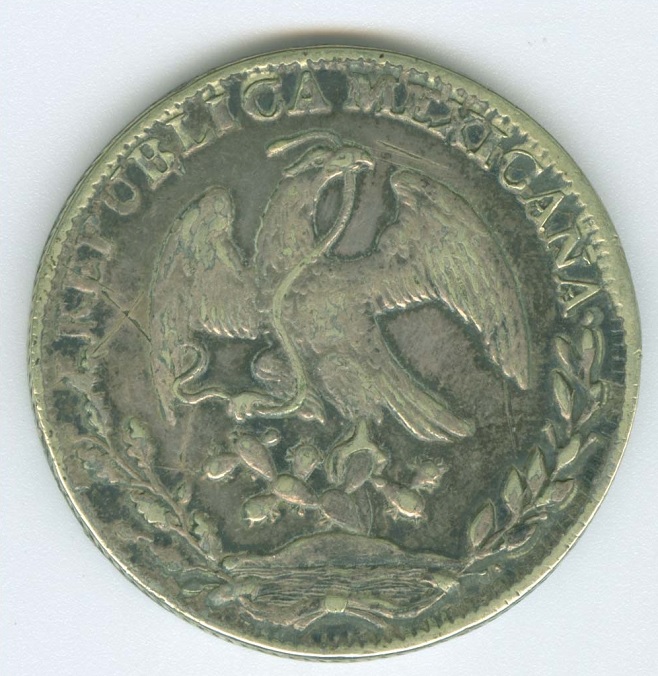 This coin is part of a larger family of dies that are related by muling. I have no photos of the other variants - I am not yet at that point in my new book.
Edited by swamperbob
02/25/2017 12:42 am
|
|
New Member
United States
10 Posts |
Thanks for the replies everyone! Swamperbob, that is really amazing information. I take it you've been researching these coins for a long time and you must have looked at thousands of them! It's nice to know that even though it's fake my coin still has some collector value. I've always liked these coins and I have a few others (which I hope are authentic!). I'm back to thinking I will start to seriously collect them, but there seem to be a lot of fakes out there. Does anyone know some reputable dealers who regularly carry these coins? For budgetary reasons I'm drawn to the 2 Reales and 25 Centavos denominations. There are hundreds on ebay every day, but I'm not too comfortable starting there knowing there are so many fakes and that sellers seem to have limited knowledge. Were these denominations counterfeited as much as the 8 Reales? I'll have to post my others on here to see if they're authentic. One is a 1788 8 Reales from Chile. That will be a valuable one if it's real! I bought that coin from the local coin dealer 25+ years ago. I had been given an 8 Reales from Mexico and so I thought I'd try to get one from every Spanish Colonial mint. The dealer and I both thought it was from Mexico and it was nicer than the one I already had, so I bought it for $65! I had no idea and I actually spent time at the library (yes, the library!!) trying to find out what Mexican mint used an "S" mint mark! The collection never really took off though, and shortly after starting the coins went into a box and I've only thought of them off and on since. I got a few Cap & Rays coins around that time too, including this 1843. |
|
Pillar of the Community
United States
1758 Posts |
If you are a Mexican Numismatic Association member in the Library is a paper I wrote on the Counterfeit 2 Reales of Carolus III,IV and Ferdinand VII issues known as Kleebergs. Some people in the MNA are coming around to the fact that Contemporary Circulating Counterfeits are a GOOD thing to add to your collection. But it will still take another decade or so before most SNAP OUT OF IT. LOL. In terms of Kleebergs look for these monarchs, plain edges and normally of a medal die axis coin turn. My new upcoming book in Chapter 2 basically completes the treatise on these issues at around 150 known varieties.
JPL
|
|
Pillar of the Community
United States
1962 Posts |
Quote:
This same Cap design 1843 Mo ML is usually seen with a Mexico City style eagle which I call the "beautiful eagle" because the design is so well executed. Here is an example of the beautiful eagle - in this case seen with the Cap die 1844 Go PM.... This coin is part of a larger family of dies that are related by muling... That's what I recall seeing this 1843 obverse with... as so: 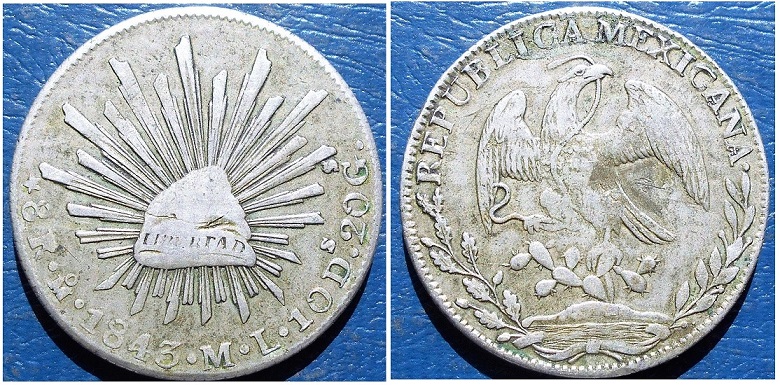 Looking quickly, I don't see any either of these 1843 MoML in Riddell (pushing that book's cutoff). Bob, without searching through... I assume some or most of those earlier-dated mulings are in there? Edited by realeswatcher
02/27/2017 12:37 pm
|
|
Pillar of the Community
United States
1962 Posts |
Quote:
... One is a 1788 8 Reales from Chile. That will be a valuable one if it's real!... Indeed it would be... "if" being the operative word. Would be curious to see at least decent pics to confirm it's not a mistaken Potosi mintmark or simply a modern fake (NUMEROUS modern Chinese fakes of Santiago mint Charles III 8R and 4R). |
|
Pillar of the Community
United States
4883 Posts |
Quote:
I'm back to thinking I will start to seriously collect them... For the "Cap & Rays" type, even in just the 8 reales denomination alone, I'd warn this can prove a seriously addictive pursuit. PCGS has a complete set pegged at 1,103 coins, and I doubt even that figure includes every one of the subtle die variations to be had. If you threw in all the contemporary counterfeits, why, that'd be hundreds more yet. Colligo ergo sum
Edited by Lucky Cuss
02/27/2017 2:09 pm
|
|
New Member
United States
47 Posts |
LC, do you have a system for collecting these, or a goal that stops somewhere short of 1,103 coins? ;) I've been collecting Mexican coins since childhood in the 60s and feel comfortable with all the decimal coinage back to Maximilian - the reales are the logical next step but even the Republic period seems intimidating by its sheer size. Where do people start in a field that contains so many issues?
|
|
Pillar of the Community
United States
5362 Posts |
I do not think anyone has ever assembled a complete set of 8Rs. It would be a fantastic set. Several dates are known from only a very few examples.
Regarding the minor denominations they were counterfeited but most are readily identifiable compared to the 8Rs. The 8Rs were counterfeited in many different places and for several different reasons.
The 2Rs are the second most often encountered counterfeits followed by 1R then 1/2R and 4Rs in about equal numbers. Only the silver quartillos are actually scarce as counterfeits.
|
|
New Member
United States
10 Posts |
1,103!?!? Sounds like a full-time job!
I have a Krause "Spain, Portugal, and New World" guide from 2002 and the 2R/25C series would still be several hundred coins, but it does at least seem attainable to put together about 90% of a mid-grade circulated date/mint set at a somewhat affordable price. It might take years and then there would be the hundreds of variants, but it could be fun to work on.
Swamperbob, you said the 2R's were heavily counterfeited but are pretty easy to detect, so I guess that's good. I wouldn't mind having them in a collection, like ColonialJohn suggested, but I'd like to at least know what is what.
Realeswatcher, it's interesting that you have a picture of that coin. It certainly looks like the same obverse die. You can even see the second superscript "s" is filled! Very neat! And interesting to see that reverse die. My obverse looks sharper than the one in your picture but my reverse looks "mushier." I wonder if the reverse die used for my coin wore out and they switched it out to keep going.
From the various and numerous posts I've been reading on this site it seems counterfeiting Spanish/Mexican coins was a booming industry!
|
|
New Member
United States
10 Posts |
This is the Chile coin I mentioned previously. Hopefully it's authentic. What do you all think? These pictures looked better on my phone. 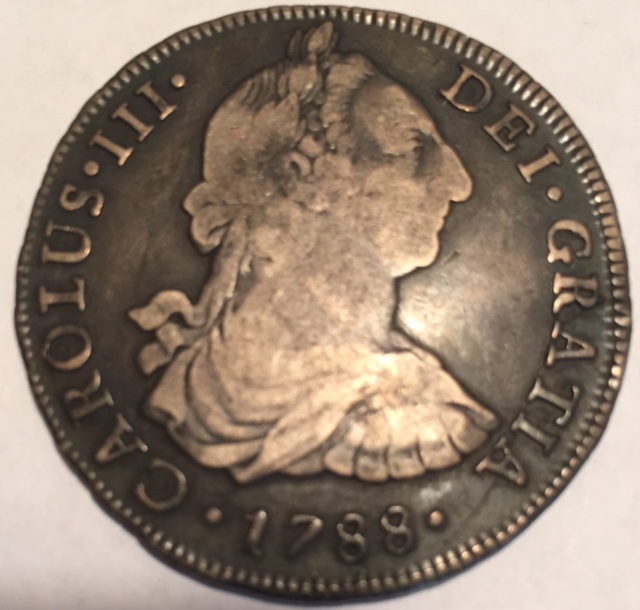 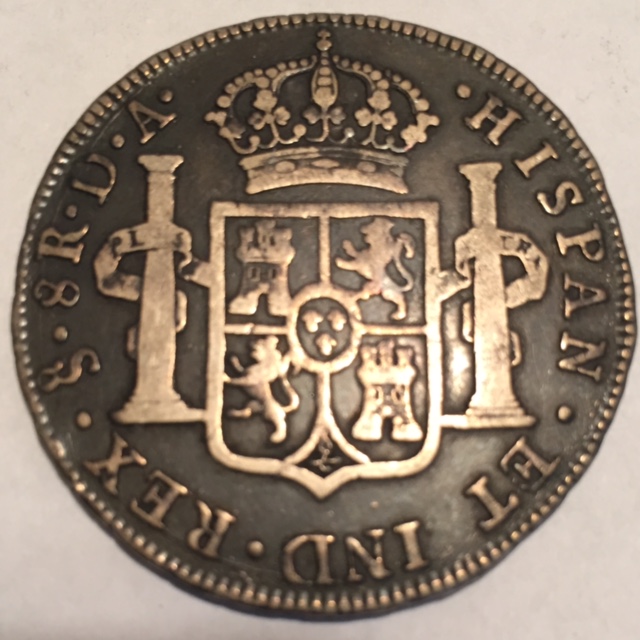 |
| |
Replies: 37 / Views: 7,735 |






 Posted 02/22/2017 5:11 pm





