| Author |
 Replies: 8 / Views: 3,191 Replies: 8 / Views: 3,191 |
|
|
New Member
Cuba
27 Posts |
This is the tiniest coin in Cuban currency ever! Copper 1 centavo (1 cent) from 2012 showing the Revolution Square in Havana on the reverse. The obverse (in case you are curious) as in 99 % of Cuban coins, shows the Cuban coat of arms. Here you can see it compared with a 1920 Lincoln Cent, so you can figure its size. Are there or do you have a smaller coin? 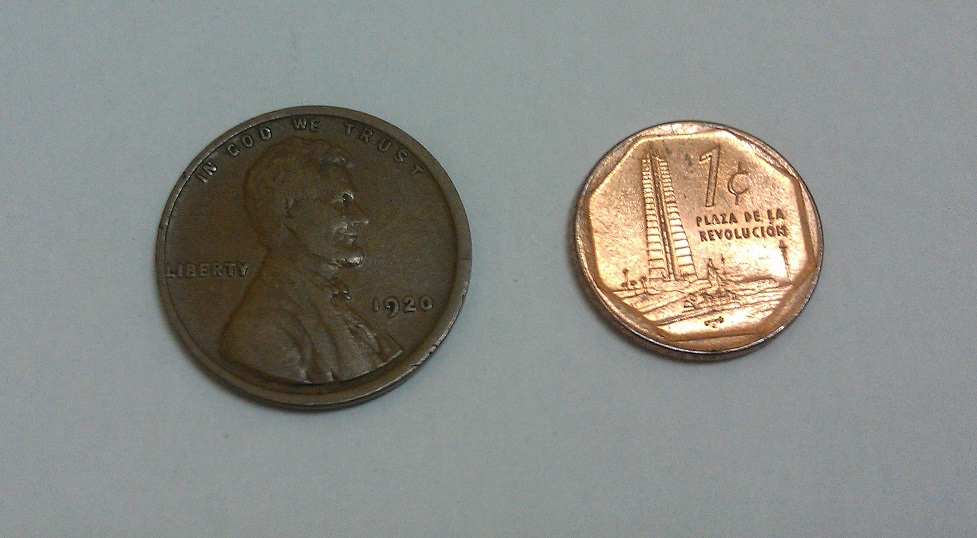 |
|
|
|
Pillar of the Community
Sweden
1078 Posts |
|
|
Pillar of the Community
Russian Federation
5186 Posts |
Technically, the smallest Cuban coin ever was the gold 1 peso from 1915-16. Very uncommon, and appropriately tiny for a relatively small-valued gold coin.
My smallest "modern" is the 2001 (just before the euro changeover) Spanish 1 peseta, I think; it's 14 mm in diameter. I guess it depends on what you count as "modern", really (I might have some smaller coins from the 19th century).
|
|
Pillar of the Community
United States
5362 Posts |
I think the smallest 20th century issue is 10mm - the Panama "pill" is that size. It is the 2 1/2 centesimos denomination and is 900 fine silver struck in the US for Panama.
There are many smaller coins if you go back another 100 years. There is the 1 penney silver from England (Maundy money) at about 10 mm. There is the Fanam from India 5-8mm and the 1/2 Chuckram also from India at about 4mm.
Krause lists a 2x2 mm square 1/4 Jawa as KM#284 under Nepal in the 1701-1800 book. It weighs 2/1000ths of a gram.
Others that are smaller always invite arguments as to whether or not they circulated in day to day commerce.
I have seen an ancient coin smaller than the head of a pin in a display at last years FUN show. But that one needed to come with it's own microscope.
|
|
New Member
 Cuba
27 Posts |
Thank you for all the info! I did not know the Cuban 1915-1916 1 peso gold coin was so small! In fact, I just realize the Krause catalog (at least the edition I have) does not include its diameter! I did find a Soviet kopek and it is definively smaller in diameter. Now, what could possibly be the intention of making such impractical coins, I wonder? Quote:
I have seen an ancient coin smaller than the head of a pin in a display at last years FUN show. But that one needed to come with it's own microscope. Yes, I hope the microscope was already invented when they first struck this coin! Poor ancient people! :) |
|
Pillar of the Community
Sweden
1078 Posts |
Usually what makes coins that tiny is because of their precious metal content relative to their denomination. The 10 öre coin I was speaking about earlier weights 2½ times less than the 25 Öre piece minted at the same time - a decently small coin, with a diameter of about 18mm. The silver fineness is the same, unlike later silver 10 öre issues. The Panamá Pill is a pretty thick coin, but weighs the same as a US Half Dime coin, 1.25 grams. I don't know what made the Panama government to issue them with such a small diameter, but hey, it's a piece of curiosity. This impractical precious metal content and denomination scale becomes even more prominent in gold coins. There were frational US gold coin minted in California during the gold rush, tiny coins with gold value of $0.25 and $0.50 respectively since there weren't sufficient amounts of silver coins circulating and gold was so common. The original US $1 gold coin had a diameter of just 13mm but was increased to 15mm with tickness decreased because of contemporary complaints about losing such a tiny coin. But in ancient societies, population complaints weren't necessarily something to consider, so fractional gold was definitely a common sight. With the wide introduction of base metal coins in the 20th century more practical sizes were used since the metal content was so longer important. But I forgot about the 1 Peseta coin, a tiny modern coin with close to no contemporary value (at the end worth about a third of a Euro cent). |
|
New Member
Cuba
27 Posts |
Quote:
But I forgot about the 1 Peseta coin, a tiny modern coin with close to no contemporary value (at the end worth about a third of a Euro cent). Well, that's pretty much the case with the Cuban 1 centavo CUC coin I posted! It has roughly the same value of 1 US cent, which recently John Oliver declared should not be produced anymore because it just makes no sense. Very interesting info about coinage during gold rush in California! Thanks! Cuba is still a rather self-centered country, shut off from most outside influence, so stories about foreign coins are not easy to find. |
|
Pillar of the Community
Australia
3840 Posts |
I am under the impression that the Dutch 10 cents was one of the smallest coins before it joined the Euro. I could be quite wrong. I remember getting a few from circulation when I was there a while back.
|
|
New Member
Cuba
27 Posts |
Quote:
I am under the impression that the Dutch 10 cents was one of the smallest coins before it joined the Euro. gxseries, it turns out that the Dutch 10 cents is similar in size to the Cuban 1 centavo and the Russian kopeck: 15 mm diameter. That is, too big ;) |
| |
Replies: 8 / Views: 3,191 |
|












 Posted 12/18/2015 3:54 pm


