| Author |
 Replies: 12 / Views: 3,577 Replies: 12 / Views: 3,577 |
|
|
Pillar of the Community
United States
5318 Posts |
Normally, I don't take much notice of a coin with a recessed area, but this coin caught my attention. I'm familiar enough with post-mint damage, and how metal is moved by those processes. However, this coin appears to have a cavity, and inside the cavity I can see detail from the design. Additionally, at the edges of this cavity, there is an incuse bevel which I wouldn't expect if an object hit the coin. Here are the photos. Any ideas what is happening here? Thanks for commenting!   A close-up showing details within the cavity, including striations around the walls of the cavity. This feature appears to me as struck into the coin at minting.  Another view taken with a QX5 at 60X:  Edited by KurtS
01/30/2008 11:15 pm
|
|
|
|
Pillar of the Community
United Kingdom
1077 Posts |
In my opinion, I would agree with your diagnosis of this having happened when it was minted. It appears as if a foreign object got in the way at the crucial moment. Possibly a broken die fragment as I would say it would have been harder than the copper coin itself. It would also have to have been something that did not become part of the coin and fell out or was knocked out afterwards?
If it had been post minting there would have been signs of displacement of the original metal, which there clearly is not. If it had been a hole in the planchet I think the inside of the cavity would have been smoother.
I would say you have a nice error coin there.
|
|
Pillar of the Community
United States
1674 Posts |
This "cavity" is pretty common in the Penny coins of the previous George. AS for the other piece, isn't that called a lamination error?
|
|
Pillar of the Community
 United States
5318 Posts |
Thanks for your feedback, and all the photos are of the same coin. I don't know whether this is a common error for this coin, but I think whatever process created this could be interesting. In particular, that incuse bevel around the edge suggests to me wear from multiple impressions. Is it possible that this cavity was on a working hub, and as multiple working dies were made, a bevel was worn into the edges as a sliver of hub metal was slowly removed? Of course, it could be something entirely different, such as a delamination on the planchet, but I would expect to see some remaining impurities and delamination. I would immediately buy the struck through object theory, if it were not for that reverse bevel.
Edited by KurtS
01/31/2008 1:08 pm
|
|
Pillar of the Community
United States
1490 Posts |
There is a term for this but it is escaping my memory at this time. But yes it is caused by a foreign object getting in the way. Here is a reverse of a 1956-D Washington quarter with the same error. It is my understanding that they can carry a premium with the premium going up the older the coin is. You may want to post a pic of this in variety and error section to get the correct term. In the meantime I will try to remember what this is called. Sorry to be so vague but errors are not my specialty. 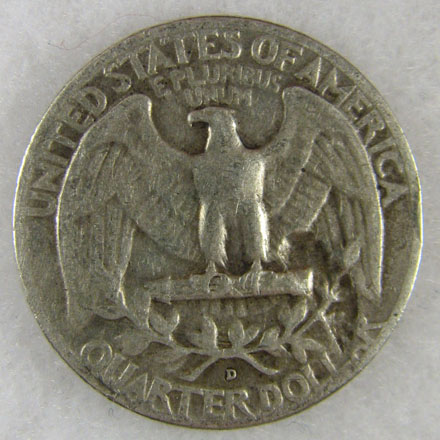 |
|
Pillar of the Community
United States
5318 Posts |
Jim, thanks for your insight! I'm not sure where I should look at your coin...under the right wing of the eagle perhaps?
|
|
Pillar of the Community
United States
1490 Posts |
Exactly. Here is a close-up 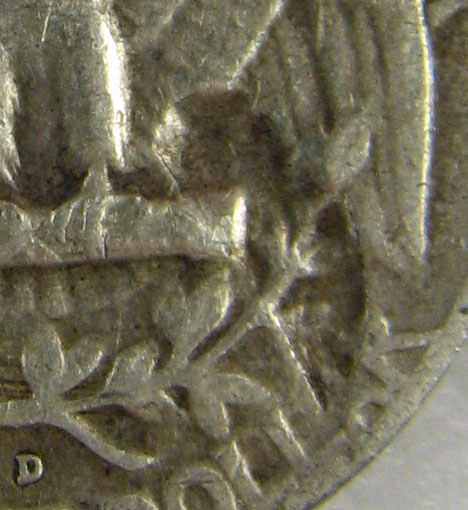 |
|
Pillar of the Community
United States
5318 Posts |
Oh, now it's obvious, lol. I would guess your coin went through a similar process. In both of these examples, I don't quite understand how a struck-through object would transfer those details to the planchet, particularly for your quarter. I've seen examples struck through oil and cloth and the details are heavily muted/distorted. Is it at all possible this relief feature is on the die itself?
Edited by KurtS
02/03/2008 1:58 pm
|
|
New Member
United States
1 Posts |
Hi! Your piece is generally called a "laminate" or "laminated" in the USA. It would also be wise to mention that exterior of the laminate is missing. Back, when I was teen in Southern California, working in a coin shop, we would refer to your coin as a "peeled laminate" This usually occurs because of a variety of reasons such as overheating, impurities being mixed into the alloy,excessive tension, improper handling, and so on during the actual minting process. Fakes are easy to catch. Your coin would probably command more interest here in the Sates than in Britain. Many Yanks, such as myself, would bring Silver Dollars to Paris, and convert the money earned into unapprecaited items like what you have, and turn around, and re-enter the USA without a hitch ( Yes, Mr. Customs Officer, I only have $150 in Change.).
|
|
Pillar of the Community
United States
1490 Posts |
I recall a different term being used for the reverse of my Washington quarter. I have posted a pic of my Quarter in the variety and error forum to find out what the incuse feature was called. |
|
Bedrock of the Community
United States
12437 Posts |
I believe that both the penny and the Washington quarter each have a lamination. The penny is an AU/Unc coin so the sharpness of the lamination is still there but the quarter appears to have spent a bit of time in circulation after the lamination detached. If a lamination is thin enough some detail will still show. The drapery on Britannia's right shoulder still faintly shows under the lamination and the detail is readily apparent on the quarter. |
|
Pillar of the Community
United States
5318 Posts |
That sounds like a plausible theory. Perhaps the lamination was restricted to this one place?
|
|
Pillar of the Community
United States
1490 Posts |
Kurt, I found my previous thread. Coppercoins stated my quarter was struck through and gave an explanation of what causes a coin to be struck through. I think your British Penny may be struck through such as my quarter https://goccf.com/t/12094#12094 |
| |
Replies: 12 / Views: 3,577 |
|







 Posted 01/31/2008 12:15 pm





