| Author |
 Replies: 11 / Views: 2,391 Replies: 11 / Views: 2,391 |
|
|
Pillar of the Community
Canada
1751 Posts |
I have often wondered why circulation coins didn't have more fingerprints. I have only come across 3 2011 cents that had prints. Yet I have never encountered other circulation coins with prints. The public doesn't handle coins with care. Are some metals more prone to retaining a print. Is it the finish that predisposes a coin. Are proofs a more risk.
The 1949 has quite a noticeable print on it. Can a fingerprint be removed. Does it get worse with time. Can toning help make it less noticeable. I look forward to replies. I do know it has something to do with hand oils.
|
|
|
|
Pillar of the Community
Canada
4912 Posts |
prints seem to be more prominent with toning. prints can come off with acetone if you take care of it quickly enough.
Feel free to call me Will.
|
|
Pillar of the Community
Canada
818 Posts |
I'm sure it is relative to what is on their fingers...
|
|
Pillar of the Community
Canada
2531 Posts |
Copper appears to be more prone to fingerprints especially if it is used for plating (zinc pennies seem to be affected the worst). Can't say for sure because I've never counted them, just my impression when looking through pennies and seeing the new style loonies and toonies in circulation. I wasn't here long enough to see what circulation does to fresh the old style ones. Nickel looks quite resistant, I haven't seen a quarter with a permanent fingerprint yet.
Once a fingerprint shows as toning on a coin there's no way to get it off without cleaning.
|
|
Pillar of the Community
 United States
5828 Posts |
I believe it has something to do with the metal reacting with the oils on your skin? On proof coins it's a bit different: any time you touch the reflective surface it leaves a fingerprint.
|
|
Pillar of the Community
Canada
5646 Posts |
I always heard (and saw) that a smoker's fingerprints had sulpher imbedded in the prints and you had almost instant fingerprints.
|
|
Pillar of the Community
Canada
3234 Posts |
A nasty fingerprint.... 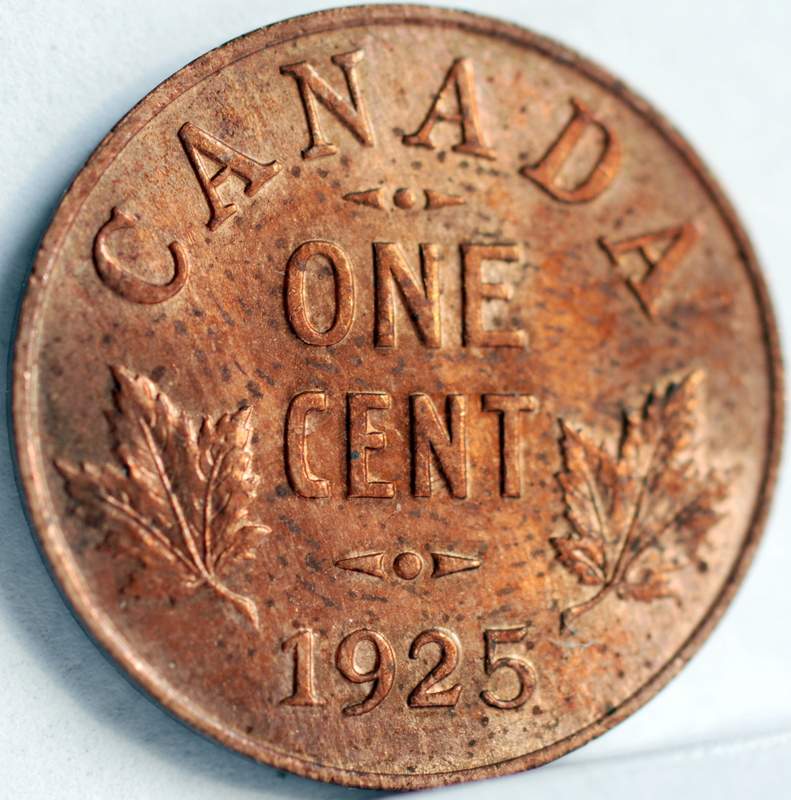 |
|
Pillar of the Community
Canada
1993 Posts |
i am a tool and die maker and there are a small percentage of people that have high acidity in their sweat and if they touch a freshly ground (high finish) plare of steel there will be rusty fingerprints the next day where the rest of us could touch the same block and nothing will happen. I'm sure this must play a role with coins also
|
|
Pillar of the Community
 Canada
1751 Posts |
Great answers, the worst fingerprint I have seen is the 1949 dollar someone won at the TCNC auction. That print is very noticeable. It got me thinking why more prints aren't noticed on circulation coin that are handled lots. I have come across 2 red 2011 cents with huge prints. I have tried leaving prints on quarters with no luck, I don't smoke. So it kind of baffles me. Look at all the circulated silver dollars with no prints. Maybe I need to eat potato chips first, then handle coin.
|
|
Pillar of the Community
Canada
576 Posts |
 It's the Doritos effect. I find Zesty Cheese is the worst for finger prints. Hope this clears things up. Liverpool |
|
Bedrock of the Community
Australia
21792 Posts |
Fingerprints never appear on heavily patinated coins. The sulfide / oxide coating helps to protect them.
The natural oils in skin are there to protect the skin and keep it supple. These oils are in the organic fatty acids group, similar to substances like chicken fat.
Under the right conditions of heat and water, chicken fat will even seriously corrode stainless steel, given enough time.
With unpatinated copper coins in the presence of moisture, fatty acids will react with with the copper to form complex combination organic / non organic salts and will form staining patterns adjacent the fingerprint contact points.
If you accidently touch the pristine surface of a copper coin, rinse it acetone immediately to prevent staining.
If acetone is not available, use alcohol (methylated spirits). Urgency is of the essence.
|
|
Pillar of the Community
Canada
1049 Posts |
I had read a few years back that there is a possible connection between the PH value of the person holding a coin weather the print may bond to the coin or not. What the conclusion was is that if a persons PH was acidic vs alkaline the print has more of a tendancy to remain.
Sorry for not being able to back this with where I read it, although it do'es make sense.
|
| |
Replies: 11 / Views: 2,391 |
|







 Posted 01/10/2016 12:02 am





