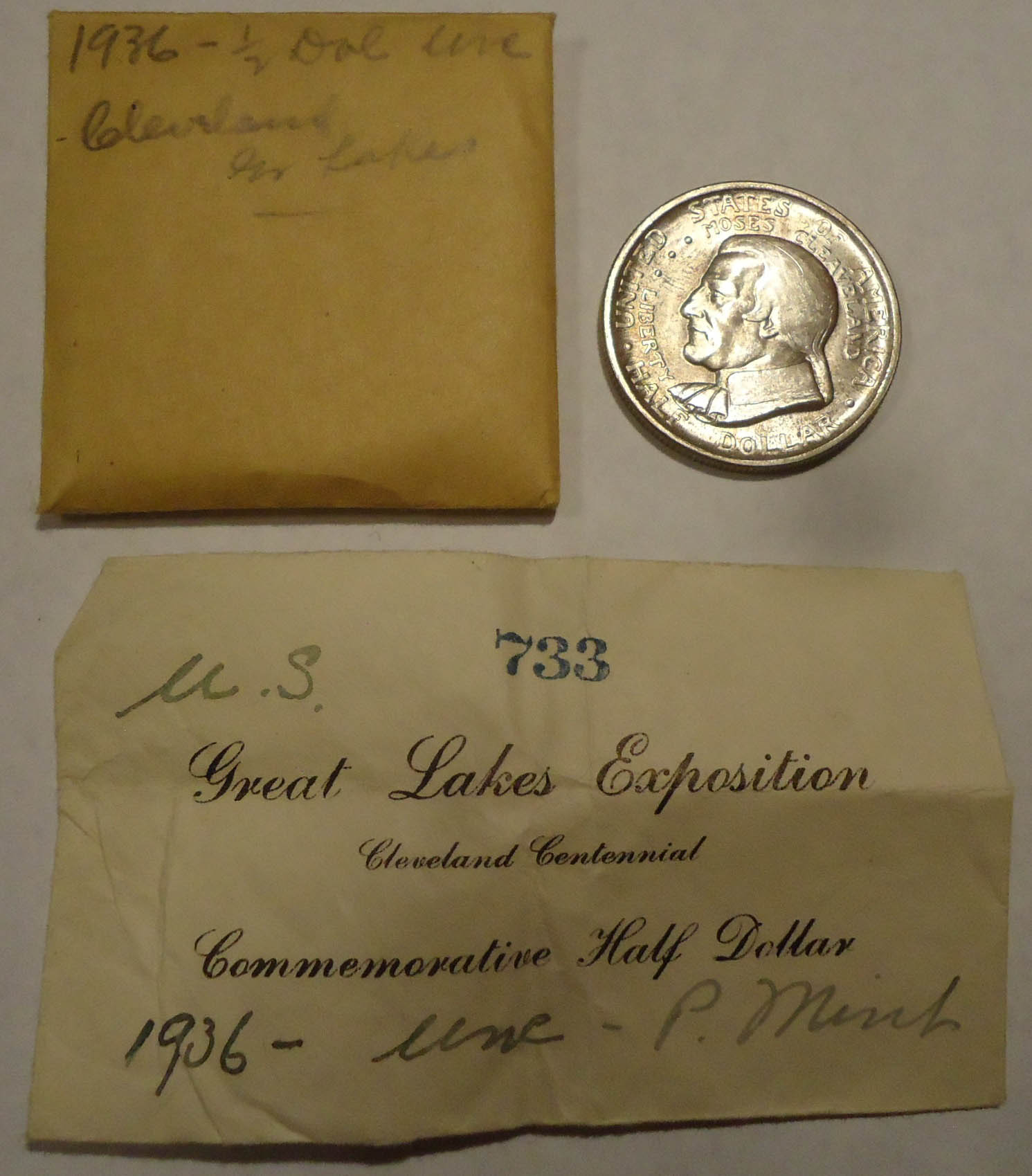
Collectors of the classic series of US commemoratives are likely familiar with the 1936 half dollar that marked the centennial of the city of Cleveland and its hosting of the Great Lakes Exposition. Here are a few links to my earlier posts about the coin:
http://goccf.com/t/116328http://goccf.com/t/128834http://goccf.com/t/160068The obverse of the coin features a left-facing portrait of Revolutionary War General Moses Cleaveland; he was the surveyor who selected the settlement site for what would later become the City of Cleveland. A map of the Great Lakes area with its major cities noted with stars appears on the reverse. The largest star, with the large compass pointing to it, represents Cleveland. Brenda Putnam was responsible for the design on each side.
Bills for the coin were introduced in the US House and Senate in March 1936; they called for the minting of up to 50,000 commemorative half dollars on behalf of the Cleveland Centennial Commemorative Coin Association. After minor debate, the Senate bill was moved forward; President Franklin D. Roosevelt signed the Senate bill into law on May 5, 1936 (less than two months after its introduction in Congress).
The design and striking of the coin also moved quickly, with an initial order of 25,000 coins being struck in July 1936; the coins were sold at the Exposition and via mail order. As sales of the coin were good, the Association ordered an additional 25,000 coins; they were struck in February of 1937 but bear the date "1936" as required by the authorizing legislation. The two orders "maxed out" the number of coins the Association could request.
The Association was not done, however. Believing they could sell additional coins if a second variety was created, it asked Congress for a new authorization.
The House and Senate bills proposing the new coin did not seek a change to its overall design, they simply requested that a small "1937" be added to an additional allocation of 25,000 1936-dated coins. As the Exposition was scheduled to run a full second season in 1937, the Association believed the dual-dated coins would be an attractive souvenir for Exposition attendees and coin collectors across the country.
The new proposal very likely was inspired by the Daniel Boone Bicentennial Commission which had recently, and successfully, requested from Congress a change to its original coin authorization to allow a small "1934" to be added to its coins struck between 1935 and 1938.
Unfortunately for the Association, its new request did not gain the same traction as its original proposal. The new bills were referred to the appropriate committees in the House and Senate, where each died for lack of action.
So, one can only theorize as to the potential popularity of a second Cleveland half dollar. Me? I would suggest total sales in the 10K to 15K range - not everyone who purchased the original coin at the time would have been a "completist" and felt the need to purchase another coin of essentially the same design.
Shown here is my "Cleveland" half dollar along with a piece of August 1937-dated ephemera from the Exposition generated in response to an apparent inquiry regarding the availability of its coin. Interestingly, Baker Camp on Lake Sebago in Sloatsburg, NY still exists today. Camping anyone?






 Posted 01/22/2016 2:38 pm







 It can't be.... Oh, this is hurting my brain


