| Author |
 Replies: 9 / Views: 3,694 Replies: 9 / Views: 3,694 |
|
|
New Member
United States
4 Posts |
I'm a total coin/medal newbie, trying to find info on the subject medal. Bought it from a coin dealer in Hawaii around 40-50 years ago (I previously resided there), put it away, and only recently got curious about it. Thought I'd simply Google it up, but to my surprise I've drawn a total blank on the web, finding only many references about a much different, much later commemorative with a somewhat similar title but commemorating Japanese immigration to Hawaii from 1885-1985. The later version was minted by the Royal Hawaiian Mint, who wasn't even in business until 1974. At this point I'm sort of out of ideas. The medal is 35mm in diameter, and about 2.5mm thick. It is non-magnetic and "looks" like silver but not sure. Anybody who might be able to help? Many thanks in advance.  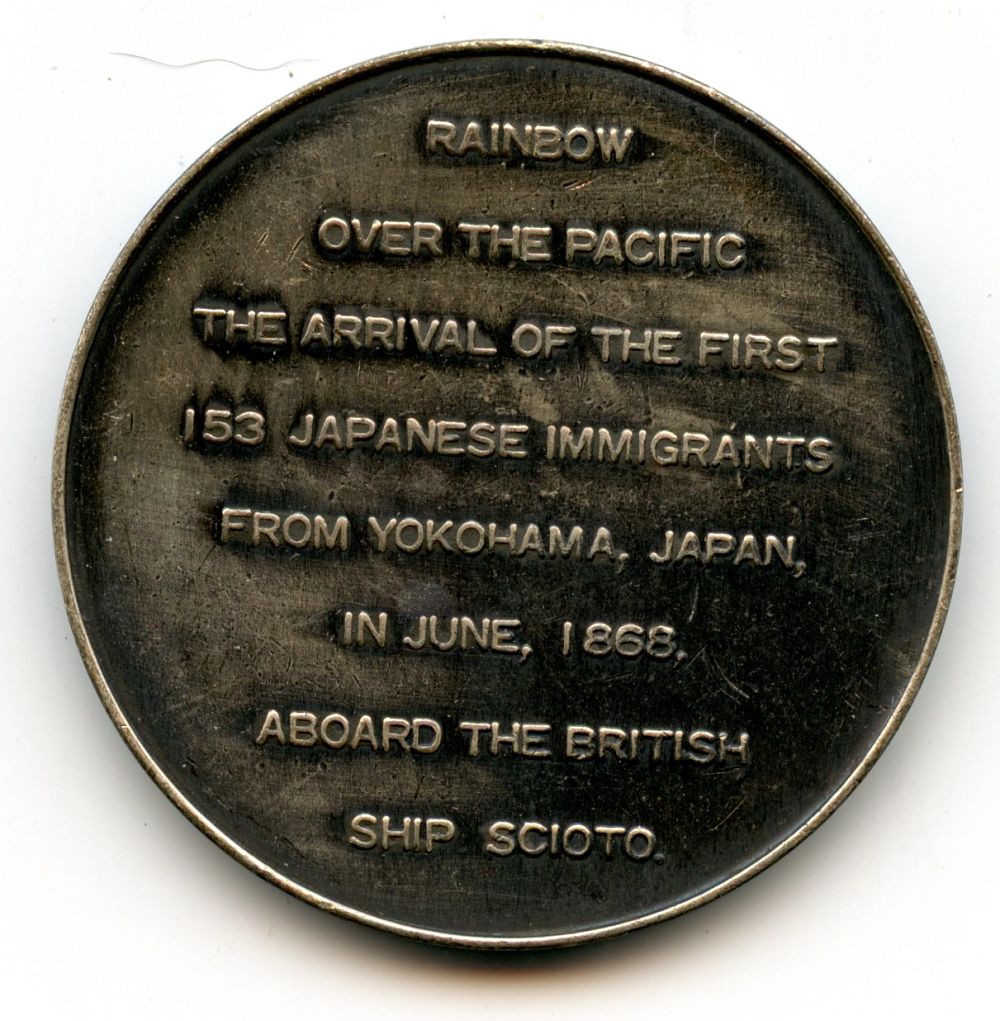 |
|
|
|
Bedrock of the Community
United States
11951 Posts |
Very interesting medal.
I hope there is someone here that has information about it.
As for what it is made of .. my guess would be pewter
|
|
Rest in Peace
United States
17900 Posts |
Yes, it has the look of pewter rather than brass or bronze. Very interesting subject matter. I'm sure any Hawaii collector would love it. Historical too. I do hope someone might help you with minter.
|
|
New Member
 United States
4 Posts |
Thanks for the interest and helpful comments. There's an interesting back story behind the event this medal commemorates that might help explain why it's so relatively rare. As best I can ascertain from bits and mentions of the event in a couple of places, it seems in 1868 sugar cane producers in Hawaii were desperate for cane field laborers, and turned to Japan in an attempt to obtain a cheap "contract" work force. They eventually succeeded in getting 148 (I don't know where the "153" came from) Japanese to sign up, and this medal commemorates their arrival in Hawaii in June of 1868. However, recruiting in the streets of Yokohama was apparently far more difficult than initially anticipated, resulting in contracting "gamblers and idlers" many of whom had no experience or desire for manual labor, and who had problems adjusting to the hard work in the cane fields, resulting in major problems and resulting in the end of official Japanese immigration to Hawaii for quite some time after that. (See http://publishing.cdlib.org/ucpress...rand=ucpress for a bit of background on this). It appears to me that in 1985, with the emergence of more numerous and politically powerful Hawaiian citizens of Japanese descent, some major ethnic image makeover took place with a NEW "1885-1985 Centennial of Japanese Immigration", officially celebrating the arrival of a later, much less controversial group of workers in 1885. Thus, the commonly available (and completely different) 1985 minting. The 1868 event and the medal I have commemorating it appear to have been pretty much swept under the rug by state politicians, in an interesting rewrite of state history. Other than the images I uploaded with this post, I have yet to see an image or visual reference to this 1868-1968 medal anywhere on the web, after days of searching, although the 1885-1985 version is literally everywhere. Quite an interesting story so far! |
|
Valued Member
United States
434 Posts |
The medal is 2M-213 in the 1991 book: Hawaiian Money Standard Catalog "Second Edition" by Donald Medcalf and Ronald Russell. 31 mm and struck in nickel. The medal celebrates the Issei (1st generation) in the Kingdom of Hawaii. https://en.wikipedia.org/wiki/IsseiEdited by DrDarryl
02/15/2016 4:41 pm
|
|
New Member
United States
4 Posts |
Many, many thanks, DrDarryl. The link contains a ton of interesting info. The only disconnect I see is the medal diameter, which I just very carefully measured again at very very close to exactly 35mm. 4mm seems to be quite a significant difference, but I suppose not all data catalogs and books can be all that precise in their listings. Thanks again.
Edited by picker77
02/15/2016 4:55 pm
|
|
Valued Member
United States
434 Posts |
More historical information http://www.discovernikkei.org/en/jo...ei-pioneers/The most well known Nisei (2nd generation Japanese-American) was Senator Daniel Inouye. During his time as U.S. Senator from Hawaii he was President pro tempore of the Senate and 3rd in the presidential line of succession (1st=Vice President and 2nd=Speaker of the House of Representatives). Senator Inouye passed away in December 2012. |
|
Valued Member
United States
434 Posts |
Below is the first newspaper article in the Kingdom of Hawaii that mentions the specific date and ship that matches the medal. 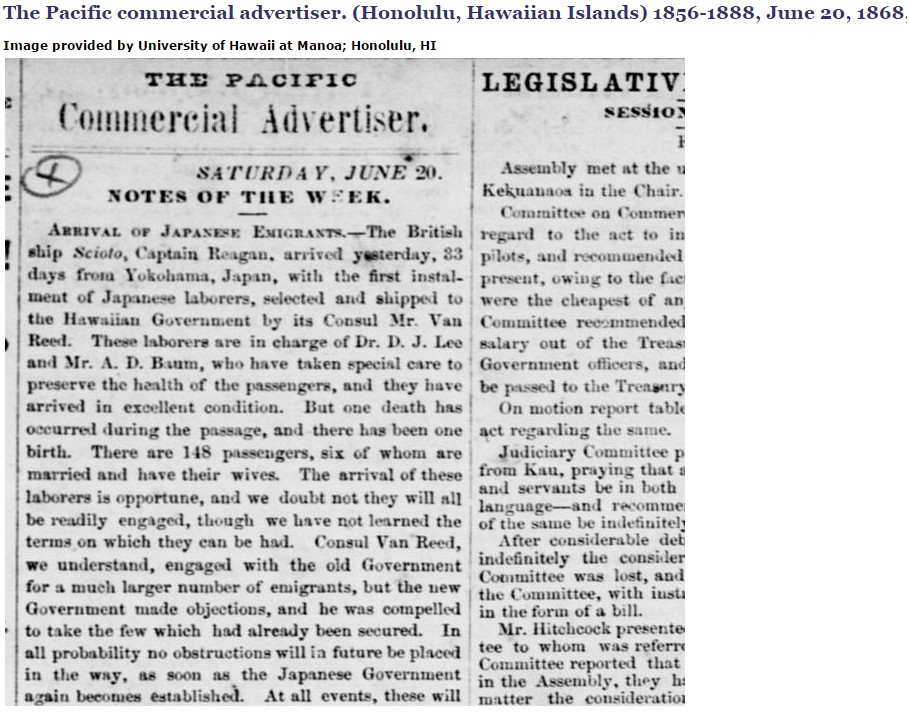 |
|
Valued Member
United States
434 Posts |
|
|
New Member
United States
4 Posts |
Good gosh, you are certainly a fountain of information. Thanks!
|
| |
Replies: 9 / Views: 3,694 |
|







 Posted 02/10/2016 06:12 am





