| Author |
 Replies: 6 / Views: 1,196 Replies: 6 / Views: 1,196 |
|
|
Valued Member
United States
54 Posts |
Hello, The coin in question is an Ottoman Empire Turkey 1327//4 (1912) 25 Kurush.. KM# 752 (0.9170 Fine, GW 0.0532oz) The issue is is it counterfeit or Unique find? I have two. One meets required specs..15mm diameter, 1.8040g, the other(photos) is 17mm in diameter, and weighs 1.700g. I've had the one in question tested at two different places, each stated coin ss 22K (0.9170). I then asked NGC, ANACS, ICG, and PCGS if they were aware of any counterfeits of this coin being discovered. So far, two have responded in the negative. Is it possible that this is the only coin of it's kind struck by the mint of Turkey? Who would go through the trouble to make a die of a coin that has no significant value, use the same fineness of gold, as the common original, and then strike only one? Your input greatly appreciated.... Dan 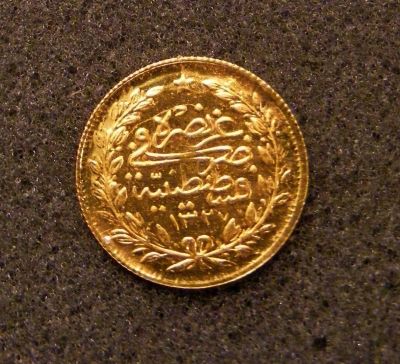 |
|
|
|
Pillar of the Community
United Kingdom
2490 Posts |
Should be KM# 825, except that they supposedly did not issue one in that year.
|
|
Moderator
 Australia
17006 Posts |
Can we see the other side? It should have the other half of the date, the "4".
Don't say "infinitely" when you mean "very"; otherwise, you'll have no word left when you want to talk about something really infinite. - C. S. Lewis
|
|
Pillar of the Community
United States
1391 Posts |
Quote:
Unique find? I have two. Can't be unique then...  But I wouldn't be surprised if it was made under the patronage of some wealthy coin collector. It could also be a pattern. It doesn't look cast from the pics, but there are some lines that concern me around the rim from about 6:00 to 12:00. Could be because it was worn as jewelry. It could also be a jewellery copy. Not designed to fool a collector but just designed to be worn. Minted and authorized by the government is a squishy concept in that part of the world even to this day. It is often the fineness and weight of the metal that mattered. |
|
Valued Member
 United States
54 Posts |
alganbagerap... What made you believe, at first, is was a KM# 825? Sap............ 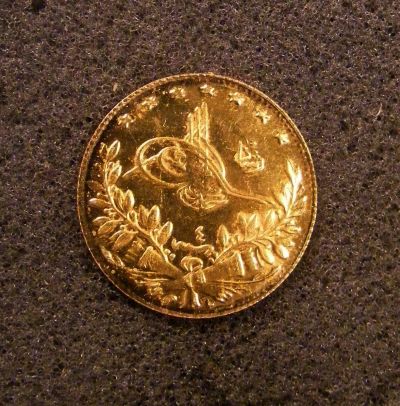 allranger...... 'Unique find? I have two.' Let me clarify that for you. Both are same date, same country, same designs, same denomination, same fineness, etc.. One is the accepted standard weight & size, the other (the Unigue One) is not. I examined rims with 30X magnification... only imperfections are two areas rubbed on jewelers stone for acid test. Pattern coin? Any existing data of those during Muhammad V reign? |
|
Moderator
Australia
17006 Posts |
There'd be no need for a "pattern" for a coin dated in what would have been the fourth year of issue.
My assumption would be - and it is a reasonable assumption, based simply on the fact that it is underweight - that it is a jeweller's replica. In the Middle East, particularly in Lebanon and around the Gulf States, it was (and still is) common practice to make replicas of common bullion coins, such as the British gold sovereign, so that the gold bullion can trade hands in a form the customers are familiar with, though the replicas were almost always either lighter in weight or lower in fineness than the genuine pieces.
In recent years it has been required that such replicas be marked with a fineness mark, and I see no such mark on either side of this coin, so I would assume if it is a jeweller's replica then it would be an older one.
Don't say "infinitely" when you mean "very"; otherwise, you'll have no word left when you want to talk about something really infinite. - C. S. Lewis
|
|
Valued Member
United States
54 Posts |
Good morning all,
Appreciate all responses. I overlooked mentioning that the coin does have a proof-like finish.
Sap... Can you suggest reference site to explore Middle-Eastern jeweler's replicas? Thanks
|
| |
Replies: 6 / Views: 1,196 |
|








 Posted 02/16/2016 7:17 pm


