| Author |
 Replies: 12 / Views: 1,821 Replies: 12 / Views: 1,821 |
|
|
Moderator
 United States
23731 Posts |
Last month Vcoins had a contest that I was lucky enough to win. It was a $100 gift card. This is one of two coin I picked up.  Latin Kingdon of Jerusalem1099-1291 Latin Kingdon of Jerusalem1099-1291The kingdom was established after the First Crusade, it's first king was Baldwin I 1100-1118. It had close ties with the Byzantine Empire and the Cilican Kingdom of Armenia. At it's height it controlled modern Israel, the West Bank and Gaza Strip, Lebanon, the Sinai Desert, Jordan, and Syria. When the kingdom ended in 1291 it's holding where a few cities along the Mediterranean coast. In 1187 Jerusalem was lost to Saladin and the Ayyubid rulers. The kingdom was force move it's capital to Acre. Where it's remained until 1291 when Mamluk Sultan Khalil and the Baibars ended the kingdom. The coin that I am posting is from the later period 1243-1260, when the kingdom was in Acre. AR Dirhem In the name of as-Salih Isma'l Sultan of Damascus It bears a Christian legend in Arabic roughly translated to "The Father & the Son and the Holy Spirit, one God, one single God, one single Faith, one single Baptism. Acre mint 22mm x 2.75 grams x 3h. Reference: CLE pl10, 233-7 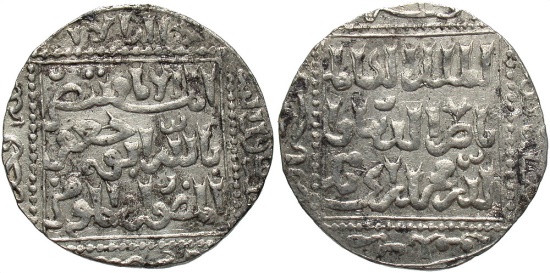 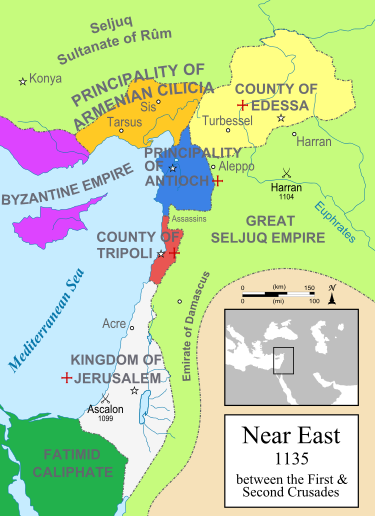 |
|
|
|
Pillar of the Community
United States
5155 Posts |
Holy Cannoli! This coin has been near the top of my list for quite sometime. The inscription is what really makes the piece. I dont know enough to verify the inscription, but I was looking at something similar from the Mongols. Great score, certainly welcome in my collection. Kudos my friend.
|
|
Moderator
 United States
23731 Posts |
Thank Nate, It's tie to the crusades is what drew me to it.
|
|
Moderator
United States
23731 Posts |
I had thought this coin would have drawn some interest being related to Medieval Crusader history.
|
|
Valued Member
United States
109 Posts |
I'm an avid follower of Medieval and Crusades Christian history. I gotta say one of those bad boys is now definitely on the list. Great find!
|
|
Moderator
United States
34561 Posts |
Fabulous coin! Thanks for sharing its story.
"If you climb a good tree, you get a push."
-----Ghanaian proverb
"The danger we all now face is distinguishing between what is authentic and what is performed."
-----King Adz
|
|
Pillar of the Community
United States
7067 Posts |
I agree, great coin - really lovely example and interesting history.
|
|
Pillar of the Community
United States
5010 Posts |
what a cool coin! from the title of the thread, I was expecting to see something with a cross on it, not a arabic legend coin...very interesting.
|
|
Moderator
Australia
17005 Posts |
Unfortunately, I believe your information about the inscriptions is not correct. This does appear to be a "Crusader imitative dirham", but it is a direct imitation of the Islamic types, with full Islamic legends, just like a regular Damascus-made dirham of the period. In fact, I'm not entirely certain that it isn't a "genuine" Damascus dirham; the Crusader imitations are usually less round than this piece. I can't read the date, which would be the telltale. Some background: in the year AD 1244 (AH 641), the remnant of the Crusader Kingdom of Jerusalem, based at Acre, made a treaty with Ayyubid king al-Salih Isma'il of Damascus, and it is from this time that Crusader imitation Damascus dirhams are first known to be dated. Prior to this, the Crusaders had been striking imitations of the "star" dirhams of Aleppo. But in the year AD 1250 (AH 647, the last known date for the above coins) a papal envoy was shocked to discover that the Crusaders were striking from their mint coins proclaiming "Mohammed is the messenger of God" and the date in the Islamic calendar. The envoy promptly demanded they cease and desist, and reported back to Rome to seek a formal edict on what kinds of coins the Crusaders should be striking instead. Meanwhile, the Crusaders, in need of coinage, struck in 1251 the so-called "Christian Arabic dirhams", which look distinctly different to the Islamic types, with a large prominent central cross as well as the Christian "one faith one baptism" legend and the AD date. They look like these examples on Zeno.ru. This series was obviously unacceptable in trade with their Muslim neighbours, so they toned things down, first by making the cross much smaller, then taking the cross away entirely. The "offensive" legend remained, however, making trade difficult, and by 1253, the Pope's formal response had arrived: Crusader coins must not bear the name of Mohammed, or "his birthdate" (ie the Islamic calendar year). Adhering to the letter of the law of the papal edict, the coins dated 1253 reverted to a much more imitative style, restoring the now-deceased Islamic ruler's names and only changing the edge inscriptions: "Mohammed" replaced with the similar-looking "Michael" (the archangel), a more generic statement about God being Merciful and Compassionate (something which both Christians and Muslims could agree to) and keeping the AD date. Finally, the date devolved to a garbled mess that might or might not be interpretable as anything sensible in terms of a date. The "Christian Arabic" coins with the date "1251" written in the AD calendar are, of course, quite popular with date-collectors, as they are the second-oldest coins ever struck with an AD date. Sadly, Echizento, your coin is not one of them. Don't say "infinitely" when you mean "very"; otherwise, you'll have no word left when you want to talk about something really infinite. - C. S. Lewis
|
|
Moderator
United States
23731 Posts |
Interesting take on this coin Sap, due to the limited information provided by the dealer and available to me I was under the impression that this coin is what it was claimed to be. I see your logic about the type. I am aware of the types where a Cross was used in the center of the coin and where a smaller Cross was used along the edge in another variant, it's unfortunate that there is not enough detail along the edge that would either confirm or repute it to be one of those. I see where I'm going to need to do further research into it. I appreciate your comment on this.
|
|
Moderator
United States
23731 Posts |
Sap's comment sent me on the road to do a bit more research. It does appear as he stated that the legend is not the Christian type, but the Islamic type. I'm hoping to come up with a translation and will post it if I do. In any event the coin is still a Crusader Imitative Dirham from the Latin Kingdom of Jerusalem.
|
|
Moderator
Australia
17005 Posts |
I can give you a translation, if you like. I have the Malloy, Preston and Seltman catalogue of Crusader States coins, which gives the translation thusly:
The obverse is the picture on the right in the OP. The inscription in the central square translates to "King al-Salih Isma'il bin Abu Bakr, Pillar of the World and of the Faith". The obverse edge inscription, beginning at 9 o'clock rather than the usual 12 o'clock, reads "In the name of Allah, struck in Damascus in the year..." and the year itself which I can't read.
On the reverse, we have the titles of the by-then-deceased 'Abbasid caliph in the central square: "Imam al-Mustansir-billah Abu Jafar al-Mansur, Commander of the Faithful". The edge inscription on this side is an abbreviated Kalima, the Islamic statement of faith: "There is no God but Allah, He has no partner, Mohammed is the messenger of Allah". It may or may not be coincidence that the name "Mohammed" is mostly off-flan on this coin.
Don't say "infinitely" when you mean "very"; otherwise, you'll have no word left when you want to talk about something really infinite. - C. S. Lewis
|
|
Moderator
United States
23731 Posts |
Thanks Sap, I've been trying to come up with the translation but wasn't having much luck. I have some reference material by Michael Bates but he doesn't translated the legend. I appreciate your help.
|
| |
Replies: 12 / Views: 1,821 |
|







 Posted 02/20/2016 9:39 pm





