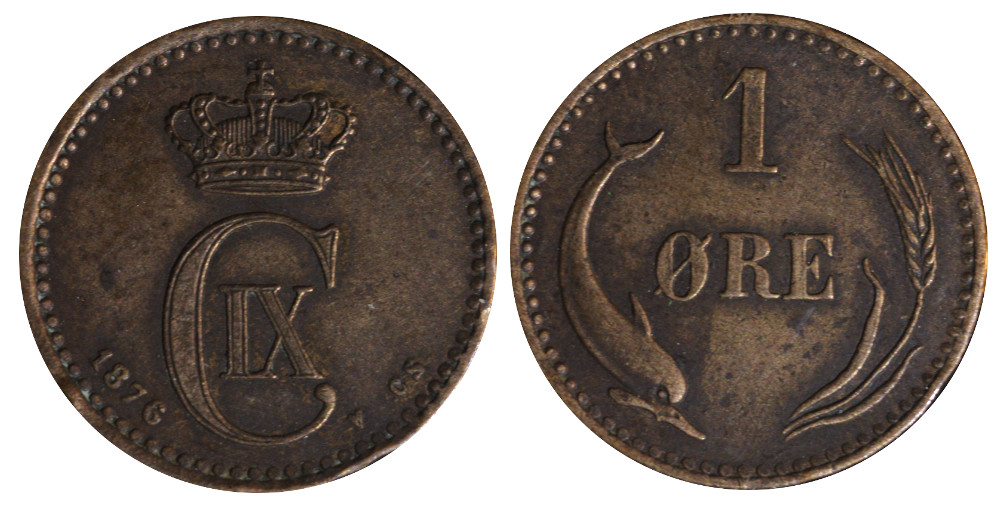
This coin was introduced according to the Scandinavian Monetary Union (SMU) that was founded in 1873. It included Sweden, Denmark and Norway (Norway was under Swedish control at this time, Swedish-Norweigan "union"). The reason for this monetary union was just like the LMU - having similarily sized coins that could circulate in all member countries. However, unlike the LMU even smaller denominations were regulated to have a common size. The Norwegian, Swedish and Danish 1 Øre/Öre coin were made in bronze, weighed 2 grams and had a diameter of 17mm. The Crown of the union was the currency unit. 1 Krone/Krona (both litterally mean Crown) were composed of 80% pure silver, weighed 7.5 grams and had a diameter of 25mm. This coin size still ives on in Sweden to thiss day but will be phased out October 16th to July 17th. Gold 10 and 20 krone/krona coins were issued aswell for every member country. Sweden issued 5 kr gold coins aswell.
The union was dissasembled officially in 1924 as of a result of WWI. Both Norway (now free from Sweden) and Denmark had issued base metal coins in the denominatins that were supposed to be silver since 1920 (as had many other former LMU-countries). The base metal coins leaked into Swedish circulation where silver coins were still issued according to the original coin standard. Ultimately, the base metal coins of Norway and Denmark wer changed somewhat. Danish 10 and 25 Øre coins were increased in size and got a center hole, 1 and 2 Krone coins were stuck in Aluminium-Bronze. The Norwegian 2 krone coin was demonetized, the rest of the former silver denominations (10, 25, 50 Øre and 1 Krone) all got a center hole.
Sweden finally changed the composition of their coins in 1942 by (permanently) debasing all silver coins to 40% pure silver. Wartime issues of the 10, 25 and 50 Öre coins were issued in Nickel-brass during periods of both world wars. These coins were distinguished from normal coins (except the 60% silver 50 Öre coin, not the later 40%) by having a milled edge and different design.
As for the smaller denominations (1, 2 and 5 Øre/Öre), all countries issued iron coins during WWI, Sweden and Norway again during WWII and Denmark issued Zinc and Aluminium 1, 2 and 5 Øre coins. All original SMU-standard 1,2 and 5 Øre/Öre coins were demonetized in 1972 (Sweden), 1973 (Denmark) and 1975 (Norway).
What's also interesting to note here is that Denmark put holes on the lowest denominations aswell after the dissolution of the SMU. They were issued up until 1940. After the war, the zinc coins kept on being produced. Another type for each denomination was issued alongside in bronze, however these coins were smaller and lighter than pre-war issues. All post-WWII 1, 2 and 5 øre coins did not have center holes.
Now that's quite a story, right?










 Posted 03/05/2016 1:55 pm




 ) about that. I just looked up recent auction prices... they're not nearly as high as the inflated KM values, but much higher than I expected. Mine has some rim damage so wouldn't fetch much, but the family value to me is priceless.


