| Author |
 Replies: 6 / Views: 2,164 Replies: 6 / Views: 2,164 |
|
|
Pillar of the Community
United States
6130 Posts |
I think it's a safe bet to say that most of us have a billon coin or two in our collection--generally defined as a "silver" coin with either less than 50% purity, or 40% depending on who you ask. Silver was the standard of European currency from the early Middle ages until the late 1800s, and there were plenty of times during that stretch where the purity of silver took a nosedive while the country experienced inflation.
My question is, what is the most debased "silver" or "gold" coin that has ever been produced?
As far as I am aware, the winner of the silver would be the Antonianii issued under Claudius II in 268-269 with a purity of 2% or less--Aurelian increased this to 4.76% two years later.
Gold, I am not sure about. I know some Japanese "gold" ingot coins dipped as low as 20%, but I feel that there has to be a better example?
One caveat--to qualify, the debasement must he controlled and intentional--I know that extreme trace amounts of precious metals will be present in a great many coins, due to refinement methods or the lack thereof used in producing certain coins.
|
|
|
|
Pillar of the Community
Australia
3832 Posts |
|
|
Pillar of the Community
Russian Federation
5185 Posts |
The Siberian copper coinage was made from copper with especially large trace amounts of precious metals - these were still low enough traces to make their separation uneconomical with contemporary (18th century) technology, but high enough for their inclusion to make a difference in the official coinage standard (that is to say, Siberian coins were a bit smaller than the regular issues, to account for the extra gold and silver).
It is said that, as the Siberian coinage issue went on, technology became better, and separation of these traces became economical - while the coins were still made under the standard that allowed for the now-nonexistent extra gold and silver. So I'm not sure if this counts as "controlled and intentional", unfortunately.
(But I still like to count my Siberian copper kopek as the only gold coin in my collection, because otherwise I just don't have any.)
Then there's the Axumite tradition of doing copper coins with tiny gold plugs in them (I think similar coins were also used in some other places). Would that count as debased gold?
|
|
Pillar of the Community
United Kingdom
510 Posts |
I'd go for the Honduran 4 Reals 1849 0.1720 silver 1851 0.1000 silver 1852 0.0625 silver 1853-6 0.0400 silver 1856 copper 1857 copper lead alloy Very crude provisional issues, possibly had a silver wash when issued, but always found in terrible grade. Here are 3 of mine 1855,1856 & 1857  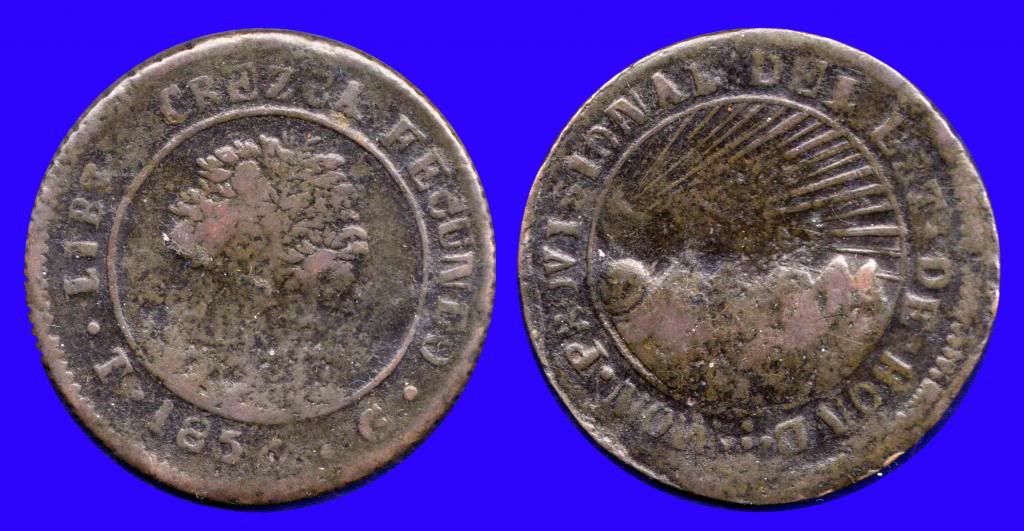 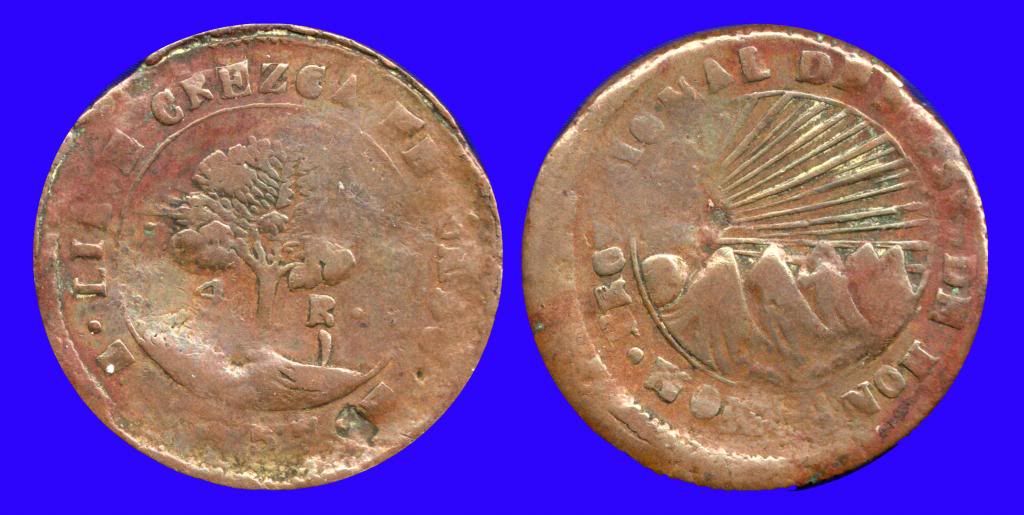 David Edited by davidrj
03/28/2016 12:09 pm
|
|
Pillar of the Community
 United States
6130 Posts |
You know, I hadn't really considered the issue of a gold or sliver plug, but that is a good point. What was the trace amount of the Siberian coins, out of curiosity? Here is one of my more debased coins, an Antoninianus of Numerian, 282-284 AD   The Antonianus was first introduced in 215 at about 51% silver. Rapid inflation was brought on by debasing the coins to pay more soldiers to try to stabilize the crumbling borders of the Empire. Aurelian fixed the fineness of the Antoninianus at a 20:1 ratio, or 0.0476 fineness. This is denoted by an XXI on the bottom of all Antoninianii made after 271 until the currency system was reformed under Diocletian. |
|
Pillar of the Community
Russian Federation
5185 Posts |
Quote:
What was the trace amount of the Siberian coins, out of curiosity? According to most sources I could find, 0.79% silver and 0.03% gold, but the latter figure is doubtful. The specific numbers are 132.3 grams of silver and 1.51 grams of gold per 16.38 kilograms of Kolyvan copper. I'm not sure how did anyone figure it out so precisely (I've snipped a few more significant figures from the original numbers) without an XRF; the 0.79% seems about right, the gold figure would've been 0.009%. I'm not sure which figure for the gold is correct, but in any case it is mostly irrelevant; as mentioned, both versions roughly agree for the silver. Russian Wikipedia says (and a few other sources seem to agree) that extra silver (though, presumably, not gold) was actually added when the amounts in ore went below the original figure. If true, that would definitely mean they count as "controlled and intentional", though I personally doubt it (who could tell, anyway?) |
|
Pillar of the Community
Australia
3832 Posts |
It is true that Siberian coinage had traces of gold and silver however I am certain that the refining technology improved quite early - if I am not wrong, I remember reading an article that in around 1770s, most of the precious metals were removed "quietly" and the weight of the coins still remained the same.
The amount of natural resources Russia has is just astounding. I am certain there's still a lot of minerals left in Siberia however is yet to be discovered - there's just a lot of money required for exploration.
If I recall correctly during the platinum rush era when Russia was the only official country to issue platinum coinage around 1830s, platinum was mainly mined from the Urals. This deposit was supposedly "exhausted" however because of the crude mining methods, it is still economically feasible to go through the waste and still look for platinum!
My partial coin collection http://www.omnicoin.com/collection/gxseriesMy numismatics articles and collection: http://www.gxseries.com/numis/numis_index.htmRegularly updated at least once a month. |
| |
Replies: 6 / Views: 2,164 |
|










 Posted 03/26/2016 10:22 pm


