| Author |
 Replies: 10 / Views: 1,813 Replies: 10 / Views: 1,813 |
|
|
Pillar of the Community
Canada
4227 Posts |
I'm not terribly familiar with these, so how does a double denomination such as this happen only on one side? Click the link and scroll to "Eleven Cent Coin." http://www.gbellauctions.com/25.html Edited by chequer
03/29/2016 4:38 pm
|
|
|
|
Pillar of the Community
Canada
5341 Posts |
The pressman dropped a struck dime into a penny collar with another dime or penny and adjusted the pressure to create a 11 cents coin which he or she finally got right, there are a few examples out there during these late seventies and eighties you can almost order any errors you want. This was a prototype, in my opinion a pretty ugly one, doubt it goes for much.
Edited by john100
03/29/2016 4:50 pm
|
|
Pillar of the Community
 Canada
4227 Posts |
You're thinking the dime was the first strike? The flip says the cent was first (I know that doesn't necessarily mean anything), but I can see how they'd think that because it looks as though the dime is the strongest strike and it appears to be on top. Again, I've not seen many of these though.
|
|
Pillar of the Community
Canada
5341 Posts |
My eyes are as you say bad, the penny die was struck first, and the pressperson was trying to make the perfect 11 cent coin, eventually they got it right.
|
|
Pillar of the Community
Canada
2529 Posts |
It doesn't look like double strikes I've seen, the penny image looks very soft. I doubt it's real. Someone whacked it with a soft die maybe.
It also looks to be penny over dime to me. If it is struck with penny dies first like the slab says, then it's most likely a uniface strike.
Edited by Altaira
03/29/2016 6:49 pm
|
|
Moderator
 Canada
10473 Posts |
I don't like it, not one bit. Even if the first strike (1c) was a uniface strike, the preservation in the fields is not right.. it looks like it was pressed with a soft die or something. The general flattening of the reverse also speaks of being a soft die compression to me. Double struck coins will have the previous strike's elements preserved in the devices. The fields, being the highest points on the dies, tend to obliterate out the previous devices, or leave them as mere outlines. I have two examples: http://www.PCGS.com/SetRegistry/coi...825201&sid=0http://www.PCGS.com/SetRegistry/coi...042124&sid=0"Discovery follows discovery, each both raising and answering questions, each ending a long search, and each providing the new instruments for a new search." -- J. Robert OppenheimerContent of this post is licensed under a Creative Commons Attribution-NonCommercial 3.0 Unported License. See: http://creativecommons.org/licenses...0/deed.en_USMy eBay store
|
|
Pillar of the Community
Canada
2529 Posts |
I thought I'd seen something like this before. Found it. There's only a pic of one side. 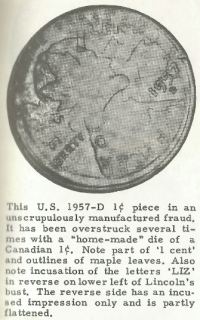 |
|
Pillar of the Community
Canada
4227 Posts |
It's interesting that there doesn't seem to be any damage to the rims and any cent design elements appear to stop at the beads. Wouldn't there be rim damage striking it with a die (soft or otherwise) after the fact? (Unless it was a manufactured die made smaller than a dime.)
|
|
Moderator
Canada
10473 Posts |
Not if you ground the rims off first...
"Discovery follows discovery, each both raising and answering questions, each ending a long search, and each providing the new instruments for a new search." -- J. Robert OppenheimerContent of this post is licensed under a Creative Commons Attribution-NonCommercial 3.0 Unported License. See: http://creativecommons.org/licenses...0/deed.en_USMy eBay store
|
|
Pillar of the Community
United States
1812 Posts |
While I will admit I don't know the exact minting process of Canadian Coinage, I can assume it's the same as here in the USA.. I read the Auction description, and I see red flags on this one.. As my Minds Eye views the Minting Process of this piece, and not knowing what die is the anvil die (obverse or reverse  ), 2 planchets (dime/cent or dime/dime) would have had to enter the Cent dies (this would explain the unistrike), then after being struck with the Cent dies, the Cent on Dime planchet would now have to reside in a bin of Dime planchets for Dime production.. This is where I see a problem, as the Dime planchet was previously struck with Cent dies, the diameter should have been expanded and not fit in the Dime chamber (yet it did) and was struck as a Dime.. I'm open to other explanations on how this so-called error can happen and go unnoticed by the employees, and enter circulation.. |
|
Pillar of the Community
United States
1812 Posts |
As I reread John100's post above, he may be correct, only entering the Cent dies first..
Edited by Broken-Coin
03/30/2016 09:01 am
|
| |
Replies: 10 / Views: 1,813 |
|










 Posted 03/29/2016 5:07 pm


