| Author |
 Replies: 14 / Views: 1,679 Replies: 14 / Views: 1,679 |
|
|
Pillar of the Community
United States
1315 Posts |
In another thread, Irbguy ask me to start this thread with unofficial Constantinopolis Commemoratives. I added a couple more to this thread. Thanks Irb. Add more if you have them. I may be wrong, but I think there is an official for this type with two standards, but I have never seen one. 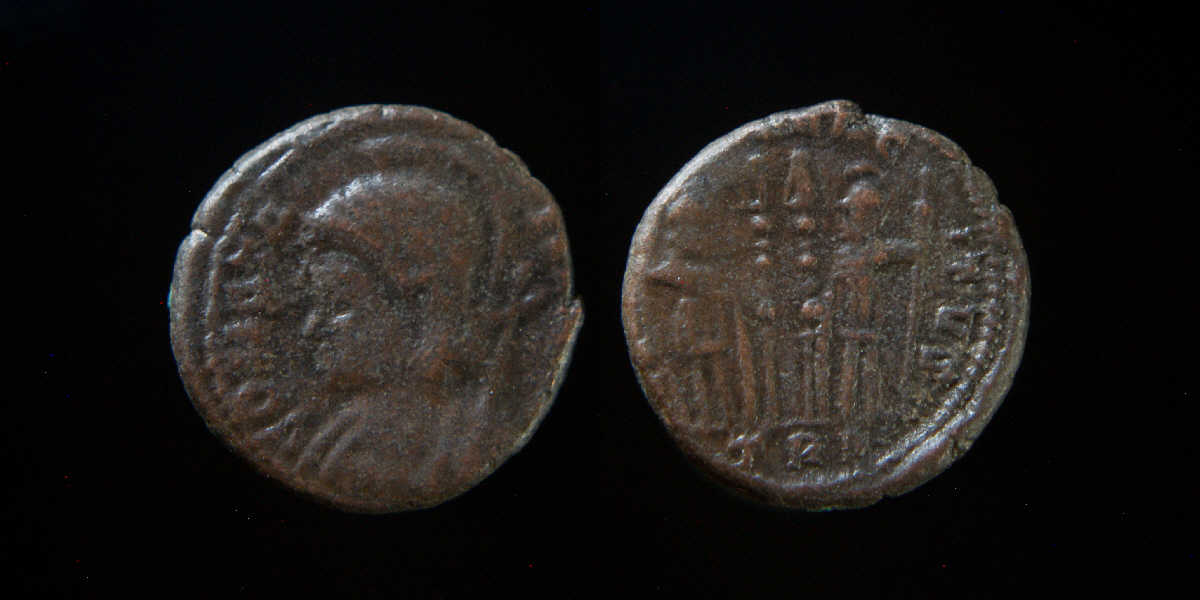 Trier mint, AE 13mm, 2.1g Cool, a bust right. 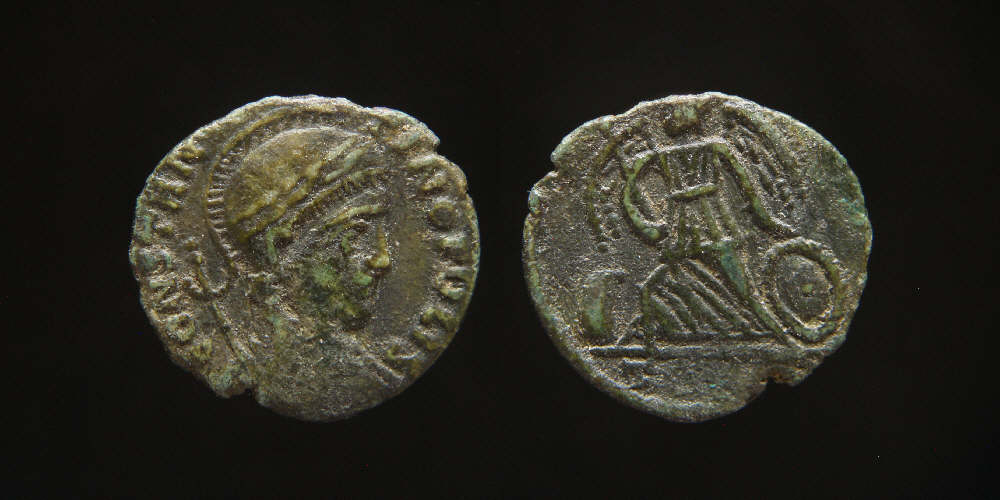 Trier, AE 15mm, 1.2g I thought this was an official coin that slipped through with the PTR mint mark being one they used on the standard types just before Constantinopolis issues were made. The consensus from people I talked with say it is unofficial, however if another could be found with the STR mark, it could suggest they are official. Keep your eye out. 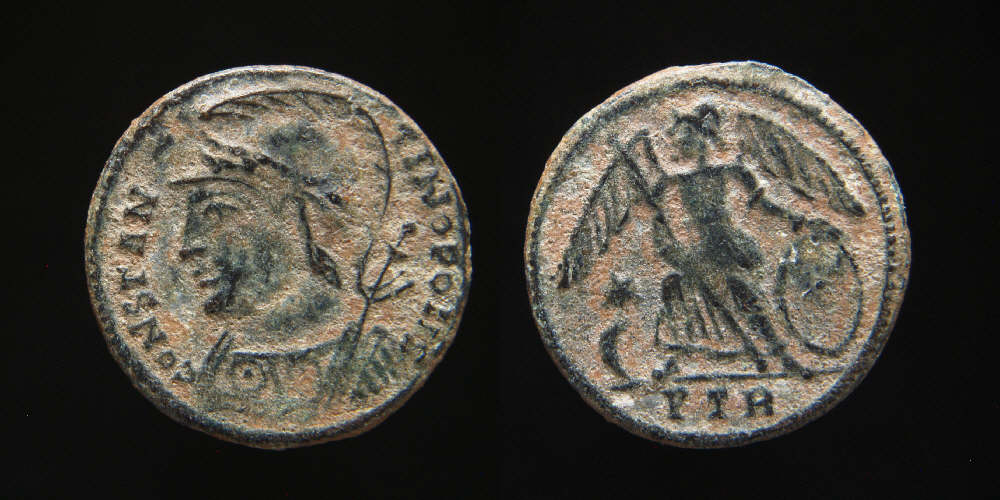 Trier,17mm, 2.1g This is a VRBS ROMA obv. with a Constantinopolis rev. I believe the opposite mules exist also, where the rev. is VRBS ROMA, wolf and twins and Constantinopolis obv. 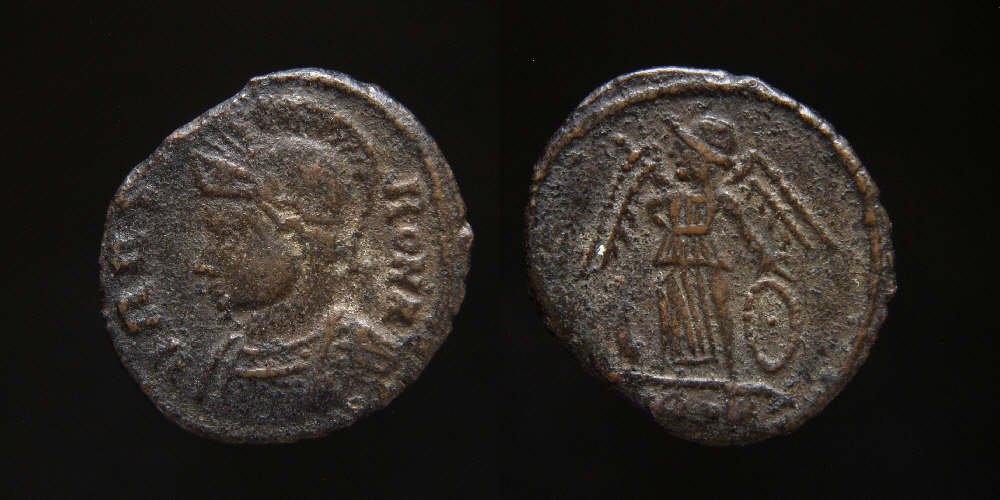 Trier, 15mm, 2.1g Here are a couple more crude examples. Both are smaller, but the second is very small. Not sure of the mint on these. 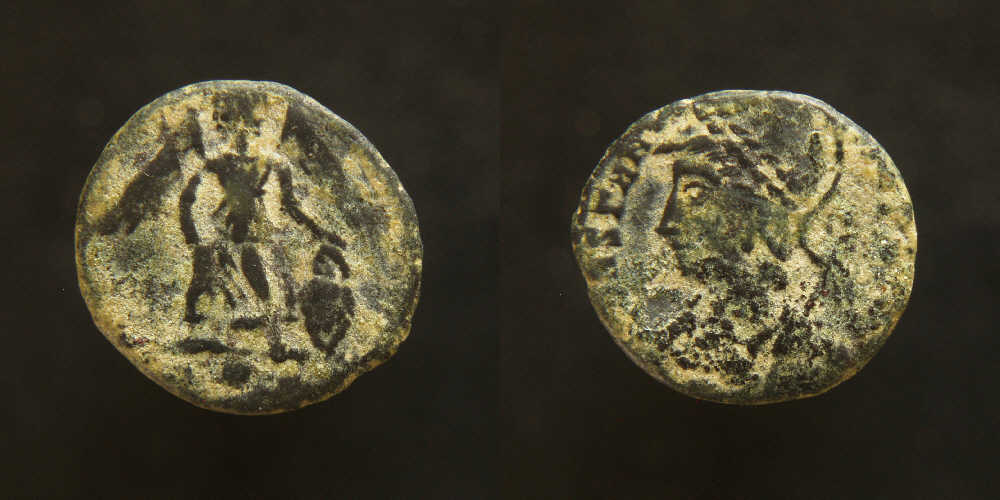 13mm, 1.6g. 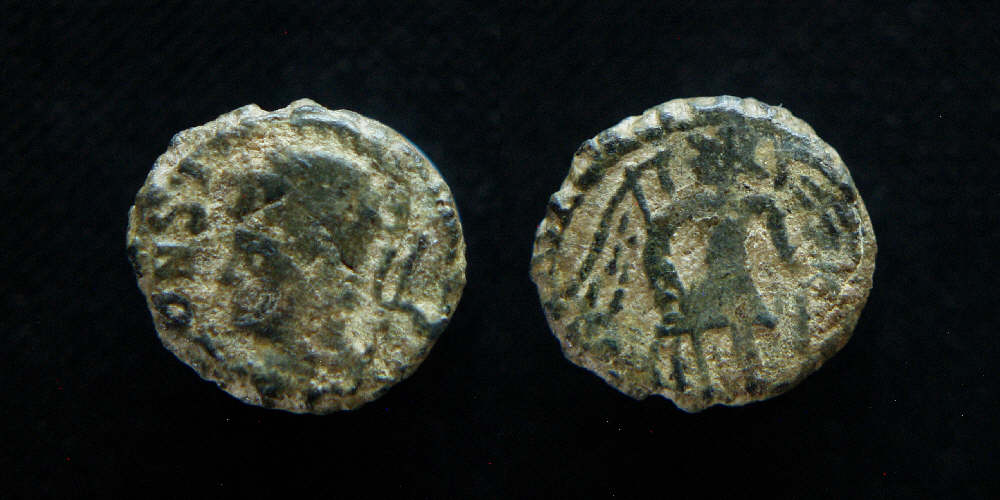 10.5mm, 1.1g. |
|
|
|
Rest in Peace
United States
17900 Posts |
Thanks so much for sharing those. The barbarous issues are at least as much fun as the "real" thing. I've been lucky in buying a few when the dealer warned me that the coin "looked odd", when it was barbarous.
It's more of a thrill for me to find the barbarous for some odd reason.
|
|
Moderator
 United States
23731 Posts |
Very interesting group of imitations. The Trier coin could easily pass an official issue.
|
|
Valued Member
United States
288 Posts |
So these are contemporary counterfeits used in the less populated outer reaches of the empire?
If so, I suppose when they did make it into highly populated places where they might be seen together with other real pieces, they would stick out like a sore thumb.
Even so, once the first person made the "profit" of passing less than official pieces, every other transaction from that point on was on par with the official currency and acted as such for the rest of its useful life. I also suppose the same is true once a population accepts and uses very good counterfeit currency in modern times.
|
|
Pillar of the Community
United States
4883 Posts |
This is a genre for which it might be very revealing to analyze via xray fluorescence for their composition, especially if comparisons could be made to known official issues.
Colligo ergo sum
|
|
Pillar of the Community
United States
949 Posts |
Quote:
once the first person made the "profit" of passing less than official pieces, This comment presupposes that "barbarous imitatives" were always viewed as counterfeits. Not necessarily. Hoard studies have shown a comingling of imperial currency and local imitatives at levels suggesting that the locals were sometimes filling a void. Currency changes and the shape of empire through the 4th century are both complex enough that each situation needs separate consideration. With regard to the hinterlands, perhaps it is best to think of "frontier currency" as a blend of official Imperial and home grown at least for coinage in bronze. |
|
Pillar of the Community
United States
949 Posts |
Thank you for posting your material Doucet. Here are some of my pieces. I'm leading off with these two because I am not sure about them. M much of the lettering is missing, including the mint marks, so comparisons are difficult, but there is a crudeness about them that makes me think they might be barbarous. Thoughts? 12mm/1.23g 14mm/1.36g 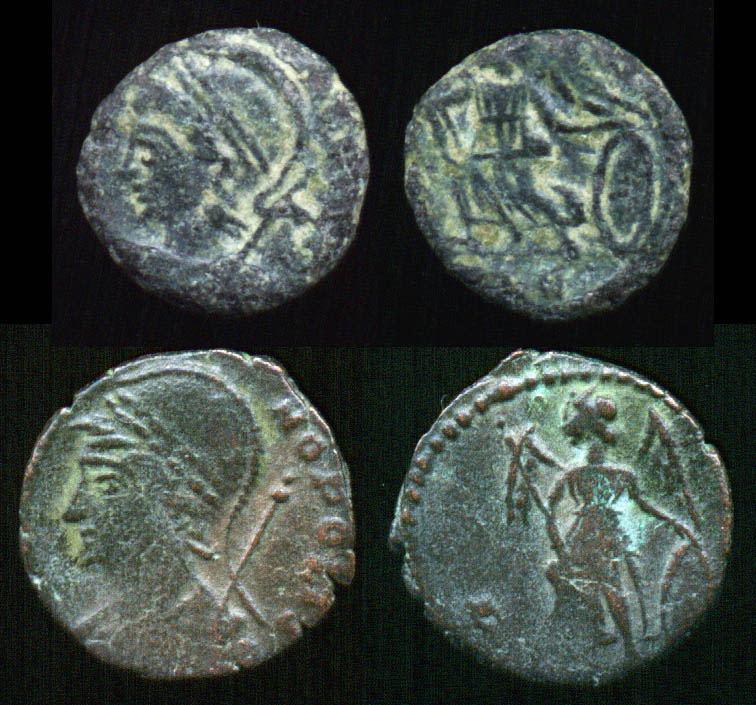 The rest are all imitative, I believe. This one emulates a Constantinopolis issue from Lyons (Lugdunum) 13mm .90g 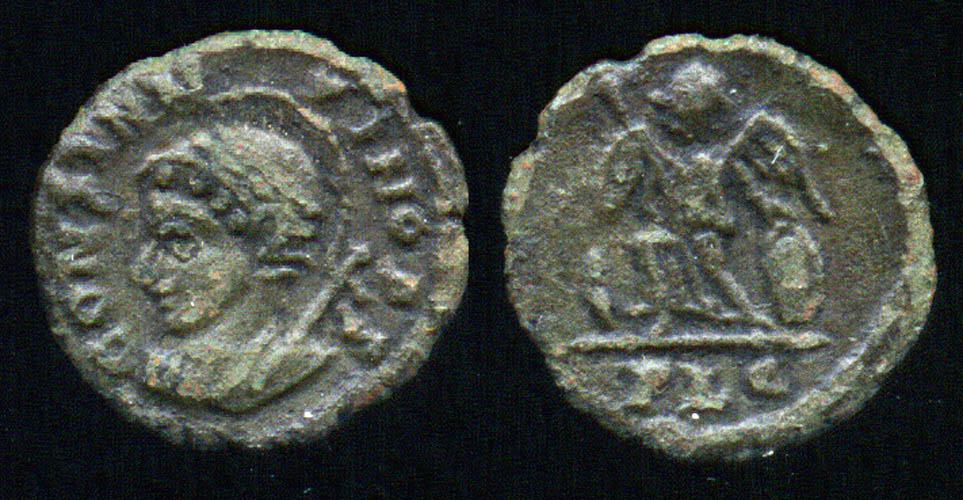 This one has a Const. reverse, but the obverse is up for grabs. The end of the obverse inscription seems to be patterned after Constantinopolis, but with an Urbs Roma style for the figure. 11x12mm .80g 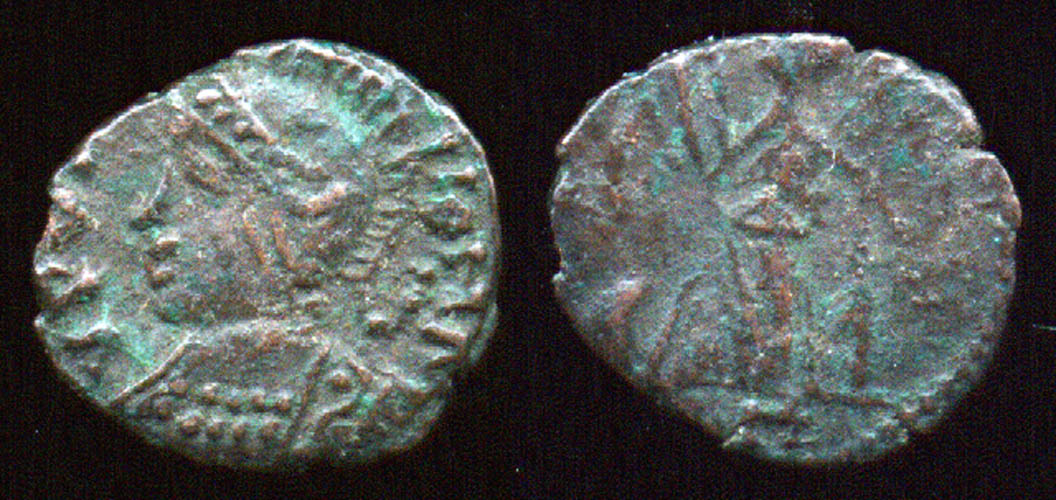 Here the obverse is styled after Constantinopolis, but the reverse is obviously Urbs Roma. 11x12mm 1.00g 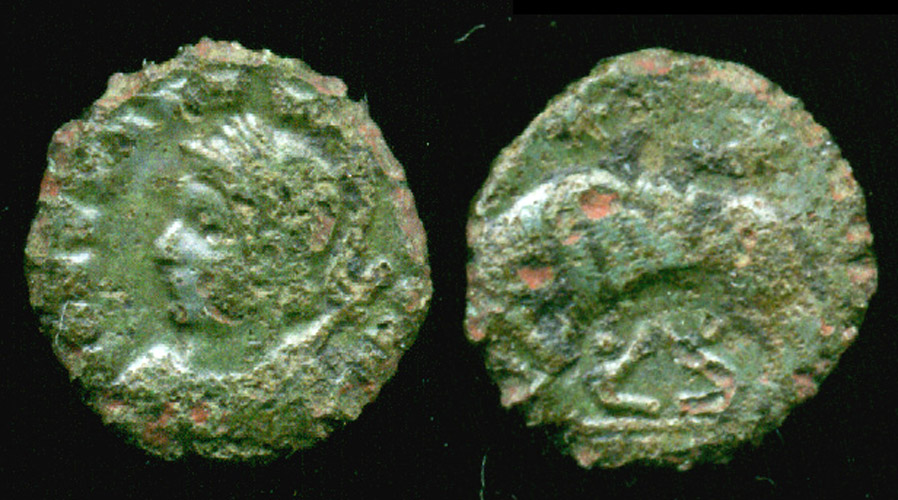 Here the obverse inscription is split but ends like Constantinopolis. The reverse is patterned after Urbs Roma, but the she wolf is facing the wrong way. 12x13mm 1.36g 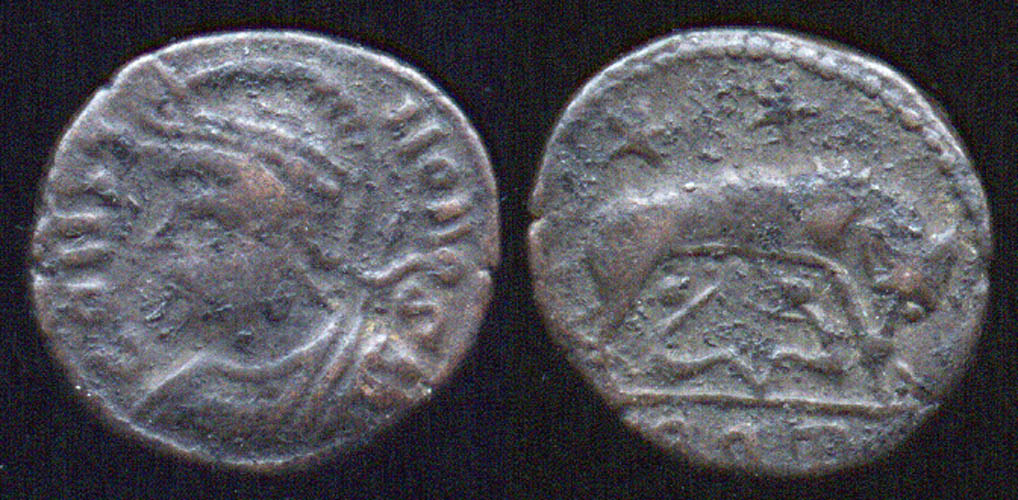 This one is emulating an Urbs Roma from Trier, but the obverse inscription is too long. Influenced perhaps by the Contantinopolis obv? 13mm 1.37g 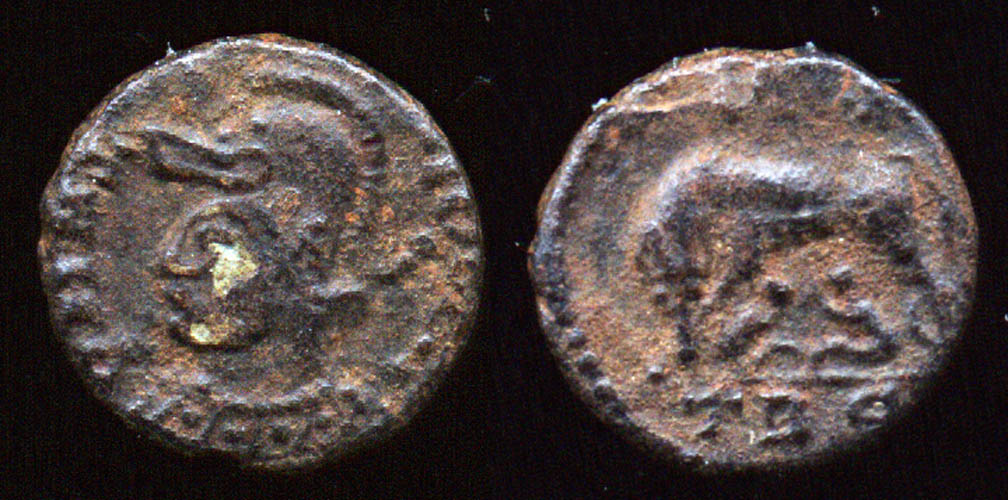 Poor example, but most likely this emulates an Urbs Roma on both sides. 12mm .88g 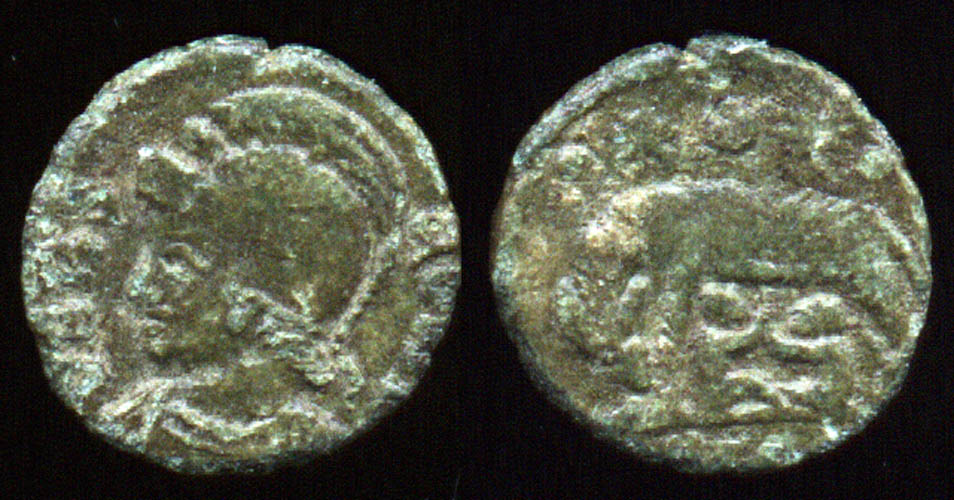 This one emulates an Urbs Roma for Trier. 14x15mm .96g 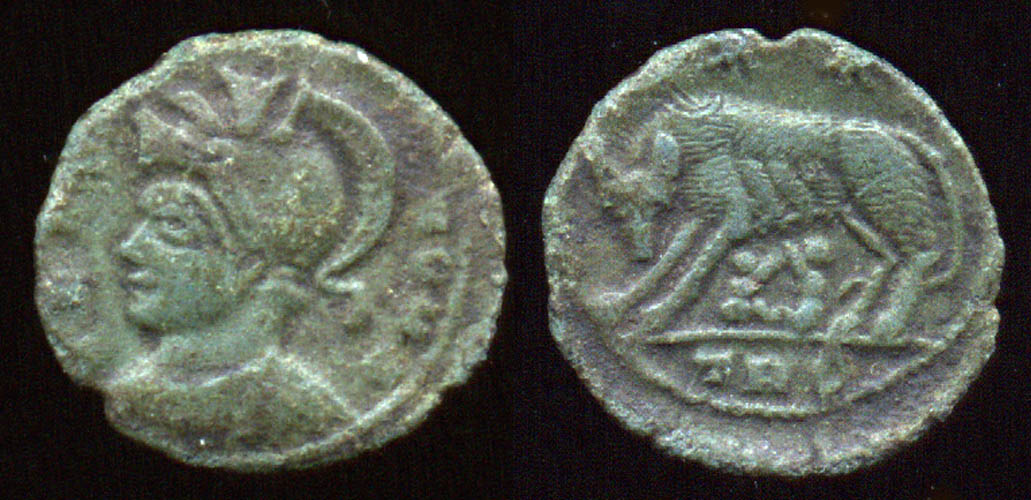 Note that all these are too small for the period when the original designs circulated. If they were minted at a later time, then the use of an obsolete issue design might have allowed the issuer, perhaps a local potentate, to dodge the claim of counterfeiting. |
|
Pillar of the Community
United States
949 Posts |
Looks like I killed the conversation I was hoping to have on these coins. I don't know how/why that happened, but I apologize. Let me see if we can pick up the thread again. Doucet wrote: Quote:
I may be wrong, but I think there is an official for this type with two standards, but I have never seen one.
Trier mint, AE 13mm, 2.1g
I can't make out the obverse inscription, but if regular for the Constantinopolis type your coin appears to be in a class with RIC VII 541 for Urbs Roma. There is a single example of that coin noted at Oxford, but Bruun gives the footnote that it is regarded as a hybrid. It is apparently presumed to have come from the official mint at Trier, officina P, and is of the mark type TR<dot>P. Yours I read as TRP<dot> (or <star>). You have a nice item that should be reported and recorded. Edited by lrbguy
04/04/2016 10:21 am
|
|
Pillar of the Community
United Kingdom
701 Posts |
I have a slightly better example which Doucet has seen and commented on via a different site, so far there is no evidence that this type was ever issued by a Western mint but only by the Eastern mints. The few examples known are all classed as unofficial. mine is from Lugdunum. There was a " similar " example up for sale with a ridiculous asking price of $5000, described by the seller as a prototype blah blah. Still up for sale  |
|
Pillar of the Community
 United States
1315 Posts |
Thanks Irbguy It seems I had forgotten the details of this conversation when I posted the above quote. http://www.lateromanbronzecoinforum...c,756.0.htmlOriginally, after seeing the type listed on Helvetica's spread sheet, (RIC VII 73/74, 92/93) I was in search of a Constantinopolis with GE, two standards reverse and when I saw this one with the scepter on the obv. (even though the legend was unclear and the mint mark was Trier and not Cyzicus) I decided to pick it up. I'm glad you like it. I wouldn't know how or where to report it or register it though. note: you may have to login to see the photos on the link to Victor's forum. You have a very nice group of unofficials. I hope a few more show up on this thread. 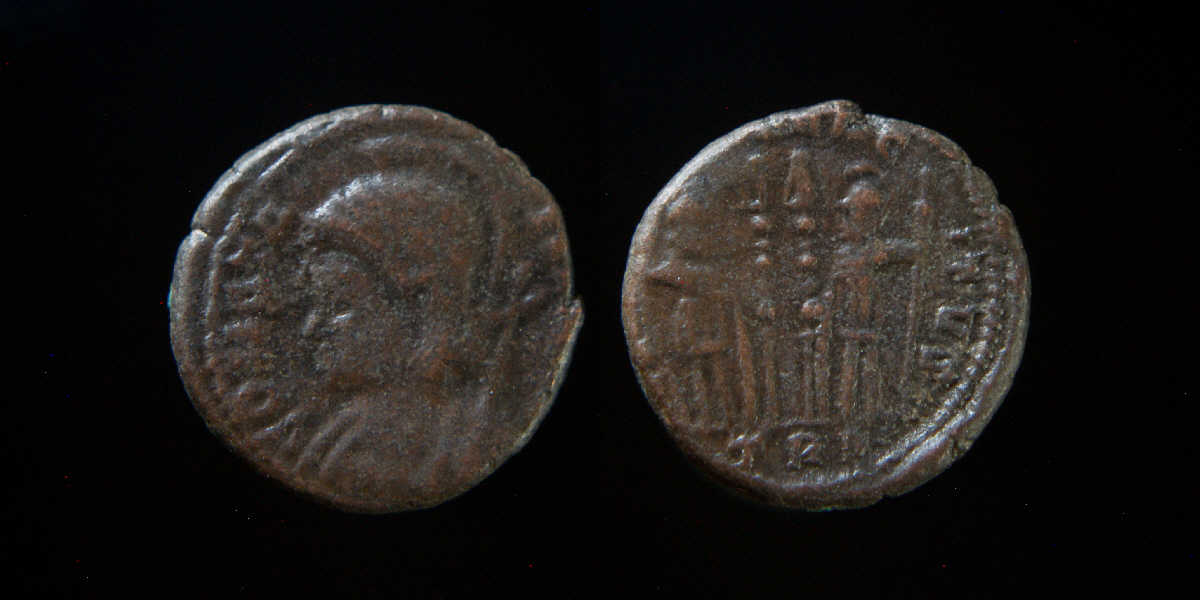 |
|
Pillar of the Community
United States
949 Posts |
Thank you for the link to the LRB site, tenbobbit. I seldom log in there (same user ID), but maybe should more often. However, I do have to raise a question about the comment from Victor echoed here by you: tenbobbit wrote: Quote:
The few examples known are all classed as unofficial. mine is from Lugdunum. Bruun list the example I referenced and calls it a hybrid in his footnote. That means it irregularly mixes an obverse with a reverse type. That was commonly done by counterfeiters, of course, and hybridization is sometimes an indication of that problem. However, slipups could occur at the mint as well, if a celator happened to use the wrong hammer due with a particular anvil. Such items from the mint are irregular, to be sure, and are not "official" in the sense of regularly intended for issue. But as mint products they are not entirely unofficial either if that term is meant to convey the notion of having been made outside the normal channels of imperial production. Certain "irregular" mint coins, when recognized as such, have in the past fetched startling prices; so, I can see how that seller might be thinking. Nonetheless, for my part I personally would not credit a verifiable mint produced "mule" with any more premium value than any other kind of striking error. It deserves a modest premium as an error coin. But as to source I would not hesitate to call it at least semi- or quasi- official. It should not be put in the same category as the imitative coinage. How do you class striking errors - official, unofficial, or something else? That is where the mint mules belong, I think. |
|
Pillar of the Community
United Kingdom
701 Posts |
I cant 100% prove or disprove the theory but based on what is available the known examples all have blundered legends of some kind. I am unable to find my example but it is on Victors site, the Obverse legend is Constantinopli & the Reverse is Gloria Execitvs. The example listed for big money is also a Lugdunum issue but is far cruder with a different Obverse and also has a blundered Reverse legend, everything about the coins shouts unofficial. I personally cant subscribe to them being official issues. As far as striking errors are concerned, they are exactly that. whether it be a mule, brockage, die clash they are all strike errors. Here is an interesting one I own - 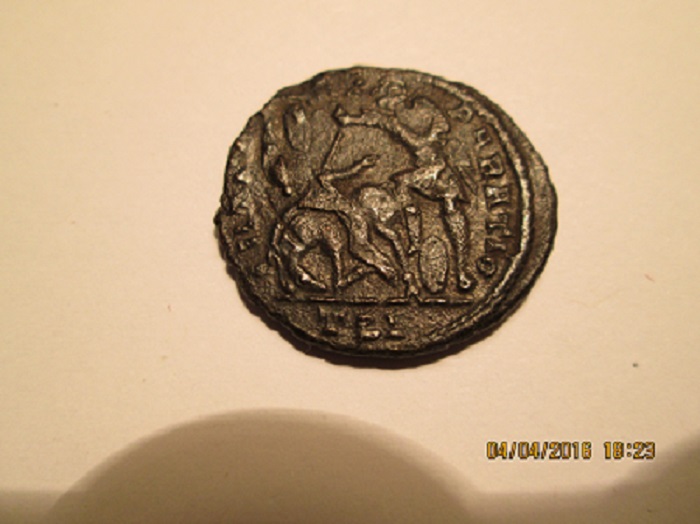 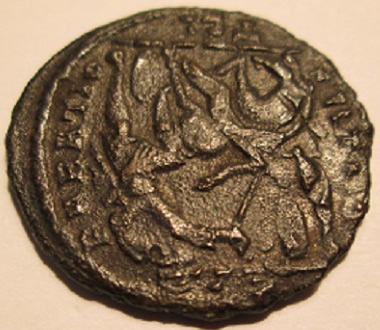 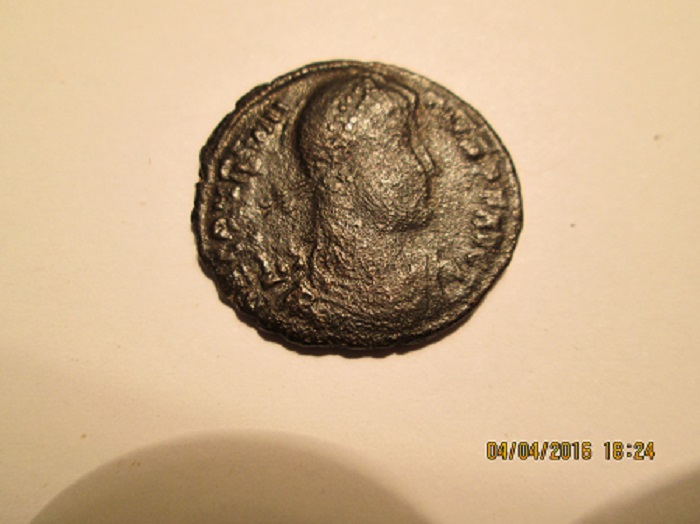 It was suggested that it was an overstrike but it is actually a rotated die double strike. The hammer has spun 180* giving it a double exergue with the leg and shield also easily visible. The obverse has a prominent double strike also. Quite scarce from what I have been told  |
|
Pillar of the Community
United States
949 Posts |
Quote:
based on what is available the known examples all have blundered legends of some kind.
I personally cant subscribe to them being official issues.
As far as striking errors are concerned, they are exactly that. whether it be a mule, brockage, die clash they are all strike errors.
I would like to nuance this a bit, because I think we may be looking at striking errors (vis a vis barbarous imitations) a bit differently. I don't want to introduce confusion into the conversation by getting off into what ought to be a separate discussion of striking errors. While it is true that some barbarous imitations may have been produced with striking errors, that is equally true for official issues. Specifically, a mule from an official mint is still an official coin, albeit one that was not intended for circulation as struck. The only relevance to a discussion about barbarous imitations is that the RIC listing for a two-standard GE reverse of a city commemorative bears the footnote "hybrid." In the language conventions of the RIC volumes, a "hybrid" is popularly called a "mule." My comment above was simply to say that in terms of significance, such coins are striking errors and not much more. I also intimated that mules ought to be valued about the same as other kinds of striking errors, all of which are rarities, but of a specialized kind. Your observation that all the examples you have seen of the muling of a two-standard GE reverse with a city commemorative obverse bear the marks of barbarous production in their inscriptions is interesting to me and important I think. I have to wonder about the RIC entry for RIC VII Trier 541. I would like to see the Oxford coin to see if it may have some inscription problem. I am working on my photo skills to try to give a better rendering of another coin in my collection, which seems to have a normal Constantinopolis obverse paired with a two-standard GE reverse from Trier, the latter of which has an altered legend. Here is a scan which does not reproduce the image as well as it can be seen in hand: 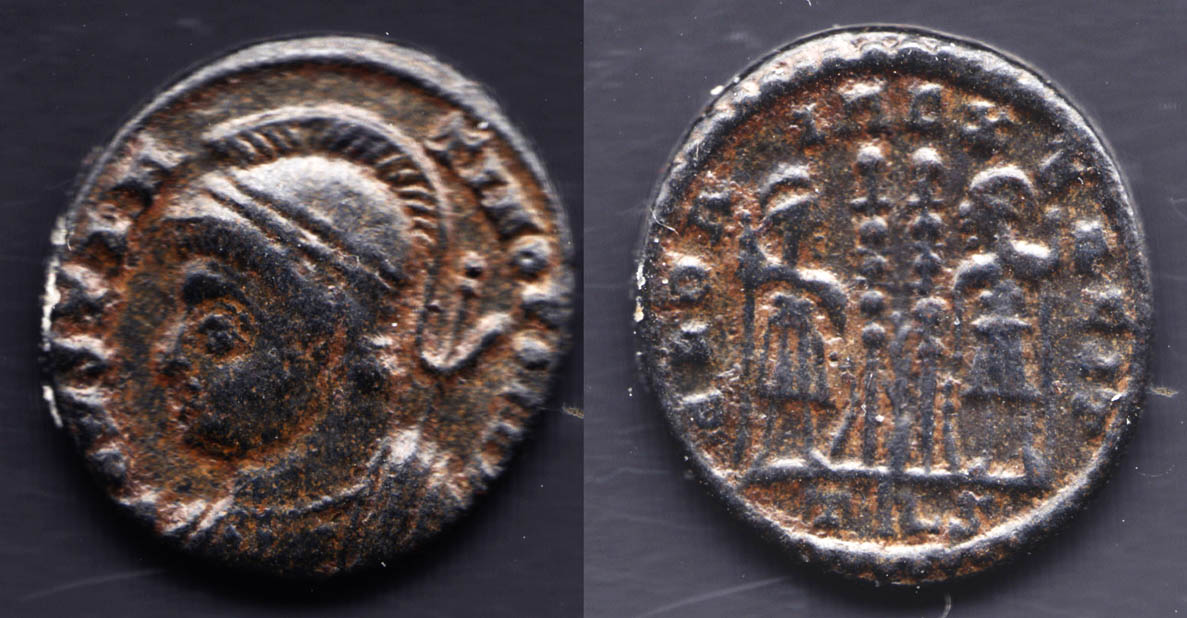 The "blundered" legend on the reverse reads GLOR - IAEX - ERCIT [in emulation of the VIRTVS EXERCIT inscription perhaps?] The mint mark reads as TRS rather clearly, but in the pic the dimensionality is lost which makes that clear. Nonetheless, in view of the altered legend I would agree with the principle that this coin should be regarded as not from an official mint of the empire. The principle being that if the design of either side of a coin does not correspond in all details with the designs known for imperial issues, then it is not to be assumed to have been issued by an imperial mint. It is at best an imitative local issue, and at worst an illegal fabrication. A tougher question, which we are not yet addressing here, is whether or not semi-official status existed for any of the local coinages at the edges of empire. Edited by lrbguy
04/06/2016 12:56 pm
|
|
Pillar of the Community
United Kingdom
701 Posts |
Hi lrbguy, been busy. You are right about the terminology used regarding a " hybrid " being a " mule " but I think without any reference material being available at that time it was more of a cop out to just list it as a " mule " which to all intent and purpose it is, I too would like to see the Oxford coin to check if there is a blundered legend. You may well be onto something and as we know mistakes are often made and new amendments are being added all the time to the known reference books. As far as what we should call them, I personally think that they are of such a good style that they were meant to circulate amongst " official " issue coins which makes them " counterfeits " in my opinion. You are welcome to use the picture and details of my coin if you are going to investigate this further. Nice example you have there, probably the best yet  Edited by tenbobbit
04/11/2016 07:20 am
|
|
Pillar of the Community
United States
949 Posts |
Quote:
As far as what we should call them, I personally think that they are of such a good style that they were meant to circulate amongst " official " issue coins which makes them " counterfeits " in my opinion. To me the word "counterfeit" implies something illicit, illegal, a look-alike intended to deceive. To be sure there was a lot of that going on in the ancient world. I think most if not ALL of fouree coinage was counterfeit in its origin and purpose. How much of the imitative coinage in bronze falls into that category I am not sure. The metrological evidence Victor shows for the reduction of silver content in VLPP bronzes seems to suggest that it was being fraudulently done to harvest silver. Okay. Do we have a clear sense of chronology for the imitatives, or have we merely ASSUMED they are contemporaneous with the official issues they resemble? But now, think with me... I am not willing to assume that ALL imitatives were made for nefarious reasons. The reason for that is due to my limited understanding of the distribution of the hoards containing this material. In the hinterlands and on the frontiers garrisoned military needed low denomination coinage in an economic setting for which Imperial coinage might be overvalued. How much business can you do in an undeveloped region when your lowest denomination currency has the buying power of a US $20 bill? You need small change. And that was the big bugaboo in the outlying areas. In settings like that, who do you suppose was going to try to do something about it? Local thieves? Local clan and tribal chieftans with no experience producing a currency of their own? Let me suggest that the most likely source for imitative currency in that kind of setting was a collaboration of the garrisoned military and the local governments under their oversight. Obviously they would need a special dispensation under Roman law in order to ward off charges of mutiny, subversion, or whatever. But who was better equipped to get that kind of permission than the military leaders stationed out there? In order to keep the central government off their backs, and still have a currency they could use, they took to making and using the equivalent of "play money" - designed to resemble the real thing, but blundered and altered so as not to arouse suspicion about what it was - i.e. local currency for local circulation only. In the local setting such coinage could be tariffed as needed, whether in concert with the official currency of the time or not. BUT over time inflation hits the imperial currency and causes the official coins to shrink and devalue until eventually and inevitably some of the old imitatives are worth more as specie than contemporary official issue. So then, does the imitative currency become free to circulate more widely as a better currency than was officially being made? --- So far that scenario is mostly a speculative reconstruction. But because it is so in accord with the history of inflation in the ancient world (4th century) and is in accord with Gresham's law, there is good reason to reconsider the ways that imitatives figure into the hoards so far recovered. Unfortunately, the tendency to dismiss them as fraudulent has caused them to be excluded from analysis too often for the picture to be easily understood. |
| |
Replies: 14 / Views: 1,679 |
|







 Posted 04/01/2016 6:27 pm





