| Author |
 Replies: 27 / Views: 4,984 Replies: 27 / Views: 4,984 |
|
Pillar of the Community
United States
6431 Posts |
I received this coin yesterday as payment for helping a lady take inventory of her late husband's coin hoard. I don't think it is particularly rare, but I think it has a beautiful look with what I believe is original patina and color. I would appreciate any comments about authenticity, originality of surfaces, or anything else. Swamperbob, are you out there? I wonder if this coin falls in your area of expertise? Thanks! 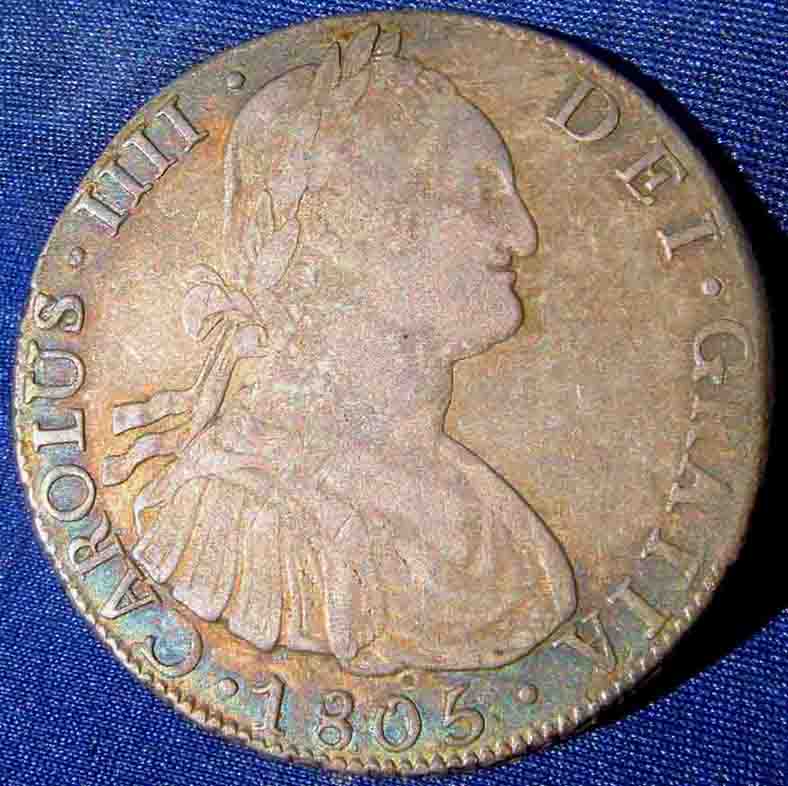 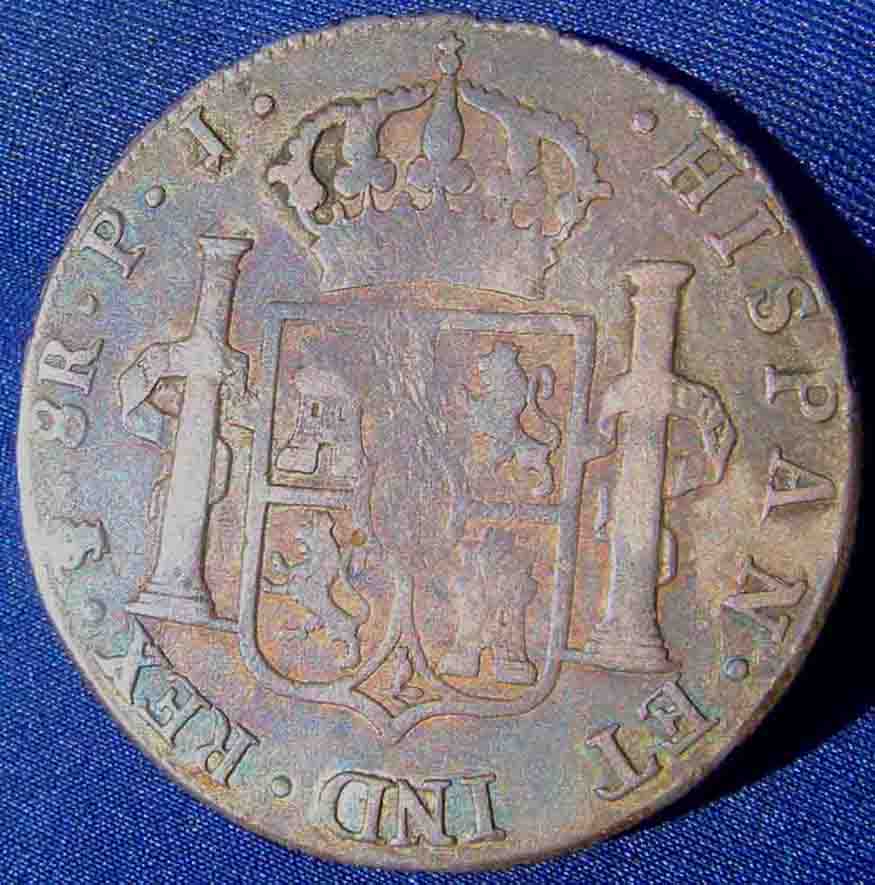 |
|
|
|
Pillar of the Community
United States
5362 Posts |
Jaobler - The 1805 is a fairly common 8R. But it looks real based on what I can see.
Now there are a few things to look at to be 100% sure it is not counterfeit.
1. Is the edge a standard circle and rectangle colonial edge?
Are all the circles actually round? No squared corners.
Are all the rectangles actually rectangles? No parallelograms.
Are the thicknesses of the two features even? No variation.
Are the spaces in between EVEN?
2. Was the edge applied using a two die edger?
Are there two overlaps - not one - nor three or more?
Are the two overlaps exactly opposite one another?
Does the edge design wobble side to side?
Are there any diagonal cut marks on the edge?
Are they all around or only on ONE HALF?
3. Does the coin fall within a proper weight range?
Under 27.0 grams and over 25.5 grams.
Does the coin ring like silver when tapped?
Is the Specific Gravity correct? 10.15 to 10.35
The color on this coin looks like a retoning from an old chemical cleaning. I have never encountered any well circulated 8R original with that particular blue tone.
It is a nice coin. If it has diagonal grip marks on 1/2 the edge - you may have a "Boston" silver forgery from the 1890s. That would actually make it worth a bit more.
Can you post scans of the edge - Both overlaps and half way in between both laps is perfect if you can.
|
|
Pillar of the Community
 United States
6431 Posts |
Hey Swamperbob, Thanks for checking in! According to my old Ohaus beam balance, the weight is 26.9 grams. The coin does ring like a silver dollar. I'm fairly certain it spent at least the last 10 years (possibly much longer) sitting in a paper coin envelope. According to the writing on the envelope, the price to the previous owner was $35. The edge appears to match your description. Approximately half of the edge consists of alternating circles and rectangles of consistent size and spacing. These shapes are all along one side of that half of the edge. The other half of the edge has the same pattern, but on the opposite side of the edge (does that make sense?). There are short transitional sections (overlaps?) between the two halves of the edge in which the shapes are indistinct. Here are some edge photos. 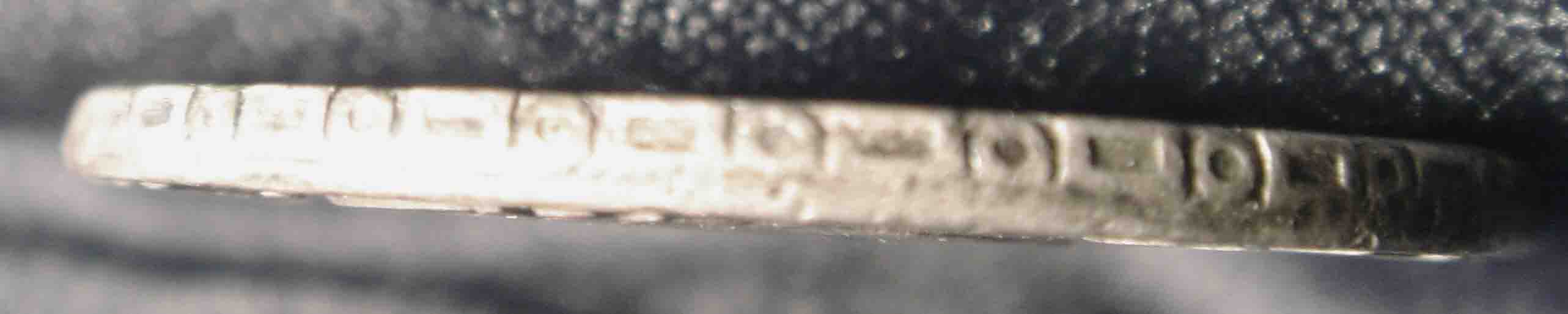   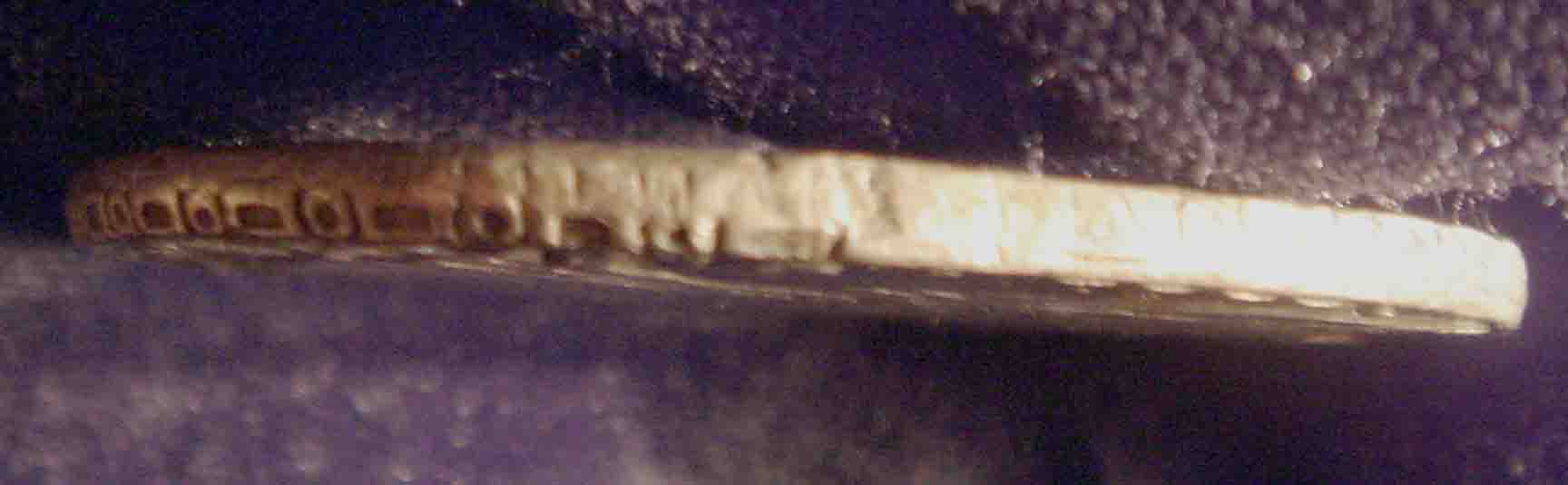 Thanks for your comments! I really appreciate your taking the time to share your thoughts. |
|
Pillar of the Community
United States
5362 Posts |
In my last post I asked about the edge:
It is a nice coin. If it has diagonal grip marks on 1/2 the edge - you may have a "Boston" silver forgery from the 1890s. That would actually make it worth a bit more.
Anyway - if you look at the scans you sent - about HALF of the edge has grip marks. This does look like a "Boston" type.
The Boston class of forgeries are full weight silver counterfeits of common Portrait 8Rs made in the last couple of decades of the 1800's by merchants for use in China. Chinese merchants trusted the old portrait 8R coins (Bustman Dollars as they were called) and paid a 5% premium OVER Face Value. Well in the US the Comstock load had dropped silver prices to all time lows and a dollar could be made with silver for less than $1.00. Forgers in the Northest US made silver dollars under contract for much less than $1 each and the coins were shipped tom China. The coins are actually silver and were made from dies using a 1-1 lathe technique. They are good enough to fool most collectors and dealers don't seem to care. The best way to ID them is the way they were edged. The edge impression was applied in TWO steps using ONE die. The first half of the impression has diagonal grip marks from the application of the second half of the edge.
That is what I am seeing here.
Also note that since the edge design is applied off center - there was no retaining lip on the edger allowing the blank to rise or fall during the application process - however the existant edgers in the Mexico City collection have retaining lips to prevent pop-outs. There may have been some slight differences in application at this mint - but I do suspect this coin may be a Boston forgery.
|
|
Pillar of the Community
United States
6431 Posts |
SB,
I can't really show what I'm talking about with pictures, so please bear with me for a verbal description.
On this coin the circles and rectangles run close to one side of the coin, either obverse or reverse. They cover an area that I estimate to be a bit more than one-half of the width of the edge. The section that is close to the obverse rim starts at the S in Carolus, runs counter-clockwise below the date and ends by the A in Gratia. Then at the R in Gratia the circles and rectangles resume, but along the portion of the edge that is against the reverse rim. They continue around (counter-clockwise, relative to the obverse) until the 3rd I in "IIII". On the "blank" portions of the edge that are above or below the circle/rectangle line there are irregularly-spaced, mostly vertical short grooves that I presume are the "grip marks" you mentioned. Some are slanted, but most appear vertical.
So, does that description constitute like a solid diagnosis for a Boston counterfeit?
Can you give an estimate for values of the "real" 8 reales coin and for the Boston version?
Thanks again!
|
|
Pillar of the Community
United States
5362 Posts |
Jaobler - The idea of the edge being applied as you described is very familiar to me. However, I have never seen an original edged in this fashion which is not also missing a great deal of the actual edge design. Usually you see only two small portions of the edge design. If the design is 50% off you see 50% of the design. But here the design looks 50% out of line but I see the entire design. A tilted edge application happens when a planchet runs through the edging mill while NOT laying flat on the surface of the apparatus. The edge on one side is making contact at the bottom of one die while on the opposite side the contact point is on the upper portion of the second die. This causes some edge distortion and can only happen if there is no retaining lip on the top of the parallel dies. Because of the pressure involved to transfer the design MOST but not all edging machines had such a retaining lip. The lip was essential to keep blanks from popping out. Here is a sketch I just made: Image Insert: Normally the edge features, the circles and rectangles, cover the majority of the edge. There should not be much space above and below the design. In your case, there seems to be too much space left over on the edge. So in addition to having no retaining lip - this apparatus was capable of putting the whole edge design on just a portion of the edge. Makes me wonder if the edge dies were sized for a 4R. I checked a few Bolivian, Mexican and Peruvian 8Rs I have at home to see if I could get a match on the design used on this coin - but in each case - REAL, counterfeit and Counterfeit Boston types - the edge is different. In most cases, the design nearly completely covers the edge of the coin. Even allowing for the fact that the angle of the impression elongates the edge - I don't get a distance similar to the one on this coin. I did find one counterfeit - a cast silver Bolivian dated 1807 with a similar edge including vertical grip marks. But that coin is a cast copy edged to cover a mid line seam. I also noted one other thing on two counterfeit Bolivians I have at home (1797 and 1807) - the last S in CAROLUS is smaller than the rest of the letters in the King's name. I will have to check to see if I can find an original Bolivian 8R from 1805 with a small S at the end of the King's name. This feature could link the counterfeit dies. Regarding value - I grade the coin as VG because the lettering is not sharply defined at the rim all the way around the coin. A real VG is a $35 to 40 coin - a Boston coin is worth about $50. Any other counterfeit from the period is worth about $35 and modern castings are $30 or less depending on the metal used.
Edited by swamperbob
02/18/2008 6:30 pm
|
|
Pillar of the Community
United States
3357 Posts |
I'd like to jump in with a new, related inquiry If I may, Bob. Unfortunately without photos. I've read a string of your posts, including the one on the ebay coin which had a set of excellent photos. In this case the coin in question is a Mexican 1805 8R, grading XF-AU with nice clear PLUS ULTRA on the ribbons. Weight is 26.95 cm, it rings like silver, and the caliper is consistent with SG 10.0-10.5. However: about 2cm of the rim displays 45 degree diagonal marking - what I thought were file marks, but which are perhaps grip marks? The circle/square rim pattern is tighter than on my 1780 Potosi - 6 to the centimeter (due to less oblong squares), where the Potosi is 5 to the centimeter. Finally, the 1805 has a somewhat wavy line running along the rim, which I don't see on the 1780. The 1780 rim is fairly crude and worn, but it is consistent from top to bottom, while the 1805 is not. I hope there's enough here to make a diagnosis. Thanks. "Two minutes ago I would have sold my chances for a tired dime." Fred Astaire
|
|
Pillar of the Community
United States
5362 Posts |
Hi THQ - There is some good news and some not so good, as well as a question or two.
First, I call this group of counterfeits the "Boston" group because of the first example I ever encountered. I bought it about 1962 from a very old coin dealer back in Massachusetts. It came from a roll of EF-AU 8rs all the SAME date. He said he knew they were forgeries because he knew the guy that made them in the 1890s. That particular coin is an 1805 Mo TH. The coin is 0.900 fine silver and is the correct weight. I only wish I had bought a few of them. Identical copies often prove a case of forgery.
That does not mean that you have the same forgery. Mine has the diagonals on HALF the edge. The two overlaps are not precisely at 180 degrees apart and the laps are DIFFERENT lengths and both ends of one half overlap onto the other half. It proves the edge was done in a TWO step process instead of one.
The fact that you have only 2 CM of diagonals sounds like damage. Did you check the patina in the diagonals with the patina in the centers of the circles? Remember that the same color patina would tend to indicate similar age but if the diagonals are lighter in color they are likely more recent. That would prove the coin is NOT a Boston fake.
You also have the spacing issue correct. In my experience, Mexican edge segments are shorter than typical South American segments. However, I have not done a detailed series of measurements to support that conclusion. I love edges and the rates they changed, but I am concentrating on the later engrailled edges of the Go and Zs mints first.
Most Boston forgeries have lumps on the coin surfaces in the fields because of poor die steel. Die chips always cause me to look at the edge.
There is one other feature often seen on Boston types. The surface of the planchet has small parallel surface splits caused by the rolling of the silver ingots. This shows through the strike. These splits are sometinmes seen alone, but they are more common on Boston types.
The one thing you say that stands out is the "wavy line" - could you explain that a bit more? Is that a border line kind of thing and does it wobble (move) up and down on the edge as you look around the edge? The edge line is common on a different group of forgeries and it is not seen on all originals. Again it is an area where more research would be helpful.
Let me know if this helps at all.
|
|
Pillar of the Community
United States
3357 Posts |
Whew....thanks for all the comments, Bob. Filling in a few of the details. I was bothered by several small sandy-grained bumps visible in the field between Carolus' chin and Gratia. I thought they might have been raised by corrosion, but they do look more like minute die chips/rust pits (similar to what I see on an AU 1878-cc quarter). The diagonal rim grooves at GRA run from obverse to reverse,and are patinated dark,the same color as the rest of the coin. Directly across the coin from this, at "ROLUS", the square/circle device disappears from the rim completely, and all that is seen is the running wavy line, which describes a bevel to the obverse side. At the point the figure disappears from the rim it only covers half the coin's thickness (the rest is unfigured bevel - appearance is very similar to Jaobler's photos) - when it resumes it is full rim thickness but heavily toned with verdigris. Both obverse and reverse lettering and rims are weak in this zone, with what appear on first glance to be file marks or abrasions. Under 15x magnification I can see that these are surface striations - wavy crack lines, propagated at about 45 degrees to the rim and about parallel, and darkly patinated as they penetrate the coin's surface. These lines extend out strongly to mid-letter on the SP of HISPAN, and are still visible almost to the ULTRA ribbon. [I may have a faulty impression, but it appears that the coin has been subjected to a very high load on the edge, causing it to crush slightly, creating the stress crack lines - almost like it had been put in a vise].
All in all, there's something wrong with the rim of this coin - not as consistently formed as the 1780 Potosi. I wish I could send photos, but I don't have the gear readily available. I could try a scan.
This coin came from a New York dealer quite recently. Do you have photos of the 1805 Mo you acquired in Boston in 1962 for comparison?
"Two minutes ago I would have sold my chances for a tired dime." Fred Astaire
Edited by thq
02/19/2008 08:55 am
|
|
Pillar of the Community
United States
5362 Posts |
thq - A scan will usually work fine. To scan the edge of the coin - place the coin in the middle of a stack of 2x2 coin holders and hold the stack together with a rubber band. That way you can place the coin standing on edge on the flat scanner bed.
You have mentioned a few very questionable items that would raise a red flag for me when taken together.
Verdigris - true verdigris sometimes develops when a coin has a higher than normal percentage of copper. I always look closely when that occurs. It can point to an older non silver forgery.
A BLANK spot on the rim. You say - square/circle device disappears from the rim completely One of the things about a two die edger - the same things are happening on opposite sides of the coin at the same time. This applies to overlaps in the design and BLANK SPOTS. If you think of the mechanics involved in the process - the dies are imparting the edge design at opposite sides of the blank at the SAME time - this is accomplished by SQUEEZING the blank in between the two dies. So if the pressure reduces or releases on one side - IT HAS TO DO THE SAME on the opposite side. If the planchet is irregular in size it releases (or partly releases) and the design is weak or missing. If there is a lump the die cuts deeper.
A coin with one blank or unedged spot opposite a properly edged section is a counterfeit.
The wavy lines you describe it appears that the coin has been subjected to a very high load on the edge, causing it to crush slightly, creating the stress crack lines - In my post I said (I just edited this to make it a bit clearer) The surface of the planchet has small parallel surface splits caused by the rolling of the silver ingots. These splits show through the strike but they may be forced closed by the pressure of the strike. I think we may be dealing with the same feature. The CRACK lines is what I mean. I have always attributed the feature I am referring to (surface fissures or cracks either still open or forced closed by the strike pressure as being caused by the stretching of the silver ingots being rolled into coin stock. The stretching action fractures the surface of the bar stock creating open stress fissures. But based on your description of CRUSHING there is a second possibility not typically seen on Boston coins but which occurs on other types of forgeries from the same era - stress crushing caused by impressing the edge design under too much pressure.
There is more than one reason for cracking. Sometimes non-malleable metal like German Silver is used. GS does not flow like silver (it is not malleable) and therefore often CRACKS when struck or pressed. This is why GS strikes are often mistaken for castings - there are NO SURFACE FLOW lines caused by the striking pressure. So one possible reason for cracking is the use of GS or zinc or some other similar metal.
I could also read your description to mean a compression failure of the metal which might cause small very shallow surface cracks where the planchet bends outward and ripples where it bends inward.
Now you really need to determine which came first the surface cracking or crushing and the strike of the coin. All real 8R Portrait coins were EDGED first to create a planchet from the blank and THEN they were struck. The pressure from the coining dies should crush any features seen on the planchet from whatever source. This is the mint way. (Now some forgers knew this and did it right so you are not home free at this point - keep that in mind).
But if any of the stress marks - cracks or folds - distort - split or otherwise interrupt or lay on TOP OF THE STRUCK features your coin was made by a FORGER. This also applies to the edge design. Dentils that are bent by the force of the edge application prove a forgery on all 8Rs struck after 1770 (earlier at some branch mints).
So if the CRUSH marks on your coin lay OVER the strike of the coin - it was edged AFTER the strike which is absolute proof of a counterfeit. (One caveat at this point - a big rim ding will distort the die features - so be careful to make sure you are not looking at simple post strike damage). If the crushed area itself is distorted by the strike features then the crushed area was there BEFORE the strike. Features on a planchet will be crushed themselves lowering the relief and closing surface voids. If you study overstruck coins like the Brazilian 960R you can get the hang of this.
My so called "Boston" series is only ONE of a series of related forgery groups. I focus on the types that match the coin I bought as a kid. But I know there are other groups and other merchants who used the same incentive to profit from the Chinese merchants love of the Bustman. Each group of forgers has it's own style and manufacturing traits, but as a class they are all interesting to me. Production of the fake Bustman dollars is documented to have reached into the 100s of thousans per year for some group. No reliable estimate of the number made or the number of survivors has ever been attempted. Many dealers who do understand and can RECOGNIZE the forgeries treat them as REAL.
I would include your coin in this general class and I would definitely buy it if I saw it at a show or in an inventory.
Edited by swamperbob
02/19/2008 11:18 am
|
|
Pillar of the Community
United States
3357 Posts |
Bob, I went back to find our microscopist this AM. It turns out she is out with the flu, so there's no chance of pictures for a while. But I did a lot of coin examination under 10-30x using her Nikon viewer. In response to your comments, here's what I see:
-The stress cracks are through the letters. The letters are poorly formed in the cracked areas, as if the planchet was thin there - not as clear and crisp as you would expect for lettering on an XF-AU coin. The 1780 Potosi in VG-F has well-formed letters all the way around.
-The bare rim section is directly across the coin from the diagonal rim marks, and I cannot determine for sure whether the rim ornament exists under those marks. At the ends of the diagonal mark zone I can distinguish the ornament, and it is under the marks. Note that all the stress cracking is located in these two areas - that's what gave me the impression that something like a vise had been applied.
-Redoing my specific gravity calculation. With .224cm caliper, 39mm diameter and 26.95 g weight I calculate sg = 10.1. I do not find that the caliper of this coin is different from the 1780 when measured at the same points. Using a ruler, I do not see any out-of-round distortion at any point on the coin. There's a slight rim flattening a the diagonal marks, but it still measures 39mm - distortion is 0.5mm or less.
-Based on the calculated sg and the ring, I think the coin is silver, but who knows whether it's 90%. The verdigris shows on the rim for 1 cm at ISP.
A lot would be revealed if I had 2 good photos of the obverse and reverse, along with 2 rim photos, and the Nikon could do that. When our microscopist comes back I'll bribe her with some donuts in exchange for photos.
"Two minutes ago I would have sold my chances for a tired dime." Fred Astaire
Edited by thq
02/19/2008 12:01 pm
|
|
Pillar of the Community
United States
5362 Posts |
thq - I look forward to seeing the coin.
|
|
Pillar of the Community
United States
3357 Posts |
Bob, I was able to do some OK scans of the coin. If these are not good enough, I'll have to get the microphotos, which will take a while. Here we go with the obverse and reverse: 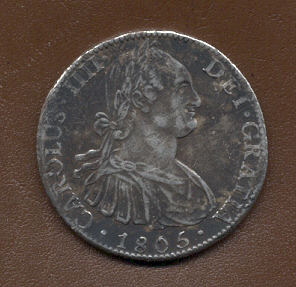 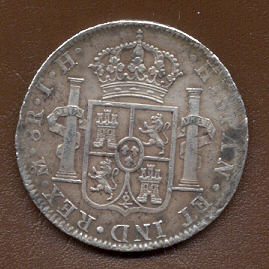 Unfortunately there's not enough magnification to see the surface fissuring, which appears as weakness particularly on ISP on the reverse. Now some rim detail at GRA, showing the diagonal marking, next to the disappearing rim ornament: 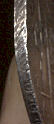 Next some rim detail at ISP, showing rim detail with verdigris:  Finally some rim detail at SPAN, showing the wavy line, blank rim section, and some rim detail before it disappears into 1 cm of total blankness. Note that the rim figure covers only the half the rim. The rest of the rim runs off to the obverse as unfigured bevel. The wavy line is the divide between figured and unfigured:  "Two minutes ago I would have sold my chances for a tired dime." Fred Astaire
Edited by thq
02/20/2008 12:05 pm
|
|
Pillar of the Community
United States
5362 Posts |
thq - I wish the scans were bigger. I think it would be advisable to get the larger resolution shots - but here is what I think I see from these:
1. The matching weakness on the edge which aligns on BOTH sides clearly points to a planchet that for whatever reason was thinner at the edges when it was struck. This is a rolling error that is quite common on both originals and counterfeits. It is associated with poor quality control in the rolling process. This type feature is often seen on the Boston types because they were "rush jobs" for the most part.
2. At this area of weakness - you describe fissures. I do not see these as compression fissures but rather like fissures caused by aggressive strain on the ingot during the rolling process. Once again, this feature is seen on both real and fake 8Rs.
3. If I am interpreting the positions of the edge correctly based on your description - it is VERY UNLIKELY that this coin was edged on the standard two die edging mill. It looks far more like a forgery.
4. Since the coin is HIGH GRADE silver, the date of the forgery simply can NOT BE BEFORE 1870. Prior to 1870, there was no financial incentive for forgers to make a High Grade Silver counterfeit. The incentive to make fakes began when the difference between the intrinsic value and the market value exceeded the cost of manufacturing and shipment of the coins.
5. The incentive to forge Bustman Dollars for the China trade was highest from the mid-1870s until the mid-1890s. The incentive (at a reduced rate) remained until the Bustman was demonetized in China about 1933. The window of manufacture if a full weight silver Circulating Counterfeit is therefore 1870 to 1933.
6. There is only one other period of time when high grade full weight silver forgeries were/are made. That is between 1950 and the present. The coins in this group are NUMISMATIC forgeries. They can be difficult to separate from the 1870 to 1933 group.
7. The "wavy" line is not totally clear on the pictures, but several different counterfeit types have a similar line next to the circle and rectangle design. The fact that you call it wavy is an indication of forgery as well. The real apparatus did not allow for a wobble. If it was eccentric at all it would be a "gradual" movement across the width of the edge.
8. The scans are too small to see any raised spots in the fields or signs of the die being a transfer copy.
No rush, but I would like to see the bigger scans as soon as you get them.
|
|
Pillar of the Community
United States
3357 Posts |
Again, Bob, thanks for the many comments. I'll get the micrographs of rim, ISP fissures and surface graininess as soon as I can. Regarding two of the comments:
7. The "wavy" line is not totally clear on the pictures: The line is a demarcation between figure and bevel, and wanders around the coin. Similar to Jaobler's photos.
8. The scans are too small to see any raised spots in the fields : The raised spots are just barely visible as a scatter of little bits, on a line from the chin to RA, close to RA. Even under magnification I'll have to cross-light to emphasize them.
"Two minutes ago I would have sold my chances for a tired dime." Fred Astaire
|
|
Pillar of the Community
United States
5362 Posts |
Here is what I believe you are referring to as the wavy line. It is typically a counterfeit feature as seen on one of my own Boston forgeries. Shown here; Image Insert: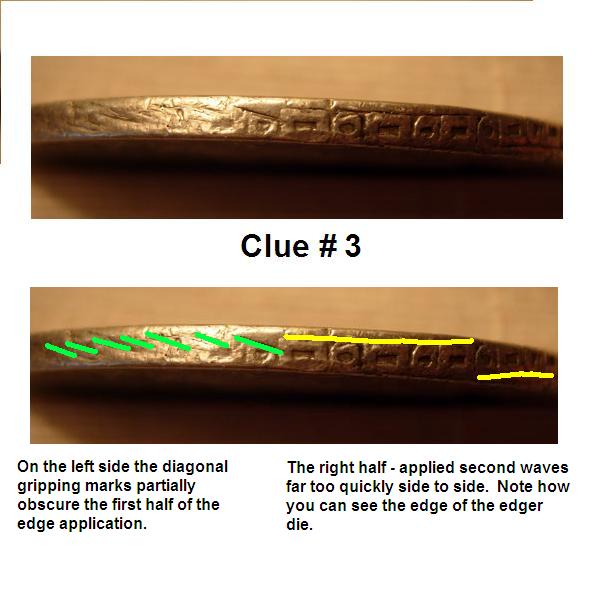 Now I can see the spots you are referring to. I wondered about the 2 white spots in front of the King's chin. If they are raised - that eqautes to small holes in the die surface and you need to ask yourself - How often do you see these spots on REAL coins? |
| |
Replies: 27 / Views: 4,984 |










 Posted 02/17/2008 01:48 am


