| Author |
 Replies: 81 / Views: 10,066 Replies: 81 / Views: 10,066 |
|
|
|
Pillar of the Community
2087 Posts |
I think you missed my point or I didn't communicate it well enough. the lenses I was using couldn't resolve to the level of the higher megapixel sensor( they were legacy lenses and cheap ones at). You don't see the same problem when you adapt lenses that resolve at high levels. As I Understand it( and experienced it) that's where your analysis comes in. Most decent enlarger lenses are resolving well beyond the large mega pixel sensors we see today.
Edited by austrokiwi
05/06/2016 1:54 pm
|
|
Pillar of the Community
 United States
4051 Posts |
No, I did not miss your point, but you missed mine apparently. I was trying to give gentle direction toward a more correct way of interpreting your results.
Contact me for photographic equipment or visit my home page at: http://macrocoins.com |
|
Pillar of the Community
2087 Posts |
I think we are talking past each other. My single point has been drowned out with unnecessary analysis.
My point is simply this. A low resolution lens will not perform well on a high resolution sensor. Any in depth analysis of speculated technical issues is not going to change that one point. Lets keep it simple.
Edited by austrokiwi
05/07/2016 12:37 am
|
|
Pillar of the Community
United States
4051 Posts |
But that point is not correct. The idea of an "18MP-rated lens" is just mumbo jumbo. Going from 14MP to 24MP should NOT have made as much difference as you state. Something else must have gone wrong.
Contact me for photographic equipment or visit my home page at: http://macrocoins.com |
|
Pillar of the Community
2087 Posts |
Quote:
The idea of an "18MP-rated lens" is just mumbo jumbo. for you may be... over the last year I have been exploring machine vision systems and a significant number of the lenses in those systems are rated to particular MP and specific sensor sensor sizes. I note even in Savazzi, he infers strongly lenses are produced to match particularly sensor resolutions ( which has been my understanding in looking at machine vision systems) from page 98: .. Lenses should also be designed with a specific sensor size and sensor resolution in mind. A lens resolution substantively higher than the resolution of which the sensor is capable would be wasted. Sony stated they designed the Fe 90mm F 2.8 macro so that its resolution matched that of the Sony A7rII. It is generally assumed that it has been designed for subsequent higher resolution models. When we deal with enlarger lenses, process lenses, and machine vision lenses etc. We are usually encountering lenses ( eg the printing nikkors) that have much greater resolutions than the native lenses made for our cameras. However consumer camera manufacturers build lenses that consumers can afford... so they design to specific tolerances which include resolution. As for trying to work out what happened years ago when I switched cameras... Its a pointless discussion. all I can say is my technique and equipment stayed the same and it was clear the legacy lenses I was using at the time were horrible on the larger sensor. Any speculation on your part remains just speculation. Now on sharpness: I think this explains my understanding of Contrast( specifically edge contrast = acutance) Note the three sample pictures showing alternate combinations of resolution and edge sharpness) http://www.cambridgeincolour.com/tu...harpness.htm |
|
Pillar of the Community
United States
4051 Posts |
Quote:
As for trying to work out what happened years ago when I switched cameras... Its a pointless discussion. all I can say is my technique and equipment stayed the same and it was clear the legacy lenses I was using at the time were horrible on the larger sensor. Any speculation on your part remains just speculation. No it is not pointless, since it is the whole point of the discussion! Of course lenses are designed to work with particular formats or for a minimum target performance. That is simply optical engineering. Any given lens has been designed to have a certain target MTF that would give a certain performance on a certain sensor. The marketing folks then take that information and create their mumbo jumbo and call the lens an "18MP lens" or whatever. Or if you look in an industrial lens data sheet you'll see that the marketing folks document the lens as being optimized for a certain line sensor resolution for machine vision. But this does not mean that the lens can't be used on a higher resolution sensor, just that it won't meet the rated specifications on that sensor. Going from a 14MP sensor to a 24MP sensor won't cause the lens to crash and burn like you described! I'm just going to chalk this one up to hyperbole on your part and assume you simply saw a "normal" level of degraded performance when going from the 14MP to the 24MP sensor, bought in to the marketing mumbo jumbo, and are exaggerating the effect out of proportion to make your point. Quote:
I think this explains my understanding of Contrast( specifically edge contrast = acutance) Note the three sample pictures showing alternate combinations of resolution and edge sharpness) Yes, this nicely describes perceived image sharpness, but I thought we were talking about lens sharpness, which is a much simpler thing. Postprocessing for sure can disconnect the two as is shown in the tutorial, which is why I jumped into this thread and asked about the in-camera postprocessing that was being applied to rocky's images. It is harder to judge lens quality when the image has been sharpened. Contact me for photographic equipment or visit my home page at: http://macrocoins.comEdited by rmpsrpms
05/07/2016 08:40 am
|
|
Pillar of the Community
2087 Posts |
I sold off my Mamiya 645 80mm macro and picked up a 120mm F4. I was very dubious about whether I was doing the right thing. After some testing I am happy with the 120mm but its not a lens I would recommend for others. I have a mirex tilt shift adapter, and I have been very pleased with the performance of the mamiya 35mm wide angle. In every day photography and with the Mirex its a Brilliant performer. The 80mm in comparison was a disappointment. I already anticipated what I wouldn't like about the 120mm. Its big clunky and to get it to 1-1 the lens extends phenomenally. In practice its like a big clunky large format enlarger lens on extension tubes.I have read many claims that the lens is APO,and it does have an ED element. However, having an ED element doesn't mean a lens is a true APO. So first up I tested it this is the result: 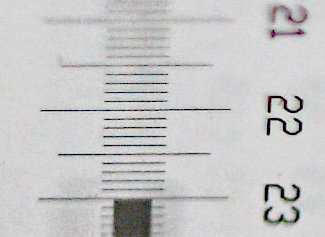 look at the 21 mm mark you can see the red fringing. likewise at the 23 mm mark you can see green fringing. The lens isn't APO but its better than the OLy 135mm and 80mm bellows lenses. however its not as good as the AGFA repromaster 80mm F4 and F4.5 process camera lenses. I then tested its resolution. now unless you have actually handled a 1951 USAF resolution chart before these photos may not mean much. In this next shot you are looking at a zoomed in center crop of an image projected through the 120 mm onto the front element of a 10X microscope objective. The region that is seen is not easily visible ( if at all) to the naked eye, you really need a loupe to see the 6 and 7 resolution groups. You will see I have marked one element of the picture with red arrows... that is group 6 element 3. That particular group is the resolution limit of my camera's ( 42MP) sensor. to identify what the lens is resolving at you find the last group that shows both the vertical and horizontal lines. In this case its Group 7 element 1. What the test tells us is the lens easily out resolves the Sony A7rM2 sensor and likely most other cameras on the market. However I am pretty sure the ARD 75mm lens( can be found for about the same price as this 120mm) performs equally well and would be much more user friendly. Likewise the very cheap( when you can find one) Agfa Repromaster 80mm F4 would also resolve to this level. 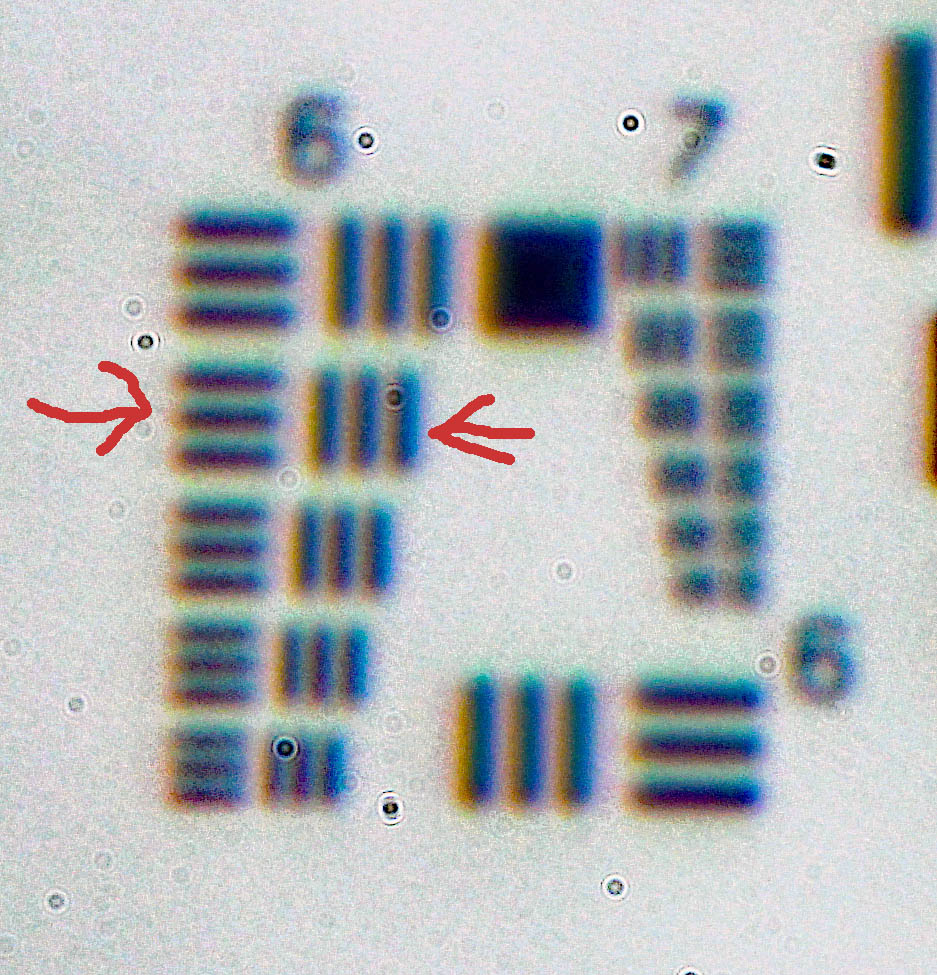 Please note the above image looks blurry this is due to the resolution test rig set up I use. There is an open gap between the bellows the 120mm was mounted on, and the front of the Microscope objective. This lets in extraneous light and drops the contrast of the resultant image. I have enhanced the photo for posting here and that enhancement did make the "blurr" much worse. I then tried the lens out on some coins. First up was a US cent at 1X magnification. I used a focusing rail for focusing so I didn't experience the issues Rocky did with focusing. You will find there is no photo of the cent. Please take my word for it, it was a bad result and that is why I didn't bother posting it. I then stuck the lens on the mirex tilt shift adapter, set it to 15mm shift. This did see darkening on the right side of the frame as the camera's sensor was imaging right at the edge of the image circle projected by the lens. I photographed an ASE and the result was WOW! This was just a test shot I didn't spend any time on the set up and the result blew me away. With more effort an even better result is likely. Here it is cropped out and placed on a grey background. following that shot is a 100 % crop.  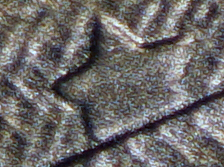 From my work with just this one example I suspect the Mamiya 645 120mm F 4 macro shows optimal performance some where around 0.6X making it a good option for silver Dollar sized coins. It performs brilliantly on the Mirex tilt shift adapter( costs around US$500.00) {If some one was wanting a cheap highly effective tilt shift system... then its a good option. the Mirex plus 2 mamiya 645 lenses would total about 2/3rds the price of a single focal length tilt shift lens from Canon or Nikon}I am confident in saying that if you are predominantly imaging coins the size of a USA 1 cent then don't even think of using this lens,as there are equivalent performing lenses at cheaper prices. If I didn't have the tilt shift adapter already I would have been really disappointed with this purchase. Edited by austrokiwi
09/07/2016 08:47 am
|
|
Pillar of the Community
2087 Posts |
I tested this lens out a lot more. Its performance decreases as the magnification approaches 1-1. But at low magnifications its phenomenal. I am starting to understand why many people rave about this lens. This shot( a photobucket link) is at 0.25X magnification the medal is 62-63 mm in diameter. This is one of the best images I have ever got of this matt proof medal. With the low magnification and 15 mm shift the coin sits almost completely out from under the lens. This enables lighting to be shone directly down on to the coin. This shot is even more impressive when one realizes it is taken using the Lenses peripheral "vision". Working distance at 0.25 X is 360mm( 14"). My earlier comments are reinforced its not a small coin lens( unless you adapted it for a MFT Camera).  Its best to download the image so as to see what this lens can do. I suspect it was designed to get to 1-1 magnification simply as a marketing exercise. Edited by austrokiwi
09/07/2016 2:19 pm
|
|
Pillar of the Community
 Canada
2784 Posts |
wow austrokiwi you are making that lens preform excellently. that is quite the photo the detail wow.
|
|
Pillar of the Community
2087 Posts |
Here is the set up on my rig for that last shot. You can see the lens is huge in comparison to the camera. In this shot the lens is shifted to the right by 15mm 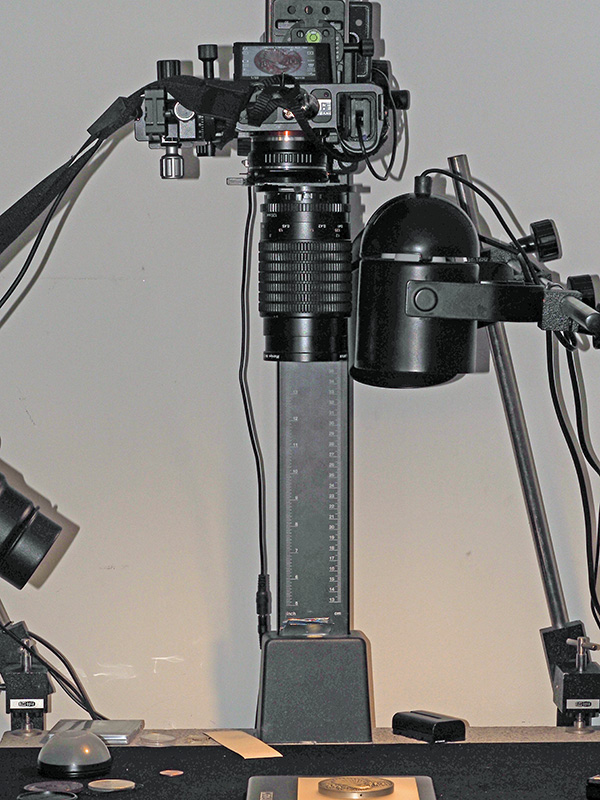 |
|
Valued Member
United States
441 Posts |
In layman terms, what are the pros/cons and/or benefits of using tilt & shift adapters? Is this method used mostly in professional circles?
|
|
Pillar of the Community
2087 Posts |
For coins I have only found shift useful. I have tried to use tilt with coins but its unnecessarily complicated. I use tilt for non macro photography, with buildings tilt enables me to prevent the falling over look that some photos of buildings suffer from. I don't think Tilt-shift is worth buying just for coins. I have tilt shift bellows and I know how to use them but I just don't bother, there are simpler ways of achieving the same effect.
Now I may seem enthusiastic about this 120mm, but I repeat I wouldn't recommend it for photographing coins. I now understand why people like it but as well as it performs at low mag its massively heavy and clunky. I think there are much better options at the price. I would put a APO Rodagon 75mm as a better buy than this lens. I actually found its easier to use this 120mm on a bellows( I have a mamiya bellows) for 1-1 magnification because using the focusing helicoid sees the lens doubling in length. Note my comments on performance at 1-1 were based on using the focusing helicoid
Edited by austrokiwi
09/07/2016 4:03 pm
|
|
Pillar of the Community
United States
4051 Posts |
Tilting a coin can help with lighting. A bit of tilt and you can achieve what I call a "pseudo-axial" look. This is usually accomplished with 5-degrees or less tilt of the coin toward the light. But there are 2 problems with tilting the coin:
1) The coin becomes distorted. The coin "shortens" in the tilted direction (usually top to bottom)
2) The coin is no longer flat vs the sensor, so can be out of focus at the top and bottom
Tilting/shifting the lens or the camera can help to compensate both of these effects.
So bottom line, if you make the coin flat vs the sensor, then you don't need tilt/shift. But if you want to tilt the coin to achieve pseudo-axial lighting, then tilt/shift is useful.
I use a goniometer to tilt the coin so that I know the exact amount of tilt, and can vary it in small increments. I then use a Camera tilt adapter to exactly compensate the tilt of the coin. This works great for toned coins that need axial lighting to bring out their color.
|
|
Valued Member
United States
441 Posts |
Thanks Austrokiwi and Ray. This was a great explanation. As Ray stated below, this is the direction I was leaning relevant to toned coins. To either of you, what's a decent-priced tilt/shift adapter that could be used on a Canon T6i? Is this adapter used between the body and lens? I would only use this adapter for coin photos as needed.
Quote:
So bottom line, if you make the coin flat vs the sensor, then you don't need tilt/shift. But if you want to tilt the coin to achieve pseudo-axial lighting, then tilt/shift is useful. I use a goniometer to tilt the coin so that I know the exact amount of tilt, and can vary it in small increments. I then use a Camera tilt adapter to exactly compensate the tilt of the coin. This works great for toned coins that need axial lighting to bring out their color.
|
|
Pillar of the Community
United States
4051 Posts |
|
| |
Replies: 81 / Views: 10,066 |








 First Page
 Previous Page


 Posted 05/06/2016 2:54 pm


