Quote:
............ they say the lens produces 800 lines of resolution. ray how would that lens of 800 line of resolution compare. say to a standard macros lens or a enlarger lens.
Actually there isn't enough info in that statement to be sure I am answering correctly. My answer assumes that a resolution rating is a frequency. Have a look at this:
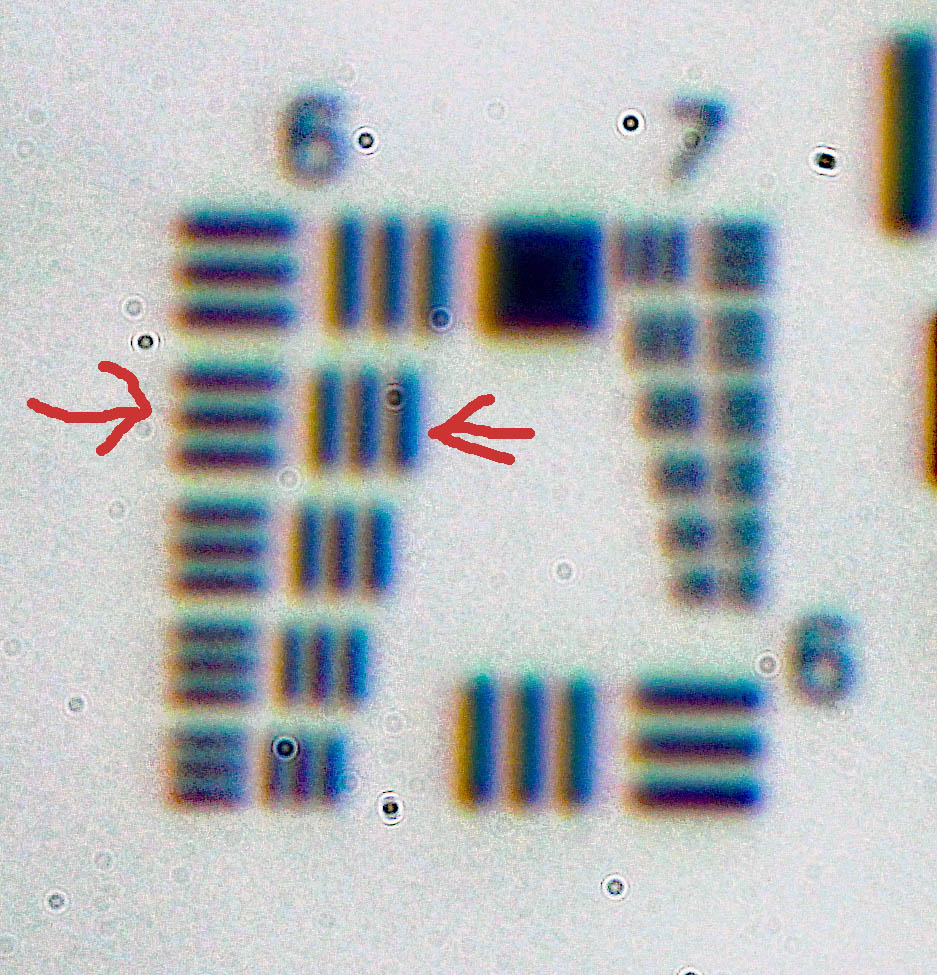
That center crop of my resolution target is the same one I posted in the Mamiya 120mm thread.
Have a look at the group of lines that is indicated by the arrows. That set of lines is formally labeled group 6 element three ( note group 6 element 1 is under group 7 ).
Group 6 element 3 indicates 80.6 cycles per millimeter. A cycle consists of a black line followed by a white line(the white line is a space on the target I use). As I interpret it each resolution target element consists of 2.5 horizontal cycles ( three horizontal black lines and two spaces) and 2.5 vertical cycles. Now some people appear to confuse cycles with lines, with the result that one can not be absolutely sure what they mean.
I suspect when someone says 800 lines per millimeter being confused with cycles( unless they are referring to scan rate of a machine vision lens). I with my limited experience have never heard of a resolution target that would be able to actually measure 800 lines per millimeter which would equate to some where around( fuzzy maths) 1200-1600 cycles per mm. I suspect 1600 cycles per millimeter is getting into territory that requires you to switch to an electron microscope to have a hope of creating an image. Therefore I anticipate that when someone says 800 lines they actually are referring to some where around 400 cycles per millimeter.
To really understand the <b>practical</b> relevance of a resolution measurement of a lens you need to know two things. What the resolution limit of the lens is and what the resolution limit of your cameras sensor is. As far as resolution goes: A lens that exceeds your cameras ability to resolve by one group is going to perform on your camera as well as a lens that exceeds your camera by 5 groups.
I have been told the resolution limit of my Sony A7rII at 42mp) is around 80.6 cycles ( group 6 element 3)
You will see in the picture above that the Mamiya 120mm is in my test resolving at group 7 element 1 which equates to 128 cycles per mm.
At this point someone may be confused: how can you take a picture that exceeds the resolution of the camera? Simple I placed the mamiya on one bellows having adjusted it for 1-1 magnification. I them placed a second bellows with a microscope objective in such away that the microscope objective sat where the cameras sensor would normally be in relation to the mamiya 120mm lens. The microscope lens by magnifying the image from the lens being assessed drops the frequency below the limit of my sensor... so that way I can get a measure of what the lenses limit real is.
With out using the microscope objective this is what I would get:
1st the full photo( 36mm wide X 24mm high)

You will note groups 6 and seven are barely visible.
Now a Crop from that image

I used my Sony FE 90mm F 2.8 lens for that shot and that tiny crop is the best I can get. I know from previous experience every other lens II have ( except for two) when set to 1-1 magnification will produce the same result... that being a maximum resolution of group 6 element 3.
I hope you understand where I am going. As long as a lens exceeds you cameras sensor resolution, it really doesn't matter by how much. In my experience nearly all Enlarger lenses exceed the resolution of the sensors of my A7rII and my Olympus OMD-E10II.
I have had lenses that resolved to lower frequencies than my cameras sensors, these were:
Minolta MC 50mm and 100 mm macros
Minolta 75mm enlarger lens
and a Meopta 80mm enlarger lens.
A lenses ability to resolve is only one factor.....That is why you see rmpsrmps showing pictures of coins at different F stops and also showing animations that display the CA.
When you talk about the perfect lens..... I think a combination of, at least, the following factors are the most important:
Image IQ( also known as sharpness) this is a combination resolution and contrast. Note: according to Edmund optical as resolution increases contrast decreases. So IQ is an optimal balance of contrast and resolution. One of the issues I was worried about with the Mamiya 120mm was the possibility of a loss of contrast.... there was a risk that that medium format lens would flood internal area of my camera with too much light resulting in a decrease in contrast. Luckily the adapters I used acted as a light choke. However it might be the case that with some DSLrs that problem might arise
Control of Chromatic aberration particularly axial CA( if I have got the right one)). Axial Ca can't be fixed in post processing.
The speed of the lens. I mean the maximum aperture, these days with large MP counts becoming more and more common, fast lenses are becoming more and more important. For coins I tend to avoid lenses that start at F 5.6 and I am mildly worried at F4 lenses.
The optimal magnification range of the lens. For example I am really pleased with the SK 40/2.8. It can clearly manage magnifications up to 10X( when reversed. Last week I tried reversing a 24mm wide angle and coupling it with the SK210 enlarger lens. It didn't take me long to realize I had taken the 24mm well outside of its optimal magnification range... the results were horrible.
The size and weight of a lens. This comes down to the rig you use and your camera, as well as your personal preference and coin interest. I have a range of coin sizes in my collection. The smallest(from Harar in Ethiopia) are less that 5mm in diametre and the largest medals are almost 80mm.
I could go on... what I am saying is resolution is only one factor among many and as long as a lens resolves to a level higher than your camera that's all you need worry about with regards to resolution. You will note a number of us use the Printing Nikkors... they are so usable because they balance out a number of factors( not just resolution)








 First Page


 Posted 05/14/2016 2:09 pm


