As echizento said, they're
notgeld. "Notgeld" means "emergency money".
They're not listed in Krause because they're not "real coins", they were tokens issued by sub-governmental authority (cities, companies and private individuals). At the time these coins were made (1920's), Aachen wasn't an independent country, nor even a province of Germany - it was "merely" a city.
During and after World War I, the German government couldn't afford to make too many coins, and most of the ones that were issued ended up being hoarded. Yet people still needed money, especially small change. To fill the void, cities and towns began issuing their own money. Many issued just paper notes, others issued metal tokens like yours.
And, of course, once people realised these things were being produced, they started collecting them. And once the issuing cities realised that people all over the country were prepared to buy their tokens as collectables, they started issuing as many as the market could bear.
Other fringe numismatic items from the period, such as POW Camp tokens, are often lumped into the definition of "notgeld", too.
Notgeld collecting is quite popular in Germany, and most of the catalogues and reference works on these pieces are in German. I have a book,
A Guide and Checklist of World Notgeld. It's one of the few English-language works around, but it's not comprehensive; all it does is list the various cities and towns that issued tokens (there are some 3000 such places listed in the catalogue, mostly in Germany), and lists which classes of notgeld were issued by that town and roughly how rare they are.
The entry for Aachen in this catalogue states that "municipal metal" notgeld like your two pieces are rated as "common - worth up to $25".
Don't say "infinitely" when you mean "very"; otherwise, you'll have no word left when you want to talk about something really infinite. - C. S. Lewis







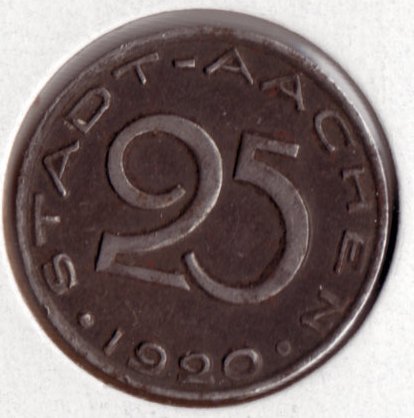 Coin1Obv.jpg
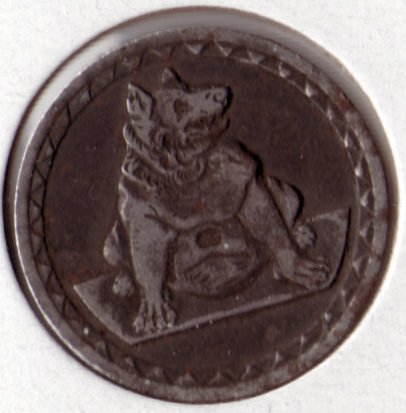 Coin1Rev.jpg
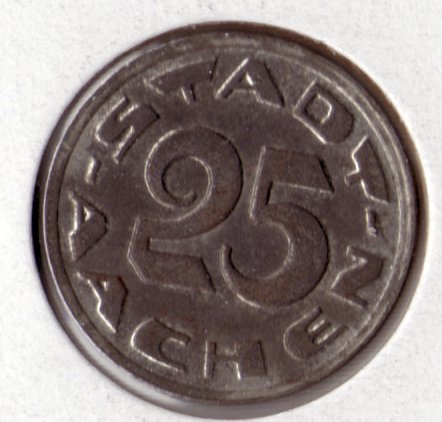 Coin2Obv.jpg
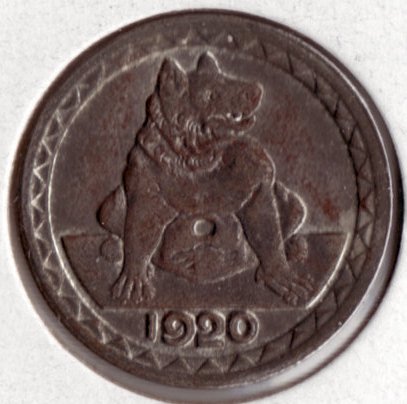 Coin2Rev.jpg


 Posted 02/24/2008 11:20 pm





