Now that I'm on a real keyboard, perhaps I should add a few more comments:
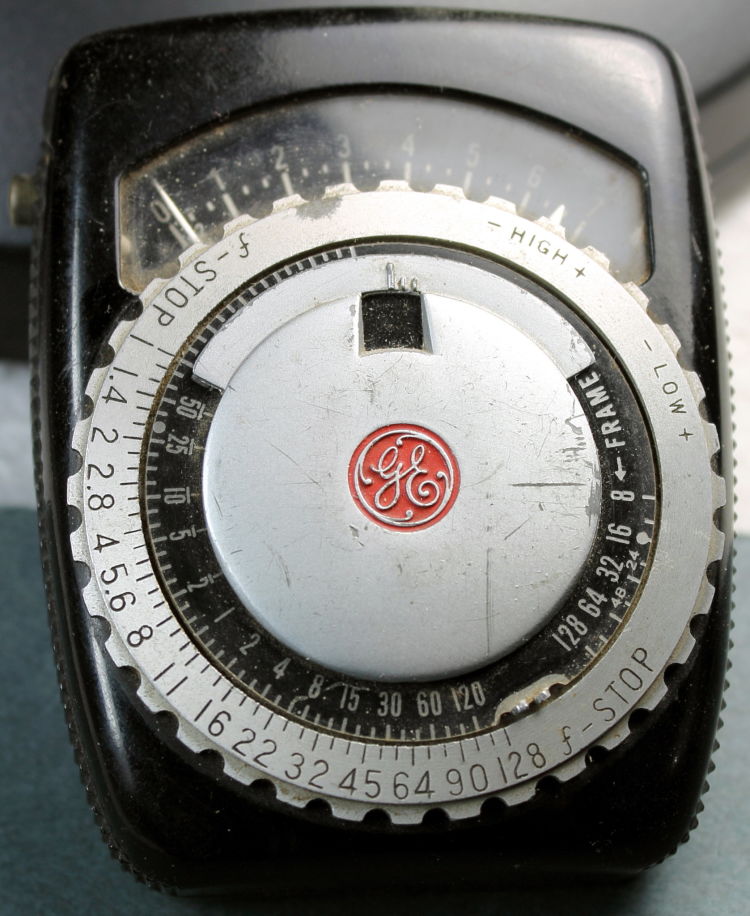
Based on the "High" and "Low" markings on the dial, there might be some sort of selectable baffle that blocks out most (15/16ths) of the light. In bright light, keep the baffle closed. In dim light, open the baffle to expose the whole selenium cell to the light.
Once you have the ASA (ISO nowadays) film speed set as described in the above post (for example: ASA 10 for Kodachrome or ASA 25 for Kodachrome 25), you'd take the reading and twist some dial to line up either the "High" or "Low" marks with the needle (or 2nd needle?, as described earlier). For one stop over or underexposure you'd line up the "+" or "-" marks, instead.
There are different ways to get a reading:
One way is to just point the meter in the general direction of the scene. You can also meter with an 18% gray card, to expose mid-tones properly, so the overall scene looks light or dark, as appropriate.
With fussy narrow-latitude slide film like Kodachrome II, you could measure the brightest and darkest parts of the scene, and then expose somewhere in between to capture the details you want to see best, over or underexposing the rest. With slide film, it's often best to err on the side of underexposure. With negative film, it can be better to err on the side of overexposure.
Another way is to use an incident light attachment (if this meter has one) and point the meter directly at the sun or other light source.
Note: when setting the ASA (ISO) speed, divide the film speed by the filter factor. As an example, I used to do outdoor shots using Kodachrome II and a polarizing filter with a filter factor of 2.5. This means I had to set the ASA speed to 10, not 25.
BTW, I swore off 35mm film in SLRs forever in 1998 -- good riddance. I'll leave the door open slightly for medium or large format someday (or rangefinders), but I doubt I'll ever shoot film again. My coin shots using film were never that great for various reasons -- one being the difficulty of getting exact focus using an optical viewfinder.









 Posted 06/04/2016 05:12 am





