| Author |
 Replies: 14 / Views: 2,999 Replies: 14 / Views: 2,999 |
|
|
Pillar of the Community
United States
6130 Posts |
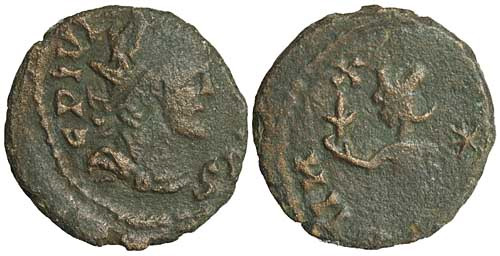
Picked this curious little (<10mm) guy from an ebay lot of assorted barbarous radiates. Obverse: Head with radiate crown, barbarized legend  Reverse: Spes holding flower, cross-potent above. Image contrast enhanced to show detail better  This raises some interesting questions. Christianity was certainly widespread in Europe by 260 AD when these coins were supposedly made, but it was a religion of the poor; notions of charity and humbleness and bowing only to a monotheistic God were not popular with the rich (e.g. the type of person who would be in charge of a mint) and professed Christians were frequently put to death for their beliefs. Supposedly, it was not until the conversion of Constantine that any Christian symbols appeared on any coins, anywhere. This coin clearly was not an official imperial issue, so it clearly was not subject to the same level of scrutiny that an official coin would have received. Perhaps this was made at a mint where support for Christians was public and strong? Perhaps it's proof that these coins continued to be made locally well into the 4th century? I'm honestly not sure to what to think. |
|
|
|
Moderator
 United States
23731 Posts |
Interesting find and theory, I guess it would be possible that Christianity in the region where this coin was minted took a strong hold and the people wanted to show their belief.
|
|
Bedrock of the Community
United Kingdom
18895 Posts |
|
|
Pillar of the Community
Russian Federation
5186 Posts |
I wouldn't necessarily call the cross potent "a Christian symbol". It had certainly been known in Europe since millenia before there was any Christianity.
And this one looks more like a swastika to me, anyway.
EDIT: I agree, though - it's a fascinating, and surprisingly plausible, theory.
Edited by january1may
06/07/2016 5:06 pm
|
|
Pillar of the Community
Canada
1747 Posts |
and to the point the swastika was a symbol that predates Nazi Germany by hundreds of years if not more.
|
|
Moderator
United States
23731 Posts |
The swastika is found mostly on coins of the Eastern Empires, especially on coins from ancient India.
|
|
Pillar of the Community
United States
7067 Posts |
|
|
Moderator
Australia
17005 Posts |
It's position on the rim of the die indicates it is trying to be an imitation letter, though it can't seem to make up its mind if it's trying to imitate a T or an X. I would put it down to "illiterate barbarian babbling" rather than "covert Christian symbolism".
Don't say "infinitely" when you mean "very"; otherwise, you'll have no word left when you want to talk about something really infinite. - C. S. Lewis
|
|
Moderator
United States
34562 Posts |
"If you climb a good tree, you get a push."
-----Ghanaian proverb
"The danger we all now face is distinguishing between what is authentic and what is performed."
-----King Adz
|
|
Pillar of the Community
United States
1047 Posts |
I have read many threads debating the chi-rho symbol. It certainly pre-dates Christianity. I suppose the symbol itself can take on many forms and can be debated on that basis alone, nonetheless, the symbol, or something very close to a chi-rho appears on Ptolemaic coins as seen here, dated 246-222BC 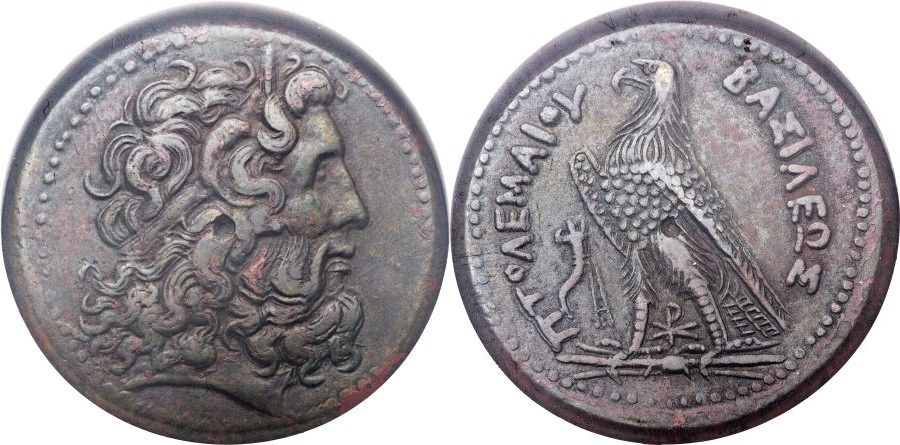 |
|
Pillar of the Community
 United States
6130 Posts |
Some very good points made here. After a little digging: Swastika theory: https://finds.org.uk/database/artef...rd/id/630210Blundered legend theory: https://www.vcoins.com/en/stores/ro...Default.aspxCross theory: Here is a Theodora from my collection featuring a cross potent t in the reverse field  IMO, the fact that the "cross" has feet must have been a deliberate design choice; Probably one of the more deliberate features on the coin, behind the radiate crown and the flower. Probably some of the more notable instances of the cross potent is on the Vandal coinage from the late 5th century; they were not adherents to the Roman Catholic flavor of christianity, and the cross potent was a symbol of their faith. Edited by Finn235
06/08/2016 09:49 am
|
|
Pillar of the Community
United States
513 Posts |
Biancasdad, the Chi-Rho was used to mean "good" before it became associated with Christianity. Not sure why Ptolemy III decided to stick it on his coins.
|
|
Pillar of the Community
United States
6130 Posts |
Here is a slightly better photo of the reverse.  I am starting to lean toward poorly executed swastika here |
|
Pillar of the Community
United States
1047 Posts |
@Chuy, the Chi-Rho on ancient coins has always been an interesting topic. I have read several discussions in regards to the Ptolemaic coins and no one has ever come up with any definitive answers.
I know in Greek mythology AETOS DIOS was a giant golden eagle that served as Zeus' personal messenger and animal companion. Some believe this eagle was a mortal king who was so celebrated that he was honored like a god. Maybe the Chi-Rho between his legs is symbolic of his goodness or godliness or his generally accepted elevated status?
Edited by Biancasdad
06/10/2016 01:59 am
|
|
Pillar of the Community
United States
513 Posts |
That's possible and I don't have a better explanation, although as far as I know it wasn't usually used in that context. It only takes one engraver to see it that way though.
I always figured it was similar in some way to a mint marking but the evidence doesn't really back that up either.
|
| |
Replies: 14 / Views: 2,999 |
|





 Posted 06/07/2016 4:41 pm