Coin Community Family of Web Sites Join Thousands of Coin, Bullion, & Money Collectors
Coin, Banknote and Medal Collectors's Online Mall Specializing in Modern Numismatics Royal Estate Auctions - $1 Coin AuctionsRoyal Canadian Mint products, Canadian, Polish, American, and world coins and banknotes. Join Thousands of Coin, Bullion, & Money Collectors Vancouvers #1 Coin and Paper Money Dealer 300,000 items to help build your collection!


Username:
Password:
Save Password
Forgot your Password?


This page may contain links that result in small commissions to keep this free site up and running.

Welcome Guest! Registering and/or logging in will remove the anchor (bottom) ads. It's Free!

New Lens Testing Method

To participate in the forum you must log in or register.
Author Previous TopicReplies: 3 / Views: 1,878Next Topic  
Pillar of the Community
Learn More...
United States
4038 Posts
 Posted 06/16/2016  10:51 pm Show Profile   Bookmark this topic Add rmpsrpms to your friends list Get a Link to this Message Number of Subscribers
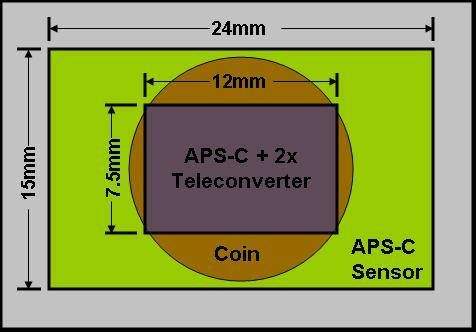
Years ago, I discovered that I could eliminate most of the camera sensor aberrations due to Bayer demosaicing problems by using a 2x teleconverter (2xTC), then downsizing the image 50%. The final image has the same effective magnification, and is essentially a crop from the center of the image without the 2xTC, but the 2x downsizing eliminates most of the sensor aberrations. The corners of this image extend to the radius of a coin, so checking corner sharpness on the magnified/downsized image can tell us how good a lens is for shooting coins.

Take a look at the image below to explain this concept:

New-Lens-Testing-Method

Using a 2xTC is similar to using a microscope objective to magnify the image from a lens, just with lower magnification. However, the microscope objective only lets you view the very center of the image in great detail. The corners of the image are outside the image circle produced by the objective.

Comments welcome. In coming days I will publish some comparative images using this new method.


Contact me for photographic equipment or visit my home page at:
http://macrocoins.com
Edited by rmpsrpms
06/16/2016 10:52 pm
Pillar of the Community
austrokiwi's Avatar
2087 Posts
 Posted 06/17/2016  11:26 am  Show Profile   Bookmark this reply Add austrokiwi to your friends list Get a Link to this Reply
There is a lot in your post that I only have a passing understanding of. As my limited understanding goes the Demosaicing issue relates to color rendition. In-camera processing creates the accurate color rendition but in combining the RBG information resolution is lost.

I understand that by using a TC then reducing the resultant image the resolution lost by the demosaicing algorythms is clawed back( by combining information from adjacent sensor pixels). I don't know but guess that it still sees some loss in resolution.

However I have this question. are you really testing the cnr-cnr sharpness of the lens or just cnrs of the resultant Field of view? I ask this as I have a full frame sensor. That may not seem important with the majority of users on APSc. However, I suspect we are going to see increasing numbers of entry level cameras with FF sensors...so I do think there may be an issue of future proofing your work, that deserves some consideration.

That said I don't think I can offer a better alternative.

I do like Mark Goodman's approach but, at times it does make my head hurt; meaning I have to think hard to relate his MTF graphs to likely real life results( He uses MTF 50 I believe). Using actual coins ( as long as the viewer knows them) does make it easier to relate your results to what I might get out of the same lens.

I would suggest that you consider adding in a simple CA measure. The one I have come to understand the most is Mark Goodman's ruler at a 45 degree angle. If you were able to add that measure ( at the optimum F stop only) it would be a great help.
Edited by austrokiwi
06/17/2016 1:40 pm
Pillar of the Community
Learn More...
United States
4038 Posts
 Posted 06/17/2016  1:50 pm  Show Profile   Bookmark this reply Add rmpsrpms to your friends list Get a Link to this Reply
AK...all Bayer sensor cameras must interpolate data to "fill in" the missing color information for each pixel. Since each pixel only contains R, G, or B information, the rest of the RGB must be "guessed at" by looking at adjacent pixel data. This process results in a lower resolution than if each sensor pixel had the full RGB data. The lower resolution shows as a blurriness to the image. Some demosaicing algorithms work better than others, and some of the newer camera 100% pixel info looks very good, but is still just an "educated guess". So in reality, my 18MP sensor is really a 4.5MP sensor when you require it to be full resolution.

As far as cnr-cnr sharpness, I'm definitely not taking this into account. The method only looks at the area of the sensor that is relevant to full-coin photography on APS-C. The same method could of course be used for FF sensors, and if I had a FF sensor camera I'd probably do the same thing.

My favorite method of showing CA effects is to focus a little high and a little low and compare. This will show the color shifts shown by looking at the tilted ruler, but on a "live" subject. You can see an example of such a "high-low focus sweep" at the page I started for the 80mm Shootout:

http://www.photomacrography.net/for...0mm+shootout
Contact me for photographic equipment or visit my home page at:
http://macrocoins.com
Pillar of the Community
Learn More...
United States
4038 Posts
 Posted 06/18/2016  12:45 pm  Show Profile   Bookmark this reply Add rmpsrpms to your friends list Get a Link to this Reply
Here are some images to show the new testing method using a 75ARD1 at f4. Each image was rendered from a focus stack of 5 source images.

Overall image, without 2xTC:
New-Lens-Testing-Method

Above image, 50% Center Crop:
New-Lens-Testing-Method

Overall image, with 2xTC:
New-Lens-Testing-Method

The above two images are the ones to be compared, so I will take crops from them, and magnify the crops 200% to make it easier to see differences.

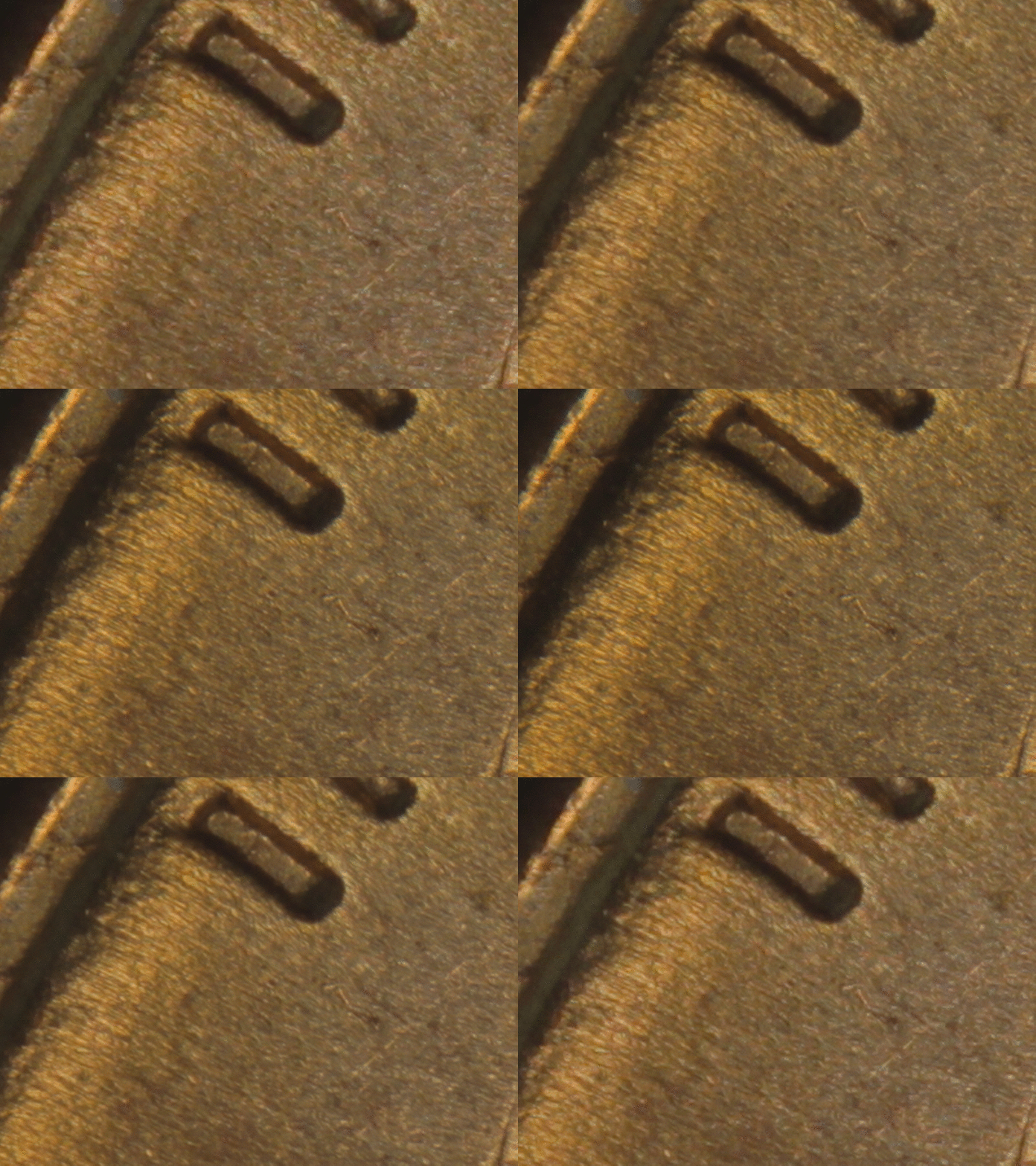
Center crops animation from images with and without 2xTC:
New-Lens-Testing-Method

Upper left corner crops animation:
New-Lens-Testing-Method

There is some distortion of the images, especially the corner crops, since I was not using a telecentric lens, and turned off scaling in Helicon.
Contact me for photographic equipment or visit my home page at:
http://macrocoins.com
  Previous TopicReplies: 3 / Views: 1,878Next Topic  

To participate in the forum you must log in or register.


Disclaimer: While a tremendous amount of effort goes into ensuring the accuracy of the information contained in this site, Coin Community assumes no liability for errors. Copyright 2005 - 2026 Coin Community Family- all rights reserved worldwide. Use of any images or content on this website without prior written permission of Coin Community or the original lender is strictly prohibited.
Contact Us  |  Advertise Here  |  Privacy Policy / Terms of Use

Coin Community Forum © 2005 - 2026 Coin Community Forums
It took 0.25 seconds to rattle this change. Forums