| Author |
 Replies: 20 / Views: 7,848 Replies: 20 / Views: 7,848 |
|
Valued Member
United States
354 Posts |
I was looking at some slabbed coin pictures from YouTube and CCF, and was wondering about PCGS and NGC holders. PCGS has a plastic scratch proof case, almost like an air tite. ANACS's holders are similar. As for NGC, they use white board to hold the coin. The modern ones have pegs that grab the coin by the side, but the older generation holders had the white board completely surrounding the coin. I was wondering what the white "board" from NGC holders are made from, and which holder is safer.  |
|
|
|
Pillar of the Community
United States
5825 Posts |
I have two problems with today's holders.
The first applies to both PCGS and NGC.
The "fingers" often get in the way of identifying some variety characteristics.
My second problem only applies to NGC holders.
Their white insert makes photographing coins considerably more difficult.
I don't have any interest in holders from other companies.
|
|
Bedrock of the Community
United States
94367 Posts |
Valid points, though the "fingers" do allow examination of the edge, which is an improvement (to me) over the earlier-generation holders.
Agree strongly I would not buy an ANACS except under unusual circumstances.
|
|
Pillar of the Community
United States
506 Posts |
Information about NGC's holders can be found here: https://www.NGCcoin.com/coin-grading/holders/About NGC's "board," I believe it is some sort of inert plastic. They don't say what the name of the plastic is, probably to keep it to themselves, but they do say it is the same they developed to hold the Smithsonian's coins, so I would think this means they are well-made and safe. I think both NGC and PCGS holders are safe for long-term storage (I don't have experience with ANACS), as they were all designed to be inert and safe for the coins they hold. As for which is safer, I don't think there is a significant difference between the two under normal conditions within our lifetimes. Edited by coinlover168
06/28/2016 02:37 am
|
|
Pillar of the Community
United States
711 Posts |
If you are feeling mad scientist and have a piece of the white plastic, a cup of water, and a source of flame you can find out what type of plastic it is by following this chart. http://www.consultekusa.com/pdf/Tec...chart%20.pdfIt will let you determine just about any type of plastic with just water and fire. To be honest, that would be a great science fair type of project now that I think about it. The science part being the why those simple tests can identify the polymer more so than the trick of following the chart. Edited by BuckeyeCoinGuy
06/28/2016 05:12 am
|
|
Bedrock of the Community
United States
20753 Posts |
It's all in the cost. Ever go to a coin show and you'll almost always hear "of course it cost more, it's PCGS"
|
|
CCF Advertiser
United States
1533 Posts |
If anyone wants to know what a type of plastic is, whether flip or holder, send it to me. I'll identify it with Fourier Transform Infrared Spectroscopy and a library of 250,000 common materials to match to. The identification takes all of 20 seconds. I'd answer some of these questions, but I don't have any opened holders as I am not a crack out artist.
Edited by Andrew99
07/03/2016 10:48 am
|
|
Pillar of the Community
United States
7390 Posts |
One thing I really don't like about the difference of PCGS and NGC plastic is NGC uses a shell casing that is highly shiny compared to PCGS. It highlights fingerprints and smudges terribly. I put a few morgans in the retro NGC black holders last year and I hate how shiny the plastic is with the black background. I'm a solid PCGS guy but even with my issues with NGC plastic I'll still use them for lower value errors sometimes as PCGS wants an arm and a leg and on a seperate submission with seperate shipping for errors.
|
|
Pillar of the Community
 United States
4622 Posts |
Do NOT confuse inert with air / water tight holders.
A holder stored under poor conditions (say a damp kitchen with lots of cooking) will allow some environmental components to enter. Even the newest PCGS holders, while water tight are not air tight...
It's also important to realize that all components - the shell, insert, label and ink(s) used - need to be inert or the contents may toning over time. Some holders from some companies are notorious for this...
For example older PCI holders have both toned coins and the paper label often exhibits foxing.
There was a generation of PCGS holders where the label color wasn't color-fast and they are known in blue, green, even yellow.
etc.
-----Burton 50+ year / Life / Emeritus ANA member (joined 12/1/1973) Life member: Numismatics International, CONECA Member: TNA, FtWCC, NETCC, EveryCountry (online) coin club Owned by three cats and a wife of 40+ years (joined 1983) Author: 3rd Edition of the Sample Slabs book, https://www.sampleslabs.info/ |
|
Pillar of the Community
United States
3552 Posts |
Quote:
PCGS has a plastic scratch proof case. I do not recall reading anything on PCGS' submission form alluding to an upgraded service such as this. Plus, one of my most recent PCGS-slabbed world coins came back to me with fine scratches on both sides: 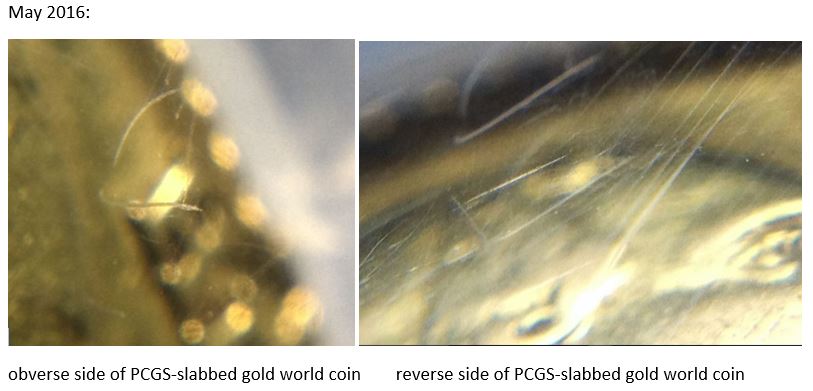 PCGS requested close-up shots of both sides displaying the alleged anomaly. I just had to resubmit my slabbed coin to them using a pre-paid shipping label that they emailed me. I attached a photo in this thread of how minor the scratches were just to emphasize that PCGS was more than willing to make things right no matter what the new scratches looked like. My holder also had another odd phenomenon going on; check out the internally-located small piece of crescent-shaped discolored plastic; see the attached photo: 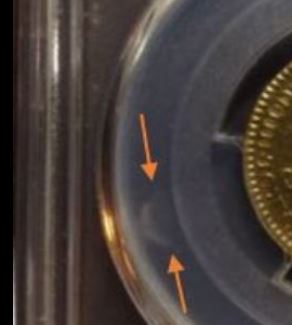 If a finger rubbed across both the obverse or reverse sides no undulations or roughness in the hard exterior slab cover could be felt above this internal half moon object. The scratches, on the other hand, could be detected by running a fingernail across the external surface... Their rep. indicated that either issue would have justified a 100% PCGS-covered redo. I never received a 100% explanation on what actually happened and really didn't care since I'm sure my slab made them review their outgoing QC processes a bit more closely; plus my re-slabbed gold piece arrived immaculate the second time. I speculate that most likely they were having some unique problems with their equipment at the World Coins site in order to have a double whammy like this one. In summary, PCGS took care of everything politely and professionally including round-trip insurance, freight and any related processing fees. I'm sure it did help expedite things, however, being that I notified them within 48 hours of receipt since it arrived to me on a Sat. On a side note, the mark of any great company is their ability to quickly resolve unanticipated problems with minimal collateral damage to their reputation or to their customer's positive perception of the company. |
|
Pillar of the Community
United States
1839 Posts |
I learned one thing the hard way today. PCGS and NGC holders are not made from the same kind of plastic. I recently received a batch of coins from a Heritage Auction. As usual they plastered them with all kinds of stickers. Even covering the the center part of the reverse on a few of them. They also like to use stickers that leave behind a lot of cruddy residue. I brought home a can of 3M Natural Adhesive remover to try to get the residue off. They said it is safe on most plastics but to try it on an unimportant area first to be sure. I tried it on part of an NGC holder first and it worked very well taking all the residue off and not harming the plastic at all. At this point I should have tested it on a corner of a PCGS slab but made the incorrect assumption that it would work in the same way as the NGC holder. Well several minutes later I learned that it attacks the plastic of the PCGS holder very badly. So now I have a coin that has the reverse of the holder looking like it's been through a war. It's completely blurry and lumpy. The coin's worth about $250 so I guess I'm going to bite the bullet and have it re-holdered.
So in case anyone was interested. Whatever kind of plastic PCGS and NGC use, they don't use the same kind.
Edited by Tbone
07/13/2016 10:53 am
|
|
Pillar of the Community
United States
4622 Posts |
-----Burton 50+ year / Life / Emeritus ANA member (joined 12/1/1973) Life member: Numismatics International, CONECA Member: TNA, FtWCC, NETCC, EveryCountry (online) coin club Owned by three cats and a wife of 40+ years (joined 1983) Author: 3rd Edition of the Sample Slabs book, https://www.sampleslabs.info/ |
|
Pillar of the Community
Australia
7096 Posts |
Quote:
On a side note, the mark of any great company is their ability to quickly resolve unanticipated problems with minimal collateral damage to their reputation or to their customer's positive perception of the company.
Are you certain that you are talking about PCGS here? In the last 4 years and over 1000 submissions later I have never found this to be the case. |
|
Pillar of the Community
United States
711 Posts |
Best guess then would be that PCGS uses polycarbonate (and a scratch resistant polycarbonate upgrade).
Polycarb or PC doesn't have great resistance to citric acid.
I always assumed it was PC with their scratch resistant PC and that NGC used PC as well but didn't have the scratch resistant material.
If the NGC's are more resistant to the same citric acid, this wouldn't seem to the be the case anymore.
On a side note, no excuse for Heritage to be using stickers leaving a sticky residue like that.
No reason you can't solve this problem within 30 days Heritage.
No reason other than lack of desire that is I guess.
Edited by BuckeyeCoinGuy
07/13/2016 10:48 am
|
|
Moderator
 United States
196100 Posts |
Tbone, send Heritage a bill for the re-holder.  |
|
Pillar of the Community
United States
1839 Posts |
Now that would be interesting.
|
| |
Replies: 20 / Views: 7,848 |










 Posted 06/20/2016 4:56 pm


