| Author |
 Replies: 16 / Views: 2,931 Replies: 16 / Views: 2,931 |
|
Pillar of the Community
United States
6130 Posts |
I have always been fascinated with coin collecting from a historical aspect, and the "first series" coins of a given nation in particular. When a country gains independence or emerges from a union, one of the first orders of business is to plan, design, and make a new currency. Since the United States, decimalized currency has been the most popular choice, usually with 1/5/10/25/50 cents, or 1/5/10/20/50. Most of the time a currency will be launched in a complete or at least functional form, but sometimes there are holes. A prime example that I am familiar with is Panama. The US helped Panama gain independence from Colombia for the sole purpose of building the Panama Canal. The newly independent Panama contracted with the United states mint to create the Balboa, which was tied to the USD. The new coins launched in 1904 with denominations of 2.5/5/10/25/50 cents. The Half Cent was introduced three years later and ran for just one year. The one cent coin was first introduced over 30 years later in 1935, and the Balboa did not exist as a coin until 1931. I know that old Colombian coins probably stayed in circulation, as well as foreign coins, but I am baffled by the complete lack of a cent coin in a decimalized currency. Feel free to openly discuss Panama and countries that started out in similar situations, with gaps in their circulating currency system. |
|
|
|
Valued Member
United States
280 Posts |
I really like the Panama Balboa coins. The high relief & Balboa's helmet are awesome. One day, I'll have a silver Balboa in my permanent collection ! 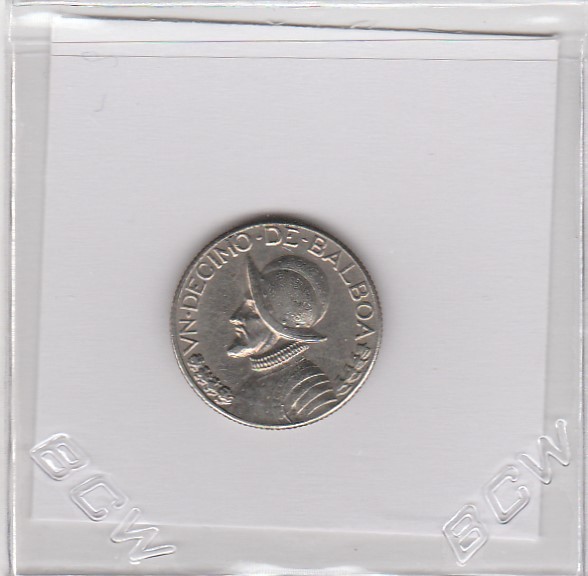 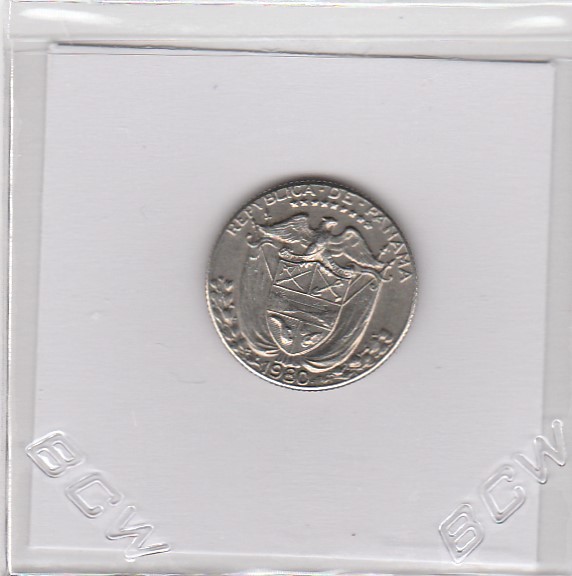 |
|
Pillar of the Community
 United States
6130 Posts |
Here's a photo of the "Panama pill" that was the country's smallest denomination officially from 1904-1907, and functionally until 1935:  Although to be fair, the Panama Pill did not really circulate because it was pretty easy to lose. A much larger cupronickel coin was introduced in 1907 along with the Half Cent. |
|
Valued Member
United States
280 Posts |
Wow...A Silver Two & a Half Cent ! Thanks for sharing that. I know England made tiny silver pennies, haven't seen one yet. |
|
Moderator
 Australia
17005 Posts |
In the case of Panama, you've partly given the reason in your history: the tie to the US dollar. If they needed one cent coins, all they needed to do was import American ones. It would have been cheaper than getting the Americans to design, make and export Panamanian 1 centesimo coins. There are many instances of such "economic dependencies" using coins from the dominant partner country instead of or alongside their own. Even today, many of the smaller Pacific Islands territories use coins of their larger neighbours, circulating alongside their own. Tuvalu and Kiribati use Australian coins; Cook Islands uses New Zealand coins. Quote:
Since the United States, decimalized currency has been the most popular choice, usually with 1/5/10/25/50 cents, or 1/5/10/20/50. Two issues to raise from this sentence. First, I hate to break it to you, but the Russians invented decimal currency before you did, with the system of 100 kopeks to the ruble dating from 1704. Well, actually the Romans were first, with 100 sestertii to the aureus, but that doesn't really count. Second, most countries that use decimal currency have a "true decimal" system, using the two factors of 10: 2 and 5 - thus, 1/2/5/10/20/50/100/200/500. This allows for complete interchangeability between every denomination of the next decimal place. The lack of a 2 cent coin is a North American peculiarity, caused mainly by the unusual dominance of the 25 cent coin: since 25 isn't divisible by 2, you can't hand out a whole number of 2 cent coins in exchange for a quarter. Don't say "infinitely" when you mean "very"; otherwise, you'll have no word left when you want to talk about something really infinite. - C. S. Lewis
|
|
Moderator
United States
196100 Posts |
Yup, we had a chance to replace our quarter dollar with a Twenty Cent coin, but instead allowed both to circulate. The quarter won that battle and today we are stuck with no easy way to eliminate the costly nickel. |
|
Pillar of the Community
Russian Federation
5186 Posts |
Quote:
Two issues to raise from this sentence.
First, I hate to break it to you, but the Russians invented decimal currency before you did, with the system of 100 kopeks to the ruble dating from 1704. Well, actually the Romans were first, with 100 sestertii to the aureus, but that doesn't really count.
Second, most countries that use decimal currency have a "true decimal" system, using the two factors of 10: 2 and 5 - thus, 1/2/5/10/20/50/100/200/500. This allows for complete interchangeability between every denomination of the next decimal place. The lack of a 2 cent coin is a North American peculiarity, caused mainly by the unusual dominance of the 25 cent coin: since 25 isn't divisible by 2, you can't hand out a whole number of 2 cent coins in exchange for a quarter. I'm not sure if the Russian system was in fact deliberately decimal, or just a lucky coincidence of what the units came to. Didn't a ruble equal 100 kopeks even earlier than that? Actually, a lot of places just ignore the 2 entirely and use 1/5/10/50 (Russia, modern Romania and Israel come to mind, though Russia and Israel both have a 200 coin - if only recently for the latter), some places (e.g. pre-euro France) use 1/5/10/20/50 (no 2 but including everything else), the traditional Russian system is 1/2/3/5/10/15/20/whatever (and it shows up in a lot of Eastern Bloc countries), some places have 20 and 25 at the same time, and some are just plain weird (1970s Romania had 5/15/25/100+). Oh, and a few places had 2/5/10/etc with no 1 (okay, I can't think of any other examples, but the first Czechoslovakian coins are like that), a few had 1/2.5/5/10/25/50 (some with a Half Cent, some without), and Venezuela consistently kept introducing a 12.5 cent coin into their 1/5/10/25/50 system - most recently in 2007. And Panama eventually ended up with a 1.25 cent coin, which is just silly. |
|
Bedrock of the Community
Australia
21792 Posts |
Curiously, the United States has a 50 cent coin and a Two Dollar note, but they are not popular.
Why then, is the 20 Dollar note more widely accepted by the Public?
|
|
Pillar of the Community
United States
6130 Posts |
@Sap, you are correct about Russia, but my point was that Russia was a relative outlier; when the US went decimal in 1792-94, that inspired France to decimalized the Franc after their revolution. After a major world power took on decimal coinage, it snowballed across the globe, accelerated by the general unrest and frequent revolutions of the period. The US is perhaps a poor example, since we launched a half-cocked decimal system in 1793 with nothing but the cent and Half Cent, since we couldn't get it together to make silver in the first year, but there was a dire and pressing need for small change. My original point however, is that as a general rule, a decimal coinage system is planned, rather than denominations arising organically as needed. It does seem strange therefore that a country would kick off such a system with gaping holes or without a baseline of a cent/mill denomination. Japan is another example. Meiji set the country on the fast track to modernization when he assumed the throne in 1868. The old, cash based system was continued while his equipment was on order, but the new denominations launched in 1870, with 5, 10, 20 and 50 sen, and a 1 yen based on the Spanish dollar standard. No bronze coins were made until 1873, since the old cash coins were allowed to stay in circulation, I think with the 4 mon coins filling the role of the rin (mill) coin. |
|
Moderator
United States
196100 Posts |
The fifty cent coin lost popularity due to hoarding in the mid to late 1960's. The reasons being "Kennedy" and silver. The half dollar did not go full Cu-Ni clad until 1971. By the time it joined the debased realm people were already used to using two quarters.
|
|
Pillar of the Community
Norway
1358 Posts |
The Netherlands have had a few peculiar years, having coins of 1, 2 1/2, 5, 10, 25 cent and 1 and 2 1/2 gulden. Indeed, no 50 cent, no 1/2 cent and no 2 gulden. A good excuse is that there was a Second World War going on in the country at the time, though. Until 1940, 1/2 cents were issued.
Anyway, for some peculiar reason, The Netherlands has had the same with their gulden as Americans have with their dollar: using quarters, not having 2 cents, barely using 50 cent pieces (really, during my dozens of visits I NEVER have been given one in change) for the USA and nothing like it in The Netherlands. And where the Americans at least have a 2 dollar note, The Netherlands had a 2 1/2 gulden coin.
Oh, and on top of it all, Netherlands also had a 3 gulden coin for a short while (but that was hundred years earlier).
Any other favorites of mine when it comes to irregular denominations in a monetary system:
- British Maundy Money (1, 2, 3 and 4 pence pieces)
- Soviet kopecs (really, almost every possible denomination was present)
- Kyrgyz Som (1, 3, 5, 10 Som). Of course, at the end of the day it doesn't really matter if you have 1, 2 and 5 or 1, 3 and 5, in case of giving an amount of coins in change. But it's quite a nice differentiation from other currencies.
|
|
Pillar of the Community
United States
6130 Posts |
That's actually a very good point about the Netherlands. A lot of countries have a 2 1/2 cent coin, and very often those coins outlast the Half Cent. I have never understood how that would work... do they round up, so that 2 coins spent separately would be worth an extra cent than 2 coins spent together? Round down so that you would lose a cent if you don't spend them together? And don't even get me started on the British coins... they had some really really strange ones, especially in the middle ages and early modern times. I have a coin weight (cheaper than the real coin) used to validate a half angel, worth 5 shillings, 6 pence. But my very favorite was Jersey, which was forced to give up their French coins in the mid 1800s. But, rather than just switching to British coins, their new coins stuck to the French standards, meaning that the Jersey penny, halfpenny, and farthing were all worth 12/13ths of their British equivalent. |
|
Pillar of the Community
United States
6130 Posts |
Also, going back to Panama as January mentioned, they did indeed issue a cent with an extra 1/4 tacked on:  (Google photo, although I do own a couple) These were a single year, single purpose coin--intended specifically to buy small bags of rice/beans etc from grocery stores, which were priced "4 for 5 cents". Obviously, the coin was difficult to use and failed miserably. That's what happens when you can owe someone 3/4 of a cent in change when your country doesn't even have a Half Cent. |
|
Pillar of the Community
Canada
5293 Posts |
Let us not forget Venezuela: 12 1/2 centimos, obviously a relic of the old Real system, and Cuba 40 centavos, for unknown reasons.
|
|
Pillar of the Community
Russian Federation
5186 Posts |
Apparently other countries that started out with a 2/5/10 cent system (without a 1 cent) included Bulgaria (1881, did not make a 1 cent until 20 years later) and Kazakhstan (1993, never made a 1 cent but in any case inflation soon made their cents worthless).
A 15 cent denomination is very common in the Eastern Bloc, and very rare outside of it. I've recently bought a 15 centimos 1953 from Paraguay; still looking for the Bahamas 15 cents (those things are darned uncommon, what with the Bahamas being a tiny country) - and I couldn't find any other 15 cent coin from outside (Russia and) the Eastern Bloc in the 20th century.
(There are some very rare examples from Italy in the 19th century.)
|
|
Pillar of the Community
Norway
1358 Posts |
@Fin: For what I know, sometimes people just got some small candy or so in change. At least, that's the story I heard.
@January1may: Malta also had some interesting coins, starting at 2 Mils, 3 Mils and 5 Mils before 1 cent. They never had 1 Mil.
|
| |
Replies: 16 / Views: 2,931 |
To participate in the forum you must log in or register.
Disclaimer: While a tremendous amount of effort goes into ensuring the accuracy of the information contained in this site, Coin Community assumes no liability for errors. Copyright 2005 - 2026 Coin Community Family- all rights reserved worldwide. Use of any images or content on this website without prior written permission of Coin Community or the original lender is strictly prohibited.
Contact Us | Advertise Here | Privacy Policy / Terms of Use
|
| Coin Community Forum |
© 2005 - 2026 Coin Community Forums |
| It took 0.58 seconds to rattle this change. |
 |
|










 Posted 07/11/2016 3:58 pm


