| Author |
 Replies: 14 / Views: 2,108 Replies: 14 / Views: 2,108 |
|
|
Pillar of the Community
Canada
1354 Posts |
Hi. A couple of questions in regards to the 1929 high 9 I know that there are the high nine, high far nine varieties. Is it just a high nine that is recognized by the TPG companies? Does anyone know who did the study on these varieties and if they will ever be recognized? Thanks. |
|
|
|
Pillar of the Community
 Canada
5653 Posts |
The coin is, I think, similar to the 1859 and other dated Vicky cents. The final digit was handpunched in because the previous year's hub's last 9 was ground down so that it just read 192. When the working dies were made, the final digit was handpunched in. As a result, the final 9 can be anywhere up, down, far, near or slightly canted. It is done to save money and to be able to use previous year's hubs when new ones are not ready or being made. My own personal opinion is that it was a grave mistake to ever list it in Trends. It will be just like the 1896 far 6, which no TPG will certify any more. How high is high or how far is far? There is no standard. My guess is that it will not continue to be certified because there is no standard or reference and open for folks to be taken advantage of. I wouldn't touch one with an 11 foot pole. |
|
Pillar of the Community
 Canada
1354 Posts |
Okie
Was it typical of the mint to hand punch a digit only for 1 year when the years before and after weren't hand punched? Why was that done to specific years? Is it based on the amount of coins made? Or the state of the economy? If that is the case with the 1929 wouldn't there be a lot more varieties? Or can you only have a couple of varieties with a hand punched digit? Sorry for the blast of questions...
|
|
Pillar of the Community
Canada
5653 Posts |
Many years had digits (usually the last one) handpunched in. It cost a great deal of money to make new masters, matrices and submatrices. By wiping out the final digit on the hub, you lost nothing and immediately started producing working dies, but only had to punch in one digit. My expertise is in large cents and I have no idea what years were and weren't done with handpunched digits (or letters for that matter). Suffice to say that it was a common practice from the 1880's through the 20's. Money was tight in the 20's through the 30's .. I'm sure they scrimped where they could.
|
|
Moderator
 Canada
10476 Posts |
I seriously doubt the working dies were hand punched in the late 1920s...
"Discovery follows discovery, each both raising and answering questions, each ending a long search, and each providing the new instruments for a new search." -- J. Robert OppenheimerContent of this post is licensed under a Creative Commons Attribution-NonCommercial 3.0 Unported License. See: http://creativecommons.org/licenses...0/deed.en_USMy eBay store
|
|
Pillar of the Community
Canada
1354 Posts |
Any other insight SPP?.....
|
|
Pillar of the Community
Canada
1354 Posts |
Thanks for the responses okie. :)
|
|
Pillar of the Community
United States
1101 Posts |
Quote:
I seriously doubt the working dies were hand punched in the late 1920s... Didn't the half dollar dies have hand punched final digits as late as the 1940's? |
|
Valued Member
Canada
257 Posts |
From the 50c variety section in 61st Edition of Charlton: Quote:In 1908 Canadian coinage production moved to Ottawa with the opening of a branch of The Royal Mint. Master tools were produced in London and shipped to Ottawa. The reverse matrcies were shipped with partially completed dates 191_, 192_, 193_, depending on the decade I expect this to hold true for 1c coins as well. As for the 1929 high 9 variety being listed: Trends: No... Charlton: Yes Haxby: No Zoell 1965 Major Varieties: No Zoell 1965 Minor Varieties: No Charest: Yes |
|
Valued Member
Canada
257 Posts |
@Phil310
Paraphrased from the Charlton 68th edition on George VI 50c Varieties;
Die refurbishing was practiced on a scale never seen before from '41-'49
The first refurbishment method was to 'touch up" a date digit by another punching of the date digit - double punching.
A second refurbishment method was the last two digits of the date were removed from the punch and manually re-entered into the working die. - thus the varieties.
|
|
Pillar of the Community
Canada
5653 Posts |
Trends lists the 1929 high 9 cent.... or at least mine from 6 months ago does.
|
|
Bedrock of the Community
Canada
21910 Posts |
Looking at the population reports for both ICCS & CCCS,
neither recognize a high 9.
There is only one listing for 1929.
|
|
Pillar of the Community
Canada
2845 Posts |
Awhile ago someone posted an excellent illustration of various types of different 9 placements, high low and inbetween but nowhere can I find it now. It appears there are at least two types of 9's as well. Notice the two photos from Coins and Canada - - the placement of the 9, the high 9 is also further away from the 2, not only higher. - the tail of the high 9 is thinner and also the bottom part of the 9's loop. 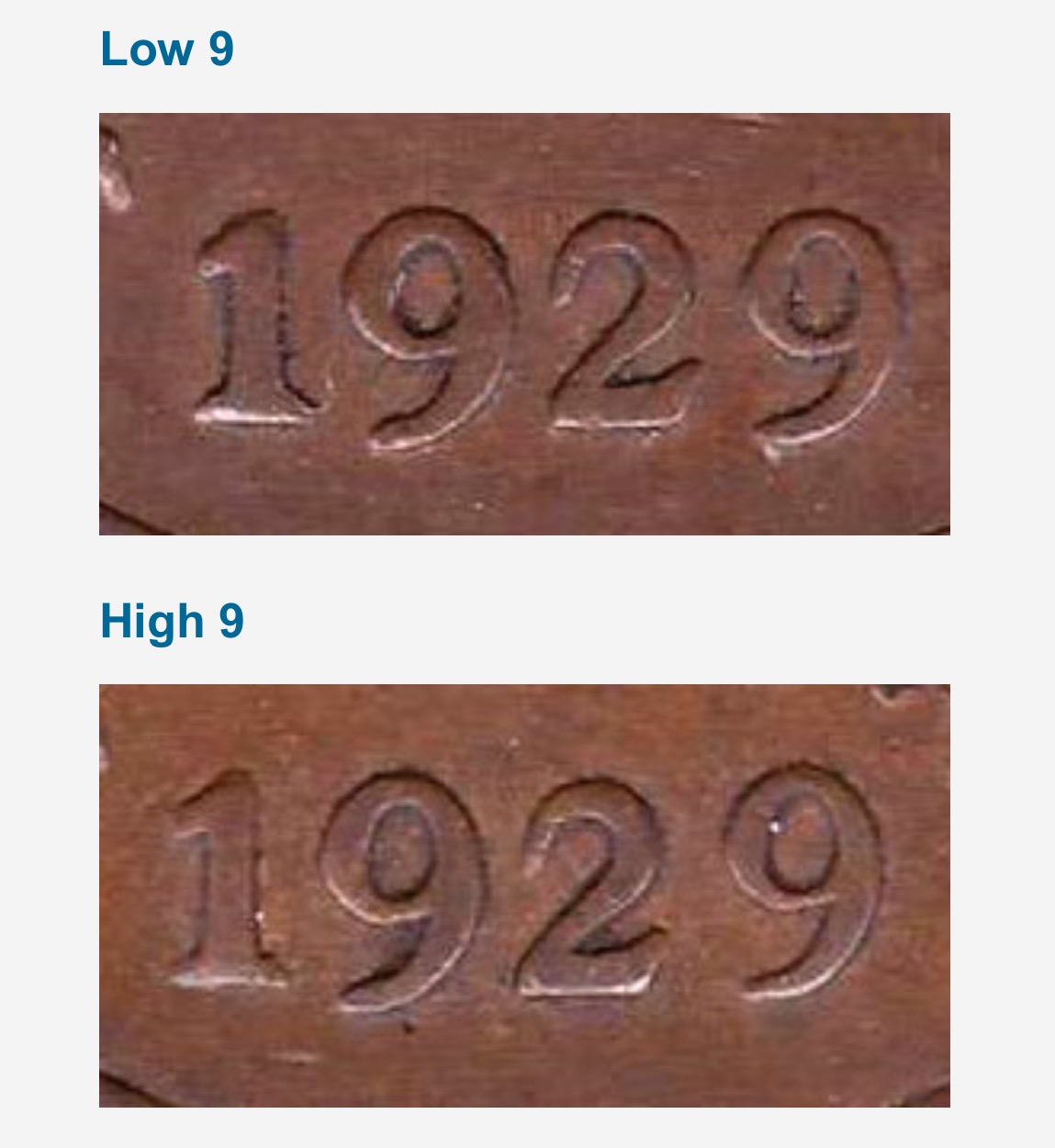 |
|
Pillar of the Community
Canada
9903 Posts |
Quote:
I expect this to hold true for 1c coins as well Not true. 50c and dollar mintages were low ,fewer dies were used thus matrices and punches would last longer and could be used for multiple years. For other denominations master tools were shipped fully dated. "Dipping" is not considered cleaning...
-from PCGS website
Edited by DBM
07/03/2016 11:26 am
|
|
Valued Member
United States
302 Posts |
The dating of coinage dies can be a bit complicated. As far as the 50c and $1 from 1941 to the early 50s are concerned, so few dies were being used that it made no economic sense to make a new fully-dated matrix and punch for each denomination for each year. Partially-dated punches were used and the final digit was punched into each die. However, from the end of the Victorian period forward the general rule was to use a fully-dated matrix and punch for every denomination and year. The only exceptions were the 50c and $1 already noted and a few dies that I call "outliers" (e.g. 1926 far 6 5c, 1929 high 9 1c) where the "regular" dies for those years were from a fully-dated punch.
Edited by JHax
07/05/2016 12:00 am
|
| |
Replies: 14 / Views: 2,108 |
|










 Posted 07/02/2016 7:23 pm


