| Author |
 Replies: 13 / Views: 1,829 Replies: 13 / Views: 1,829 |
|
|
Pillar of the Community
United States
6130 Posts |
Another musing that popped into my head. For each language currently being used, what is the oldest coin that a fifth grader of that native language could pick up, read, and comprehend? Languages can go through prolonged periods of stagnation, or extremely rapid evolution; thus I think the answers may surprise us. A few examples: English: I think the oldest English (not Latin) inscription on a coin would either be the 1790s US coins, the 1780s Conder tokens, or the 1600s colonial tokens, depending on how you want to define things. My oldest coin with an English inscription is a 1787 Conder token, reading "IRISH MINERS ASSOCIATION" and "PAYABLE AT CRONEBANE" on the rim. I do not think the UK issued coins in anything besides Latin before the 1860s, when the English denomination began to be added. Chinese: these lines are a little blurry; I don't know wether a child would be able to read the Wu Zhu (118 BC - 600s AD), or the more "modern" cash coins since the Tang dynasty. Arabic: If memory serves, the "official" Arabic has not changed one iota since the Koran was originally penned during Muhammad's lifetime. I honestly don't know if that would render the coins of the Umayyad and Rashadun caliphates comprehensible to a child without formal education on the subject. Greek: Again if memory serves, classical Greek would be about as similar to modern Greek as Chaucer's English to modern English. I'll leave it open to discussion here. Feel free to share any coins you have in your collection! |
|
|
|
Pillar of the Community
Canada
1747 Posts |
Ahem... note Chaucers English IS classified as modern English.
also I think you need to hash out what you mean by comprehend, as they may be able to say the word, but they may not no what it means, or where it is.
|
|
Pillar of the Community
 United States
6130 Posts |
http://www.librarius.com/cantales.htmChaucer's English differs from modern English to the extent that Canterbury Tales is nearly incomprehensible without extensive footnotes or an extensive knowledge of the vocabulary of those days. I had always learned in school that it was both one of the terminal works of Middle English, and the first works of (very) Early Modern English. At any rate, by "comprehend" I mean that any literate child can pick up an old US coin and read "United States of America" and the denomination, but "VICTORIA D:G: BRITT:REG:F:D" is Latin, not English.
|
|
Pillar of the Community
Poland
3201 Posts |
What comes to mind for Poland:
1787 - abbreviations in Polish used on a silver 10 groszy coin: 10 GR. MIEDZ. 250 1/2 Z GRZ. KOL. (10 copper grosz, 250 1/2 pieces out of a cologne mark of silver).
The first part of it may be understood by some.
1794 - denomination fully in Polish: 6 GROSZY.
This will be obvious for everyone as it is exactly the same form as is used today.
And a more interesting, though not the oldest one:
Z MIEDZI KRAIOWEY (made from domestic copper) on 1 grosz and 3 grosze coins of the 1820s.
Different spelling would be used today but the pronunciation remains the same.
Edited by DL20K
08/10/2016 4:36 pm
|
|
Moderator
 United States
34549 Posts |
I'm gonna go with Kufic script, which is still used today (such as on the flag of Iran). From wikipedia: Quote:
Kufic developed around the end of the 7th century in Kufa, Iraq, from which it takes its name, and other centres. "If you climb a good tree, you get a push."
-----Ghanaian proverb
"The danger we all now face is distinguishing between what is authentic and what is performed."
-----King Adz
|
|
Valued Member
China
171 Posts |
I teach in China and I showed some old coins to my students. They could all identify the emperor and such and some of these coins were easily over two thousand year old.
|
|
Pillar of the Community
United States
968 Posts |
Are there ancient coins in Hebrew? I would think that is one of the languages with the most direct connections to ancient times.
|
|
Bedrock of the Community
United States
20753 Posts |
Fifth grader? Why pick on them. I have a large box of foreign coins and can't pronounce hardly anything on them and I know less of what they are. Maybe I'd be better if I was a 5th grader.
|
|
Moderator
Australia
16991 Posts |
The Greek used on ancient Greek coins is, essentially, the same as Greek spoken in Greece today. While the Greek vernacular is modified slightly from region to region, the "officially taught" Greek is the same classical Greek as appears on the coins. This "officially taught" Greek is also the one you're likely to find on the evening news. By analogy, it would be as if everyone on the television in America, Britain or Australia spoke in King James / Shakespearean English. So a Greek child, even if they may not speak quite the same language at home, they should nevertheless be able to easily "read" what a typical ancient Greek coin says. Quote:English: I think the oldest English (not Latin) inscription on a coin would either be the 1790s US coins, the 1780s Conder tokens, or the 1600s colonial tokens, depending on how you want to define things. My oldest coin with an English inscription is a 1787 Conder token, reading "IRISH MINERS ASSOCIATION" and "PAYABLE AT CRONEBANE" on the rim. I do not think the UK issued coins in anything besides Latin before the 1860s, when the English denomination began to be added. You are forgetting the Commonwealth period (1649-1657), when England was ruled by Puritans and all things Latin were deemed too Catholic and unfit for public use. Coins of the Commonwealth period are entirely in English, with "The Commonwealth of England" on one side and "God with us" on the other; the only "un-modern" feature of this inscription is the use of the letter "V" for "U" (GOD WITH VS). NGC database page for the Commonwealth shilling. After the restoration of the monarchy, the English language did not reappear on English or British coins until the word "farthing" appeared on a farthing in 1799. Chinese: yes, the Chinese script used on post-wu-zhu coins should be easily readable by anyone in China. Arabic: while the language is changed little, the way of writing it has changed a couple of times. Few modern Arabic-speakers can read Kufic script; it's not entirely unlike the typical modern English-speaker's difficulty trying to read words written in blackletter or "Gothic" fonts like Fraktur; even if the words are entirely ordinary, the script used to write them is alien to their experience. Don't say "infinitely" when you mean "very"; otherwise, you'll have no word left when you want to talk about something really infinite. - C. S. Lewis
|
|
Pillar of the Community
Norway
1358 Posts |
Quote:
Maybe I'd be better if I was a 5th grader. I remember there once was a TV show 'are you smarter than a 5th grader' or something among those lines. The results of the show were sometimes pretty interesting. Anyway, I think you misunderstood: I think Finn means 'can read in their native language'. Most American 5th graders should be able to read English coins up to several centuries back, I guess. For the oldest readable coins in a still existing language, I also settle for China. For what I know, it was already used on coins before the Greeks. Edit for background: I got this knowledge when visiting the Shanghai Museum, which has an awesome numismatic collection and is therefore recommended to visit. If memory serves me well, people nowadays can still read the coins issued well over 2000 years ago. Edited by UltraRant
08/11/2016 12:51 am
|
|
Pillar of the Community
United States
6130 Posts |
I don't know enough about Chinese to know when it stops being "recognizable". Here are a few of the major types to show the evolution: (Internet photos; I don't own half of these and wanted to illustrate the writing more clearly than an affordable example could) Spade money - 600-200 BC  Ban Liang 220-118 BC  Wu Zhu 118 BC - 618 AD  Wang Mang 9-23 AD  Tang dynasty (Li Yuan) 618 AD  These are all the same language, but I don't know well enough to tell if a Wang Mang coin would be like reading English in cursive, or blackletter, or Runic. The Li Yuan obviously is exactly the same script that was used up until 1912 and then on modern coins. Edited by Finn235
08/11/2016 11:08 am
|
|
Pillar of the Community
United States
6130 Posts |
And for Jewish writing, Judaea did use their native language on coins, but only used what today is called paleo-Hebrew, using a variant of the Aramaic alphabet:  Greek I suppose is tough, since the very early coins had at most a few letters or a short word, usually the full or partial city name: 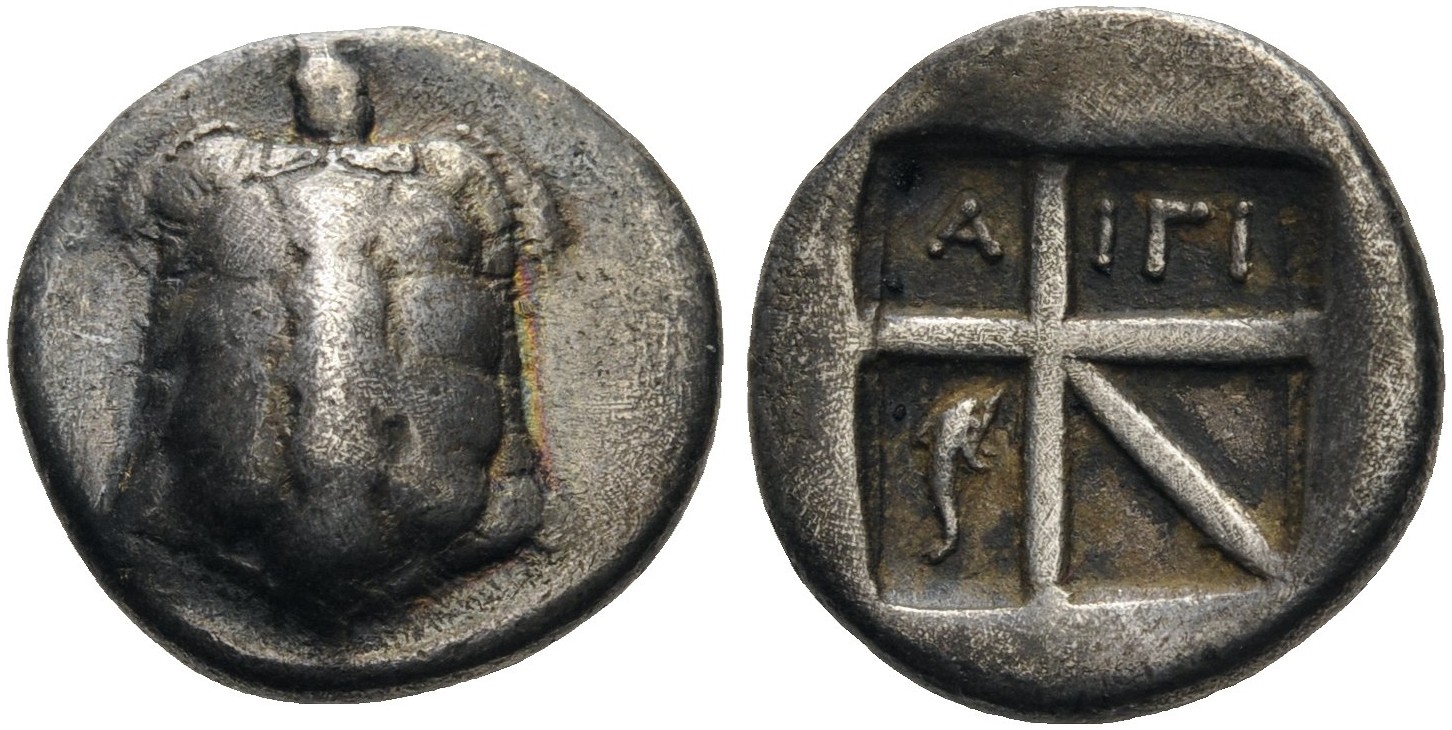 AIGI for Aegea |
|
Pillar of the Community
Russian Federation
5186 Posts |
The problem with Russian coins is not as much the language itself as 1) the 1918 orthography reform (though a 5th grader would probably know of that), 2) the occasional abbreviations (a common example is KNS or KNZ for "kniaz"), 3) words running together (no spaces) and line breaks in weird places, 4) unusual letter shapes (and/or some letters that aren't used anymore, though that partly falls under the "1918 reform" clause), and 5) small flans, so it's almost impossible to find a coin with a full legend. The language itself didn't actually change that much. With that in mind, something like this denga from the early 1540s should probably be recognizable, if only because the lines correspond exactly to words:  KNSb BE/|IKI IBAN ~= "Kniaz veliki Ivan" ~= "Great Prince Ivan" (IV the Terrible, as it happens). I don't know enough about pre-unification (14th-15th century) coin legends to say which ones would be recognizable; again, in practice, most of them would never actually appear on a coin fully. |
|
Pillar of the Community
United States
6370 Posts |
I would say Greek coins might have that title, but Chinese coins would give them a run for their money. The script on Chinese coins was standardized at the beginning of the Qin in 221 BC into what the Chinese language is today. The inscription on the Ban Liang uses modern-day characters in seal script, and they go back to 350 BC. From 221 BC to 618 AD, almost all of the Chinese coins had inscriptions written in seal script, and it is debatable that the fifth graders would recognize the characters in that form.
|
| |
Replies: 13 / Views: 1,829 |
|










 Posted 08/10/2016 4:23 pm


