PCGS:
What is Coin Grading?Grading is a way of determining the physical condition of a coin. Grades range from Poor (almost completely worn out) to Perfect Uncirculated (a coin with absolutely no wear and no flaws of any kind). Over 99.9% of all coins fall somewhere between these two extremes.
Coins that have been properly stored since the day they were minted are called "uncirculated" or "mint state." If a coin saw circulation for a short time but still looks nearly brand new, it is called (or graded) "About Uncirculated." After that, the grades in descending order are:
EF: Extremely Fine, VF: Very Fine, F: Fine, VG: Very Good, G: Good, AG: About Good, FR: Fair, and PO: Poor
Uncirculated coins have different grades as well, depending on how carefully each coin was made, handled, and stored. Some uncirculated coins have heavy marks caused by contact with other coins during minting or storage. Other uncirculated coins are nearly free of such marks. The coin in the best state of preservation will almost always have the greatest value.
Photograde link:
http://www.PCGS.com/photograde/PCGS Coin Facts link:
http://www.PCGScoinfacts.com/NGC:
Coins We Grade:Some coins are ineligible for numeric grading due to
detrimental surface conditions, like environmental damage, improper cleaning, surface alterations, mechanical damage or repairs or mint-made irregularities. These coins are
NGC Details Graded. Coins submitted to NGC are either graded numerically
(if they have acceptable surfaces) or with
Details Grading, at the discretion of NGC's grading team. Each Details Graded coin receives a grade that relates the amount of wear present due to metal loss during circulation. Following the Details Grade will be a description of the noteworthy surface condition.
IMPORTANT NOTES: Certain coins are not eligible for NGC grading and encapsulation:
1. Coins that have
altered dates, mintmarks, and coins that are not genuine or of questionable authenticity are not certified by NGC
2. Coins with stones glued to the surface or inset.
3. And coins with active surface residues such as PVC cannot be certified by NGC; such coins must be conserved to have harmful residue removed prior to certification.
NCS Conservation: Effects of Improper Cleaning:When a coin is improperly cleaned, surface metal is forcibly removed from the surface by either mechanical or chemical means.
When a coin comes back graded with the qualifier
"improperly cleaned" it can be disappointing. Some numismatists almost take it personally as an accusation rather than the simple description of the coin that it is. As numismatists we strive to acquire coins that are as natural and damage free as possible. This drive is so great that occasionally coins can receive treatments that may be intended as beneficial but in actuality are very damaging.
What makes a coin improperly cleaned is important to identify when considering new coins to add to the growing collection. When we speak of cleaning on a coin we are almost always
referring to a type of damage to the original surface. Identifying improperly cleaned coins is important as those coins with damage trade at a
diminished premium. Improperly cleaned coins typically come in two distinct types: improperly cleaned by
mechanical means and the less common chemical means.Typically a mechanical improperly cleaned coin will
feature certain telltale signs. Of these features, the most prominent are the
presence of large areas of parallel scratches.]/u] These parallel scratches can be across the entire coin or in just a particular area. Looking at the coin at a variety of angles will help make the nature of these scratches clear. The scratches are caused by [r]metal removed from the surface of the coin and is an indication of a coin that has been cleaned through mechanical means. While some other phenomena can make the appearance of parallel scratches on the surface of a coin, the scratches of a coin that has been improperly cleaned are distinct in one important way. Scratches that continue from the field (background) over the devices(details) and legends are a sign of improper cleaning.
While patches of hairline scratches are a quick identifier for most coins that have been improperly cleaned, there are other features to look for. An even granular texture to the surface of the coin or an unusual color, especially with copper coins, can be indications that a coin has been improperly cleaned by chemical means.
Once a coin has been improperly cleaned it is natural to question if a coin can be properly cleaned. It's a common request of NCS services. When a coin is improperly cleaned, surface metal has been forcibly removed from the surface by either mechanical or chemical means. Once this metal has been removed, sadly this cannot be replaced. In the case of a coin that has been mechanically cleaned, any attempt in removing scratches will result in additional scratches, further damage, and a less desirable coin.
While it may not be possible to reverse the effects of an improper cleaning, discovering a coin in your collection that has been improperly cleaned is far from a loss. A coin that has been improperly cleaned may still be authenticated and certified with a qualifier. By examining the features that make this coin deemed improperly cleaned, coins with similar damage may be better identified in the future.
ANACS:
What is PVC residue?
PVC residue is a surface contaminant that may be caused by storing a coin in a soft, pliable vinyl flip. The amount of time a coin needs to reside in a vinyl flip before the PVC film develops will vary significantly, depending on temperature, humidity, the age of the flip, and the type of coin. Under optimal conditions, PVC residue can begin to form in as little as two weeks. At ANACS, we only use Mylar flips. Mylar flips are free of all PVC.
The composition of a coin is a strong factor with the formation of PVC residue.
A gold or platinum coin will be the most resistant, a silver coin is next, and a copper or copper-nickel coin will be the most susceptible. Copper and copper-nickel coins are also highly susceptible to corrosion and/or spotting from excessive moisture and high emperatures. Due to this, collectors need to be extra careful with their choices of storage materials for these coins.
During the manufacturing process for soft vinyl flips, an agent is added to increase pliability. The main reason for this is to allow the flips to be reused without breaking or tearing. This softening agent will migrate out of the plastic over time, and becomes the surface film that is called "PVC Residue." As this film continues to degrade, it eventually turns into a mild acid, and begins to attack the surface of the coin. Until the film is removed from the coin, it is usually not possible to tell if the coin has been damaged. Additionally, this chemical reaction can continue even if the coin is sealed in an inert plastic holder. This is why ANACS does not encapsulate coins with active PVC contamination.
Recognizing PVC residue is not always easy. When the residue begins to form, it often appears as light milky spots on the coin. PVC residue also appears as streaks or a light haze, and ranges from nearly white to dark green or gray. If the coin has enough contamination, and your sense of smell is good, you will detect an odor that imitates the smell of a new plastic shower curtain.
[u]Make sure to use the hard flips that don't smell like a plastic shower curtain.Does ANACS certify "problem coins"?Yes. ANACS is the first major grading service to grade cleaned, corroded, damaged, repaired, and other "problem coins". Label's display a coin's "detail grade" and the coin's corresponding problem(s). "Details" Graded coins are not eligible for the ANACS Guarantee.
The previous information was from the three web sites of PCGS, NGC and ANACS. If you would like more information on them, just search the internet. They have a lot more information that I didn't post. But some good suggestions on how to grade your coins.
Coins with scratches on the surface that are easily seen will lower the grade a lot. Usually about 90% loss of value. So these you can put back into circulation or save as educational pieces. Coin that are Dark colored are ones I toss back into rolls to go back to circulation. Probably the best advice on what to save is this: Ask yourself this question; "Would I buy this coin?" If not, I toss them back into circulation. There are a lot damaged coins out there that are ones to put back into circulation. Finger prints, carbon spots, split plating, orange rind texture on Zincolns are one to put back into circulation. A lot of coins are found outdoors and have a red color on them, they can go back into circulation or carry them in your pocket to see them antique. The red will come off the tops of the devices, leaving the red/black color on the fields.
Here is a grading guide:
Shelton Grading Scale 0-70:
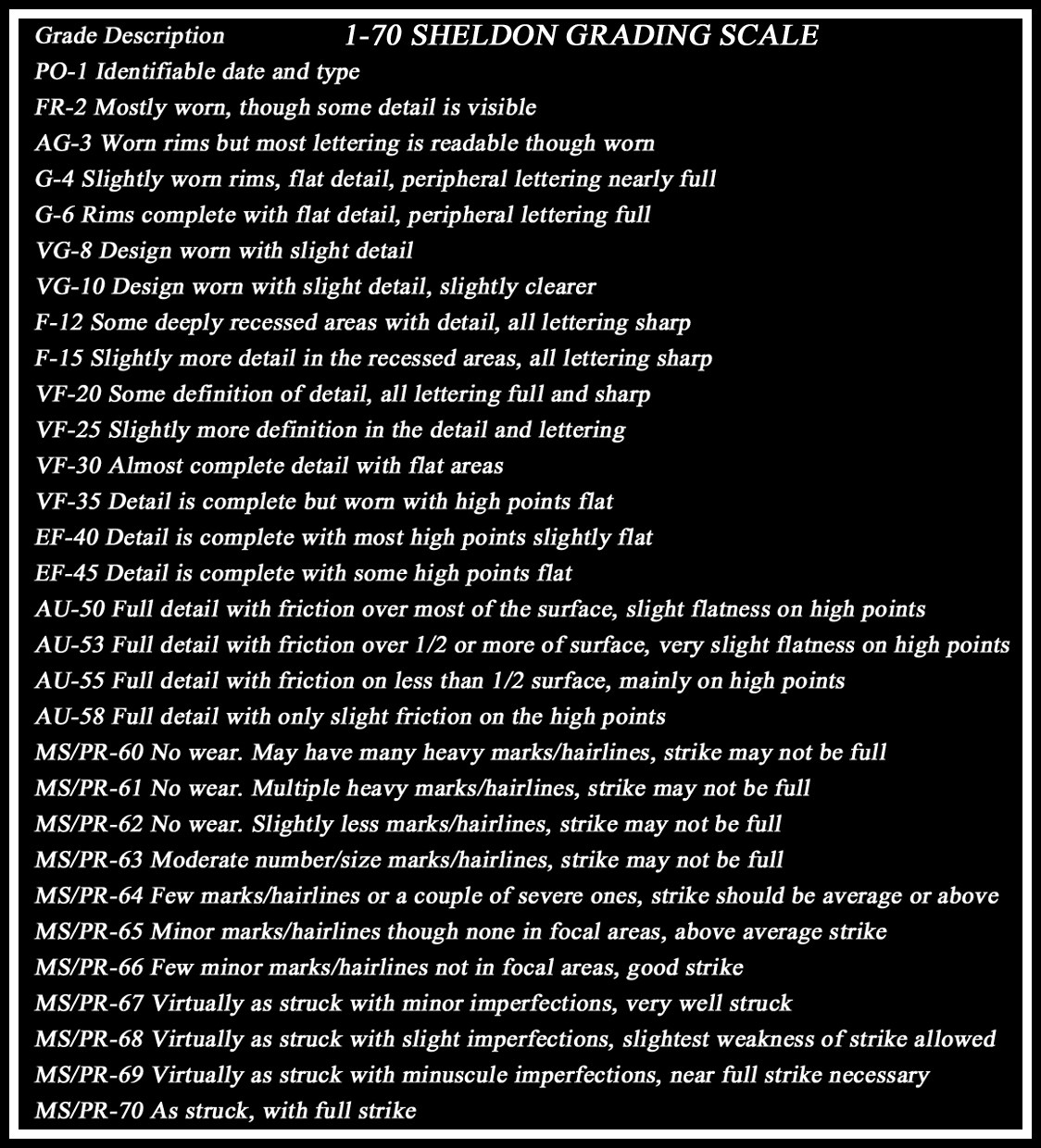
This is a set of images for the
Standing Liberty quarters, But the information can be used on all coins for grading. I put some surrounding grading information on these images also. Not all grades have images. But if you want a set for a certain series of coins, check out the PCGS photograde. They have all the U.S. Coins Covered.
G-6  VG-8
VG-8  F-12
F-12  VF-30
VF-30  EF-45
EF-45  AU-55
AU-55  MS-63
MS-63  MS-64
MS-64  MS-65
MS-65  MS-66[/b]

Hope you will enjoy this thread. I will probably add more on to as time goes along, or start another one. If you want to copy this, that is the best way to save time. Save time? You know when you forget to copy something and you try searching for it another time and sometimes you just don't find it. So save time and copy what you will us again and again.







 Posted 08/17/2016 09:41 am





