| Author |
 Replies: 13 / Views: 6,073 Replies: 13 / Views: 6,073 |
|
|
Pillar of the Community
United States
9395 Posts |
In order to not hijack the other thread, I'll put the comparison photos here. ----------------------------------------------------------- The 10X microscope objectives in this comparison:
Part number           Markings
------------------    ------------------------------------------------------------------
Nikon MUE10100        LU Plan Fluor  OFN25   Epi        10x/0.30 A  oo/0     WD 17.5

Nikon MRL00102        Plan                              10X/0.25    oo/-     WD 10.5

Nikon MRP70105        MTB C20 Plan                      10X/0.25    oo/-     WD 7.0

Nikon MRP70100        MTB CFI E Plan Achromat  OFN20    10X/0.25    oo/-     WD 7.0

Nikon MRN70100        BE Plan OFN18                     10X/0.25    oo/-     WD 6.7

Mitutoyo 378-803-3    M Plan APO f=200                  10X/0.28    oo/0     (WD 33.5)
These were used with a Thorlabs ITL200 200mm tube lens. The spacing in front of the tube lens was about 120mm (in middle of the 70-170mm range specified by the manufacturer) for the Mitutoyo and about 130mm for the others, since the Thorlabs SM2 thread to RMS, M25, and M26 adapters have different lengths. The camera is a Canon T6s with an APS-C sensor that has 3.72 micron pixels. - - - - - - - - The first comparison is with 2X Canon EF teleconverter to reduce the influence of pixels on the result. The light source is an unfiltered Jansjo light. The 9-3 group in the AF test chart was at the approximate center of the field in these shots. Numerous images were taken around the approximate best focus as determined by 10X live view, using a 1 micron focus step increment. Looking at the shots seemed to show the sharpest images were not when the lines in the AF test chart were darkest, but rather when they were a lighter red/purple color (except for the Mitutoyo). I let Zerene Stacker (PMAX mode) impartially decide which shots were the sharpest, and the resulting stack is shown in these results. (Added note: The original APS-C images are 4000x6000 pixels. A 200x200 pixel area was cropped out (either from the center or upper-left corner), and enlarged 500% to 1000x1000, using the Photoshop "nearest neighbor" resizing method. This means each original sensor pixel becomes a 5x5 square in the enlarged image. The TIFF files were compressed to JPEG using GIMP (quality=75, with no resizing), and uploaded to CCF, where the forum software may have further resized, resampled, or compressed them.) - - - - - - - - - - - - - - - - Nikon BE Plan: 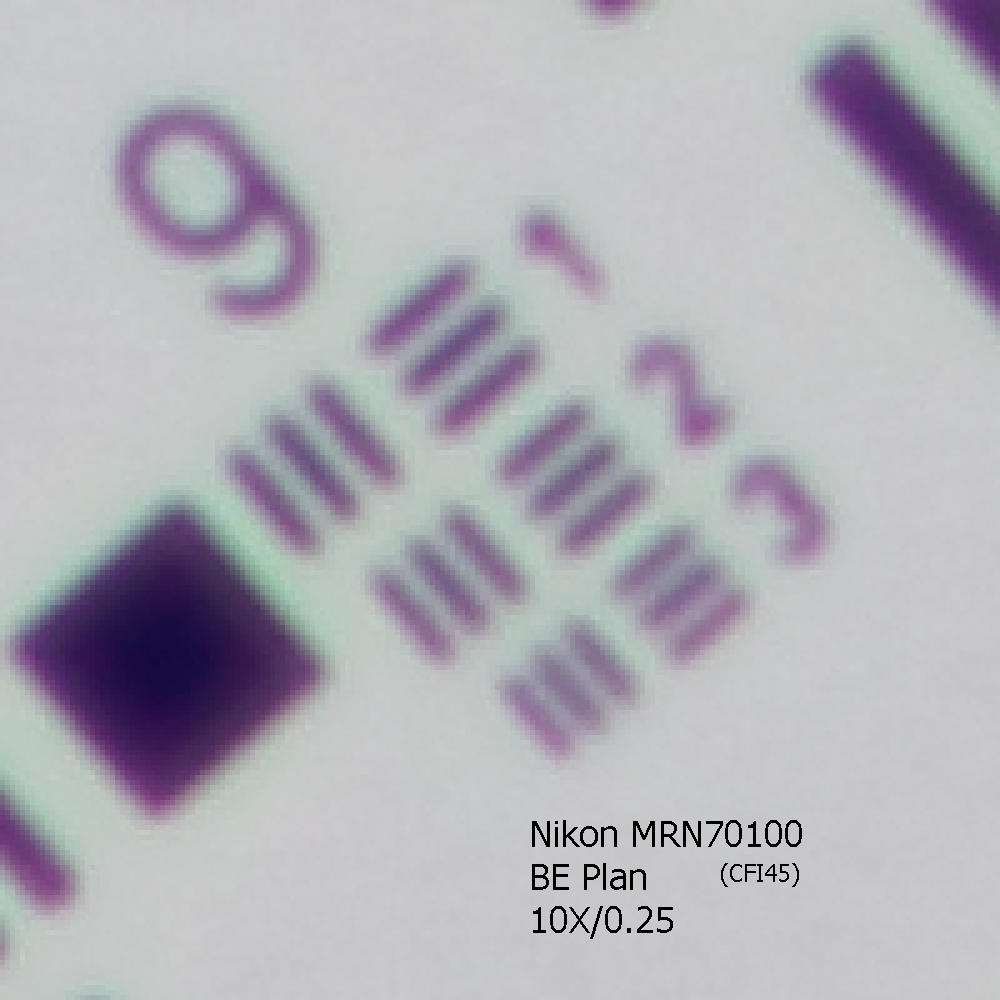 Nikon E Plan: 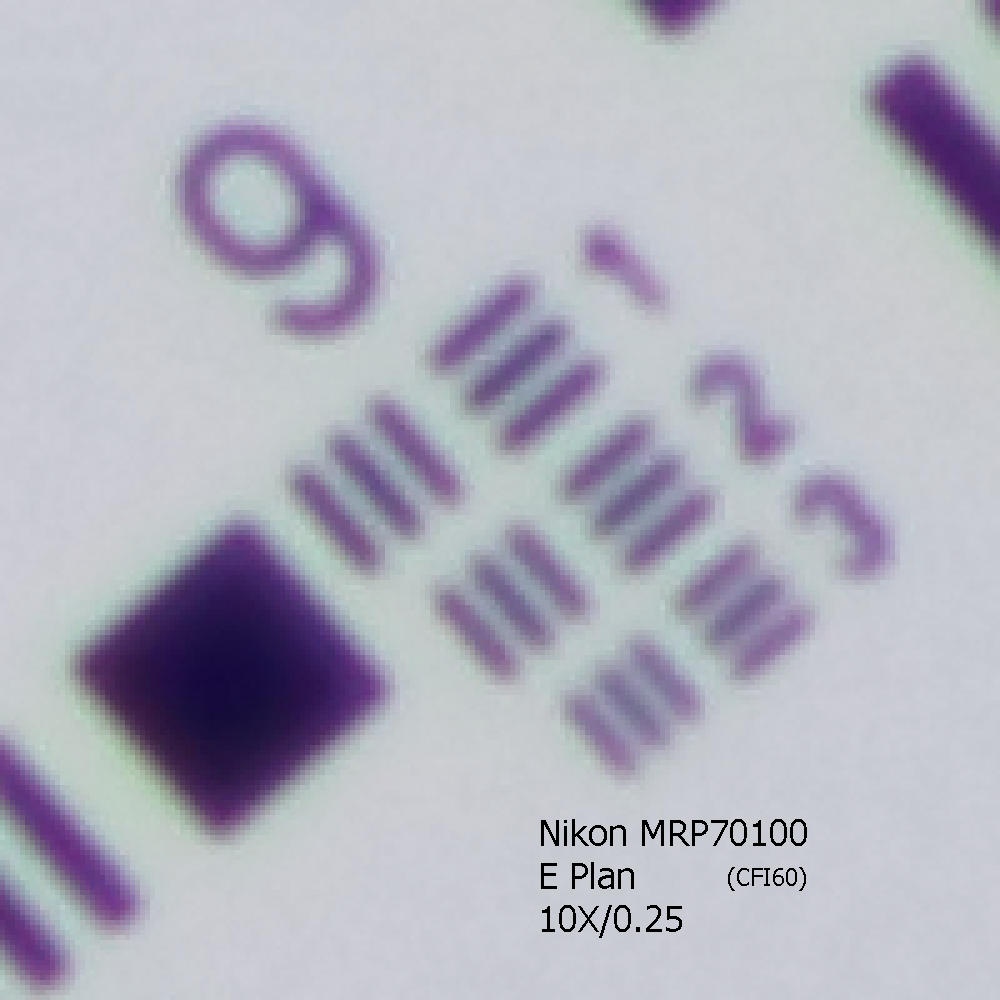 Nikon C20 Plan: 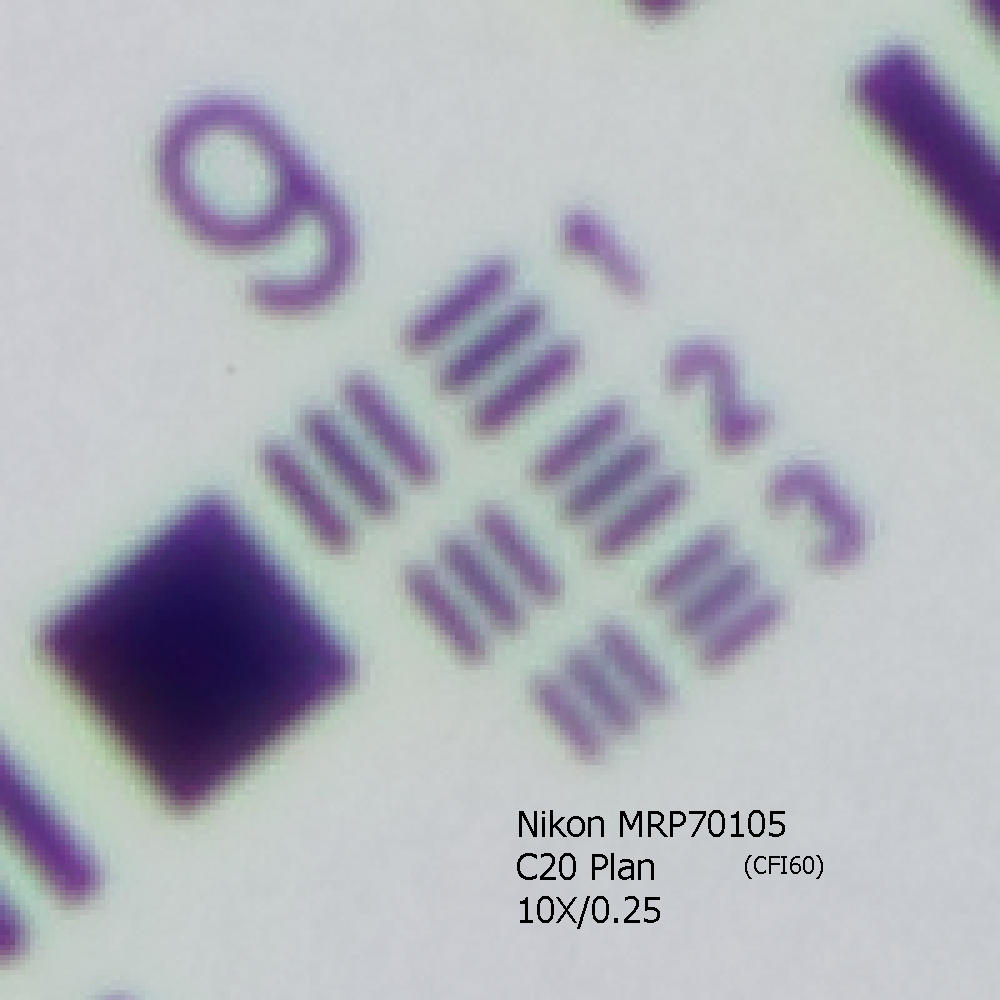 Nikon Plan: 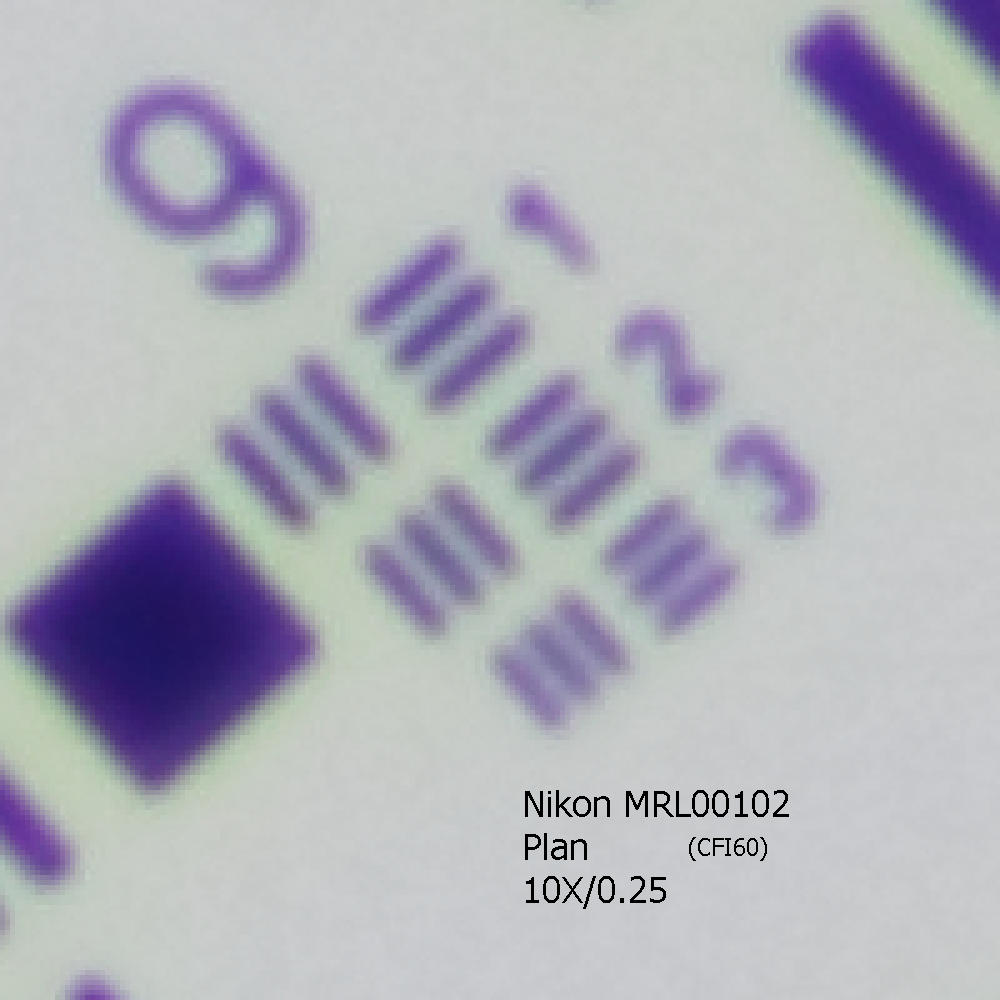 Nikon LU Plan Fluor:  Mitutoyo M Plan APO:  In this series of shots, it's unclear which one is the sharpest, but the Nikon LU Plan Fluor possibly edges out the Mitutoyo. I don't know how fair the test is, since the sharpest image for the Mitutoyo probably includes all or most of the wavelengths from the Jansjo, but the sharpest Nikon image may be favoring a subset of wavelengths at the point of best focus. It looks like the Mitutoyo has the best color correction in these shots. It's not clear how much CA is added by the teleconverter and tube lens (which is designed for Plan Fluor objectives, not APOs). Edited by pepactonius
08/20/2016 2:39 pm
|
|
|
|
Pillar of the Community
 United States
9395 Posts |
In order to reduce the effects of CA on the test results and to look at sharpness at the corners, I did a 2nd test with no teleconverter. An Astrodon green filter from the Tru-Balance LRGB I-series generation 2 CCD filters (used with monochrome cameras for shooting color astrophotos) was used to filter the light from the Jansjo. It looks looks like the passband for this green filter is from about 490nm to 570nm. In these shots, the center set was shot with the 9-3 group near the center of the sensor, and the 9-3 group was placed about 13mm from the center for the corner set (max distance is 13.4mm for the Canon T6s sensor). Note that the ITL200 tube lens has a "diffraction limited" image circle of only 25mm, so these corner shots were outside that image circle by about 0.5mm. Some of the fuzziness in the corner images may be caused by the tube lens. Added note: The stacks for the center and corner shots were independently focused, so any field curvature should not affect the sharpness of these test shots. - - - - - - - - - - - - - - - - - - - - - - - - - Nikon BE Plan (Center): 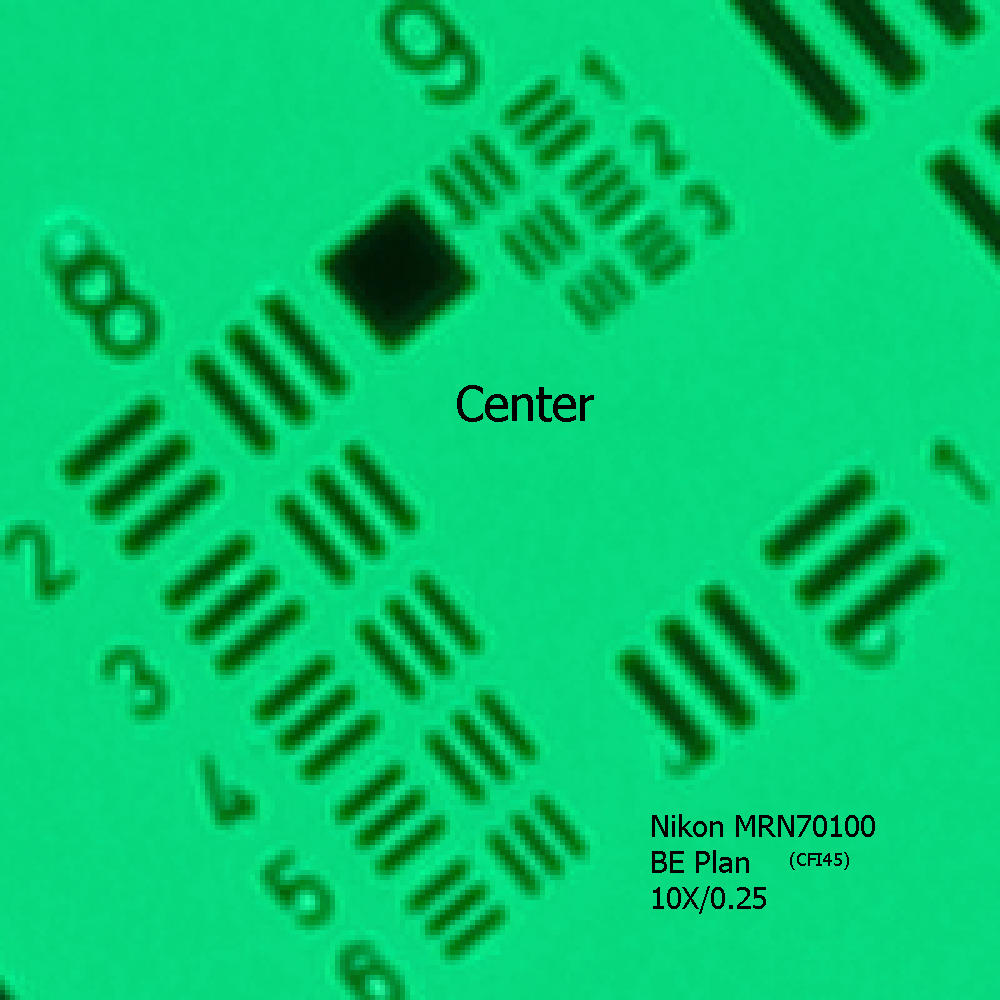 Nikon BE Plan (Corner):  Edited by pepactonius
08/20/2016 3:05 pm
|
|
Pillar of the Community
United States
9395 Posts |
Nikon E plan (center): 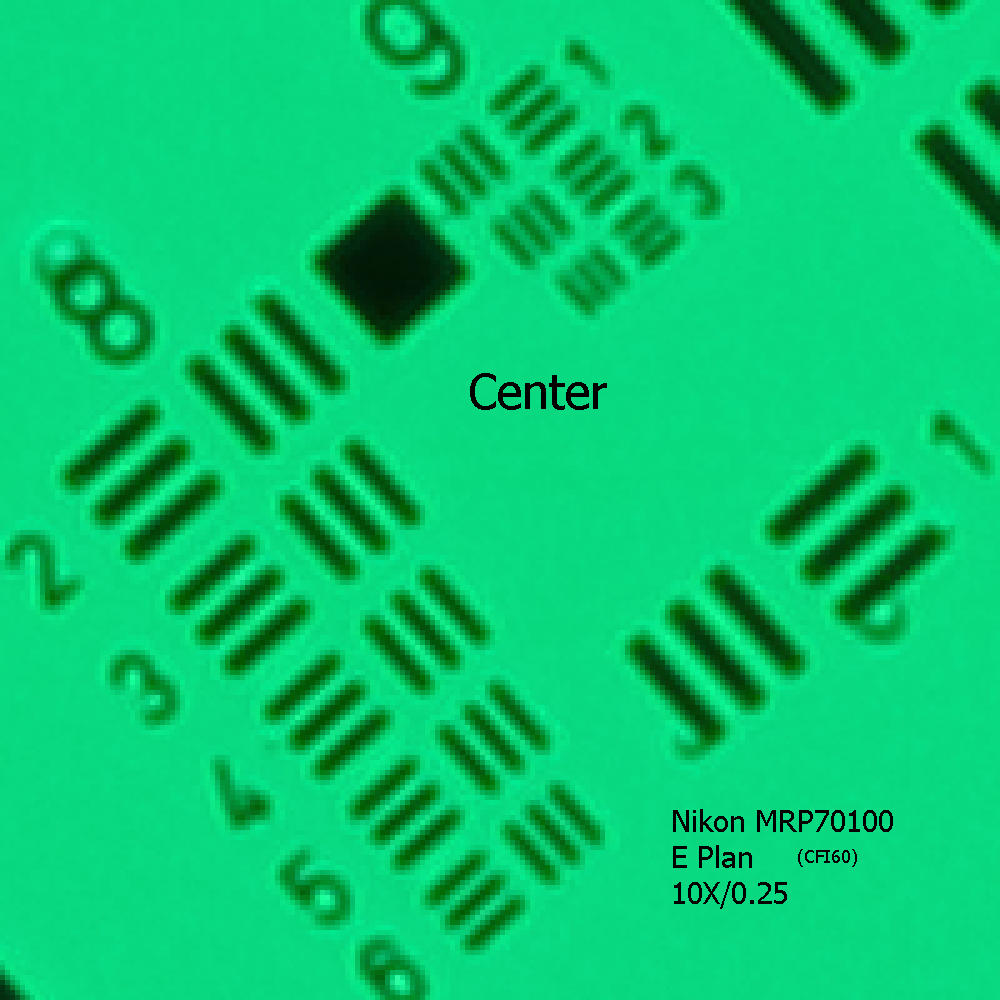 Nikon E Plan (corner):  |
|
Pillar of the Community
United States
9395 Posts |
Nikon C20 Plan (center): 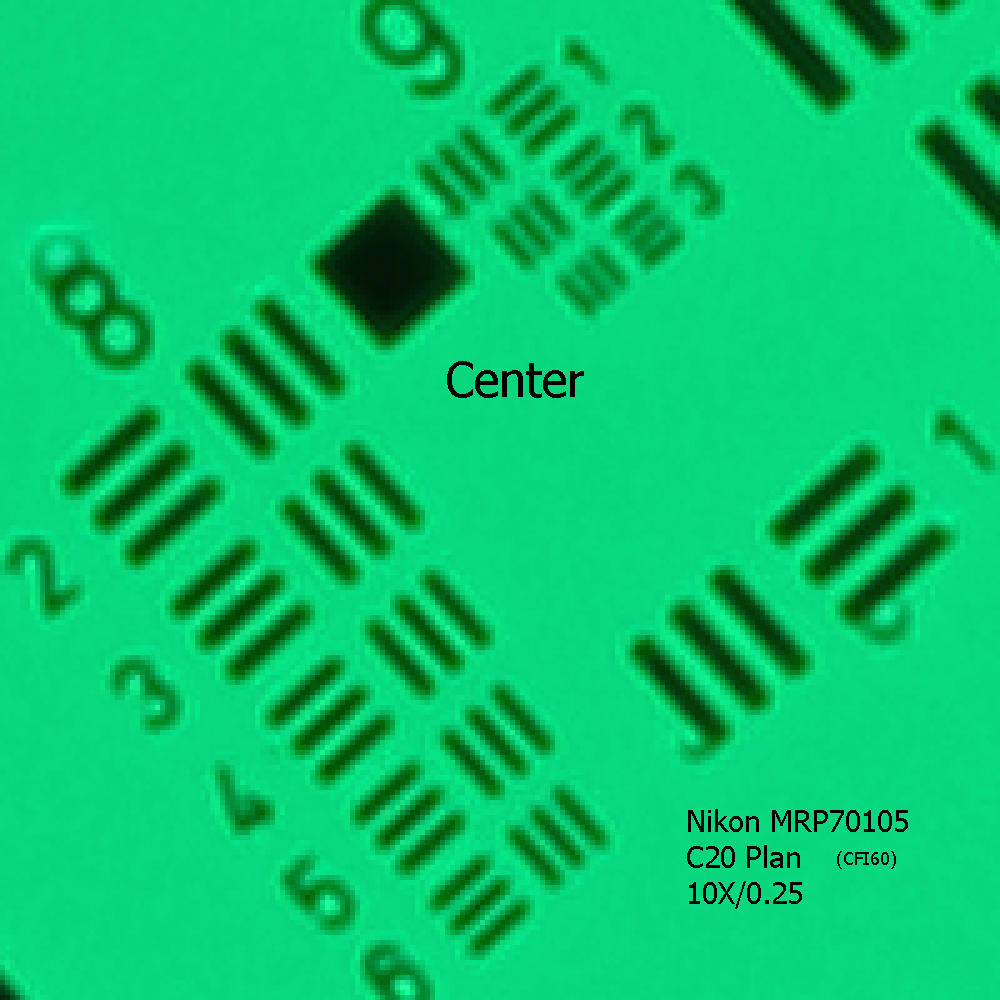 Nikon C20 Plan (corner):  |
|
Pillar of the Community
United States
9395 Posts |
Nikon Plan (center): 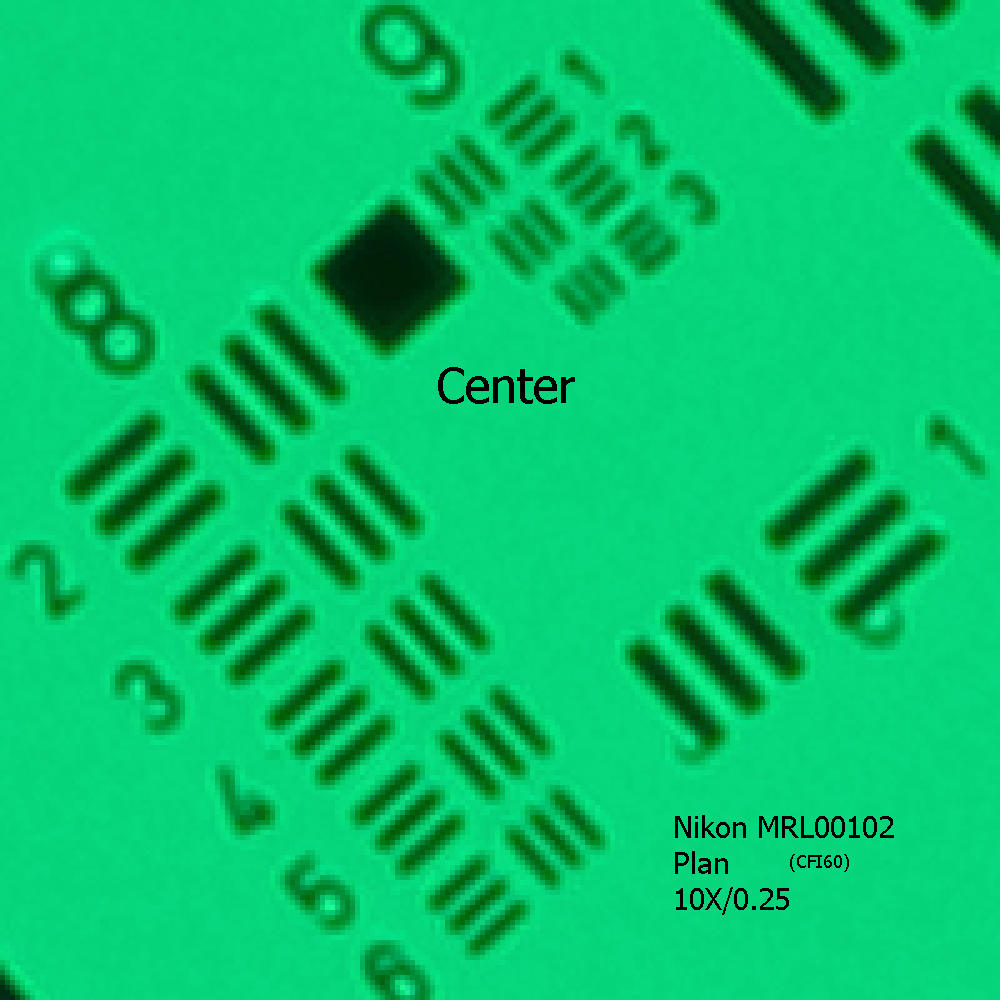 Nikon Plan (corner):  |
|
Pillar of the Community
United States
9395 Posts |
Nikon LU Plan Fluor (center):  Nikon LU Plan Fluor (corner):  |
|
Pillar of the Community
United States
9395 Posts |
Mitutoyo M Plan APO (center):  Mitutoyo M Plan APO (corner):  --------------------------------------------------- In these shots, most of the objectives are pretty sharp at the center. The Nikon LU Plan Fluor and the Mitutoyo seem to be about the same at the center. There is more difference at the corner. The Mitutoyo and Nikon LU plan Fluor are the sharpest at the corner, but fuzzier than at the center. The field number for the Nikon is supposed to be 25mm, so the corner shots are slightly out-of-bounds. I have no idea what the field number is for the Mitutoyo, but there are posts over at Photomacrography.net that say it can cover a full-frame sensor well, given the right tube lens (perhaps a camera lens or a Raynox). The other (cheaper) Nikon objectives are much worse at the corner. Some of these have a field number of just 20 or 18, so I suppose some fuzziness is expected. In summary, it seems that the Mitutoyo is approximately as sharp as the Nikon LU Plan Fluor, with much better working distance and much less CA. This seems to be the one to use, unless you have the high-resolution Mitutoyo (NA=0.42), which is much more expensive (too expensive for me). I guess there's nothing surprising here. I need to work on the field curvature tests, but probably just for the Mitutoyo and Nikon LU Plan Fluor, since all the others are so bad at the corners. |
|
Pillar of the Community
 United States
4051 Posts |
Nice comparison work! The LU seems sharper in the corner than the Mitutoyo. Maybe due to optimum matching to tube lens?
All the shots look quite pixelated. Are you presenting at 200x, 400x, or ?
I found that the glass of my 1951AF target was skewing sharpness and CA. Shooting from the back seemed to be better but I have not done extensive testing with it yet.
|
|
Pillar of the Community
United States
9395 Posts |
Quote:
Nice comparison work! The LU seems sharper in the corner than the Mitutoyo. Maybe due to optimum matching to tube lens?
All the shots look quite pixelated. Are you presenting at 200x, 400x, or ?
I found that the glass of my 1951AF target was skewing sharpness and CA. Shooting from the back seemed to be better but I have not done extensive testing with it yet. I suppose the tube lens makes a significant difference at the corners, especially outside of its designed image circle. Perhaps a 200mm full-frame camera lens would work better at the corners, although it would be much tougher to make a rigid setup. These are all 500% crops -- I added a note about the cropping and resizing to the OP. This test target has the markings on the upper surface, facing the objective, so you don't have to shoot through any glass. I'd think that shooting through 1+ mm of glass would cause severe aberrations for these 10x objectives, but I didn't try it. In the table at the top of the OP, notice how the NA .28 and .30 objectives specify 0 cover glass thickness. The .25 NA objectives specify "-", so a 0.17mm coverslip apparently doesn't matter for them. I guess with a NA of .28 or .30, the 0.17mm of cover glass starts to cause noticeable problems? I would guess that 1+mm would cause severe image degradation for all these objectives? Shooting through the glass of the test chart might be something like doing a stack through a plastic slab. For this, I usually use the 0.14 NA Mituoyo 5X, which should tolerate 16x more coverglass thickness (2 mm or so?) than the 10X Mitutoyo. |
|
Pillar of the Community
United States
9395 Posts |
Here's an actual coin pic with the 10x Mitutoyo. This was made using Zerene Stacker DMAP mode, with 55 slices, but unknown stack increment. The full frame shot (4000x6000, reduced to 960x640, using GIMP sinc/lanczos resampling):  An unreduced 1000x1000 crop near the center:  An unreduced 1000x1000 crop at the top left corner: 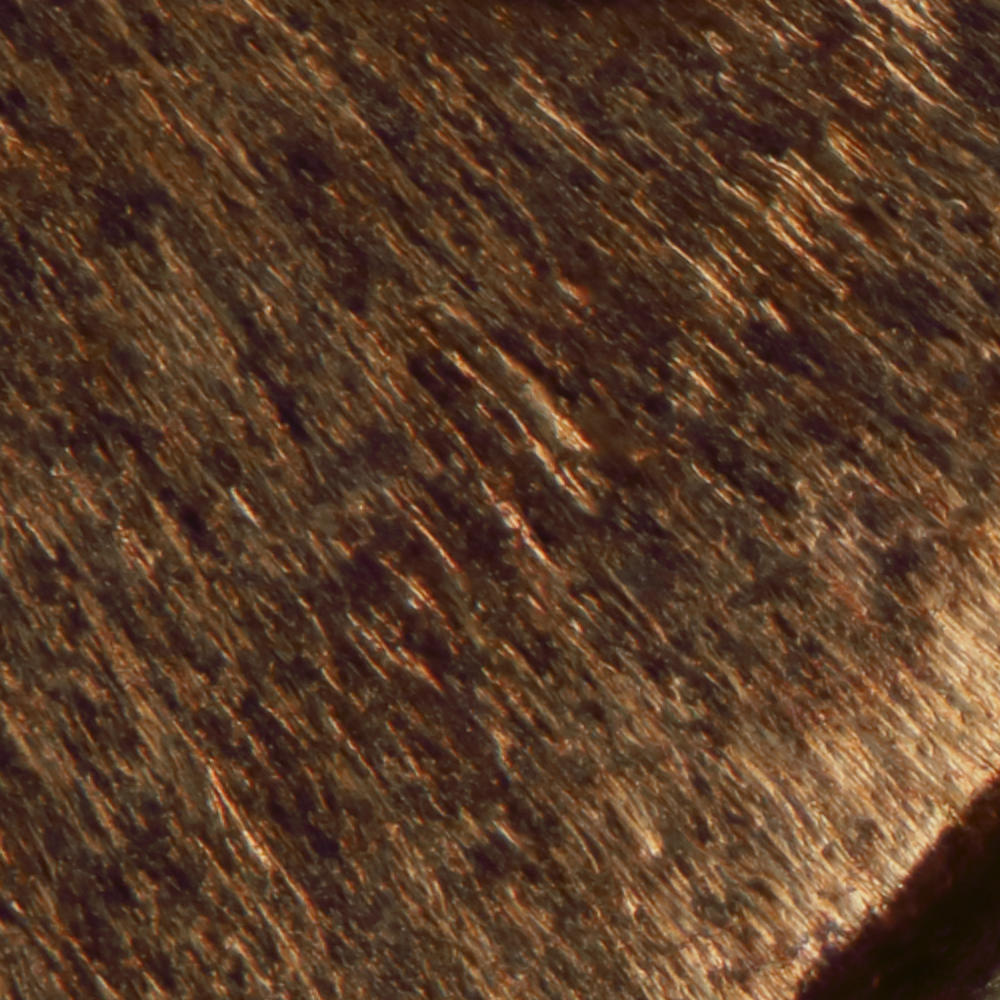 From these photos, the corner fuzziness is with the Mitutoyo 10X and ITL200 tube lens doesn't seem too objectionable. |
|
Pillar of the Community
United States
4051 Posts |
Very nice. Nice 56-D/D RPM#1 as well! I have not started using my new Mitutoyo for coin photos yet. Too busy with other things...
Contact me for photographic equipment or visit my home page at: http://macrocoins.com |
|
Pillar of the Community
Canada
2784 Posts |
pepactonius totally excellent. very well done nice work.
|
|
Pillar of the Community
Canada
2784 Posts |
pepactonius. question your statement:Here's an actual coin pic with the 10x Mitutoyo. This was made using Zerene Stacker DMAP mode, with 55 slices, but unknown stack increment.
my question do you slightly tilt the coin. meaning make the coin just slightly higher on one side. then focus stack from the high side moving. toward the lower end of the coin. would that be how you would get 55 slices.
|
|
Pillar of the Community
United States
9395 Posts |
Quote:
my question do you slightly tilt the coin. meaning make the coin just slightly higher on one side. then focus stack from the high side moving. toward the lower end of the coin. would that be how you would get 55 slices. The coin was as flat as possible for this stack. The focus stack required 55 slices because I was using an unusually small stack increment for this test, so as to make sure there were no slightly fuzzy bands in the composite stack. I didn't record the stack increment, but it probably was 2 microns, since that is easiest with the fine focus wheel in my setup (no StackShot). For normal stacks with the 10x/28 Mitutoyo, I'd probably use 5 micron steps, since that's fairly easy as well. With 5 micron steps, inaccuracies in the Zeiss fine focus mechanism might cause excessive spacing between some slices. I don't know how accurate the fine focus is, but with 2 micron steps, I was hoping to reduce the chances of excessive spacing. |
| |
Replies: 13 / Views: 6,073 |
|







 Posted 08/20/2016 08:58 am





