|
This page may contain links that result in small commissions to keep this free site up and running.

Welcome Guest! Registering and/or logging in will remove the anchor (bottom) ads and the security checks. It's Free!
To participate in the forum you must log in or register. | Author |
 Replies: 10 / Views: 1,785 Replies: 10 / Views: 1,785 |
|
|
Valued Member
Netherlands
91 Posts |
As my first "real" post on this forum, I thought I would go with of my favourite coins present in my collection. Frequent visitors of Zeno.ru might have already seen it, but I'm guessing many of you haven't. As I have stated before, I am certainly no expert on the area of authentication, especially on these spade coins, I might have picked up a thing or two along the way, but again, definitely no expert. Nevertheless, I am assuming/have an inclination towards it being genuine, but I am obviously not sure. This spade originally came from an auction house of a German numismatic author and has been looked at and passed as genuine by the lovely gents at Zeno.ru, including B.W. Smith. But please, should you notice anything odd, I encourage you to tell me, even the best make mistakes! 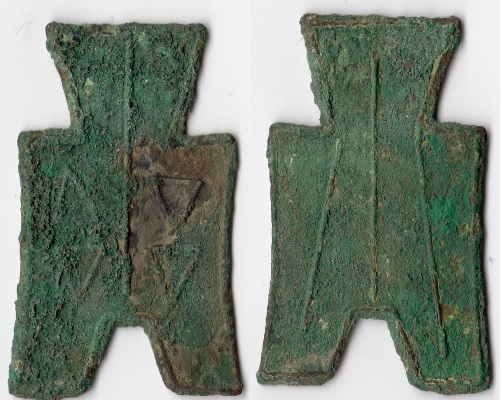 I am going to spare you the entire story of how the spade coinage came to be, I believe Thomas did an excellent job at that a while ago. And please note that some of the coins he posted are probably 10 times as rare; I just really enjoy this one and it has a rather interesting backstory. This spade falls under the category of the "square-foot spades" (Fang Zu Bu, #26041;#36275;#24067;), issued from approximately 350 to 221 BC. It was probably minted within the state of Liang (Wei), one of the central kingdoms during the Warring states period . The dimensions of this coin come in at 47 mm by 29 mm, rather average for this type, and the weight is a little on the high side; it weighs in at 6.38 gram, probably due to the corrosion on the obverse. The reading of this spade has been a discussion for a long time. Among early collectors, the consensus seemed to be that the character pictured on the obverse had to be "T'ai (yi)" (#37040; or #21488;#37009;, with or without the "yi"-radical attached), as quoted by Terrien de Lacouperie in 1892 (nr.426-27), Chinese scholar Ding-fu Bao (English translation by George Fisher, nr 255) and by Coole in the third volume of encyclopaedia on page 314. The "T'ai" they attribute it to was famous for being the ancestral home of the Ji-clan, which history would better remember as the Zhou, who overthrew the Shang-dynasty and founded their own dynasty, during which we later found out these types of coins were issued. This attribution was probably, like a large part of the nineteenth -century archology, wishful thinking; T'ai, probably close to the modern day city of Wu Gong, was located to the west of Xi'an city, which during the warring states era would be in the state of Qin, a state, in which we are now almost certain no spade coins of this type were issued. Hartill, in his excellent 2005 catalogue , attempts to fix this problem; He still keeps the T'ai reading (nr. 3.378), yet describes it as being a short version for the city of Tai Yang (#37040;#38525;), located in the state of Liang (Wei). While this is a rather plausible theory, the leading theory, widely accepted in China, differs a little. Instead of reading the character on the obverse as being T'ai, they read it as being "He (yi)" (#21512;#37009; or #37059;), which would also be an abbreviation, but for the city of "He Yang" (#37059;#38525;). This city, also being located in the state of Liang, was close to the banks of the yellow river, an area well protected by one of Liang's long walls, until the state's fall in 225 BC. The funny bit is that Coole (Hartill does not seem to mention it, or sees it as a script variety of 3.378) also attributes a spade to this "He Yang" (vol. 3, page 126), a version rather similar to mine (for example, look at the closed "triangles"), but mirrored and the bottom part of the "He" character being more roundish. Did Coole make a mistake, and did he make two catalogue entries for one type of spade? Or did he correctly identify two distinct varieties? To be honest, I am not really sure, and would love to hear your opinion. Only having limited knowledge of Chinese, having taught myself a little bit of etymology, I cannot come to a definitive conclusion. As for the reading and geographical place name associated with the latter; I am equally undecided. Both readings make sense to me, and so do the attributions to Tai Yang and He Yang. The rarity of this coin is a little above average for this type; not common like some of the Anyang spades, but also not the rarest spade coin there is. Hartill gave it a 8/16, the highest given to a small square-foot spade being a 6/16. In the 1930's, Ding Fu-Bao priced it a four dollars, as opposed to 10 cents to 2 dollars for the more common spades. Both these ratings however, are for the script variety with protruding lines in the character; the "triangles" (hate calling them that, but okay) on mine are rather neat and closed. One precise such example is given in Ma Feihai's 1988 "Pre-Qin Money" and is in the possession of the Shanxi Provincial Museum (picture here). Feihai gives it one star, out of a possible four, making it somewhat scarce. So what do you guys think? Should all the different type of calligraphy be considered as the same character? Or are they two or three different ones? Overall, there seems to be a general agreement that the coin should be read as "he", short for "He Yang", and I am inclined to believe. Nevertheless, a good discussion never hurts! Anyway, I hope someone will have found this interesting and please, if you have questions or if I mentioned anything wrong, do comment! With ever so kind regards, Mika PS. Attached are a few scans from some catalogues mentioned, for visual aid (my writing may not always be that clear). From left to right: Hartill 3.378 (also Coole page 314), variety with "protruding lines", reading "Tai". Coole page 126, given reading "Ho (He in Pinyin)"; lastly, The variety similar to mine, "closed triangles", listed in "Pre-Qin Money" by Ma Feihai, originally unearthed in 1963, currently in the Shanxi-Provincial museum with reading "He". 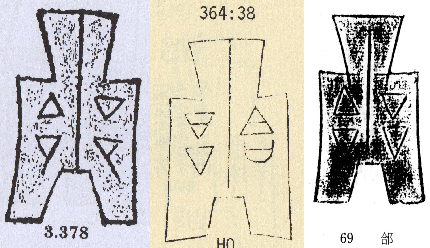
|
|
|
|
Moderator
 United States
23731 Posts |
 to the community I know very little about these coins so I can not comment if its genuine or not. But I enjoyed reading this thread it was very informative. |
|
Pillar of the Community
United States
7067 Posts |
Welcome, Mika, and thanks for sharing. Lovely example and great write-up. I look forward to seeing Thomas' (TypeCoin971793) reply to your questions.  |
|
Pillar of the Community
United States
6370 Posts |
Yay! Someone with a similar passion as I! We are few and far between. First off, nice coin! As far as authenticity is concerned, if the guys at Zeno says its good, then I believe it is good. I, however, would have been leery about this coin. These early spade coins were characterized by needle-sharp rims and characters, and I'm not seeing those here. While those characteristics are the norm for spade coins, that does not mean that it applies to all of them. I have just noticed those things on all of the common varieties, which I see and handle most often, and I have learned (perhaps erroneously) to expect them. I have seen thick rims/characters in some Stephen Album auctions, so I'm sure that some varieties exist with those attributes. I have seen too many fakes with thick characters/rims to be comfortable buying one. Since I am a type collector, not one looking for scarcer varieties, I would have passed this one by and bought one I was more comfortable with. My method of authentication is to observe the style/fabric of the coin and the patina present. The first is easy to do by looking at as many genuine coins as possible (look at auction photos, inventory from reputable sellers, etc.), and, if possible, get a chance to examine both fake and genuine coins in hand. You would learn a lot from discerning the minute differences between a fake and a genuine. The patina is tougher to learn. I am still working on being able to pick out modern fake patina, but it is hard. My suggestion is buy a couple hoards of Song Dynasty coin and/or Han dynasty coins to get an idea of what genuine patina often looks like. However, there are expert forgers who can mimic the style and patina of coins almost exactly, and I can't tell these apart yet. My suggestion is to stay away from pristine, very rare coins unless they are backed by a lifetime guarantee. Quote:
I am going to spare you the entire story of how the spade coinage came to be, I believe Thomas did an excellent job at that a while ago. I did? I don't remeber that... |
|
Pillar of the Community
United States
6370 Posts |
Your research into the etymology of this coin is more in-depth than I have ever done for a coin, with the exception of the ant-nose coins. I am impressed. Your coin definitely does not have protruding lines, and I think that might be different enough to be considered a different variety, though it could be a calligraphic variation of "Tai." I do not believe that the character on your coin is "He," at least not the Coole example of it. The lower-right component of the character is just too different, plus there are crossbars in the middles of the top two triangles. The characters on these spades were fairly consistent, even in 300 BC. I'm not familiar with Ma Feihai's book, so I can't comment on the accuracy of his work. It is nice to see someone so pationate about these coins at 17. For reference, I am 19.  |
|
Pillar of the Community
United States
7067 Posts |
|
|
Valued Member
 Netherlands
91 Posts |
First of all, thanks for all the comments, genuinely appreciated! keep them coming! And please note that I am in a different time zone, so if a reply comes late, I'm probably asleep. Quote:
Yay! Someone with a similar passion as I! We are few and far between. I couldn't agree more! I too have noticed that here in Holland, and probably in a large part of the rest of the world as well , not many collectors have ancient China as their focus point, even in the ONS, I am one of the few who "specialises" (read: tries to specialise) in Chinese coins, let alone those issued in this magnificent era! It's always nice to have likeminded people that appreciate new acquisitions and are as passionate on the same subject as you! And that is why they invented forum's :). Thomas, your input is greatly appreciated and respected of course! And indeed the thicker, duller rims, are one of the problem this coin has. In person, the character(s) look a tiny little bit sharper (the picture presented here actually is a scan, thus a little flattened), yet nothing compared to the sharpness of the characters on other spades present in my collection. I'll show those in another post, although I am afraid I don't have a collection matching the size and rarity of your collection. Before posting the spade on zeno.ru I had three main points of attention: The calligraphy, which turned out to be totally okay, specifically looking at the specimen in the Shanxi Museum. The relatively short length of the legs (most spades have longer legs), which, especially looking at the specimen Coole presents as reading "Ho", is also no problem. Lastly, the clunky and thicker rims, those are still, as you mentioned, somewhat doubtful. I trust everyone on Zeno to have done their homework correctly, they are some of the most knowledgeable people within this area, but even the best make mistakes. Unfortunately, I fear we will never know for a hundred percent whether this coin is genuine or not. Even if itturns out to not be genuine, I don't have too much invested in it, a refund is possible, and the knowledge gained on this series through coin is already worth gamble ;). Quote:
My suggestion is buy a couple hoards of Song Dynasty coin and/or Han dynasty coins to get an idea of what genuine patina often looks like. Indeed, that was a rather good tip! While I have handled a few coins from such hoards, "practice makes perfect" as they say. I contacted my only Dutch "dealer" yesterday (Even though he himself is not that knowledgeable on Chinese coins, I trust him 101%. Although this is a story for a different time). He coincidentally had a lot of 53 N. Sung cash, mostly from one hoard, but a few 'outsiders', up for sale for a reasonable price. Picking it up tomorrow! Quote:
I did? I don't remeber that... Oh you haven't? Shoot, must have confused it with the article in Hartill I reread the other day. Ah well, both are equally knowledgeable, so It was bound to happen. All jokes aside, I, If I remember correctly, believe you very shortly touched the topic in one of your posts. If this is considered "not complete enough", I would be more than happy to give a preliminary attempt at such a write up myself, although I am unsure whether I have enough knowledge (and pictures, so far only two/three types of spade have been added to my collection) to write such an article. We'll see. Still, even though it has its problems, a, in my opinion, rather nice spade, you definitely don't see every day! Kind regards, Mika PS. Looking back at my original post, the Chinese characters seem to have rendered incorrectly, showing the ASCII-value instead of the real character. Perhaps a question rather noobish, but is there any way to fix this? |
|
Valued Member
Netherlands
91 Posts |
And now back to the discussion about the character; I most definitely agree with your statement concerning the crossbars, one such extra stroke obviously must have an impact on the reading, just look at Hartill 3.452-5, proposed reading "Lan" or "Zheng" (both of which have a cross bar in their modern character) . Although this does generate an additional question, not directly related to mine. I am not sure whether you have a etymological dictionary at hand, if no, a favourite of mine is . When looking through the different versions of both the "T'ai" and the "Ho" character, none seem to have a crossbar in the top component of the character. Which the example Coole gives obviously does have, so a was this an artistic expression of the mould carver? Or is the Coole reading wrong? Or is the etymology of this character not well documented enough to draw this conclusion, and is a version with crossbar possible? Confusing.. I guess a real etymology expert is needed to settle it once and for all, but speculating about it is waáááay more fun  As for Ma Feiahi's book, it is perhaps better known as being the second part of the huge "Daxi catalog series", partly covering the collection of the Shanghai museum. I believe Scott Semans either has or had them for sale. Sadly, though understandably, they are rather expensive.. Surprising, and somewhat odd, that both collectors (please excuse me if I forgot anyone) of ancient Chinese coins, are of the "younger generation" (man, saying that makes me sounds so pretentious, but okay). Kind regards, Mika PS. Thanks for the links, Bob! PPS. While I do not have Ma Feihai's work, I believe I do have a few PDF copies of some Chinese reference works, as well as a few older, more obscure western sources, lying around here. PM if interested ;). |
|
Pillar of the Community
United States
6370 Posts |
Quote:
Looking back at my original post, the Chinese characters seem to have rendered incorrectly, showing the ASCII-value instead of the real character. Perhaps a question rather noobish, but is there any way to fix this? You will have to ask Bobby (the site owner) about that one. CCF isn't set up to display Chinese characters. Quote:
r in their modern character)I am not sure whether you have a etymological dictionary at hand, if no, a favourite of mine is . The name seems to have disappeared. Could you post the name as I have been wanting to get an etymological dictionary for a while. Quote:
Or is the Coole reading wrong? Many of Coole's readings have been decided to be inaccurate. This coin could be one of them. Quote:
Indeed, that was a rather good tip! While I have handled a few coins from such hoards, "practice makes perfect" as they say. I contacted my only Dutch "dealer" yesterday (Even though he himself is not that knowledgeable on Chinese coins, I trust him 101%. Although this is a story for a different time). He coincidentally had a lot of 53 N. Sung cash, mostly from one hoard, but a few 'outsiders', up for sale for a reasonable price. Picking it up tomorrow! I'll PM you a dealer that sells a bunch of authentic hoard material in bulk. Quote:
If this is considered "not complete enough", I would be more than happy to give a preliminary attempt at such a write up myself, although I am unsure whether I have enough knowledge (and pictures, so far only two/three types of spade have been added to my collection) to write such an article. We'll see. Go for it.  |
|
Valued Member
Netherlands
91 Posts |
Yep, it helps when you copy in the title. I personally use the 1965 reprint of "Chinese Characters Their Origin, Etymology, History, Classification and Signification", originally published by the French Jesuit missionary Leon Wieger in 1915. Unfortunately, this publication year makes it rather dated. It, obviously, does not take in account many of the newer discoveries made during the rest of the 20th century. So unfortunately it does not include any of the Shang-dynasty oracle bone finds, which are quite instrumental to the decipherment of the later characters. Wieger lists 1 or 2 etymological versions per character, and of course the modern version, as well as the evolution of the different radicals. Apparently, one of the main sources he used was the second century AD etymological dictionary Shouwen (Jiezi), which focusses more on the script after the unification of Qin Shi Huangdi, the so called "small-seal script", in which the characters are often a little more "simplified". Yet the book is not that expensive, and in my opinion, worth it! It is one of the better dictionaries in English (one of the only ones, to be honest), but there are quite a few more comprehensive and modern ones printed in Chinese. I am not sure whether you are familiar with the website http://www.Chineseetymology.org/, if not, it is also an excellent online source. It draws from multiple sources, including Wieger, the Shouwen dictionary and many, many Chinese sources. The database ranges from Oracle bone characters to regular seal script, and lists an unusual high amount of different versions of the same characters, yet it is not completed, and does not include a history for all characters. In my opinion the best online source! Kind regards, Mika |
|
Pillar of the Community
United States
6370 Posts |
|
| |
Replies: 10 / Views: 1,785 |
|
To participate in the forum you must log in or register.
Disclaimer: While a tremendous amount of effort goes into ensuring the accuracy of the information contained in this site, Coin Community assumes no liability for errors. Copyright 2005 - 2026 Coin Community Family- all rights reserved worldwide. Use of any images or content on this website without prior written permission of Coin Community or the original lender is strictly prohibited.
Contact Us | Advertise Here | Privacy Policy / Terms of Use
|
| Coin Community Forum |
© 2005 - 2026 Coin Community Forums |
| It took 0.51 seconds to rattle this change. |
 |
|
| |
| |




 Posted 09/26/2016 7:49 pm


