| Author |
 Replies: 63 / Views: 11,913 Replies: 63 / Views: 11,913 |
|
|
|
Pillar of the Community
 Sweden
1078 Posts |
Ok, I'll be honest. Sometimes we do say kronEr in Sweden but that happens to be in a strong Stockholm accent  Today was the day! After the new coins seemed to have been out for a while I decided to go to a supermarket, buy a cheap snack and see if I got a new coin in change. I got my first new 5-kr from circulation! I tried again with an item costing 6 kr, giving me 4 kr in change but only 4 old 1-kr coins were dispensed. Oh well, atleast I got something I wanted |
|
Pillar of the Community
Sweden
1078 Posts |
And all new coins are now being dispensed at my local supermarket. Looks like I'm up for a treat when I'm going shopping next couple times  I now have a basic amount but I'm waiting to get more |
|
Pillar of the Community
Sweden
1078 Posts |
Another update: After a while where my local supermarket seemingly had run out of new coins, they seem to have resurfaced after my visit today! In addition to that, a common discount supermarket brand (LIDL, otherwhere know as Aldi) in central Stockholm city have started dispensing new 2-kr coins during my visit there. I got 3 kr in change from their machines, one being a new 2-krona and one being an old 1-krona. This confirms my own little philosophing that the new 2-krona coins will be the first common new coin. Since machines are upgraded to dispense 2-kr coins (and thus have a slot exclusive for the new 2-kr coins) those coins will be dispensed alongside old 1-kr coins that have been stocked up in masses from customers bringing in their own change. (same goes for normal cash registers). Another reason is because the 2-kr slots are empty at first, when they start filling in new coins the 2-kr coins will reach the bottom first and thus be dispensed along old 1- and 5-kr coins. Just my own little speculation I have yet to encounter circulated new coins that show signs of toning, more nicks than the distribution chain makes, damage or other signs of circulation. Because the new coins all have surfaces containing copper, they will sooner or later show browning surfaces. Some of my earliest finds are already doing that, albeit just slightly. |
|
Pillar of the Community
Germany
995 Posts |
|
|
Pillar of the Community
Sweden
1078 Posts |
Quote:
LIDL and Aldi are two different discount supermarket chains. They are bitter rivals here in Germany. Ouch. Bad call  I don't have much experience with Aldi but the only time I was in one was in Australia and I remember thinking to myself "how eerily similar this is to LIDL. Must be a different name for the same chain". Like Burger King and Hungry Jack's In other news, my local supermarket gave me once more new coins in change today, so it seems they're keeping up with the consistency of distributing the new coins. I'm slowly but surely gathering a decent bunch of them! 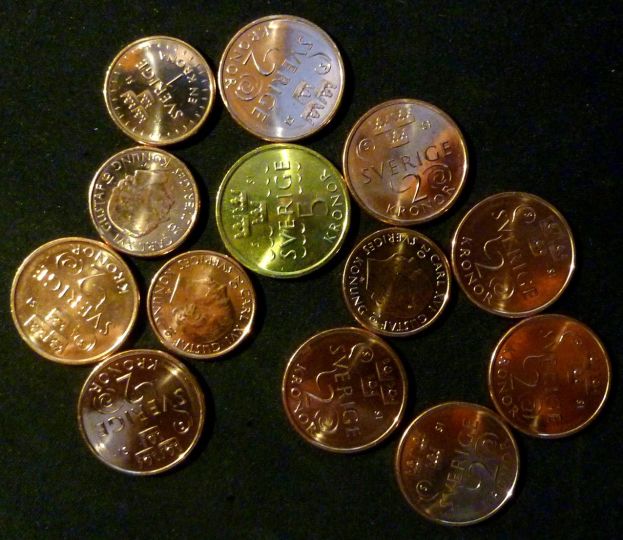 |
|
Pillar of the Community
Norway
1358 Posts |
Next time I'm in Sweden I'll just take out some cash and try to do some shopping around to get some coins from circulation. I might do a trip of 'Harry shopping' soon.
|
|
Pillar of the Community
Sweden
1078 Posts |
Quote:
Next time I'm in Sweden I'll just take out some cash and try to do some shopping around to get some coins from circulation. Good luck. The best bet to get new coins is at the supermarket chain ICA, who have partnered up with the Riksbank to distribute the new coins (and notes). Any moderately large ICA has to have them by now, but that's the Stockholm resident of me talking |
|
Pillar of the Community
Norway
1358 Posts |
Driving all the way from Norway to Stockholm for grocery shopping is a bit much... At the border there is a bunch of other supermarkets, like MaxiMat and Eurocash and I do believe they have been started especially to cater the Norwegian invasion. The nearest ICA would be another half an hour drive. We also have ICA here in Norway, but it's the most expensive of the already ridiculously expensive supermarkets in this country: it's the kind of shop where you go if you want to go bankrupt deliberately. And it's really no use: Norway has a monopoly or duopoly on almost all products, so it doesn't matter where you buy something. Not sure if it's different in Sweden with ICA. I'll see what Nordbysenter and Svinesund have to offer. |
|
Pillar of the Community
Germany
995 Posts |
Off topic... Quote:
I do believe they have been started especially to cater the Norwegian invasion. Please, do explain. Yes, I am really that curious. Quote:
it's the most expensive of the already ridiculously expensive supermarkets in this country: it's the kind of shop where you go if you want to go bankrupt deliberately. So there are enough people in Norway that don't mind that? Or, put another way, how do these supermarkets stay in business? Aren't Norwegians not that ''price conscious?'' Here in Germany, competion between the supermarket chains, particularly the discount chains (Aldi, LIDL, Netto, Penny, Norma -- to name the most important), is very fierce. That has kept prices for everyday goods (especially food) pretty low. As there is still a strong middle class here in Germany which is environmentally ''conscious'' there is a trend to ''better food'' (aka organic and eco-friendly produced), which is of course more expensive than ''normal'' food. But even the eco-friendly stuff is reasonably affordable if you are part of the middle class. Edited by redlock
10/27/2016 03:21 am
|
|
Pillar of the Community
Norway
1358 Posts |
Quote:
Please, do explain. Of course, no worries. As you know, Norway is not part of the EU. One of the reasons is that Norway wants to overly protect its internal market, especially their own produce. This is why most products are either banned from being imported (to protect Norwegian farmers), like eggs and cheese, imported in tiny quantities (if production in Norway is insufficient) or only imported at the cost of huge import taxes and fees (for example: alcohol and so). The Norwegian government has a huge grip on the market and the regulation. Even worse, most things are regulated by monopolies or duopolies. There has been just one producer of dairy products for decades and now it finally got a bit of competition. A result of having monopolies and duopolies is that quality is often appalling and the price you have to pay for it is huge. Add to that the even supermarket employees are paid relatively huge salaries compared to similar jobs in other countries, and you end up paying 2.5 euro / $3 for a half a liter bottle (17 OZ) of Coca Cola, for example, or 50 euro per kilogram ($60 for 35OZ) for bad quality steak. Takeaway food is even worse. A medium Big Mac menu costs about 12 euro now that the kroner dropped (it was 15 euro about 2 years ago), or about $13.5. Preparing a hot meal here costs me about 10 euro per person per day and then I have nothing special: pasta or chicken with rice or so. Anyway, Norway is a long and thin country with a huge border with Sweden. Sweden is part of the EU and has opened its market for all those 'dangerous' foods which Norway is banning. So most Norwegians live relatively close to the border: I do live just over 1,5 hours of driving away from Svinesund, where the E6 highway crosses the border. A lot of Norwegians take advantage of this and do grocery shopping just across the border. The amount of Norwegians doing so is so big that dedicated shopping centers have been opened over the years at the busiest border crossings. The biggest ones can be found at this E6 crossing near Nordby / Svinesund. And a lot of shops, like the aforementioned Eurocash and MaxiMat, only have outlets in those shopping centers. Usually, prices are significantly lower than what we pay in Norway, especially when it comes to non-food. To given an example: I can get a 4 liter bottle of laundry detergent for the same price as I get 1,5 liter in Norway, when talking about the same brand. also because 4 liter bottles aren't available in Norway, by the way. For food products, we can get a lot more stuff at better quality and better prices, even though we know that the prices in those outlets just over the border aren't the cheapest around compared to the rest of Sweden. We can get a kilo tasty Irish Angus minced meat for the same price as 500 gram of bad quality Norwegian minced meat of unknown source, for example. Of course, there are limits to quantities one may import and there are quite regular border controls upon re-entering Norway. Once a Norwegian minister tried to defend the Norwegian market and tried to sell Norwegian products as superior and safer compared to all the 'weird' stuff people get out of Sweden. This minister called the people who did this 'Harry'. Harry is a Norwegian word for 'strange' or 'weird' in a usually not so positive sense. However, it was instantly turned into the popular expression 'Harry shopping' and everyone here does it. Quote:
So there are enough people in Norway that don't mind that? Or, put another way, how do these supermarkets stay in business? Aren't Norwegians not that ''price conscious?'' This requires a bit of understanding about Norwegian culture. In Norway, it is sort of 'not done' to talk about money or to show any wealth. Wealth is distributed quite equally, too. You start with a relatively high salary compared to similar jobs in other countries and you end with a relatively low salary compared to similar jobs in other countries. People here are used to high prices for basic items as food and Norwegians are too lazy nowadays to stand up against it and demand action. Harry shopping isn't something we do every week, and is still regarded as something extra. As at least 90% of all the products in all supermarkets are equal, no matter which brand you choose, the more expensive supermarkets have to find a way to distinguish themselves. Usually, the only difference is how food is being presented: the cheaper ones like REMA and KIWI usually just present you with boxes right out of the factory, where expensive ones like ICA have it stacked in a more attractive way. Usually ICA and the likes also have a salad bar and a ready-made hot food counter, something the cheaper ones lack. So, what's the difference? ICA and the like managed to sell that they have 'better quality' than the others. And a lot of Norwegians are buying it. I have one colleague who really only buys at ICA because he believes he only tolerates the best of the best. As if you get better Coca Cola at those supermarkets... Now, for the idea, we actually had LIDL here for a short while and they really tried to make a difference with their assortment and distribution principles. They had, for example, direct contracts with farmers instead of going via the monopoly. And their prices were much lower. But Norwegians ignored them because they weren't Norwegian enough and other companies warned against them. And with those cheap prices and unknown foreign products, it could only be dangerous, right? So at the end of the day, only immigrants ended up shopping there, which gave them a bad reputation as 'foreigner market', so they left again. Sometimes I really want to take the average Ole Hansen and bang his head on a wall to wake him up... Quote:
Here in Germany, competion between the supermarket chains, particularly the discount chains (Aldi, LIDL, Netto, Penny, Norma -- to name the most important), is very fierce. That has kept prices for everyday goods (especially food) pretty low. As there is still a strong middle class here in Germany which is environmentally ''conscious'' there is a trend to ''better food'' (aka organic and eco-friendly produced), which is of course more expensive than ''normal'' food. But even the eco-friendly stuff is reasonably affordable if you are part of the middle class. I have lived many years in The Netherlands and this exactly what's happening there. I could easily buy a week's worth of groceries for the price of two days in Norway and end up with lots of fresh and surprising food from all over Europe. Even the trend of ecological and 'environmentally friendly' food settled in there. We also had Aldi and Lidl there. Lidl is considered a decent and cheap store, but lacking a lot of the typical Dutch stuff, where Aldi (not sure if Sud or Nord) has a bit of a shabby reputation. We had a few 'price wars' between the big ''normal'' chains like Albert Heijn, Dirk, C1000 and Jumbo in the last decades. |
|
Pillar of the Community
Sweden
1078 Posts |
Quote:
Not sure if it's different in Sweden with ICA. It is quite different, Here ICA is the norm, at somewhat big competition by Hemköp and Coop. They have quality and cheaper items but are a fairly priced supermarket. We don't have any normal-cheap (excluding LIDL that is) supermarket chain in the Stockholm region, as far as I'm aware. I had my first encounter with Aldi in Australia, never thought of them elsewhere. LIDL is not rare but also not very common. Netto is much more popular in south Sweden, but rare north and in the Stockholm region. Also: Quote:
the average Ole Hansen Interesting and informative discussion about this supermarket culture But to stay on topic: The new coins seem to be almost very common now as of a sudden. I'm constantly getting them at my local supermarket, I got some at a quick visit to Burger King but NOT when I went to Pressbyrån (convenience store like 7-eleven). I wonder if I should not start spendning some soon. |
|
Pillar of the Community
Norway
1358 Posts |
I should add, for consistency, that Norwegians tend to be scared by foreign foods, but that Swedish food is generally considered safe, but not as safe as Norwegian food. What propaganda can do, it's amazing. Every time I do a trip of harry-shopping, my mother in law warns me only to buy Swedish minced meat and not the scary Irish stuff, as it is dangerous. Strange enough, she enjoys dining out at small local eateries in the Mediterranean when she's on vacation, though... Neither does she advise me to bring seven packed dinners and lunches with me when I go on a work trip somewhere on this world, though... apparently I am allowed to eat local stuff when abroad. Also, with 'cheaper' ones I actually should say 'less expensive ones'. Usually when I get to a country with new coins (new to me) and I happen to harvest a pile and decide to spend some, I usually sort out the 'ugly' ones first and spend them first, while taking good care of my best finds. Just talked to my wife, we might go for a tour in a week or two. Looking forward to seeing the results! |
|
Moderator
 United States
196572 Posts |
Quote:
apparently I am allowed to eat local stuff when abroad Maybe she believes that the good stuff is kept at home, while the rubbish is exported. It is not the first time I have come across that sort of thinking. |
|
Pillar of the Community
Norway
1358 Posts |
Quote:
Maybe she believes that the good stuff is kept at home, while the rubbish is exported. It is not the first time I have come across that sort of thinking. Apart from salmon, Norway doesn't export much food. No one wants it.  |
|
Moderator
United States
196572 Posts |
I was thinking of the other countries. Eat ("good") Irish food while in Ireland, but avoid the ("rubbish") Irish food exported to Norway. Sorry, I keep dragging this thread off course.  |
| |
Replies: 63 / Views: 11,913 |
To participate in the forum you must log in or register.
Disclaimer: While a tremendous amount of effort goes into ensuring the accuracy of the information contained in this site, Coin Community assumes no liability for errors. Copyright 2005 - 2026 Coin Community Family- all rights reserved worldwide. Use of any images or content on this website without prior written permission of Coin Community or the original lender is strictly prohibited.
Contact Us | Advertise Here | Privacy Policy / Terms of Use
|
| Coin Community Forum |
© 2005 - 2026 Coin Community Forums |
| It took 0.44 seconds to rattle this change. |
 |
|








 First Page


 Posted 10/19/2016 2:13 pm


