| Author |
 Replies: 12 / Views: 3,889 Replies: 12 / Views: 3,889 |
|
|
Pillar of the Community
Canada
849 Posts |
Can someone explain cameo finishes to me? I have been tracking TPG Canadian Silver Dollars on ebay for three years. I see grades that are Proof Like and then some of the same year and grade that are Proof Like Cameo. What make some cameo and some not? Is a PL Cameo usually more valuable than a PL non Cameo? Next question. Starting about 1953 I see some MS coins that are marked say MS64 Cameo. I thought Cameo was only related to Proof Like so how do MS coins become Cameo? Is an MS Cameo usually more valuable than an MS non Cameo? *** Moved by Staff to a more appropriate forum. *** |
|
|
|
Moderator
 United States
56855 Posts |
Cameo The term applied to coins, usually Proofs and prooflike coins, that have frosted devices and lettering that contrast with the fields. When this is deep the coins are said to be "black and white" cameos. Occasionally frosty coins have "cameo" devices though they obviously do not contrast as dramatically with the fields as the cameo devices of Proofs do. Specifically applied by PCGS to those 1950 and later Proofs that meet cameo standards (CAM). From CCF glossary. John1  |
|
Pillar of the Community
 Canada
849 Posts |
Maybe I should have posted this in the Canadian Forum.
|
|
Moderator
United States
56855 Posts |
Cameo is cameo regardless of country is it not? John1 |
|
Pillar of the Community
Canada
849 Posts |
Are Proof-Likes manufactured the same way in all countries?
Are percent price differences between MS, PL and PL cameos the same in all countries?
|
|
Moderator
United States
56855 Posts |
Sorry but I don't know. John 1 |
|
Pillar of the Community
Canada
3733 Posts |
in Canada coins, there is at least 3 pl grades for each. for example.. 1957 pl, 1957 pl cameo, 1957 pl heavy cameo. and yes the price goes up with each grade..straight pl being the lower price, then cameo, then heavy cameo..and there is the occasional ultra heavy cameo it isn't seen to often, but there are some out there.
|
|
Pillar of the Community
Canada
849 Posts |
So does the Mint arbitrarily decide to make a certain percentage of a particular coin PL and the balance PL cameo? Is it usually more cameo than non or does it vary a bunch?
That still does not explain how some MS63 and higher coins end up cameo when they were not Proof-like to begin with.
|
|
Pillar of the Community
Canada
581 Posts |
Usually after polishing the dies etc they coins that they start to mint will have an ultra heavy cameo, and as the dies are used it becomes less and less of a cameo until it has none; or that is the story I have been told :P
-Kev
|
|
Pillar of the Community
Canada
1747 Posts |
normally the UHC and HC are first off the dies, there is no specific amount of these produced its is just by luck, and the composition of the dies.
|
|
Pillar of the Community
Canada
867 Posts |
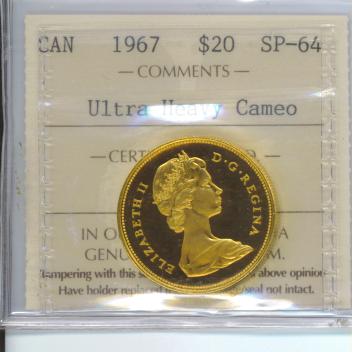 Here's an example of the cameo contrast |
|
Pillar of the Community
Canada
2187 Posts |
darn  I want |
|
Valued Member
Canada
393 Posts |
Interestingly enough this exact topic was discussed at a recent club meeting I attended.
The consensus is unlike modern proof coins which are deliberately struck to create this artificial finish and by nature designated UHC, the circulation strike and/or proof-like coins of the 1950's, - 1980's seldom exhibit this unique quality.
Those that qualify are generally considered 'first strikes' as the cameo effect from highly polished new dies is very fragile and quickly fades away.
Simply put there was much more attention to detail and craftsmanship for circulation coins rather than churning out lack luster products at the minimal cost and effort.
You will be hard pressed to find anything comparable in the last three decades which is why these are becoming more desirable and sought after.
Edited by Proof Nut
10/28/2016 7:27 pm
|
| |
Replies: 12 / Views: 3,889 |
|







 Posted 10/27/2016 2:09 pm





