| Author |
 Replies: 11 / Views: 2,316 Replies: 11 / Views: 2,316 |
|
|
Press Manager
 United States
1420 Posts |
CoinWorld - New import restrictions involving a broad group of ancient Egyptian coins have the potential to impact collectors in the United States by restricting the movement of affected coins into the country. 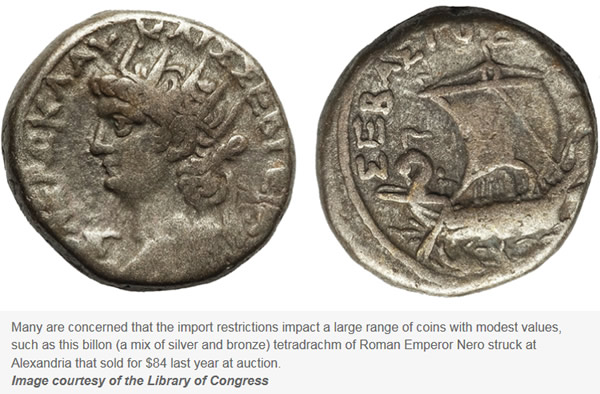 The agreement — called a Memorandum of Understanding — was made between the United States and Egypt on Nov. 30 and includes a wide range of materials created across different periods and cultures dating from 5200 B.C. through 1517 A.D. Included are items from Egypt's Predynastic, Pharaonic, Greco-Roman, Coptic, and Early Islamic through the Mamluk Dynasty eras. The new import restrictions were published in the Dec. 6 Federal Register and represent the first cultural property protection agreement between the United States and a country in the Middle East and North Africa region. A Nov. 29 State Department press release stated, "Restrictions are intended to reduce the incentive for pillage and trafficking and are one of the many ways the United States is fighting the global market in illegal antiquities." It explained, "The cultural property agreement, negotiated by the State Department under U.S. law implementing the [UNESCO] 1970 Convention on the Means of Prohibiting and Preventing the Illicit Import, Export and Transfer of Ownership of Cultural Property, underscores the United States' commitment to our relationship with Egypt, as well as our global commitment to cultural heritage protection and preservation." Read the Entire Article
|
|
|
|
Rest in Peace
United States
4078 Posts |
Very interesting. Looks like U.S collectors are out of luck..
|
|
Moderator
United States
23731 Posts |
|
|
Bedrock of the Community
Australia
21792 Posts |
This sort of agreement between the U.S. Government and various countries that do not like their antiquities exported is becoming more common.
Some likely outcomes as a result of this Memorandum of Understanding.:-
1. Those ancient coins already outside Egypt will now constitute a fixed, non expanding resource. The result of this will be an increased rise in values of those in current collections, above what is current.
2. As a tourist, DO NOT buy genuine ancient coins (or even deceptive fakes) in their country of origin, or where they circulated in ancient times. If discovered, you may well end up in jail.
3. Very obvious tourist fakes may be produced in greater volumes.
|
|
Pillar of the Community
Russian Federation
5186 Posts |
At least they were generous enough to exclude Alexandria mint LRBs. That would really have been a disaster.
Good thing I'm not a US collector. (And mailing ancient coins out of my country is illegal regardless of origin, so I'm not doing it.) But it will probably somehow affect me anyway.
|
|
Rest in Peace
United States
17900 Posts |
Considering the number of archeology sites plundered and that those numbers continue to increase each year I'm actually glad to see this.
As much as I love those coins, I'm willing to discontinue or reduce my collecting in those areas if it helps to protect those irreplaceable historical sites.
The new systems of information gathering via satellite shows just how bad grave robbing has become in the last decade with the use of ground penetrating radar.
Last month's Smithsonian magazine had a great article on this subject.
|
|
Valued Member
Croatia (Locally: Hrvatska)
78 Posts |
What is with coins that are found in Europa(minted in Alexandria)?
|
|
Pillar of the Community
Russian Federation
5186 Posts |
Quote:
What is with coins that are found in Europe (minted in Alexandria)? I'm actually not sure: unless they're well-documented hoard finds, or were found before 1970 and had been in European collections since at least that long, it would be kind of hard to get any provenance before the find time - there's no way to know that the Alexandria coin that you just found with a metal detector was really in the ground for the last few centuries and wasn't actually dropped by a traveller from Egypt in the 1980s. (And if it wasn't you but some other guy who proceeded to sell it to a nearby collector, you don't even get that much.) At least they actually tried to limit the whole thing mostly to valuable coins (and incidentally mostly to coins that didn't circulate much outside of Egypt) - as I've mentioned, a typical act of this kind would have been sweeping enough to include the Alexandria mint LRBs too, and that really would have been a disaster. |
|
Bedrock of the Community
Australia
21792 Posts |
I am wondering how long it will be before the Hermitage, Bibliotheque National, British Museum and Hunterian collections will be voluntarily donated back to their country of origin.
There has been a lot of pressure exerted on the British Museum to give the Elgin Marbles back to the Greek Government.
|
|
Pillar of the Community
Belgium
1194 Posts |
the museums dont have to give back theold collections because most were obtained legally ,when they had the political power in this countries .There are exceptions as the Elgin Marbles - if you may take one piece of the marbles of the Parthenon and you take 10 pieces... - or the bust of Nefertiti in Berlin - said to be exported in a trash bag - , then it is normal you can have problems . Problem also is , if collections are rendered to the country of origine , there are sometimes sold there as happened in former Belgian Congo.albert
|
|
Valued Member
Croatia (Locally: Hrvatska)
78 Posts |
Hm... well I have one Antoninus Pius tetradrachma from alexandria. Am I in problem  . I just say it wasnt droped by some tourist in 1980s. |
|
Moderator
Australia
16991 Posts |
Quote:
What is with coins that are found in Europa(minted in Alexandria)? The MOU makes no distinction of this. If a coin is of "Egyptian type", that is, it is on the list of proscripted types, then they do not need to prove that coin was dug up in Egypt recently. It is up to you, the importer, to prove that it was not. And I'm afraid a receipt from a coin dealer isn't going to cut it, unless the receipt dates from before 1970. If you cannot provide this proof, then the coin will be seized and repatriated to Egypt. Don't say "infinitely" when you mean "very"; otherwise, you'll have no word left when you want to talk about something really infinite. - C. S. Lewis
|
| |
Replies: 11 / Views: 2,316 |
|






 Posted 12/09/2016 4:02 pm





