



Coin Community Family of Web Sites Join Thousands of Coin, Bullion, & Money Collectors
Shop for APMEX Bullion on eBay!300,000 items to help build your collection! Coin, Banknote and Medal Collectors's Online Mall Join Thousands of Coin, Bullion, & Money Collectors Specializing in Modern Numismatics Vancouvers #1 Coin and Paper Money Dealer Royal Canadian Mint products, Canadian, Polish, American, and world coins and banknotes.


Username:
Password:
Save Password
Forgot your Password?


This page may contain links that result in small commissions to keep this free site up and running.

Welcome Guest! Registering and/or logging in will remove the anchor (bottom) ads. It's Free!

German/French Coins Help Needed

To participate in the forum you must log in or register.
Author Previous TopicReplies: 5 / Views: 1,150Next Topic  
Pillar of the Community
Steelers72's Avatar
United States
1448 Posts
 Posted 11/16/2016  01:41 am Show Profile   Bookmark this topic Add Steelers72 to your friends list Get a Link to this Message Number of Subscribers
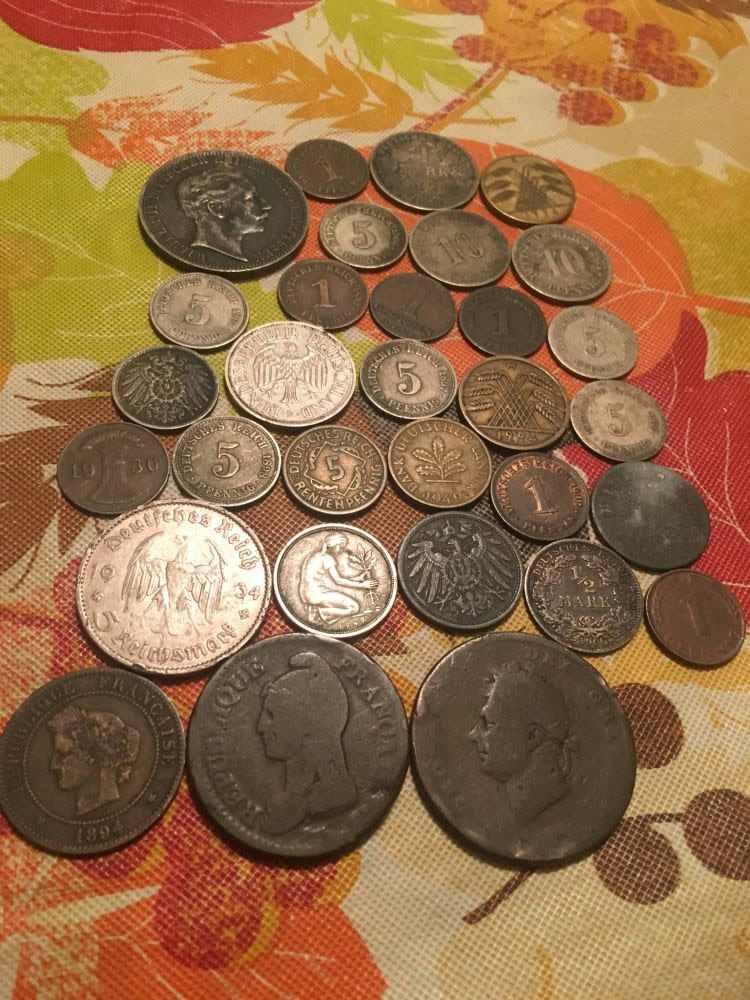
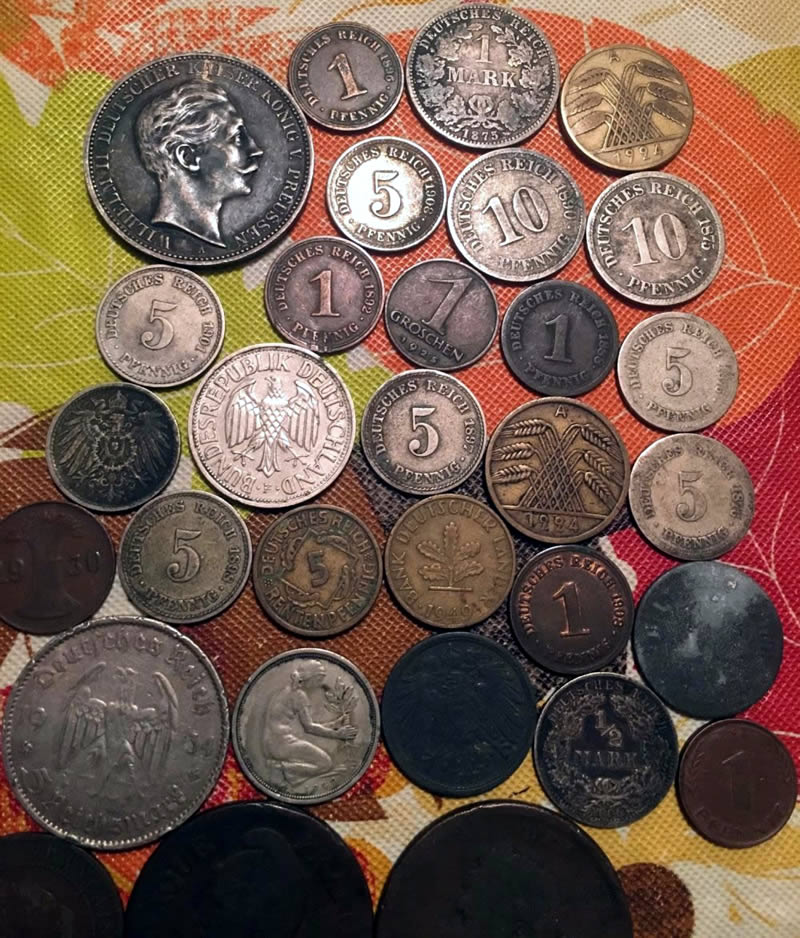
I am going through a large collection to try to sell for a relative, and came across these German and French coins. If anyone could provide any information essential to their pricing it would be greatly appreciated. I only collect US coins so I have no clue where to begin.


German/French-Coins-Help-Needed


German/French-Coins-Help-Needed
Pillar of the Community
X2an's Avatar
Sweden
1078 Posts
 Posted 11/16/2016  02:58 am  Show Profile   Bookmark this reply Add X2an to your friends list Get a Link to this Reply
What I see is mostly common coins, the exceptions would possibly be the first, large silver coin (5? Marks, Prussia) and the last two coppers, though they are worn as most of these pieces seem to be. You've got three other silver coins in there (1 Mark, 1875, 5 Reichsmark 1934 and ½ Mark on the same row, can't see the date) and some more recent Deutschemarks (2nd coin in row 4, 1 Deutschemark, 4th coin in row 5, 5 Pfennig, 2 coin in row 6, 50 Pfennig and the last coin in the same row, 1 Pfennig). The more recent Deutschemarks are worth very little. They can still be exchanged for euros at about 2 DM = €1, but that's pretty much their value.

I'll refrain from saying anything about the last three copper coins, but the rest I haven't gone into detail are common, junk-bin candidates (here in Europe, atleast)

The 5 Reichsmark (1934) tends to sell above its melt value because of its ties to Nazi currency. Although it's missing a swaztika it was the predecessor to the infamous nazi coins, which do carry corrector value almost up to double their face value if in normal, circulated condition.

I don't have enough knowledge about the Prussian large silver coin so I don't dare say anything about it if I were to mislead you, but I know for sure it's silver.

Just have to add, the third coin in the third row (1 Groschen) is in fact Austrian
And for the record, just in case, I don't think any of the coins pictured here are counterfeit.
Pillar of the Community
UltraRant's Avatar
Norway
1358 Posts
 Posted 11/16/2016  03:55 am  Show Profile   Bookmark this reply Add UltraRant to your friends list Get a Link to this Reply
First of all, it would really have helped to get a pic of both obverse and reverse of the coins.

The small German stuff from before WWII is the kind of stuff I find in junk bins and sells per kilogram (or 2.2lbs).

All WWII German coins, the zinc ones, are also junk bin coins. They're not special.

All the post-WWII German currency can still be changed for Euros at about half the value of the coin. so 5 Pfennig would be about 2.5 Eurocent.

The pre-WWI German coins of 50 Pfennig / 1 Mark and up are made of silver and should go for at least melt. Depending on quality, a small premium may be added.

The bigger German pieces will go for a bit above melt. I can't determine quality from here, so I can't give you prices there.

Now for the French pieces: that's bottom row only, I believe. The left one is a very common one in junk bins. The middle one is too worn to have any collector's value and the third one looks more like a British coin (given that Britain used 'Dei Gratia' on their coins, the French didn't). It's also a lowball and I can't get a proper impression, but I wouldn't hope for hitting the jackpot.

As X2An pointed out: you also have a Groschen from Austria here. You can still exchange it for about 0.15 eurocent (that's right, less than a cent), if you please. Otherwise it's a nice to have coin, but nothing special.

If you want to look for truly valuable German coins, then look what I wrote here: http://goccf.com/t/273387

Hope this helps!
Edited by UltraRant
11/16/2016 04:00 am
Valued Member
Potsdam's Avatar
Germany
303 Posts
 Posted 11/16/2016  04:18 am  Show Profile   Bookmark this reply Add Potsdam to your friends list Get a Link to this Reply
By the size of the Wilhelm II coin I'd guess its a 3 Mark piece. For the smaller German denominations I'd check for date and mint mark.

UltraRant might be right saying that you often find these coins in junk bins there are also key dates for pre 1945 Pfennige. The 1908 1 Pfennig for instance seems to be in a very good condition with traces of luster around the lettering.
Bedrock of the Community
NumisRob's Avatar
United Kingdom
17925 Posts
 Posted 11/16/2016  05:00 am  Show Profile   Check NumisRob's eBay Listings Bookmark this reply Add NumisRob to your friends list Get a Link to this Reply
Regarding the two large copper coins in the bottom right-hand corner, the right-hand one is indeed a British George IV penny. It appears to be too worn for the date to be legible, and is therefore of little value. These pennies were only struck in 1825, 1826 and 1827. The 1827 issue is quite scarce and would still be worth a little in this condition if the date was legible.

For the French coin (the left-hand one of the two large coppers), please could you post a close-up photo of the other side? It is most likely to be a 1-decime coin of the late 1790s / early 1800s, and will have the date in the style of the French Revolutionary calendar - such as L'AN 5 (meaning 'Year 5') on the reverse, in addition to a letter indicating which mint struck the coin. Although it looks to be quite worn, there are some scarcer date and mintmarks, in addition to coins with official countermarks or overstruck on earlier 2-decime coins.

The French coin bottom left - is it a 5 or 10 centimes? 5c weighs 5 grams and is 25mm in diameter, 10c weighs 10g and measures 30mm. The 1894 10c Is quite scarce with a mintage of 800,000. Condition looks much better than many I've seen, but hard to tell from the photo: the area that tends to wear flat first is the centre of the reverse.
Edited by NumisRob
11/16/2016 09:08 am
Pillar of the Community
Steelers72's Avatar
United States
1448 Posts
 Posted 11/16/2016  11:50 am  Show Profile   Bookmark this reply Add Steelers72 to your friends list Get a Link to this Reply
Thank you all for this information! I will get you clearer pics of the coins requested
  Previous TopicReplies: 5 / Views: 1,150Next Topic  

To participate in the forum you must log in or register.


Disclaimer: While a tremendous amount of effort goes into ensuring the accuracy of the information contained in this site, Coin Community assumes no liability for errors. Copyright 2005 - 2026 Coin Community Family- all rights reserved worldwide. Use of any images or content on this website without prior written permission of Coin Community or the original lender is strictly prohibited.
Contact Us  |  Advertise Here  |  Privacy Policy / Terms of Use

Coin Community Forum © 2005 - 2026 Coin Community Forums
It took 0.24 seconds to rattle this change. Forums