| Author |
 Replies: 18 / Views: 4,172 Replies: 18 / Views: 4,172 |
|
New Member
United States
9 Posts |
|
|
|
|
Pillar of the Community
United States
1758 Posts |
Well might as well jump in and make a fool of myself?
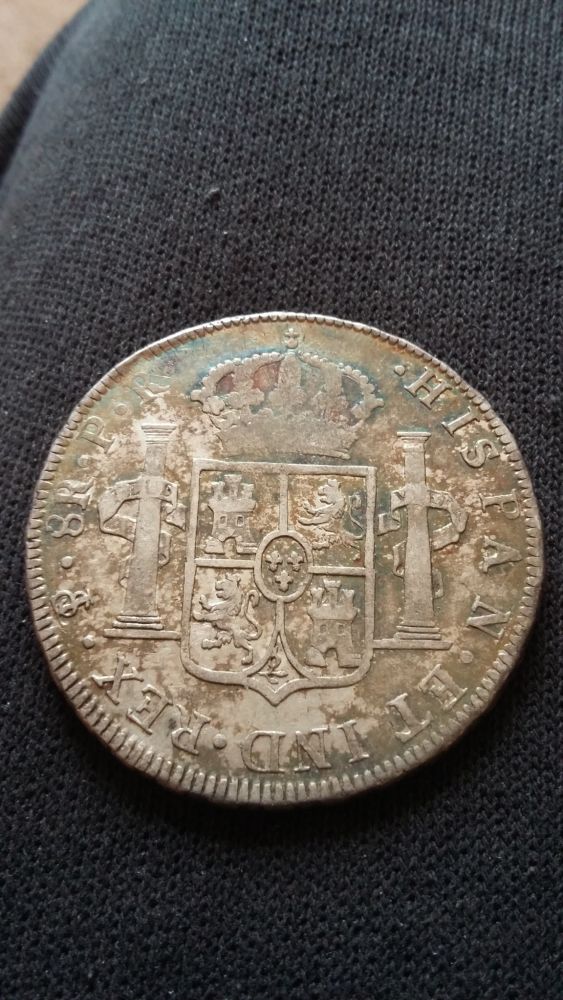
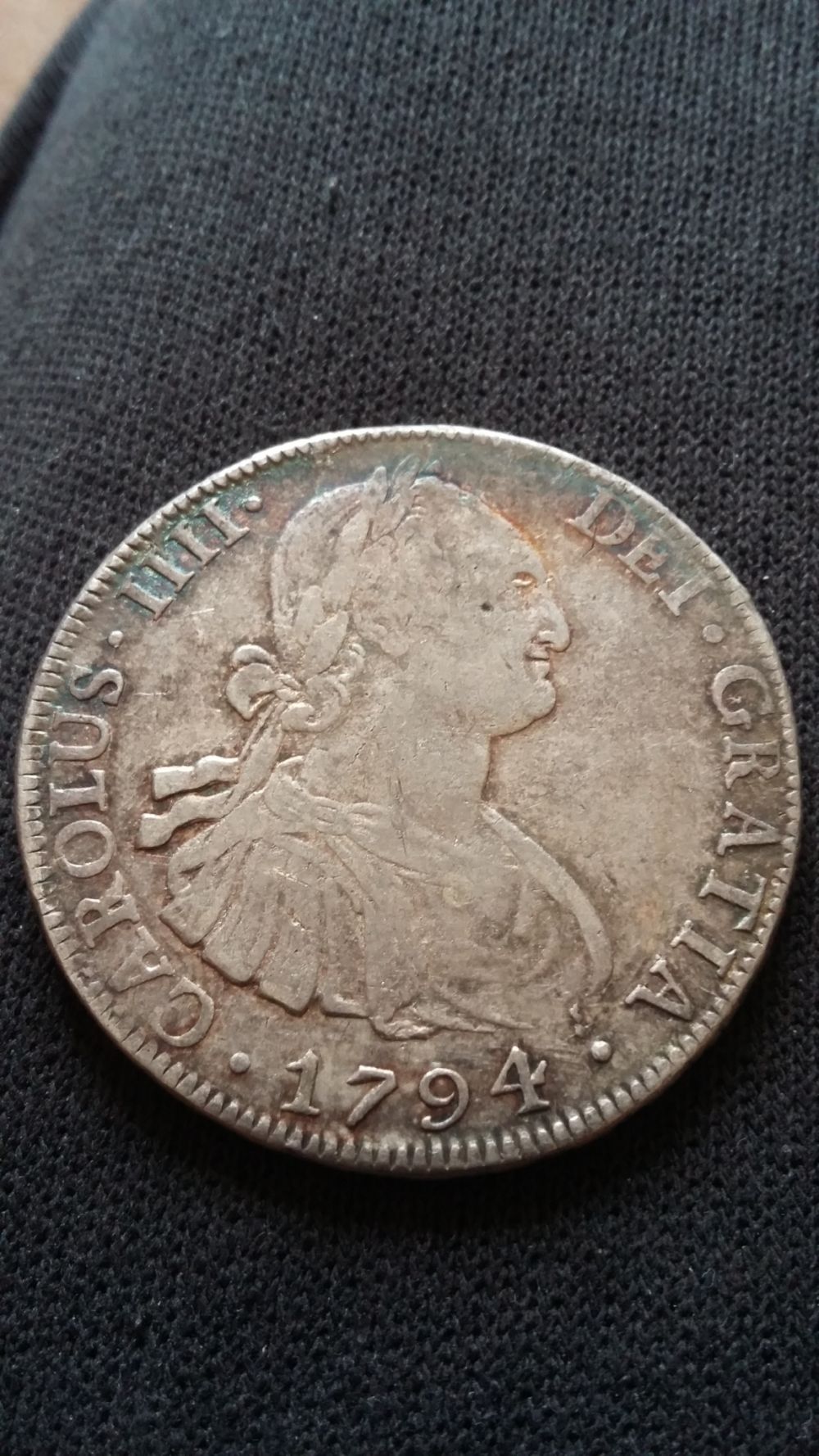
Bob when you have a chance see page 312 in the GNL Book GNL#1794-O:Ba/R:Pts PR-001. Of course no countermark here ... neverthless ... close in many apsects.
Some close similarities although we call Gord's unique piece a possible early cast but silvered wash over copper or brass. Not the case here IMO.
See the apparent separation of HIS PAN. Note the small "S" in CAROLUS. Hints of debasement at the tops but this is seen on occasion and reported by many on this channel and confirmed by XRF as not a tribute to debasement but just a leaching effect with certain coins in certain environmental conditions and its 26.5 grams.
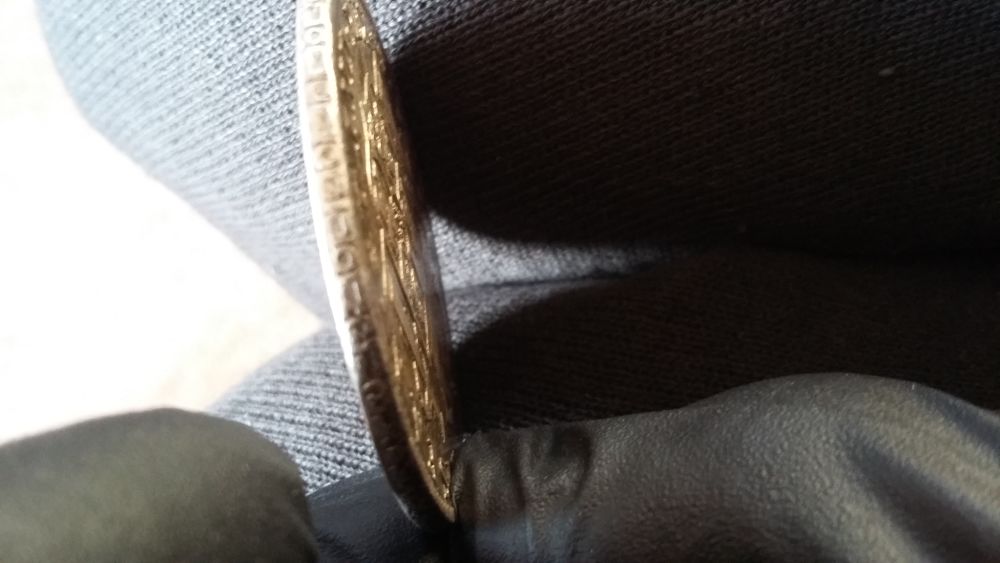
Maybe a Class 3 sub-variety. Maybe nothing ... but the HIS PAN separation is bothersome and the small S. But the "R" in GRATIA is "not" short and thick as in the GNL plate coin. Edge pics obviously not great.
JPL
Edited by colonialjohn
11/09/2016 8:31 pm
|
|
Pillar of the Community
United States
1915 Posts |
I was in the same boat as Kenneth Hodges measuring density. I was creative and found my smaller resolution scale was mostly acceptable for a coin as large as this one. Where it fell out of favor was measuring smaller coins. Then I had to shell out the big bucks to get good numbers. I placed a small wooden stick across the top of my scale. Then I made a hanger out of thread with a tiny drop of super glue securing the thread end to the coin edge. It worked. The coin hanging under the scale after zeroing out the tare showed a good weight of the coin. I held a small glass of water under the coin and raised it so I had the reading in water. Doing the calculation I had an acceptable good measure to clearly indicate silver instead of some other. But later I got a much better setup with a built in under hook weighing option. And the resolution and so on is by far superior doing very well for even the smallest coins.
|
|
Pillar of the Community
United States
1962 Posts |
Look at depth of the toning... And, while the shield side is splotchier, it is not scattershot like you see from the Chinese spray tan factory. Also, realize you're considering an earlier Charles IIII Potosi strike... they're always a bit wonky-looking.
FYI, concerning overlaps... you're showing one of them VERY clearly in the photo!! If you don't recognize that, I would suggest searching and reading more thoroughly through some of the old threads on here (many of which are quite good... and there have certainly been a lot of pieces submitted for approval).
|
|
Pillar of the Community
United States
5362 Posts |
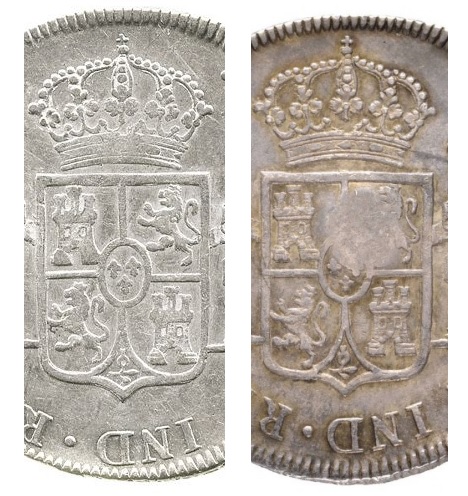
Kenneth - this coin I like far better. In fact I would love to own it for further testing. The weight is a bit low. But the real issue here are the castle punches used. In my book I explain the "broken castle" punch counterfeit coins on pages 150 and 151. On some counterfeit Potosi coins there is a crack that extends from the doorway upward and to the left to the edge of the left side of the castle. I own several examples. All of mine are counterfeit. Some have copper cores. Others with the same crack appear in TPG holders and the owners insist they are genuine. The problem is that the identical punch seems to have been used on dies dated 1774 to 1782 and all the dates in between. That is 8 years. In practice a punch is used to make dozens of dies EACH year. That is far too long for a damaged punch to have survived. Also in some cases, the crack appears to be wider on earlier dated dies - which of course is only possible for counterfeit coins. I have never resolved the issue satisfactorily. I did locate a 1789 version used to make a cup bottom - probably in the late 1800s. But that may simply be a cast made from a genuine coin that was redated. Your coin is dated 1794. That is 20 years later than the first appearance of the broken castle. I can not be 100% certain from photos but it appears to be the same punch again. It would be great to study this one. If it is ever for sale let me know. |
|
Pillar of the Community
United States
5362 Posts |
colonieljohn I checked the 1794 Ba die type against this coin using the original photos from Gordon. The dies are not identical. The punches are close but not an exact match either. Obverse: 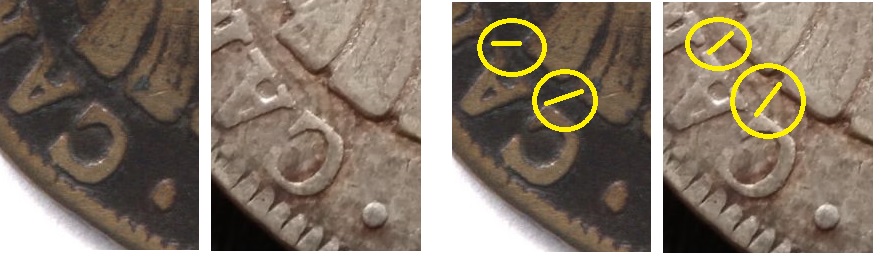 Reverse: 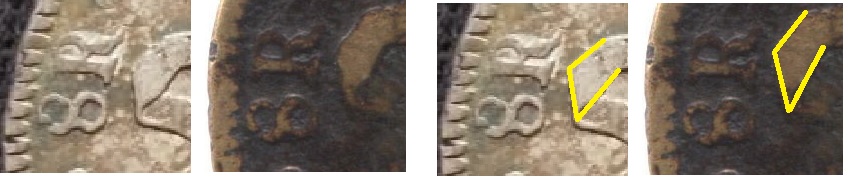 The castle in one case may be a broken punch on Gordon's coin but it is not clear at all. There is a dark spot possibly indicating a depression.
|
|
Valued Member
Germany
55 Posts |
Just sent this one of for grading, Potosi mint 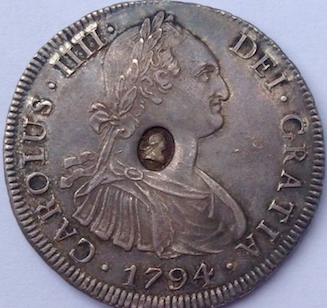 |
|
Valued Member
Germany
55 Posts |
REV 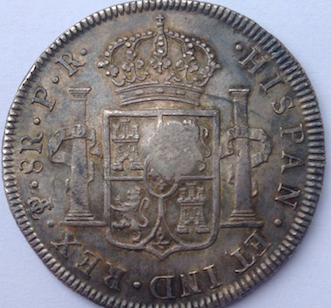 |
|
Pillar of the Community
United States
1758 Posts |
Yes the broken castle and SO LATE. Surely an interesting alloy - possibly? It does mimic Gord's coin in some ways but no counterfeiter makes a date into the future ... this 1794 date and the broken castle (i.e., an initial indicator the 8R may be counterfeit - high probability) is an interesting one!
JPL
|
|
Pillar of the Community
United States
1962 Posts |
|
|
Pillar of the Community
United States
5362 Posts |
wiamcim Based on my past experience with NGC - they will grade it. They do not do checks of alloy - either Specific Gravity or XRF even though I have heard they bought an XRF handheld unit.
They do NOT EVEN weight the coins they authenticate.
realeswatcher After this coin came up - I began hunting for others in auction archives - I have found 9 others so far.
Do you know the origin of the Cuzco Hoard? Date? Circumstances? The earliest auction I have seen with a large number of those in it was 2009.
The break appears to be in the same spot but on most it is more advanced than the earlier dates.
This Broken Castle situation gets more confusing every time I look at it. I own examples that simply can not be genuine. Others clearly look genuine, but I have never tested one. So I have been calling all of the dies SUSPECT.
I was concerned that all of these could be some type of modern forgery. However, if the CUZCO Hoard has a solid provenance proving they are of the proper age, I will still have doubts about Classification but at least it will rule out a modern forgery anyway.
|
|
Pillar of the Community
United States
5362 Posts |
I located a reference in a Sedwick auction Quote:
From Daniel Frank Sedwick's Treasure Auction #12, October 2012. KM-73; CT-721. 26.9 grams. Highly lustrous UNC with bold rims, no problems. Pedigreed to the ca.-1808 "Cuzco hoard" -- a trunk full of silver coins, all minted in Potosí, but found in Peru in 2007 -- and to Treasure Auction #5 (lot 890). A find of a trunk load of coins located in 2007 has been assigned a date of ca 1808? Is anyone other than me suspicious how a trunk could have remained unopened for 199 years? |
|
Pillar of the Community
United States
1962 Posts |
Most probably, if not undoubtedly, made by Peruvian day laborers in late 2006... More of the castle break discussed above (many more out there, too many to list... from a wide variety of sources, with and without BOE marks, etc.). Quick search of 1793 and 1795 doesn't immediately show any with said castle break: https://www.acsearch.info/search.html?id=491626https://www.acsearch.info/search.html?id=1241517https://www.acsearch.info/search.html?id=3195155https://www.acsearch.info/search.html?id=2291927https://www.acsearch.info/search.html?id=548624https://www.acsearch.info/search.html?id=2021186Here's one with the same crack... but rare variety with no separator dots in the reverse legend: https://www.acsearch.info/search.html?id=2820672A piece from Aureo Calico - same crack, plus also shows the same notable break in the crown seen on the one "wiamcim" (which is from a recent Künker auction): https://www.acsearch.info/search.html?id=2706044Another... same crack in castle, plus the crown issue... this time w/extra metal from die cracks on the reverse: https://www.acsearch.info/search.html?id=2976911Then we have this... a completely different break seen on examples of at least 1793, 1794, and 1795 (grouped by year below): https://www.acsearch.info/search.html?id=770514https://www.acsearch.info/search.html?id=3309408https://www.acsearch.info/search.html?id=2469668https://www.acsearch.info/search.html?id=3093937 (badly deteriorated die, but break is discernible) https://www.acsearch.info/search.html?id=3268088https://www.acsearch.info/search.html?id=2678249https://www.acsearch.info/search.html?id=2706045https://www.acsearch.info/search.html?id=1249623https://www.acsearch.info/search.html?id=2236115https://www.acsearch.info/search.html?id=2061268Note: For the 1795 pieces I perused, this other castle crack seems exclusive to assayer PR examples from what I'm seeing, rather than the later PP assayer. Actually, ALL of the 1795-PR pieces I looked at (without exception) HAVE this castle break... |
|
Pillar of the Community
United States
1962 Posts |
|
|
Pillar of the Community
United States
5362 Posts |
realeswatcher Is there any way to increase the size of any of these pictures? - I can not see the cracks in the castle very clearly.
A cluster of breaks can be found in any group of dies that were made one or two years apart. There are many such series. The problem is when the period stretches to 5 , 10 or 20 years. Punches were easily broken and replacements could be produced as long as the matrix block was intact. There is no possible way a cracked punch could last long after the initial crack. The force needed to set the punch into die steel would destroy the punch after a very few dies were made.
I presume your initial comment is "tongue in cheek" or do you have any specific backup for the comment?
|
|
Pillar of the Community
United States
1962 Posts |
Bob, I'm guessing you don't have an ACsearch login? Just sign up... they basically just need a username/password, and use any throwaway/backup email address.
Once logged in... they don't provide pricing data for free accounts anymore, but the pics blow up decently large.
|
| |
Replies: 18 / Views: 4,172 |












 Posted 11/09/2016 10:28 pm