| Author |
 Replies: 38 / Views: 5,433 Replies: 38 / Views: 5,433 |
|
Pillar of the Community
United States
7067 Posts |
On the occasion of picking up my fourth coin of Vologases IV (the last one posted below), I thought I'd write a bit about this fellow. Despite the fact that Vologases IV had a long reign, ruling Parthia from c. 147 - 191 AD, not too much is known about him: he was a son of Mithradates IV; there were more battles with Rome during his reign (over control of Armenia); and he reconquered Characene, which had apparently gained temporary independence a few decades earlier. He issued tets with at least 125 different dates on them at the Seleucia on the Tigris mint. He also issued drachms and some of the more interesting Parthian bronze types. He is always depicted on the coins - no matter the denomination - with a Parthian tiara that has ear flaps and "hooked appendages" on the crest. The drachms display the typical linear abstraction we associate with the denomination during the last century of the Empire: 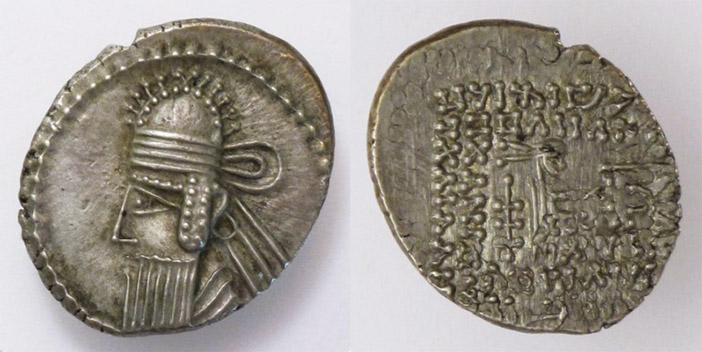 Sellwood 84.128 On the tets and bronzes of Volo IV, a horn is shown on the tiara's side. As with most of the tets from the later Parthian Kings, Volo IV's are typically composed of a dull billon. Most are in rough shape on tight flans, with some wear occasionally evident on dies: 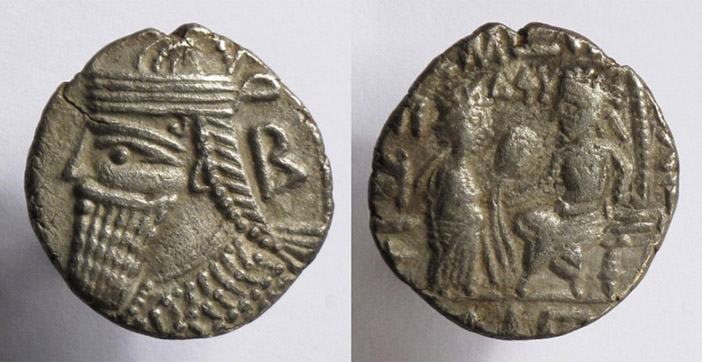 Sellwood 84.93-5 However, some very nice ones periodically hit the market. If one is patient and vigilant, and willing to compete at auction, these nicer examples are obtainable. The following two look very similar to one another, the only difference of note being the dates based on the Seleucid era, with years written in Greek and located above the diadem being presented by Tyche to the king on the reverse. (Months - just barely legible - are in exergue) The first coin here, which I picked up a few years back, was minted in October 153 AD (epsilon-xi-upsilon), the second one - which is my new pickup - was minted in October 155 AD (zeta-xi-upsilon). Given the close time frame, the similarities, the same mint, and the subtly superior artistry as compared to many other Volo IV tets, I would not be surprised if the same skillful die engraver at Seleucia created both. 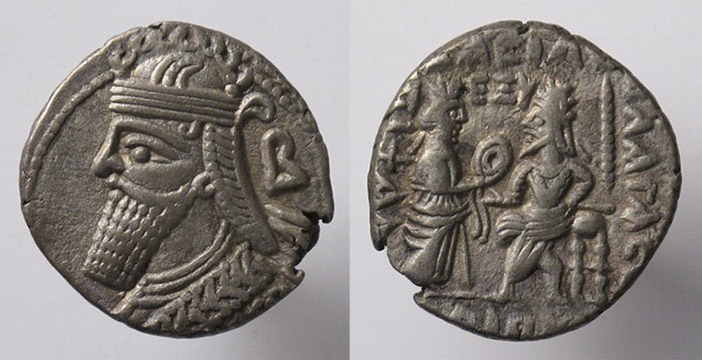 Sellwood 84.16 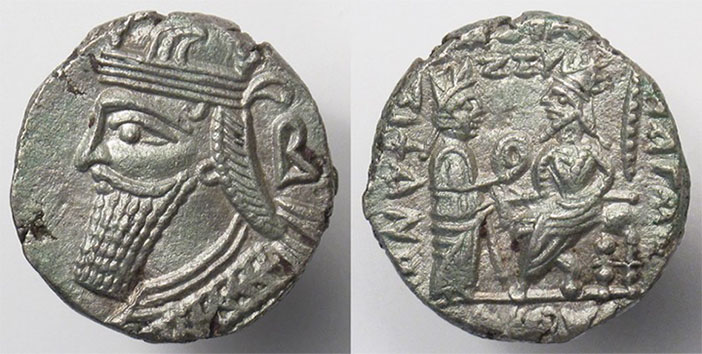 Sellwood 84.18 Edited by Kamnaskires
12/29/2016 4:28 pm
|
|
|
|
Rest in Peace
United States
17900 Posts |
Bob, Bob, Bob. What a presentation. What superb coins.
I sold my set of Parthian coins about 15 years ago when I reached the point that I could only add a new coin about once every 3-4 months.
Seeing your exemplary presentation really makes me think seriously about getting a dozen or so, just so I don't feel deprived.
I think I still have some bronze I never identified. Maybe ill dig those out and ask YOU what the check they are. They didn't match any Sellwood I could see.
|
|
Pillar of the Community
 United States
5029 Posts |
Great looking coins Bob. What is the reverse on the top coin - maybe it is just my eyes...but I am not sure what the symbols or the picture is representing.
|
|
Pillar of the Community
 United States
7067 Posts |
Quote:
What is the reverse on the top coin - maybe it is just my eyes...but I am not sure what the symbols or the picture is representing. Thanks for the comments, guys. Scott, the top one - the drachm - has a very, very abstract seated archer in the center of the reverse, and two lines of legend/inscription above, below, and to the left - and one row to the right. Interestingly the top legend line is in Aramaic ("King Vologases") whereas all other lines are in blundered Greek. It was rare for Parthian rulers to use their names on their coins, but this is an exception to the general rule. I should add that the tiny circular shapes on the top and left reverse fields on the drachm could be indicators of an overstrike...might be flattened lettering from the host coin...but I'm not sure about that one. Edited by Kamnaskires
12/29/2016 5:03 pm
|
|
Moderator
United States
23731 Posts |
Super coins Bob, one of these days I'll get a least one of this type. Congrats on the new addition.
|
|
Pillar of the Community
United States
6130 Posts |
Fantastic coins for a fantastic collection  I was going to ask about the legend on the reverse... Very cool that at least some level of literacy was retained on the coins in the later stages of Parthian coins. |
|
Pillar of the Community
United Kingdom
2624 Posts |
Great coins Bob, number 3 is my favourite since you ask :P
Thanks for the information too, if you keep telling us about these guys I am sure some of it will sink in sooner or later ^^ though I think maybe some of it is starting to I am glad to say.
|
|
Pillar of the Community
United States
7067 Posts |
|
|
Pillar of the Community
Belgium
1194 Posts |
very nice coins , I did not know the second type . What is the inscription ? on the top ..leio..: basileos ? , at right : ..lagas.. Vologases ? , left and the bottom I can not read . albert
|
|
Pillar of the Community
 Spain
2752 Posts |
Lovely looking coins Bob and interesting write-up thanks for sharing Paul |
|
Pillar of the Community
United States
7067 Posts |
Thanks, guys. Quote:
What is the inscription? Coin one (the drachm): Greek usually listed as illegible, and the Aramaic at the top translates as "King Vologases": 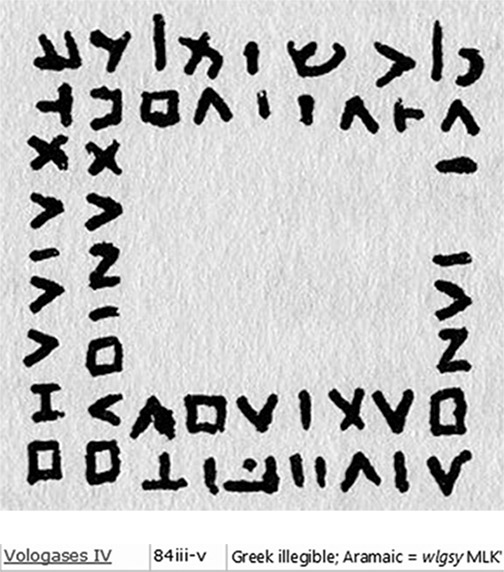 Coin two, minted 182 AD (delta-koppa-upsilon), inscription largely cropped off in the example above. Greek translates as "King of King, Arsakes, Vologases the Just, the Noble, the Greek-Loving" (Vologases here is written in the Greek form): 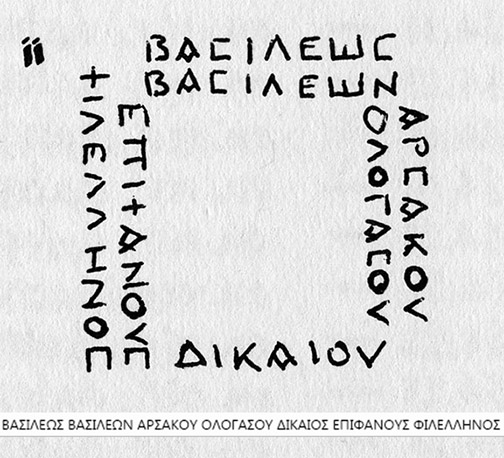 Coins three and four, legends cropped but same as above: 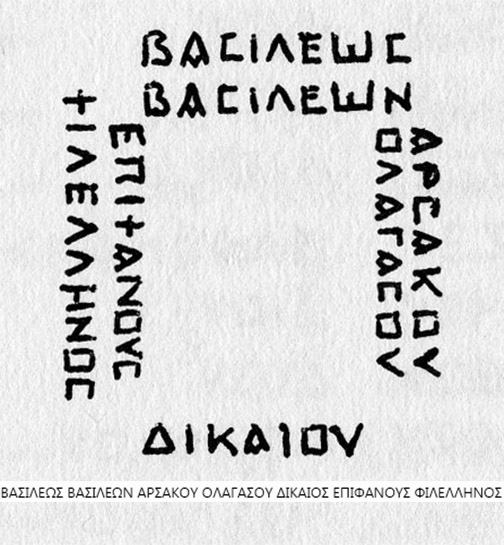 Edited by Kamnaskires
12/30/2016 1:18 pm
|
|
Moderator
United States
34542 Posts |
@bob, great work explaining the rev inscription--definitely one of the more challenging to read, with letters facing different directions.
"If you climb a good tree, you get a push."
-----Ghanaian proverb
"The danger we all now face is distinguishing between what is authentic and what is performed."
-----King Adz
|
|
Pillar of the Community
Spain
2752 Posts |
Quote:
Greek usually listed as illegible Bob I don't understand why an engraver would go to so much effort to produce an illegible text ?...Do you think it's a lost language, dialect or possibly just a decorative frame? What do you think? Paul |
|
Moderator
United States
34542 Posts |
@paul, I'll be interested to hear Bob's reply, but I can tell you that at least in medieval times, some of the degenerate or illegible inscriptions are chalked up to the die cutters being illiterate. They were just copying the general shapes of the letters without understanding their meaning.
"If you climb a good tree, you get a push."
-----Ghanaian proverb
"The danger we all now face is distinguishing between what is authentic and what is performed."
-----King Adz
|
|
Pillar of the Community
Spain
2752 Posts |
Thanks Spence....Yep tat meks sens Paul |
|
Pillar of the Community
United States
7067 Posts |
From the first century onward, Greek influence in Parthia waned. It's easy to see in the portraiture - obviously portraits became increasingly abstract through the series. But it's reflected in coins' legends too - particularly on the drachms and obols from Ecbatana and the eastern mints. But, for some reason, the tradition of the legend enframing the archer continued, despite the increasing gibberish.
As Fred Shore states it in his "Ten Dragons" book (and here he's speaking about a coin from the late 1st century AD): "Due to the continued shift away from Greek cultural influences, the legends on the reverse of Parthian coins becomes increasingly corrupted from this time on. It is likely that few dies engravers even understood the meaning of the letters they were engraving."
I don't know if the kids in Spain play "whisper down the lane" as they do in the States, Paul, but this is the die engraver equivalent, with Greek legends on each generation of coins getting progressively more garbled and decorative.
|
| |
Replies: 38 / Views: 5,433 |







 Posted 12/29/2016 4:41 pm





