To participate in the forum you must log in or register. | Author |
 Replies: 10 / Views: 2,527 Replies: 10 / Views: 2,527 |
|
|
Pillar of the Community
United States
6370 Posts |
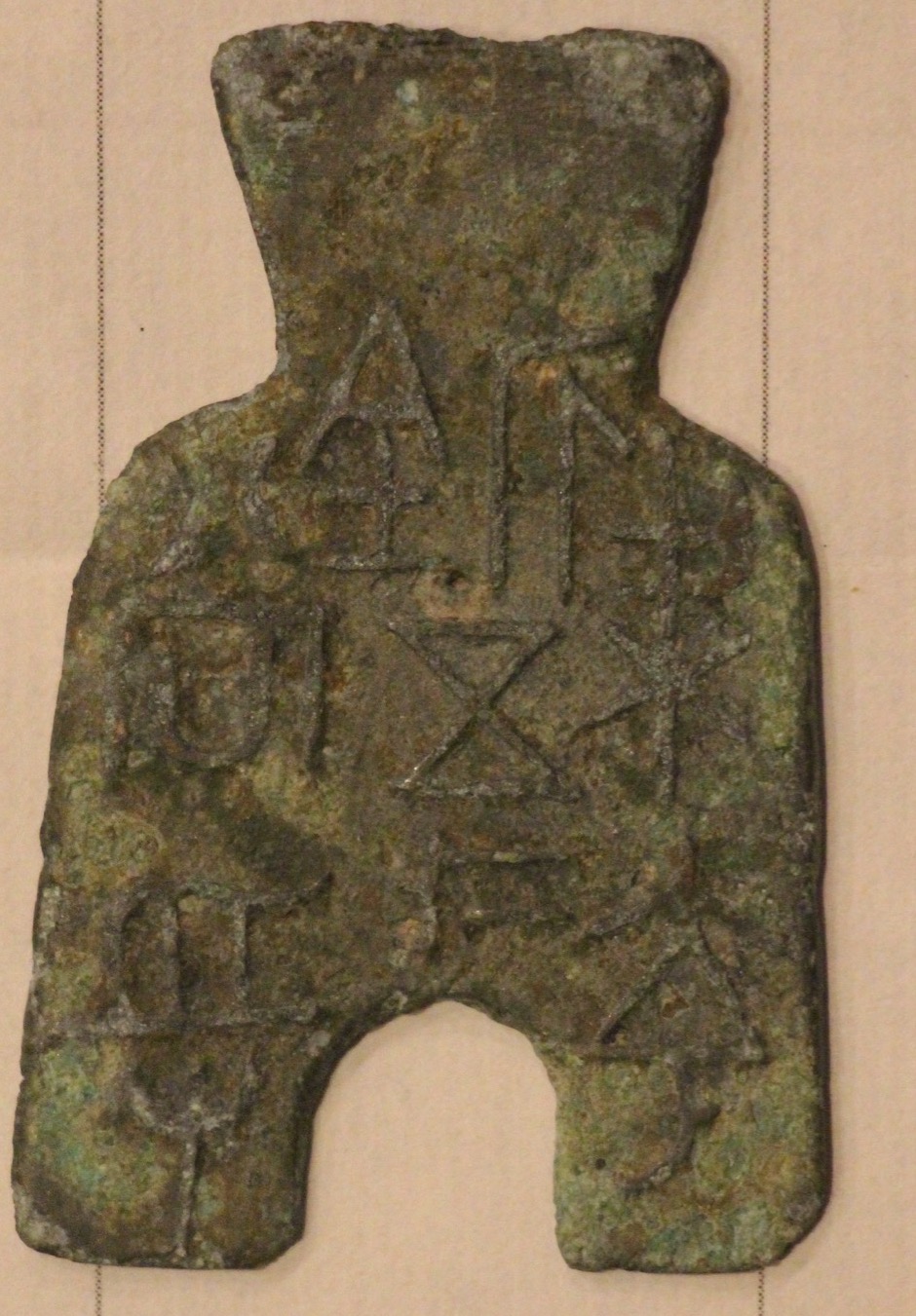
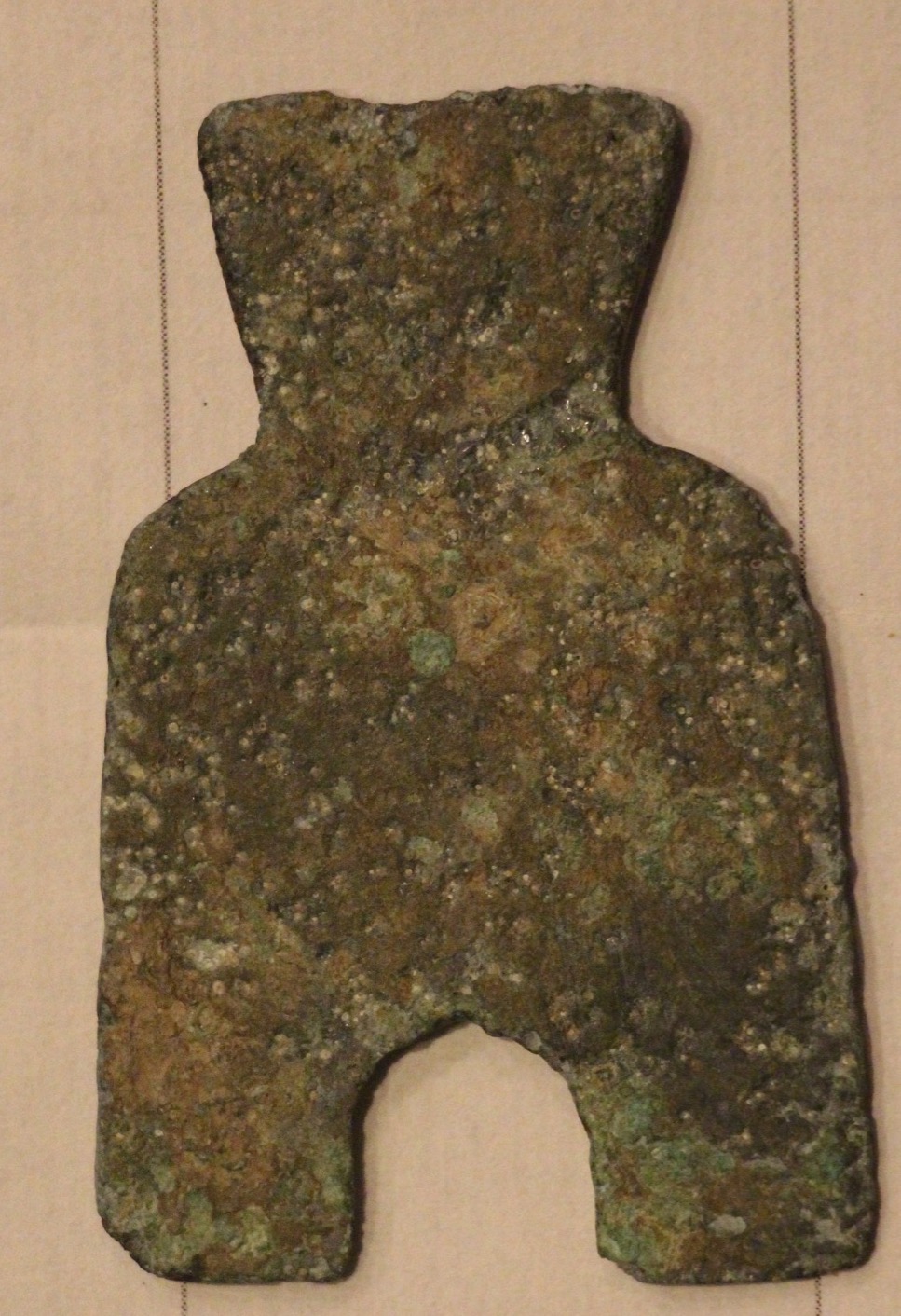
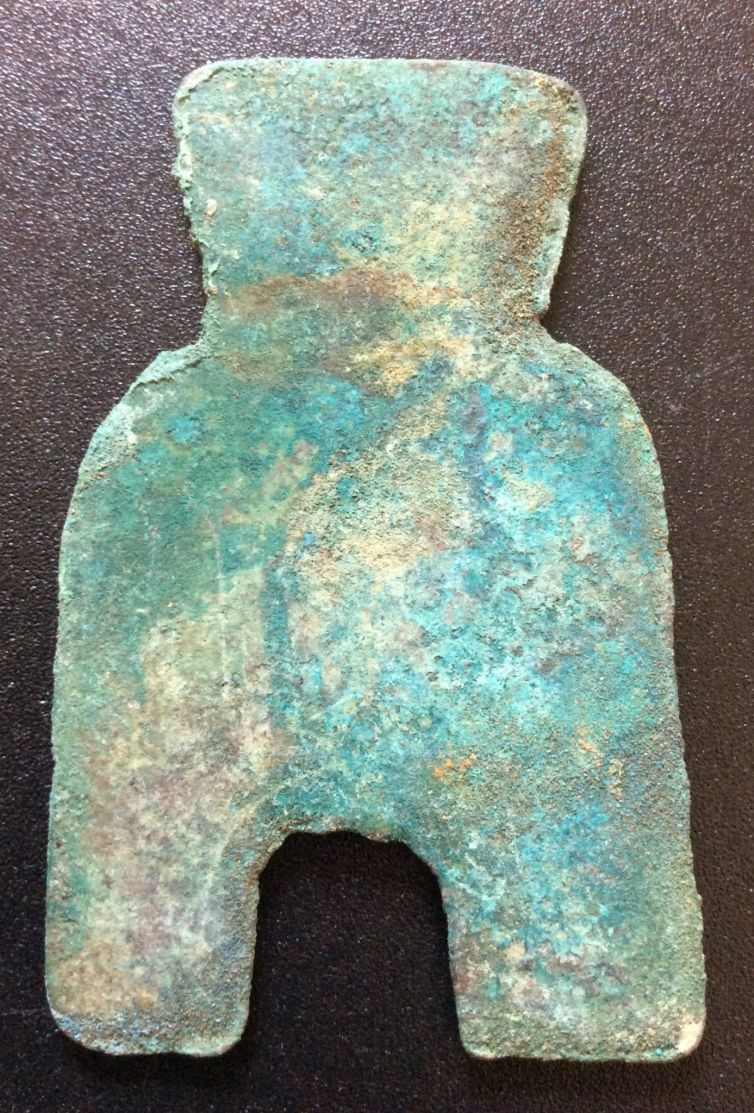
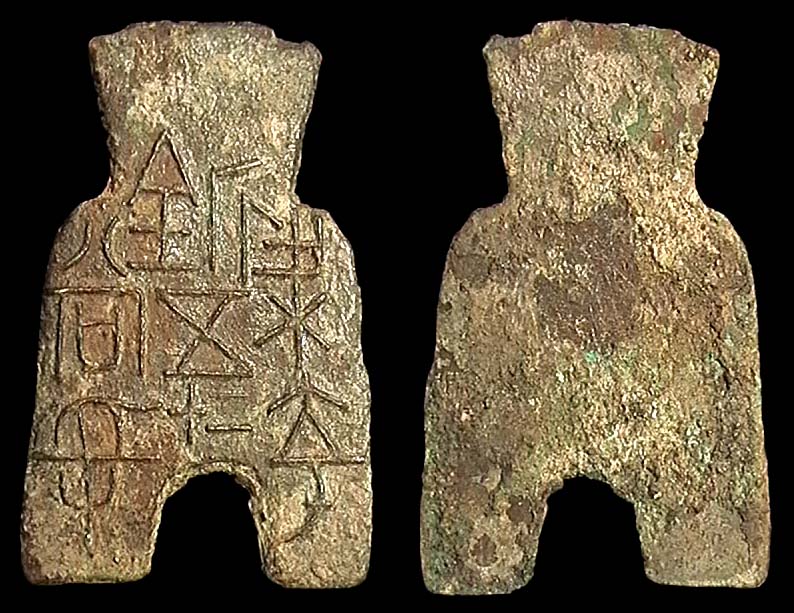
I just made my first purchase of the year! I had originally planned to buy this in December, but a delay in the arrival of a check pushed things back a bit. Prior to the flat-footed and pointed-foot spades that we all know and love, there existed a species of spades called arched-feet because the crotch of the spade is arched. (The Georgia Tech Band would now be giving a long, sarcastic OOOOOOOOOOHHHHHH.....). These are sometimes called "Heavy Spades" because they are more robust and have more metal than the other flat-handled spades. (OOOOOOOOOOHHHHHH.....) Almost all, if not all of this type, are attributed to the State of Liang and are said to have been cast between 425-344 BC because that is when Liang was in its height of power. The distinct legs suggest that these directly evolved from the hollow-handled spades with pointed shoulders and feet (pictured at the end), adopting the flat handle for ease of transport and commerce. If this is true, then it is likely that this variety of hollow-handled spades were the latest in the evolution and represent the transition between hollow-handle and flat-handle. Also interesting is that the arch-foot spades are the first coins in China (and only spades) to consistently have a denomination. These were denominated in Jin, which was equivalent to the Chinese ounce, the Liang. An ounce had 24 Zhu. Judging from Zhou weights, a Zhu was supposed to weigh the equivalent of 0.65g. However, in practice (or due to depreciation during the Warring States Period) the Zhu used for coinage averaged about 0.5g. The arch-foot spades were denominated in 1/2, 1, 2, and 3 Jin or 12, 24, 48, and 72 Zhu. Why these are denominated and not others is unknown, but it may be because the state of Zhou had recently fallen and the Warring States period had begun, necesitating a denominated coin for interstate commerce. This particular spade is called a "Special Spade" of Liang because of the complexity of its inscription. There are four denominations for these, 1/2 Jin, 1 "Old" Jin, 1 "New" Jin, and 2 Jin. This coin is the more-desireable 2-Jin denomination. Though not fully agreed-upon, the most plausible inscription is Liang Chong Jin Wu Dang Lie Shi Er or "Liang Money to be Used as 5 Jin and Equal to 12 Lie. It is interesting to note how there seems to be a currency conversion in the inscription. What exactly a Lie is is unknown, and all known records of a Lie do not corroborate with the weight of this coin. The problem with this decipherment is that this coin is denominated 5 Jin, even though it weighs 2 Jin. One can argue that this is a fiduciary and inflated issue, but that theory is unsubstantiated because all of the other coins in this type weigh consistently with their denomination. This coin is pretty rare. I had been wanting an example of this type for about 4 years and decided that I would never get one. I even bought a counterfeit for my collection to fill the hole. Then this one popped up for half the going rate, so I watched it until I bought it. I am pretty sure it is genuine, but I won't be absolutely sure until I have it in hand. Everything I have bought from this seller has been genuine, but I have seen some fakes in his inventory. Arch-Foot Spade (ca 430-300 BC) Obverse: Liang Chong Jin Wu Dang Lie Shi Er Reverse: Blank H-3.48 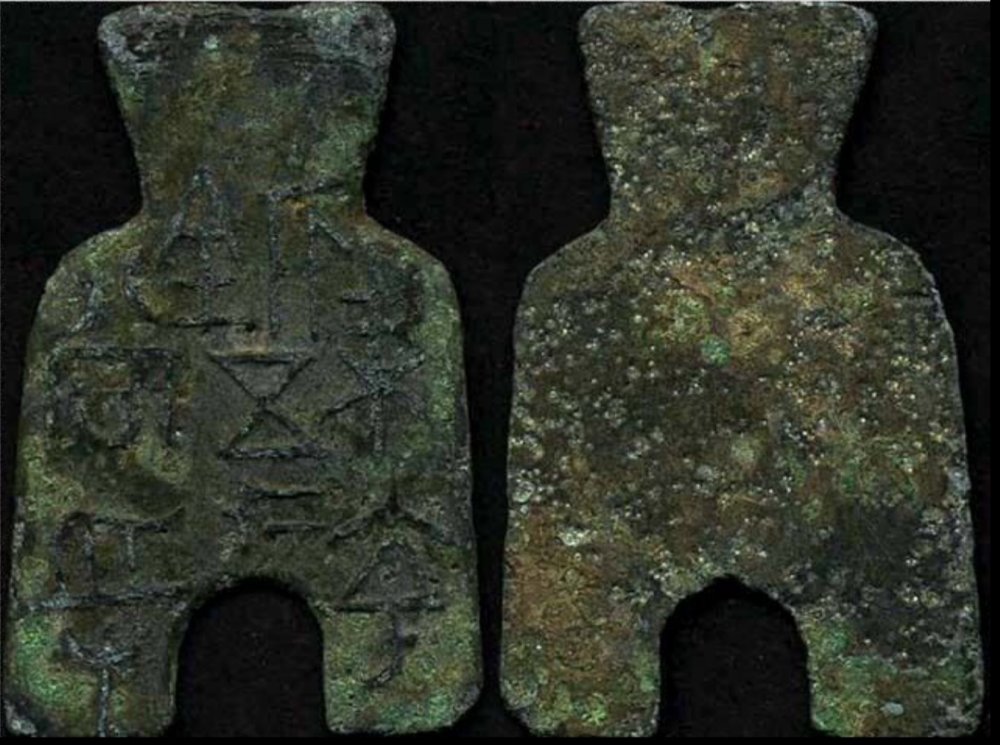 As promised, here is this one: Hollow-Handled Spade (ca 500-400 BC) Obverse: Blank Reverse: Blank H-2.183 (though same size as H-2.186) 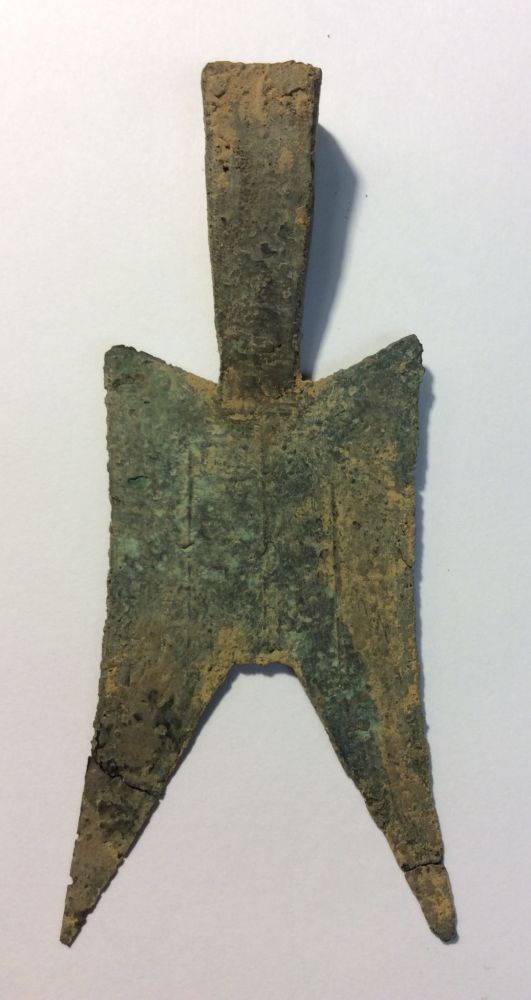 |
|
|
|
Pillar of the Community
United Kingdom
2624 Posts |
I have nothing like that in my collection, I wouldn't know where to start...
Good work on your patience and glad you finally plugged the hole, great patina on that first one too ^^
|
|
Moderator
 United States
23731 Posts |
|
|
Rest in Peace
United States
17900 Posts |
Really lovely original pieces. Congratulations on those beauties.
|
|
Moderator
United States
34549 Posts |
Quote:
I am pretty sure it is genuine, but I won't be absolutely sure until I have it in hand. When it arrives (and if you have the time), I would be very interested in a point-by-point breakdown comparing the new (hopefully real) one with the counterfeit. "If you climb a good tree, you get a push."
-----Ghanaian proverb
"The danger we all now face is distinguishing between what is authentic and what is performed."
-----King Adz
|
|
Valued Member
Netherlands
91 Posts |
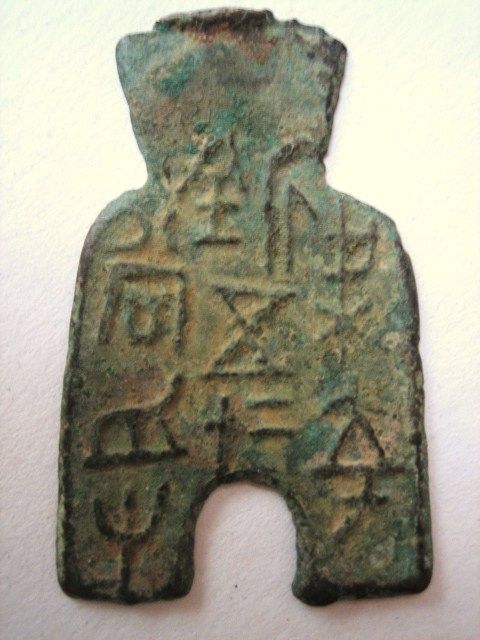
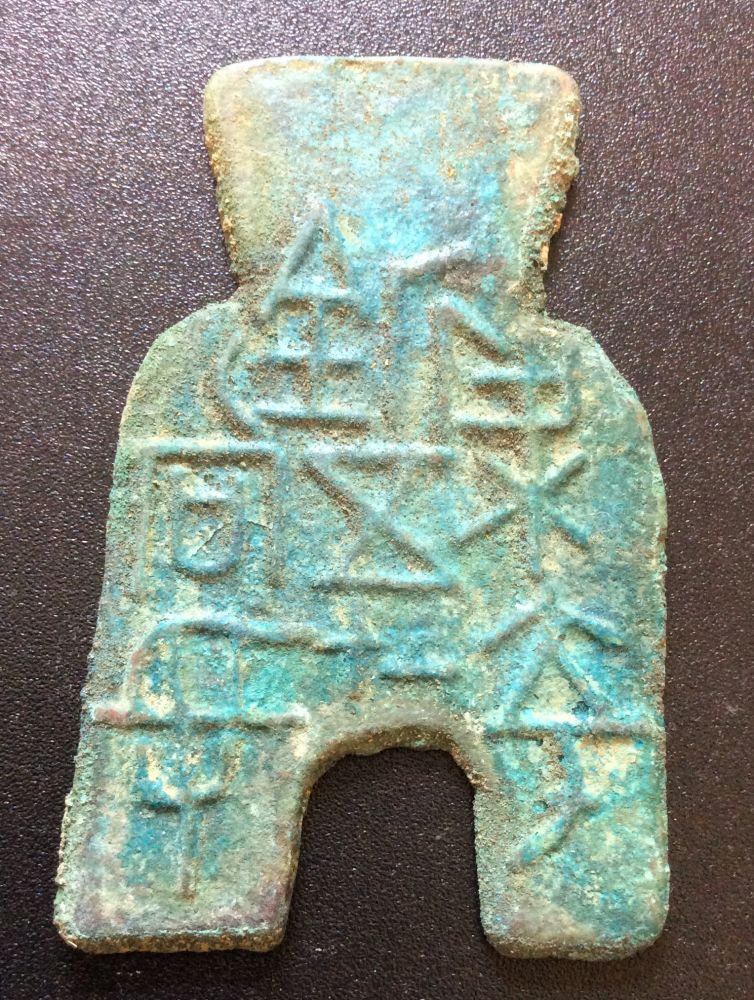
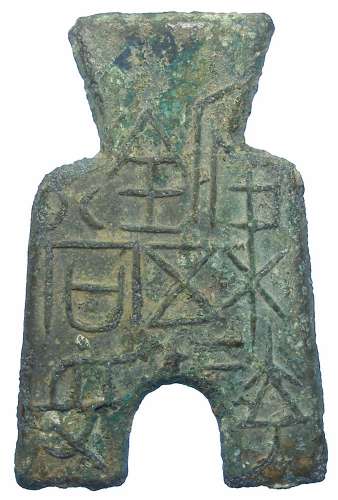
So I'm gone for just a tiny bit and everyone starts buying great and rare coins. Sweet pick-up, dude! Truly a scarce type you don't see every day. (I guess this was the coin you were referring to in your e-mail. Reply coming soon btw). I did see it pop up on ebay a while ago, but passed it because of the seller. As you yourself already said, he has had some decent fakes in the past. The Zheng/Lan spade and the "fish" he still has for sale don't look that good to me to be honest, but this may just be the photos playing tricks on my eyes. Anyway, you are the authentication expert here and if you have bought from them before, I'm gonna trust you on this one ;). Have you already received it? What can you say about it? I'm gonna guess authenticating these spades differs quite a bit from the process you go through on regular, thin spades. The discussion on the reading and interpretation of the characters on the coin is indeed one of the most interesting within the field of early Chinese numismatics. While most spades and knives, both late and early, show perhaps one, two or three characters to interpret, this one has an inscription long enough to almost classify as an entire sentence. I must admit that the discussion on denominations and weight standards is not the one I'm the most knowledgeable on. So I'm trusting you to have done your homework correctly. ;). One thing I would like to note is the first character in the inscription (remember to read from right to left): Liang. Sorry if you guys find my history lessons tiring, but I can't help it. As Thomas pointed out, this could refer to the Liang state (coming back to this): In previous topics I may have already mentioned one of the most influential events in Archaic Chinese history, that truly marked the transition from the semi-peaceful Spring and Autumn period into the chaotic, yet interesting, warring states period. This event of course being the "partition of Jin". I'm gonna try to keep it short, seeing as this is actually of minor importance to this coin, but it is nice to know anyway. What basically happened was that in the Jin state, one of the larger and key players within the Spring and Autumn period, three major clans (noble houses) rebelled against the ruling Zhi clan. And to make a long story short, in 453 BC (it actually took 50 Years for the Zhou King to acknowledge this) they, after successfully destroying any Zhi opposition, divided the Jin lands between themselves and founded three new states, often referred to as the three Jins. One of these was the Wei state, the state which Thomas's coin is from. Wait.. Wei state? I thought it was attributable to the Liang state? Well, attention-paying reader, you're right and wrong. In its early years Wei had its capital in the city of Anyi, which literally translates to "peaceful city". Problem is, this city wasn't that peaceful at all. It was located close to the western border, where the Wei state bordered with the Qin state. While at first Qin wasn't that much of a threat, they, towards the middle of the Warring States period, quickly became one of the larger states, with an army to match. Finally, in 361 BC, The Wei king Hui decided that it was too risky to have his capital so close to the dangerous Qin state, and moved it eastwards, to the city of (Da) Liang (side note: there were actually more than one city in the Wei state called Liang, so prefixes, such as "South", or in this case "Great" were used, as to prevent confusion). After this move, the Wei state actually changed its name; from Wei to Liang, in reference of course to the new capital (this is actually my main point). It turned out moving the capital was a pretty great move; a mere 80 years later, in 286 BC, the former capital of Anyi was captured and destroyed by Qin forces. So what does this tell us about the coin in question? Well, that depends. If the Liang on this coin refers to the name of the state instead of the city, it must have been minted after 361 BC, seeing as the state technically only came into being after the capital move in that year. If the Liang on this coin indeed refers to the city of Daliang, it could have been minted any time after the Partition of Jin (453 BC) to the actual demise of the entire Liang state in 225 BC, which was marked by the fall of Daliang. {Digressing again; It was said that Daliang was surrounded by a large moat, filled with water from the nearby Yellow River, and that there were no more than five gates, all having drawbridges, that granted access to the city. Sounds like a pretty hard keep to conquer, right? Nope. This formed no problem for Wang Ben, one of the greatest Qin generals during the final campaign against Liang. Quite the contrary; he kept besieging the city for three months with a minimal force, while a large part of his army worked on redirecting the flow of the nearby Yellow river. Meanwhile, Liang had used this extra time to build up their defences, for one final epic last stand. It actually never came to fighting; Wang Ben's brilliant plan had worked. The redirected river now flooded the entire capital, destroying buildings left and right, and drowning, according to some, at least 100000 people. The Liang king immediately surrendered and Liang was no more. This history was of course written down by the victors, the Qin state, so may have been subject to a bit of enhancing over time} That being said, there is one other coin that might shed some light on the inscription: 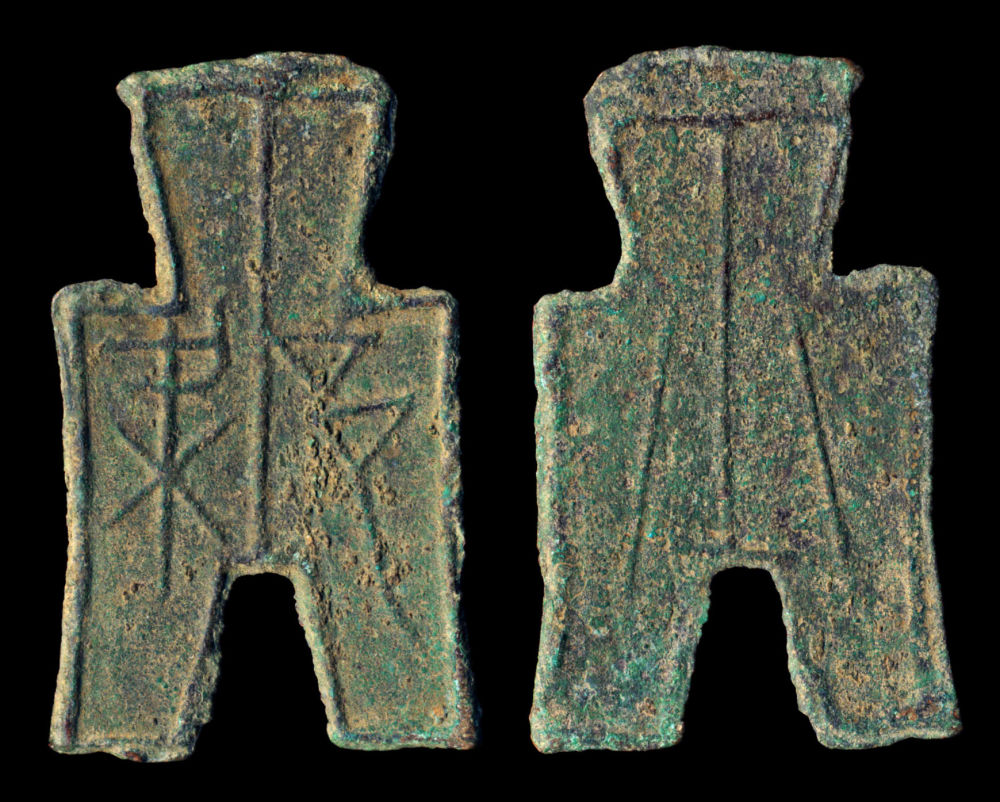 {Unfortunately this specimen isn't from my collection, I pulled the Image from Bob Reis's store, where it is offered for sale. $75 dollars, decent condition, and you don't see these value two spades that often (nearly all Fangzubu were cast at around 5 grams, this weighing nearly double.} We are back at my favourite type of spade, the Fangzubu (straight-legged spade), again. The attention-paying reader might have already recognized the character inscribed on the left; it is the same as the one in the top-right of Thomas's spade; Liang! Which in this case absolutely stands for a city name instead of the Liang state. The radical on the right namely just so happens to be 163th radical, Yi, indicating a city. Whether the city mend here is truly DaLiang, or any other city called Liang remains up for debate, but I am willing to believe this for a couple of reasons. As our first piece of evidence, we know for a fact that Wei/Liang issued tiny spades of this type. Some numismatists are even able to attribute a tiny spade looking only at its shape; the Han-state spades apparently have slightly straighter sides, these Liang-spades have sides that are slightly more concave, the Zhao-state issued both, and the Yan-state spades have an atypical, slightly raised rim. While these classifications are definitely not set in stone, and many, many exceptions do exist, they, when averaged out, do match up with the inscription attribution. Moulds of such type have apparently also been found in Liang-controlled territory, although I am afraid I can't confirm which inscriptions and where from my sources. Our second piece of evidence comes when looking at the character itself. Even though every major state used the same set of characters, there were often many local differences. Take the character "An", one frequently featured on Chinese coinage from this period, for example. Nearly all versions of this character, made by different mints throughout the different states, are a little different, using two or three strokes for the middle component for example. If we compare the Liang on these two spades, we can see that the calligraphy is fairly similar. This does not mean they are from the same mint per se, but it can point in this direction (many arguments against this are possible, I'm already regretting touching on this subject)). So we basically have a spade from a city called Liang, issued in large numbers (it is one of the least-rarest types available), in the Wei/Liang state. Seems a perfect fit for a DaLiang spade. These Fangzubu are of course of a later date, originating somewhere around 300 BC and probably being cast all the way down to the fall of the city in 225 BC. They are not contemporary with the Arched-foot spades, but some overlap may be present. One type that is contemporary, albeit commoner, yet historically equally interesting, is another arched-foot, inscribed Anyi (two characters on the right): 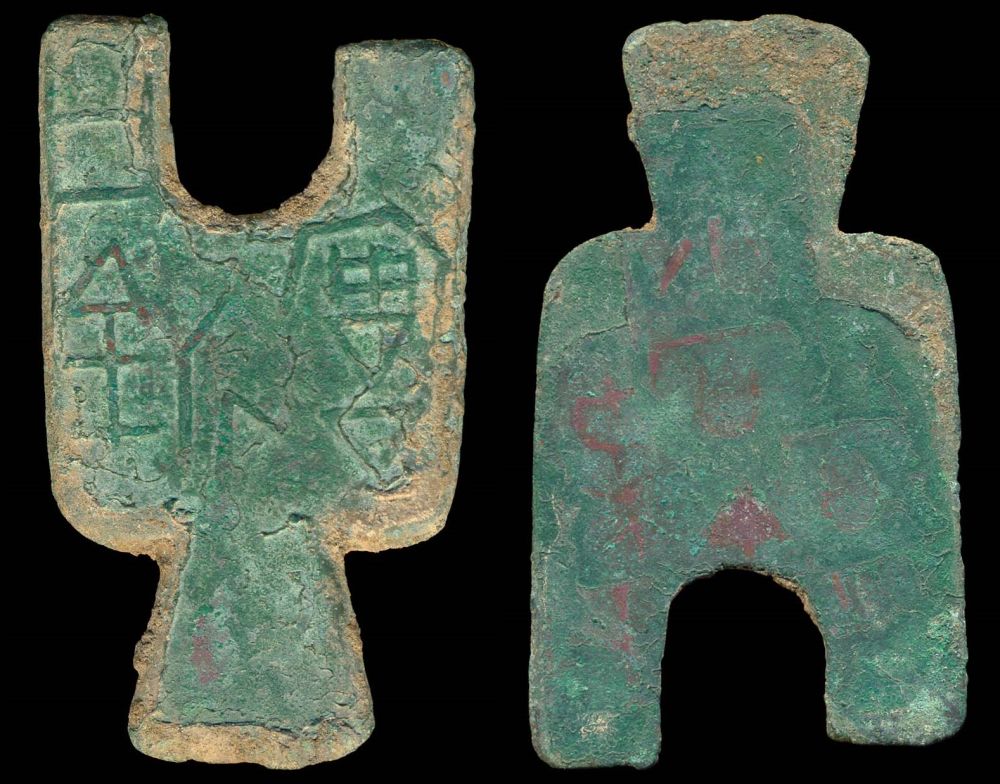 {Also stole this image from Bob Reis, although this one was sold ages ago. Note the fact that I had to turn the coin 180 degrees, with its legs up, for the inscription to make sense} As one might have guessed, these were issued in the earlier Wei Capital of Anyi. The attribution to this city is almost certain; Again, the fact that it is a city is specifically named in the inscription (Yi), and the archaeological finds seem to support this identification as well. What is really fascinating about this type is that the fact that we almost certainly have an end-date to the minting period, namely 286 BC, when the city was conquered by Qin. I picked this specimen as an example because of the reverse; no characters appear, but when one looks carefully, one can actually see the obverse of another spade, of the same type as Thomas's, imprinted in the patina. This, as well as many other hoard finds, tell us that the two types circulated alongside each other. I included this type because I just find it to be one of the most beautiful ever issued, both historically and numismaticly. And you don't get to write about arched-foot spades every day, so I might as well throw it in! So can we with certainty say whether the character Liang represents the city or the state here? Well, we probably can't. We know that on most of the coins issued in the Liang state, whether it be early round coins or spades, the inscribed character stood for a city. So in my opinion, attributing this to DaLiang seems to be the most acceptable theory. Yet it is not entirely possible to rule out the other option. The inscription itself does not specifically mention a city after all. To summarize in one sentence; We can either identify the city your coin was made in (DaLiang) and not a more specific period, or vice versa (361 BC - 225 BC, which would be later than originally thought). Anyway, it sure is a cracking coin, with a history to match. I sure hope it is genuine (else I would have written this for nothing :) ). So, I hope someone found this at least a bit interesting. It may have been a bit jumpy and all-over the place, my apologies for this. I just think that having this historical background make the coin so-much more enjoyable for all of us! Kind regards, Mika Ps. Just curious; since you are a type collector, does this mean that the entire arched-foot series is now checked off from your want-list? Or are you still on the lookout for other inscriptions (Anyi) or different denominations with the same inscription? Pps. Please don't take anything I have written as 100% fact. In Chinese numismatics, particularly in this early branch, it isn't as straight forwards as it sometimes is in other areas. In some cases, the most-likely explanation has to be used. We for example can't be entirely sure that the Liang referenced to on these spades is in fact DaLiang, not just some other city called Liang. However, seeing as the other ones we know of in the Wei/Liang state were economically quite insignificant, and adding the fact that both the arched-foot and the square-foot series were cast in huge numbers, I believe we can safely attribute these to this city. Until archaeology comes along and proves this, preferably by finding the mint that they were made in, we can never be 100% sure though... |
|
Valued Member
Netherlands
91 Posts |
One tiny addition: The seller has just listed two new coins; A san Kong bu (three-hole spade) and an inscribed hollow head spade. They don't look that good to me to be honest. The three-hole spade is almost a certainly a fake. The hollow head is most likely also fake, although I am not entirely sure. What do you think of these Thomas?
|
|
Pillar of the Community
 United States
6370 Posts |
Once again, I am very impressed by your vast knowledge of ancient Chinese history. What sources do you derive your knowledge if you don't mind me asking? To be honest, in my notes, I had written that this spade was likely of a later date due to the complexity of the inscription. It seems unlikely that there would be a transition from the hollow-handle spades with one (and very rarely two/three/four) - character inscriptions to a flat-handle with an 8-character inscription, so I disregarded Wang's assertions that these were the earliest flat-handle spades made. When I saw that Hartill had given a similar date range, I trusted his judgement and research, so I gave Wang's theory a little more credence (as you can see in my original post). However, I do agree with Wang insofar that this spade and its fellow varieties in this type are transition spades of some sort. It is too rare as a type to be a regular mass-produced coinage. Whether that was between hollow-handle and flat-handle or between arch-foot and square-foot, we can't tell for certain. You raise interesting points with both of the coins you posted. Yes the two characters are "Liang," which was used for both the name of the state and the city. However, on the square-foot spade, you mentioned that it had the radical for "city." Mine does not, and that is a significant difference between the two characters. As a result I feel my coin is referring to the state, while yours is referring to the city. With regards to the AnYi spade you posted, I find that particular example fascinating as it proves that the two types did circulate together. However, it does not prove which variety came first. Given the inscription complexity of the special spade and the two different time windows when the Liang state and AnYi existed, I'd say that the special spades were cast later. Since there are no pointed-foot specimens that have the inscription "Liang," I would say that there was a direct transition between the arch-foot and square-foot spades. Possibly, the square-foot spades were gaining popularity, and the Liang state tried issuing an arch-foot spade with a full denomination and conversion rates to foster trade and acceptance of the coin, but we can tell now that did not happen. Quote:
Just curious; since you are a type collector, does this mean that the entire arched-foot series is now checked off from your want-list? Or are you still on the lookout for other inscriptions (Anyi) or different denominations with the same inscription? I thought about that, but I could not justify crossing off all arch-foot spades with the addition of this specimen. It is too different from the other types (eg. AnYi) to be a standalone representative of the type. Quote:I did see it pop up on ebay a while ago, but passed it because of the seller. As you yourself already said, he has had some decent fakes in the past. The Zheng/Lan spade and the "fish" he still has for sale don't look that good to me to be honest, but this may just be the photos playing tricks on my eyes. Anyway, you are the authentication expert here and if you have bought from them before, I'm gonna trust you on this one ;). Have you already received it? What can you say about it? Unfortunately, I do not have it in hand, and I won't be able to examine it for a little while (it arrived the day I moved to NC). However, what made me think this coin is genuine was the severely-pitted reverse and the well-defined characters on the obverse. I have yet to see another fake that had severe pitting like the coin here (seriously -- try to find one!). The sharpness of the characters is a contrast to the fake I own. Also, I have not bought a single fake coin from this seller, so I trust almost all of his stuff. Quote:
One tiny addition: The seller has just listed two new coins; A san Kong bu (three-hole spade) and an inscribed hollow head spade. They don't look that good to me to be honest. The three-hole spade is almost a certainly a fake. The hollow head is most likely also fake, although I am not entirely sure. What do you think of these Thomas? I got bad vibes from both of them. The three-hole is likely an older fake, and the hollow handle could be genuine but modified. I'd stay away. |
|
Pillar of the Community
United States
6370 Posts |
|
|
Valued Member
Netherlands
91 Posts |
First of all, let me apologize for replying this late. I have the annoying and irritating tendency to reply to topics when I actually should be doing other stuff, and afterwards I then completely miss your reply. Ahh well.. better late than never. Secondly, especially with these new pictures, I too am levitating towards genuine. "Guilty until proven innocent" is the correct mentality to employ in this area of numismatics, certainly when the seller is known to have sold fakes. But the pictures your dad took are loads better than the ones from the seller. I thought it would be rather grainy, sort of like the first imitation you posted, but they look more than okay-ish now. The same goes for the calligraphy on your coin, which can only be described as "elegant". Compare this to calligraphy on the two fakes; thick, clumpsy and unbalanced characters, bumping into each other. Although I must say the Shi (er) component on yours differs slightly from the genuine ones I have seen. But this hardly any reason for concerns; such tiny deviations do exist, look at the two genuine ones you have posted. I also agree that the pitting on the reverse looks good and authentic, but you never know. In hand these coins are hard enough to authenticate for a real expert, let alone for someone, who has handled precisely one of these coins for only two minutes once, from a mere picture. Your expertise on authentication by far exceeds mine, so if you're certain it is genuine, it most probably is. Still an amazing addition, and a truly rare type! I am interested in the amount of relief the characters show though. Quote:
Once again, I am very impressed by your vast knowledge of ancient Chinese history. What sources do you derive your knowledge if you don't mind me asking? To be honest, I feel flattered. As numismatic-historical references I use the usual (in order of decreasing use: Hartill, Wang, the English translation of Peng Xinwei's work, Lacouperrie's catalogue of the coins present in the British Museum (and to a lesser extent Schjöth, and Coole)), as well as some Pdf copies of a couple of Chinese books, which I can hardly read, but are nevertheless useful. If you're interested, I might be able to send you some. And a question; how is your German? A work I use perhaps a little bit more often than Wang's is "Frühe chinesische Münzgeschichte - Zur Chronologie der Spatenmünzen (7. bis 3. Jahrhundert v. Chr.)", a top-notch work by Heinz-Wilhelm Kempgen, comparable to Wang's, but focussed more on the background history and geography of the coins (not just spades, anything from round coins to Qi-knives are also included). Totally worth it if you have 7(!) bucks + shipping left over, provided you are able to understand anything of what he is saying. One of the nicest things about it, in my opinion, is the fact that he is one of the few authors that include detailed maps of mint-positions, not a generic overall overview of China in its entirety, in his work. As for purely historical sources; my favourites include; the pre-221 BC volume of the Cambridge History of Shina (modern), and a couple of (semi-) period pieces: The Zhanguo ce ("strategies from the Warring States", the work that gives this period its name), The Bamboo annals, the Spring and Autumn annals and tiny parts of the Shiji (perhaps better known as "records of the Grand historian") and the Shujing (Book of documents). And I must admit, Wikipedia too. This is becoming an interesting discussion. I think we must also take a look at the inscriptions found on the other arched foot-spades. As far as I can place them, most seem to reference place names. A favourite of mine being "Gong Ban Jin", referencing the city of Gong, where the round coins with a similar inscription were minted. Shanyang, most probably a city answering to the modern city of Jiaozuo, in current day Henan province. Although an entire topic could be dedicated to this spade. Anyway, from what I have gathered, it seems likely that most of these names actually refer to city names. That being said, this does not mean that the Liang on this coin can't refer to the state. Another couple of interesting spades are the ones listed by Hartill under 3.12-23. These spades are all inscribed with a character similar to the Liang found on this coin, but with a slightly differing calligraphy for the top component. This leads me to believe these are either not entirely contemporary, contemporary but not issued by the same mint, or that the character on these is not Liang, but something else. Hartill himself even placed question marks with this reading. Historically, this character has also been read as "ying", the same as the "ying" on a rare Fangzubu. One thing to note though; this city was probably located in the Han-state. This possible attribution to the Han-kingdom is one of the major reasons these spades are also sometimes associated with the Han-state. Although the latter seems less likely in my opinion, it should still be considered. What do you think Thomas? Is the character Liang? Or Ying? Or perhaps even Song, as Coole for some weird reason suggests. If it truly is Liang, what does this tell us? You correctly mention that the yi-radical is not on the coin. But to be honest, I am not sure this means it can't be attributed to the city. We see this, city names without "yi", all the time, on everything from Small spades, to round coins and knives. Take my favourite type of knife for example, the straight ones issued by the Zhao state in the city of Handan. No Yi-radical is present. To be honest, I am a little divided between the two different interpretations of the character. While I feel attributing it to the city of Daliang fits a little bit in the "wishful thinking" area, it could well be. I mentioned Kempgen earlier in this post, and I would like to add his theory. He states that the An-yi spades where the earliest, arriving as far back as before the partition of Jin, namely in 496 BC. These special spades arrived later, after the move of the capital in 361 BC. All other arched-foot spades, the rarer types, were issued sometime in between, by local merchants, or local rulers under Wei-jurisdiction. Concerning the chronology; you are probably right. To me it would seem more likely that these arched foot-spades formed the transitional period between the hollow handles and the late "thin" spades. Because 1) the Handle often shows, on the rarer types at least, a hole or deep pivot, both round or square. This feature is often seen on hollow handled-spades, and not on the fangzubu's and contemporaries. 2) the sloping shoulders seen on some of these arched-foot spades remind me more of the sloped hollow-handle spade shoulders, than the straight, yet upright pointing of the later spades. This is just my observation though, and I could be proven wrong easily. Quote:
I got bad vibes from both of them. The three-hole is likely an older fake, and the hollow handle could be genuine but modified. I'd stay away. Noted ;). Mika |
|
Moderator
United States
23731 Posts |
Wow! what an excellent thread.
|
| |
Replies: 10 / Views: 2,527 |
|
To participate in the forum you must log in or register.
Disclaimer: While a tremendous amount of effort goes into ensuring the accuracy of the information contained in this site, Coin Community assumes no liability for errors. Copyright 2005 - 2026 Coin Community Family- all rights reserved worldwide. Use of any images or content on this website without prior written permission of Coin Community or the original lender is strictly prohibited.
Contact Us | Advertise Here | Privacy Policy / Terms of Use
|
| Coin Community Forum |
© 2005 - 2026 Coin Community Forums |
| It took 0.48 seconds to rattle this change. |
 |
|
| |
|







 Posted 01/03/2017 6:59 pm