So, to sum up:
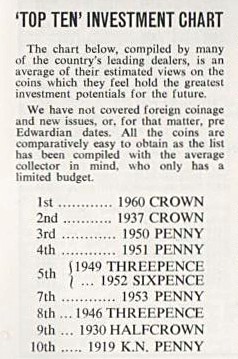
If you had taken their advice and bought those £144 worth of coins in 1967, put them in a locked airtight cupboard, taken them out now and sold them, you'd get £4935. If, instead, you'd have put that £144 in the bank earning interest at the inflation rate, you'd now have £2426, or about half as much. From that point of view, coins are a "good investment".
On the other hand, most of that profit came from the number 10 coin - in other words, from a coin that almost didn't make it onto the list. Delete that coin, and the 144:2426:4935 numbers become 84:1418:2085, which is a much less profitable scenario, and one avoided by what can only be called pure chance. So from that point of view, coins are a "bad investment", as they are much less predictable. It was entirely possible that the whims and vagaries of the coin market had meant that all ten of those chosen coins had growth rates lower than the inflation rate, and it would have been impossible to know in advance.
It should also be pointed out that half of the coins "fell" in value, inflation-adjusted; four rose, and one was pretty much even. So the best guesses of the coin pundits fifty years ago were only able to "get it right" 50% of the time.
To conclude: making profits by "investing" in coins is possible, with the following caveats:
- It's very long-term.
- It's not guaranteed; even the best guesses of experts on which coins make "good investments" are little better than tossing a coin.
- Diversification is important to cover the inevitable losses. You only need one really good investor-coin to cover the losses on a whole bunch of poor choices.
Don't say "infinitely" when you mean "very"; otherwise, you'll have no word left when you want to talk about something really infinite. - C. S. Lewis









 Posted 01/12/2017 12:43 pm





