| Author |
 Replies: 22 / Views: 4,287 Replies: 22 / Views: 4,287 |
|
Pillar of the Community
United States
4883 Posts |
Colligo ergo sum
|
|
|
|
Valued Member
Uruguay
217 Posts |
Could be a repaired punch? I'm speculating, it makes sense only if the punch's base was something like this: 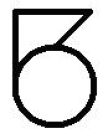 |
|
Pillar of the Community
 United States
4883 Posts |
An update on this specimen, of which I was a bit suspicious to begin with because of the slightly brassy tone the cap exhibits.
Weight's not terribly off at 26.71 grams, but my measurement of its specific gravity comes in at just 10.05, which would peg it at only 75% fine silver if copper were the sole other alloyed component. Visually it doesn't match up with any of the counterfeit 1832 Zs types catalogued by Riddell, and that apparent purity also doesn't jive with any of those, either. Of course, it really wouldn't make much sense for a counterfeit to be made with that much Ag anyway, so I'm thinking perhaps there's Pb in there somewhere which might account for the respectable (albeit still deficient) weight and specific gravity. In any case, it's another questionable piece that might well have to undergo analysis via xray fluorescence at some future date to sort out precisely what it might actually be.
Colligo ergo sum
Edited by Lucky Cuss
01/24/2017 09:25 am
|
|
Pillar of the Community
United States
4883 Posts |
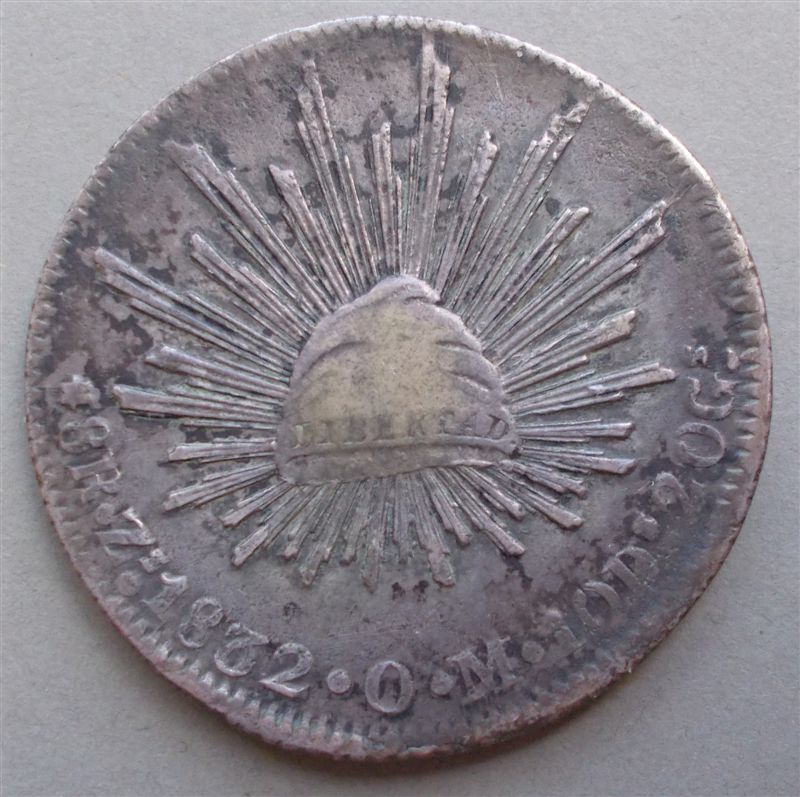
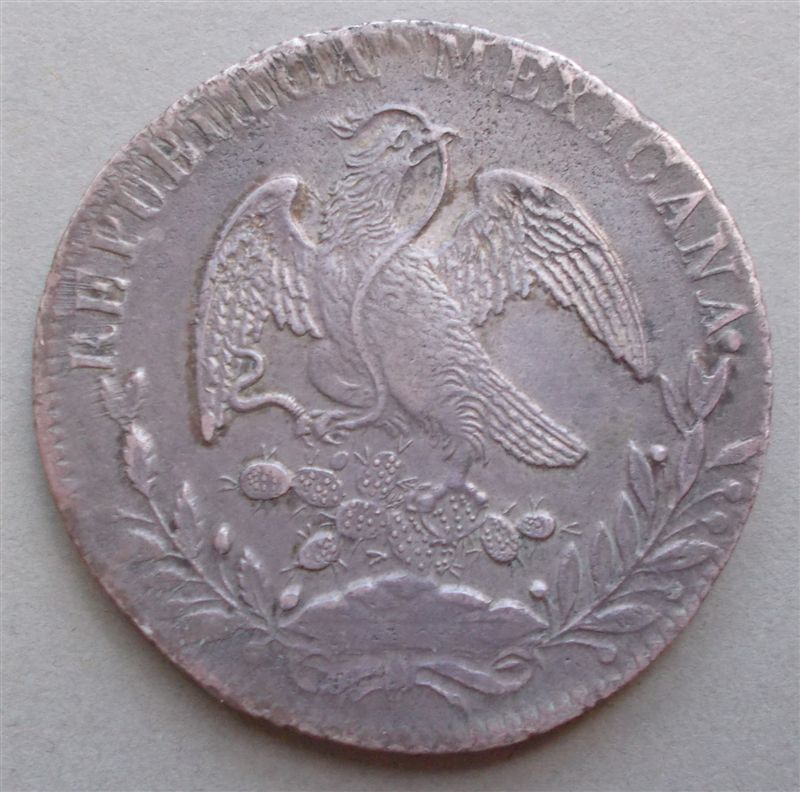
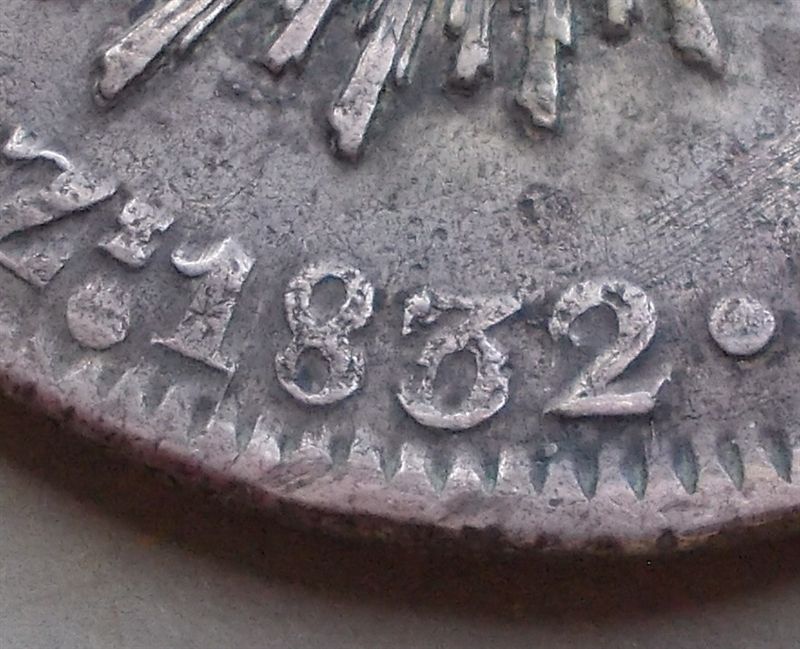
Another development in my evaluation of this coin. For months, I haven't seen a Cap & Rays worth my attention. Suddenly, everybody seems to have early First republic types to show me. So today, I picked up this 1833 Zs, and am posting pics of it here for comparison to the specimen with which I started off this thread. 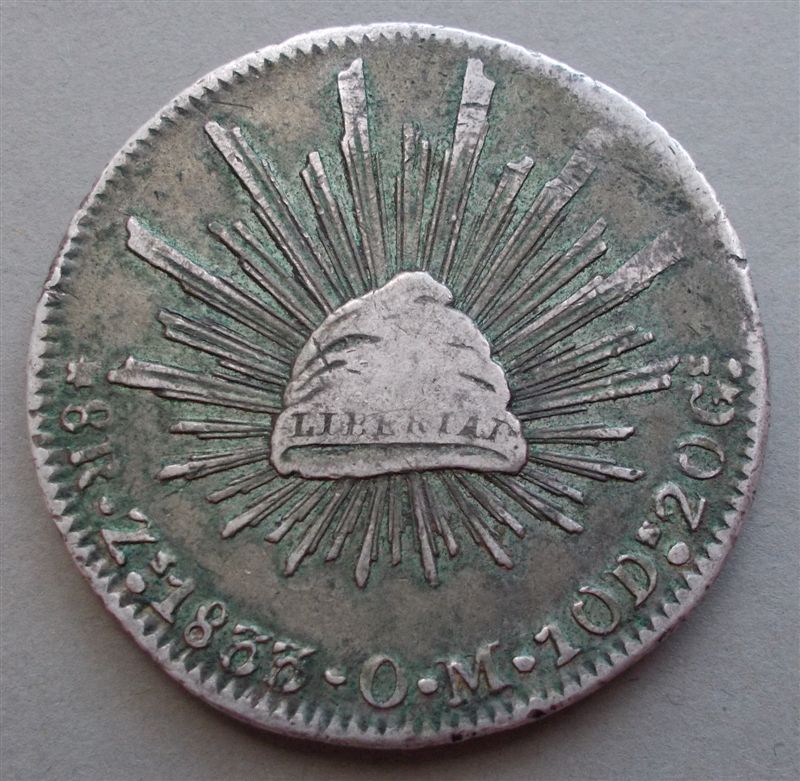 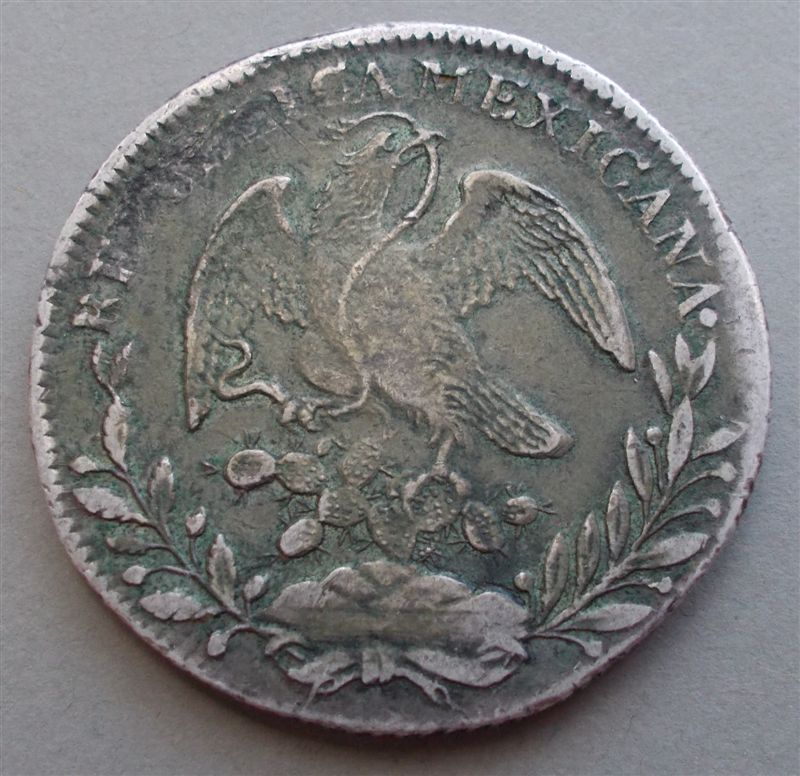 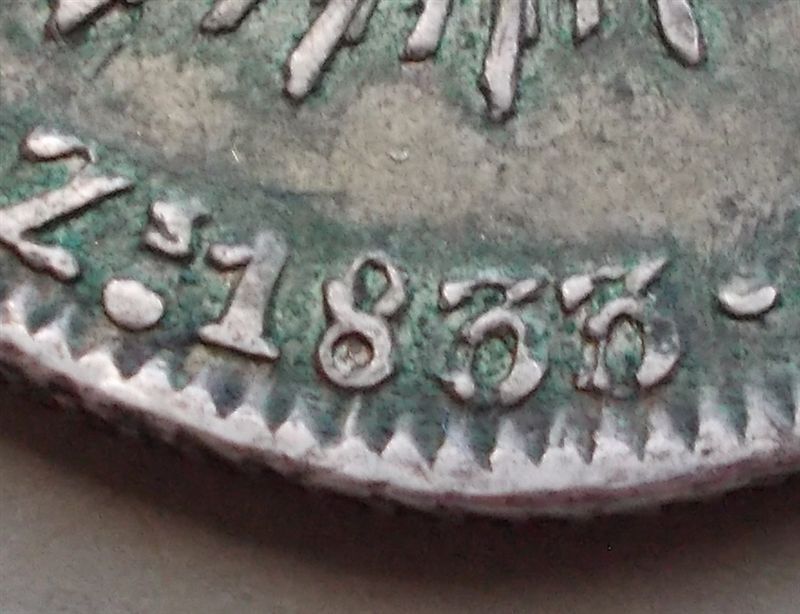 This one is overweight at 27.37 grams. What's really interesting is how precise a match the eagle side is to that of the 1832. Furthermore, both 3's in the date are very much like that oddly punched 3 for the 1832 (note the recessed but clearly visible bar running from the central point to the tip of the bottom loop in all three cases; this is really suggestive of the same punch being used for each). So I confess to being really confounded at this juncture.... Colligo ergo sum
|
|
Pillar of the Community
United States
5362 Posts |
First of all the 3 punch used at the mint had the bar I see here. It connects the point at the end of the loop with the point at the center of the 3. There are no overdates shown here. The overdate shows a clear second line that crosses the entire loop from near the opening to the back of the numeral.
Next there are some contemporary counterfeits made outside the mint with old scrap dies that were sold to a local junk dealer without having the designs effaced. That is reported in letters in Riddell's book. Some of them can be identified by the edge designs. They tend to use very old bad edge dies that were broken into pieces. Check the overlaps from 1830 to about 1836 to be sure. Also check for reversed edge designs {{{{{{}}}}}. I suspect that these may be mint made debased copies with the edge acting as a way to ID them quickly for the mint workers themselves.
The ones I have tend to be roughly 60-70% silver which meant they would successfully pass into circulation unnoticed. Riddell reports others in this purity range in 1845 so they were made. The margin of profit was less important than not being caught. If people wore down the coins by placing them in bags of sand to get 2-3% of the value then a 10-30% margin would be a big profit.
I classify coins that are under 70% fine as counterfeits and those that are over 70% fine but under 87.5% as debased. There is nothing yet to prove where the debased strikes were actually made.
|
|
Pillar of the Community
United States
4883 Posts |
The edge design on the 1832 is well defined, and runs in all one direction. There is an overlap, but it's very subtle and wouldn't be apparent to an untrained eye that wasn't specifically looking for it. I'm supposing the other side just happened to mesh together more or less perfectly.
Colligo ergo sum
|
|
Pillar of the Community
United States
4883 Posts |
Here's another 1833. 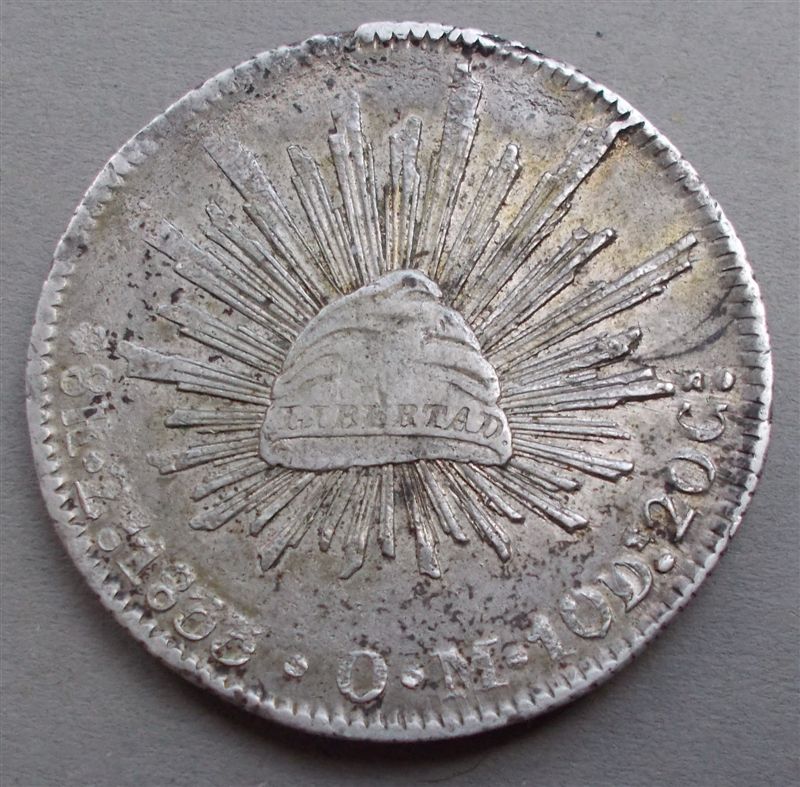 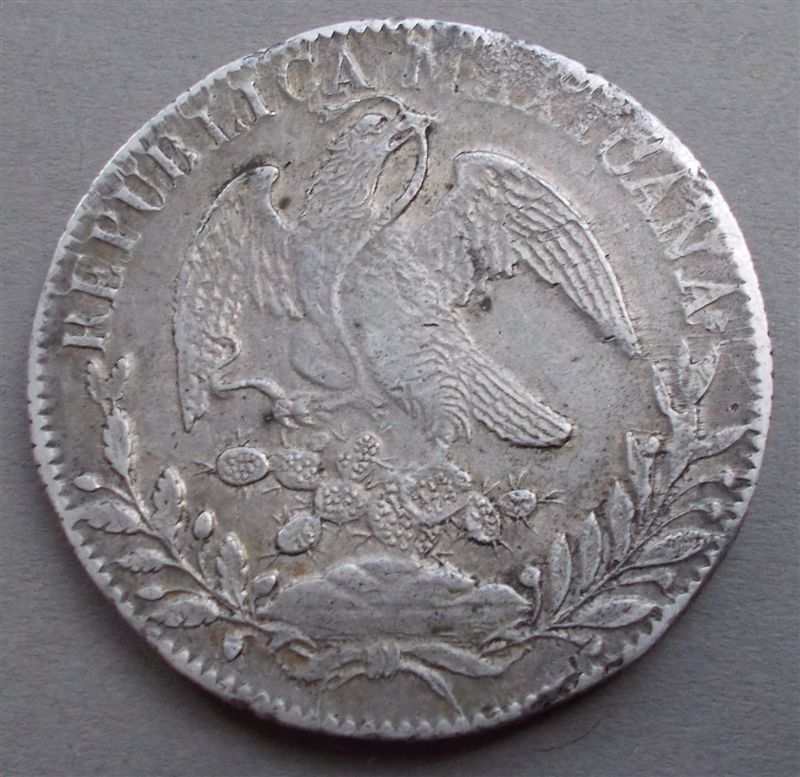 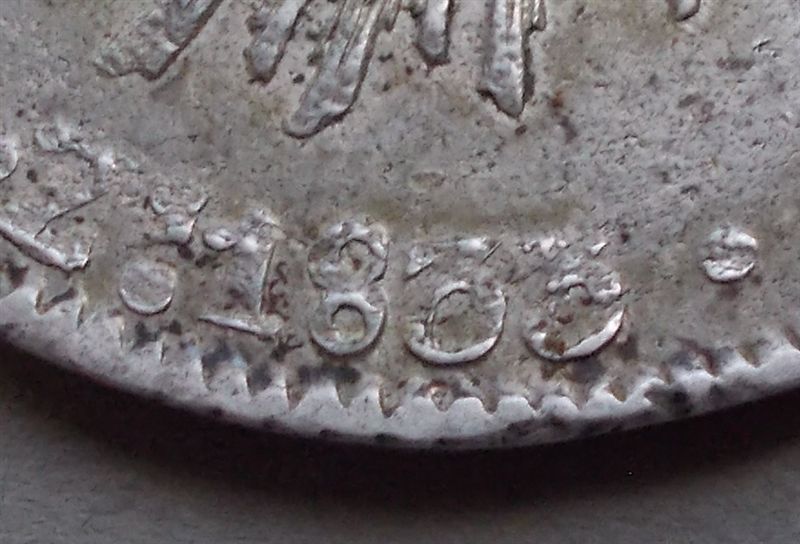 I'vs just had this spevimen subjected to analysis via xray fluorescence, and the results suggest some slight debasement, probably in the 80% silver range. The only other major mettallic component is copper, with no zinc or tim being detected (so the copper present is not in the form of a brass or bronze alloy). Once more, the characteristic "bridged" 3's in the date can be seen. The dies utilized to strike all three of these coins are consistent in this respect, yet two seem to be counterfeit in terms of deficient silver content. The possible conclusions have to be that either 1) there was corruption or negligence at Zacatecas during this period resulting in substandard specie being produced there, or 2) that somebody outside the mint obtained genuine dies to work with (which apparently has been docmented), which might well lead back to the corruption or neglgence theory again. Colligo ergo sum
|
|
Pillar of the Community
United States
1156 Posts |
Quote:
The only other major mettallic component is copper, with no zinc or tim being detected (so the copper present is not in the form of a brass or bronze alloy). What about minor components. Was the XRF device sensitive enough to detect any gold? |
|
Pillar of the Community
United States
4883 Posts |
Quote:
What about minor components. Was the XRF device sensitive enough to detect any gold? I had hoped to see some trace gold to verify its pre-1850 origin, but according to colonialjohn, the particular apparatus used will not pick up metals that comprise less than 0.5% of the overall composition. Colligo ergo sum
|
|
Pillar of the Community
United States
4883 Posts |
You may have noticed that the first 1833 here (for which I posted the pics right after I got it) was pretty loaded up with green gunk, probably from improper storage within a reactive medium. That's since been washed away with acetone, so I thought I'd post updated images. The distinctive "barred" or "bridged" threes are especially prominent on this specimen. 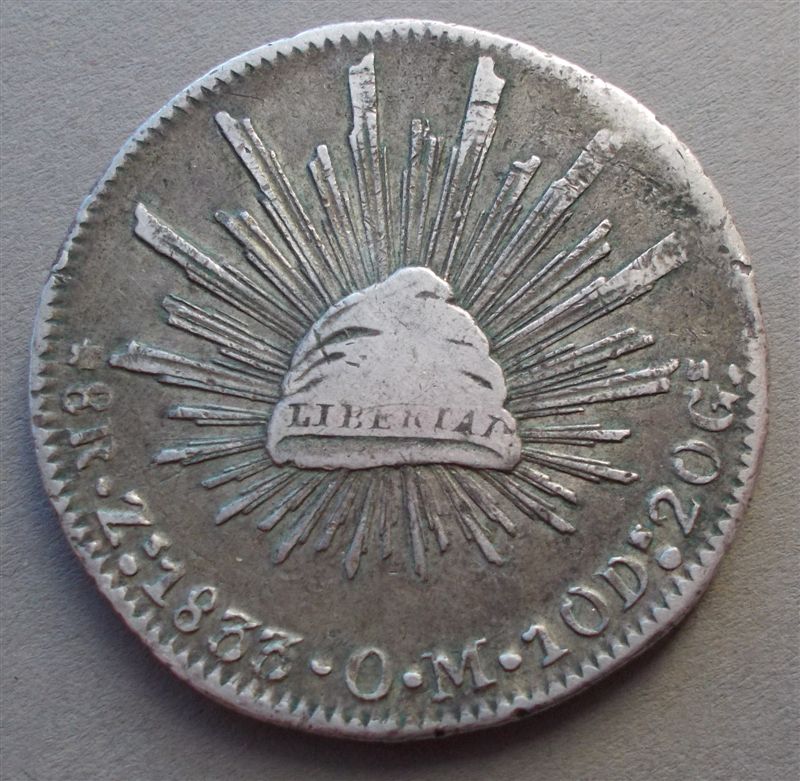 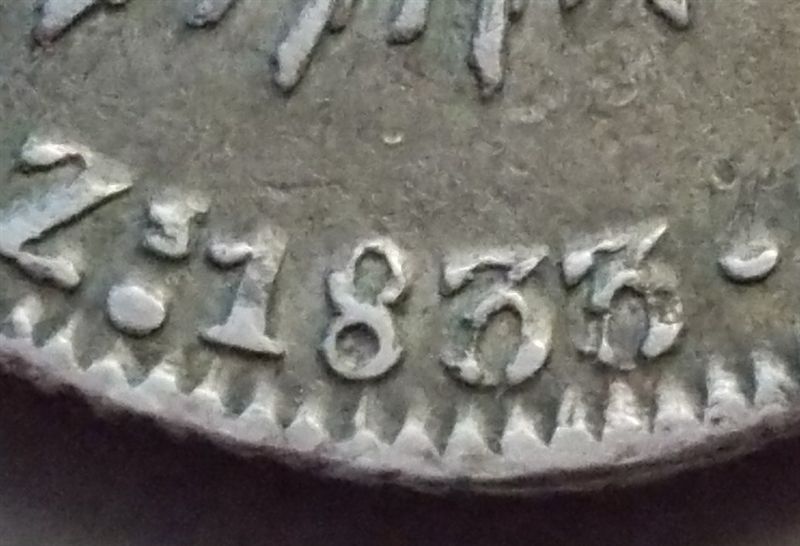 Colligo ergo sum
|
|
Pillar of the Community
United States
5362 Posts |
Regarding the use of XRF to test for gold, you need to exercise caution when looking at the results. You can easily infer too much by reading into the tests things they really do not say.
Silver contained in counterfeits made at the same time as genuine coins should contain the same or similar trace contaminants as genuine coins provided the silver was drawn from the same location.
To explain further, lets say these 1832 and 1833 coins that test low in silver are counterfeit with a silver content of 80% instead of about 90% - the trace contaminants should appear in ratios of 8/9 ths or about 89% as much trace contaminant as a coin made of genuine silver from the same area. So the source of silver used by the counterfeiter is what is being tested. Coins made in the mint with an alloy that was short in silver would be IDENTICAL in all respects to genuine full alloy coins from the mint.
If the counterfeiter used silver from melted coinage and he was located near the mint - it is very likely that the silver signature is very similar.
If the counterfeiter was actually located in New York City the signature could be quite different depending on his silver source.
Another critical thing to keep in mind is that if there is significantly less silver in the counterfeit say 50%, you need to remember that you are looking for one half of the level of trace contaminants in the silver signature and as many as 4 times more contamination from the copper source.
So XRF signatures will depend where the counterfeit was made as well as when it was made. If the counterfeits are found primarily in Mexico it is more possible that native Mexican silver was used because the coins were likely made there. However, a similar counterfeit made in the UK (Birmingham) likely used silver available in that location. History tells us that silver mined in the UK came from lead deposits but it also tells us that England captured many Spanish ships with cargoes of silver coming from Mexico, Peru and Bolivia in the time period of about 1800. Therefore the silver signature of a UK counterfeit could display any of 4 or more contamination patterns.
The take away from this and the only factor at this date that can be stated strongly is that pure silver (0.999 fine) and pure copper (0.99 fine) were not available in large monetary quantities before 1850 (UK for lead silver only) and 1870 (US for Nevada silver). After 1890 silver worldwide reached purity of 0.999 or better. I expect all silver coins that were actually produced before 1850 to be contaminated. Coins made after 1850 may contain high levels of contamination if older refining methods were used.
KEY POINT - Coins made from essentially pure metals are products of the late Nineteenth and Twentieth Centuries. This is the point that you need to recall when assessing laboratory test results.
|
|
Pillar of the Community
United States
1761 Posts |
Unfortunately the apparatus at my company now are around 20+ years old so we normally have an instrument detection limit of 0.5% and are wary of the accuracy below 1%. For our work this instrument is good enough so to speak. When at EDAX/Spectro I was working with accuracy down to 0.01% and IDLs of 0.001% such as on the EDAX Orbis for testing I provided Gurney in his book BIG DIFFERENCE. Again, low trace signatures are fine to make general assessments as with gold levels and time of manufacture - but be careful when we are talking provenance to a certain mint. Lead isotopic analysis (LIA) is the main tool now used to provenance coins to particular mints as this was started around 1967, even today in 2017 recycled metals are a problem for coins dated 1500-onward to particular mints with very high certainty. What they generally do now is do a LIA study on the surrounding in-ground ore deposits first in a region or around a particular mint in question and then compared the LIA ratios to that of the coin in question and see how they MATCH UP. Works great for ancient coinage if we just wish to verify a suspected known mint to a particular coinage since recycling of metals may have not occured as with later post-1500 operations - so it gets complex after 1500 or so due to the recycling metal factor ... they are also using copper isotopic analysis recently also as a tool for provenance with promising results. For those who know this coinage determining if the copper ore around Simsbury, Ct. was used for the infamous Higley Coppers would be a good project. Dr. Freidus (known authority on Higleys) never could and another argument they simply did not have the technology to purify the ore for this rare issued coinage but it was still exported due to its high copper purity and the Simsbury copper ore at the time was world-renowned for its copper purity so exportation was worth the EFFORT.
In my new book I discuss this in detail and give many research papers to substantiate this information not for the Higley dilemma but the power of LIA.
One of the projects I am looking know is to try to compare and see if Chinese paktong was used in earlier contemporary counterfeits prior to 1830 which seems to be the cut off we discuss in the Gurney book until recent evidence has shown that Matthew Boulton was purchasing and making paktong objects like buttons in and around 1771! From a previous post here via Keith Pinn book on paktong. I have yet to verify a paktong Kleeberg for the earlier date CC2Rs say in and around 1771-1825 which all seem to be European GS so to speak and not Chinese paktong (i.e., lower copper, higher zinc, 1-2% iron) based on Pinn's empirical formulas for these two metals in his fabulous book. This will also IMPACT possibly Larry Schmidt and his Davignon Bust Halves XRF analyses for all his varieties dated prior to 1830 on his website of CC Bust Halves. He like me assumed back-dating on all Bust Halves CCs with a date earlier than 1830 to being produced 1803-onward. We really can't say that anymore withis new evidence about Boulton and verification of ships bringing in paktong metal into England in and around the 1770's. Its a whole new ballgame on this so-called 1830 cut-off date Oliver Hoover and everyone at the ANS was so adamant about ...
Upward and onward ... everybody.
LOL.
JPL
Edited by colonialjohn
02/01/2017 8:09 pm
|
|
Pillar of the Community
United States
1156 Posts |
It is safe to assume that the type of XRF devices used in jewelry stores, pawn shops and perhaps the TPGs are not sufficiently sensitive to detect gold in pre-1850s regal Mexican silver coins?
|
|
Pillar of the Community
United States
1761 Posts |
Probably not. For this to be certain I would like the instrument detection limit down to 0.01% with an accuracy to 0.1%. Those XRF guns (newer models) may have this accuracy to 0.1% and IDLs of 0.01% or better. Case by case basis. Remember also there are other indicators like the required presence or more importantly the LEVELS of lead, good level of copper and silver, the presence of questionable elements like iron ,nickel,zinc, etc.. Most debasement of Portrait China Type II's of course will be PREDOMINATELY with copper only and zinc and tin really enter predominately with the Class I's. Personally, I have yet to verify the purity of silver on electrodeposited type Cap and Rays being theoretically near 98-99%. Bob is working with a state of the art laboratory I am sure he will substantiate this fact. In terms of this specimen here notice how we must use numismatic knowledge and scientific analysis to prove our facts. Based on the analysis his piece was confirmed as a debased copper Cap and Ray. The instrument was probably not sensitive enough and time demands did not allow say a surface SEARCH of 6-8 surface spot analysis on the coin. Besides with this specimen I do not think we are entertaining the idea of a modern forgery or a silver electrodeposited Cap and Ray. Will be clearer after Bob releases his second book. You will also get a real good taste of many different alloys that go into a CC after my book is released in a few months. Be patient.
Edited by colonialjohn
02/02/2017 4:08 pm
|
|
Pillar of the Community
United States
5362 Posts |
jgenn You ask: Quote:
It is safe to assume that the type of XRF devices used in jewelry stores, pawn shops and perhaps the TPGs are not sufficiently sensitive to detect gold in pre-1850s regal Mexican silver coins? Unfortunately the answer is yes in most all cases. However, do not despair. The Handheld XRF is of great value in all but a handful of cases. The need to isolate the trace of gold is critical only for the class of Portrait 8 Reales that were made for the China trade in the US and other countries after about 1870. These coins contain 90% silver. They are not typical counterfeits that contain little or no silver. These coins produced decades after the originals were made require a laboratory facility that is up to date. I use a Laboratory with a new generation XRF that can detect accurately to 1 ppm all elements between Carbon and Uranium on the periodic table of elements. This type of testing is costly and should be done only when it is absolutely needed. Typically I need to come up with $500 to have access to the machine for 1 hour. To get the 1 ppm level you would get 3 tests at most for $500. At the 20 ppm level you get 6. At 100 ppm you can get 20-30. This is done by doing shorter interval testing which makes the results less precise. Consider that 1 ppm testing is accurate to 0.000001 or a percentage of 0.0001%. That is one ten-thousandth of one percent. Just 10 years ago that standard was unobtainable. The instrument John has is accurate to about 0.01% which is fantastic in the majority of cases. This is about as accurate as the 100 ppm tests the lab can process at 20-20 per hour. This level is still more accurate than you need in 99.9% of cases. In most cases, a handheld XRF accurate to 0.1% will be good enough. It is perfect if the question is "How much silver is in this coin?" and you can get them for $5 each. Most counterfeits were produced in off metals and for all of these 0.1% is more than you need. This covers contemporary counterfeits and numismatic forgeries. The test is so cheap that the TPGs have finally begun to use them in some but not all cases. In my new book, I will be using both types of lab tests but far fewer of the detailed expensive tests than the handheld XRF type. The difference between $5 and $250 is too significant for my level of income.
|
|
Pillar of the Community
United States
4883 Posts |
Since my original post, this thread has proven to be a bit of a revelatory odyssey for me. Below I've listed the main points I'm taking away from this discussion.
First, not all counterfeits from this time frame bearing a Zs mint mark are of the sort catalogued by Riddell, that is, struck with identifiably phony dies on heavily debased planchets. Some, whether their origin was within the mint or outside of it, were struck with official dies and only marginally deficient in their silver content.
Second, for the latter very deceptive forgeries, either determining a specific gravity or doing an analysis by xray fluorescence should pick them out. That said, many certainly circulated undetected for a long time, and probably wouldn't necessarily be recognized as spurious by many numismatic dealers, even those specializing in the type.
Third, XRF testing ought to continue to show that these didn't contain the sorts of metals that the cruder forgeries might be expected to. They're simply mildly debased (my initial speculation that some Pb might be present can be safely dismissed, I think).
Finally, in a gerneral sense this has served as a reminder that evaluating coins in isolation can lead to wrong conclusions. I originally was looking at the "3" in the 1832 specimen as a possible overstrike until the 1833's gave context to that, revealing instead that there was a distinctive, irregular formaion of that numeral.
Colligo ergo sum
|
| |
Replies: 22 / Views: 4,287 |












 Posted 01/23/2017 6:04 pm


