| Author |
 Replies: 7 / Views: 1,442 Replies: 7 / Views: 1,442 |
|
|
Pillar of the Community
United States
4883 Posts |
This is an interesting specimen. When I first examined it, my impression was that there was an awful lot of wear (albeit localized) on the eagle device. Looking more closely, however, I realized based on the condition of the rest of the coin that this is in fact was owing to a centrally weak strike. This conclusion is reinforced on the other side by the striae on the cap which would appear to be almost certainly flan adjustment marks that were not obliterated as ought to be the case with a full strike. Original luster can be detected in the fields even though the toning (very attractive in itself) somewhat obscures it. The dealer had assessed this as well circulated (and priced it accordingly) but I now see it as actually not so far away from mint state as it first seemed, with just the slightest bit of high point abrasion and a smattering of tiny dings. 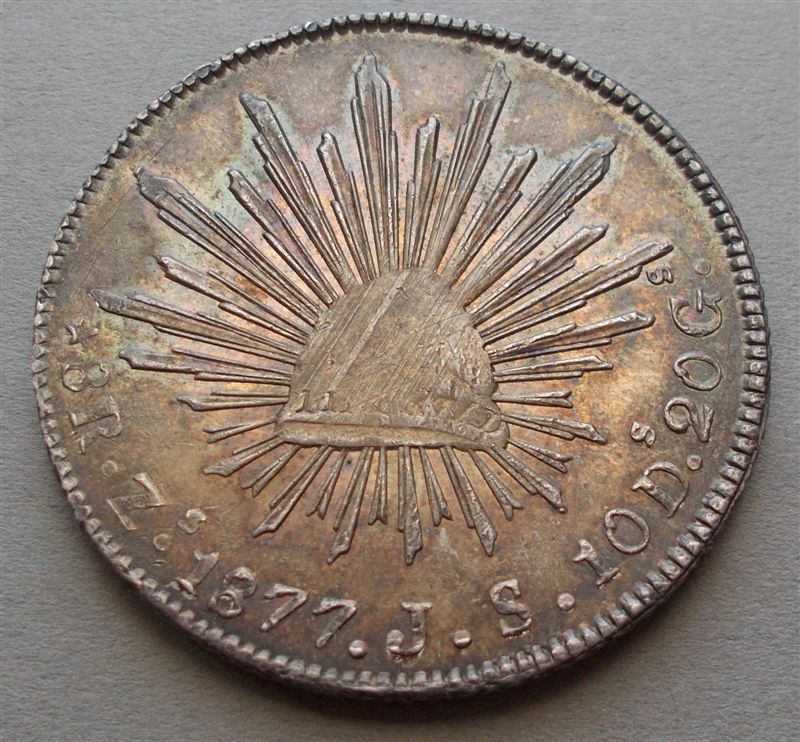 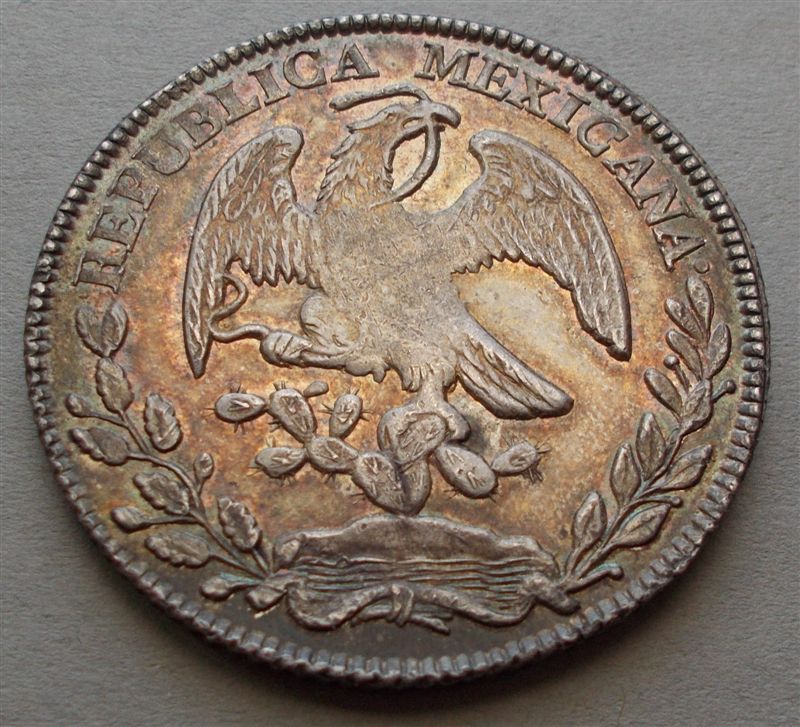 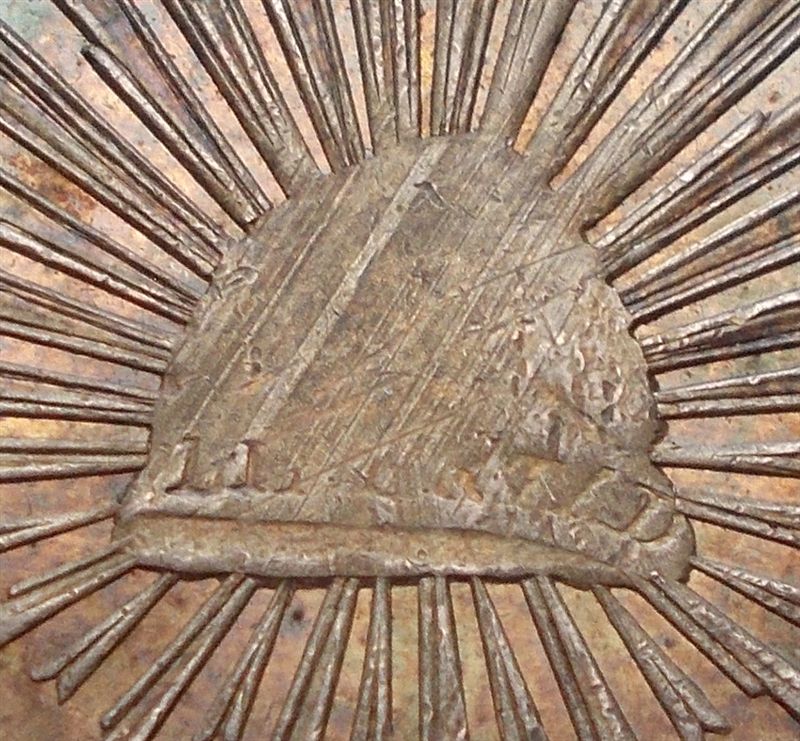 Colligo ergo sum
Edited by Lucky Cuss
02/11/2017 5:58 pm
|
|
|
|
New Member
United States
47 Posts |
When I see what I think are adjustment marks on one side, I actually like to see strike weakness on the other as confirmation. I suppose some people would avoid this sort of thing, but to me it makes for an interesting coin.
|
|
Pillar of the Community
 United States
1950 Posts |
Very interesting piece, lI like the toning on that piece quite a bit!
|
|
Pillar of the Community
United States
5362 Posts |
Zacatecas was a high volume mint during most of its operating life and in particular the 1870s were plagued by weak strikes. That is the case here. The marks on the cap appear to have been there before the planchet was struck. I actually see only a few actual adjustment marks on the surface. There are three sets. Adjustments were common in the very early days of the mintage but were less common during the period when power equipment proliferated. Adjustment marks are filing marks - they are parallel over the width of the file itself and they tend to be irregular in depth and orientation often crossing one over the other. There are the non-parallel deeper scratches that cross the cap at several (3) different angles of incidence. (see picture below the RED lines). Some of the adjustment marks appear to curve slightly. People familiar with flat filing will notice the curve which tends to bend toward the strong side of the person doing the filing. Most of the very uniform parallel lines seem to be caused in the rolling and lamination procedures. These are uniorm in depth over their entire length. These are the lines at a high angle of incidence relative to the bottom of the cap (dark blue lines). Those were not caused by hand filing of the surface of the blank in my opinion. They are too uniform in in depth (of each notch) and parallel over the entire surface left unstruck by the dies. I see that as extremely unlikely to have been due to hand filing. It is far more likely that they are either due to marks on the rollers that produced the strip of metal for blanking or even more likely still that they were caused by damage to the surface of the lamination die itself. They are like drag marks caused by a chipped lamination die. I hope that is clear. I have seen this feature on too many 1870s Zs coins for it to be the result of random filing. Here is a sketch. The red groups are individual filing strokes made AFTER the coin blank was laminated. The blue lines show the extent of the parallel grooves caused by the production and finishing of the fillet strip. 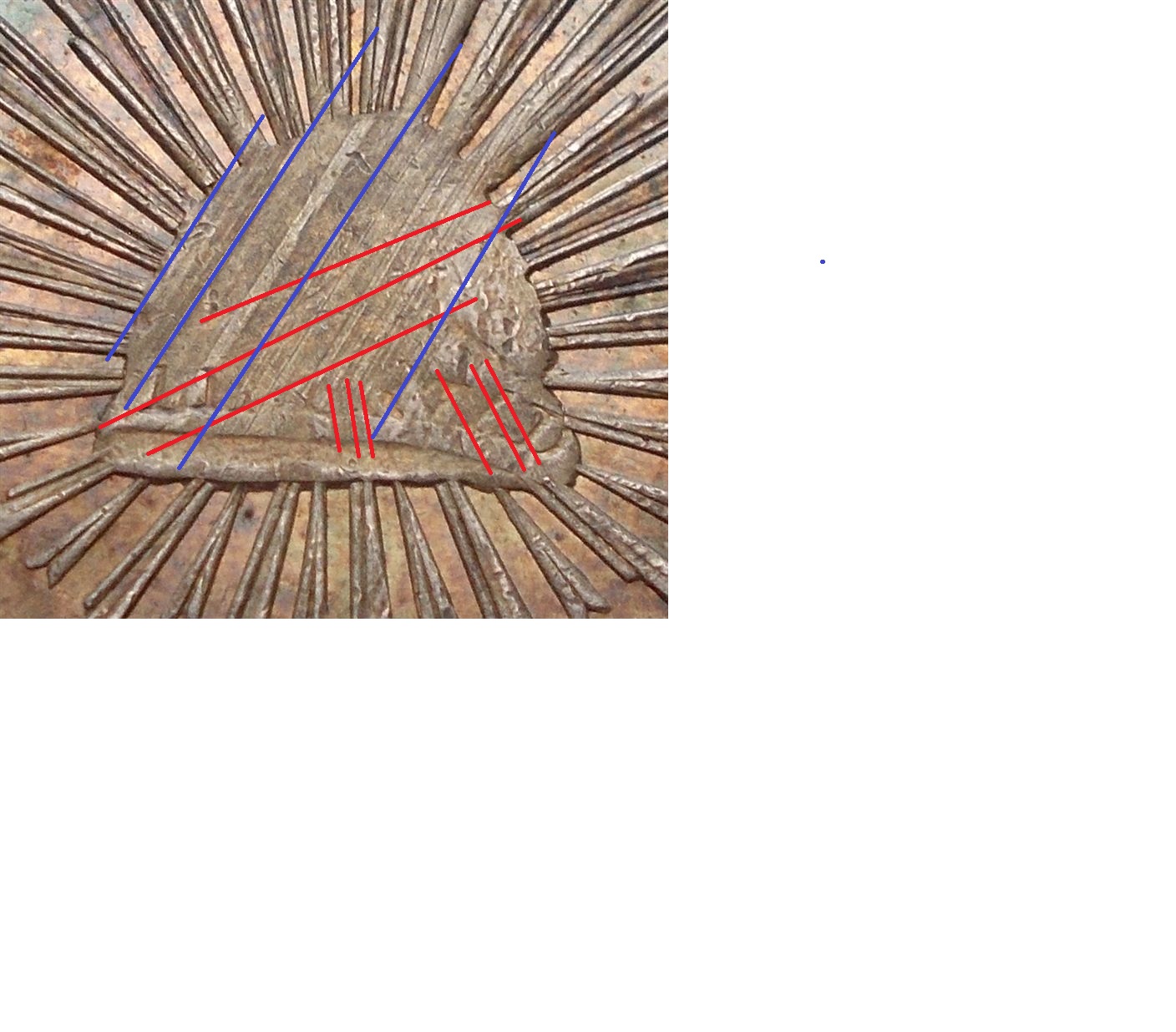 |
|
Pillar of the Community
 United States
4883 Posts |
Quote:
The red groups are individual filing strokes made AFTER the coin blank was laminated. The blue lines show the extent of the parallel grooves caused by the production and finishing of the fillet strip. Thank you for the clarification. Your analysis makes sense, and your highlighting of the closeup shot is compelling. Colligo ergo sum
|
|
Pillar of the Community
United States
5362 Posts |
The only caution I forgot to mention was that you would need coin in hand to make sure the "red" scratches were on the planchet BEFORE the strike. Near the ends there should be faint indications of compression of the grooves by the strike pressure. That is next to impossible to be sure of in a photo and in this case I could not actually see anything that I would trust as a compressed image - except for some of the lamination marks.
I also noted that this appears on many Zs issues of the 1870s and I came to the conclusion that the vast majority were lamination marks years ago. I suppose if you compared a few dozen side by side it would be possible to match up the damage like tree rings used in dendrochronology.
|
|
New Member
United States
47 Posts |
This is helpful. These were pointed out as "adjustment marks" to me once and I hadn't thought to question it, though they clearly don't look like the result of hand filing. (In _From Mine To Mint_ Roger Burdette describes late 19th century adjusters filing the edge of the planchet rather than the face - though of course he's talking about the United States and not Mexico.) I do think these marks correspond to a thin area in the flan as there is so often pronounced strike weakness on both sides. The OP's coin made me think of this one and when I got it out I realized it is another Zacatecas: 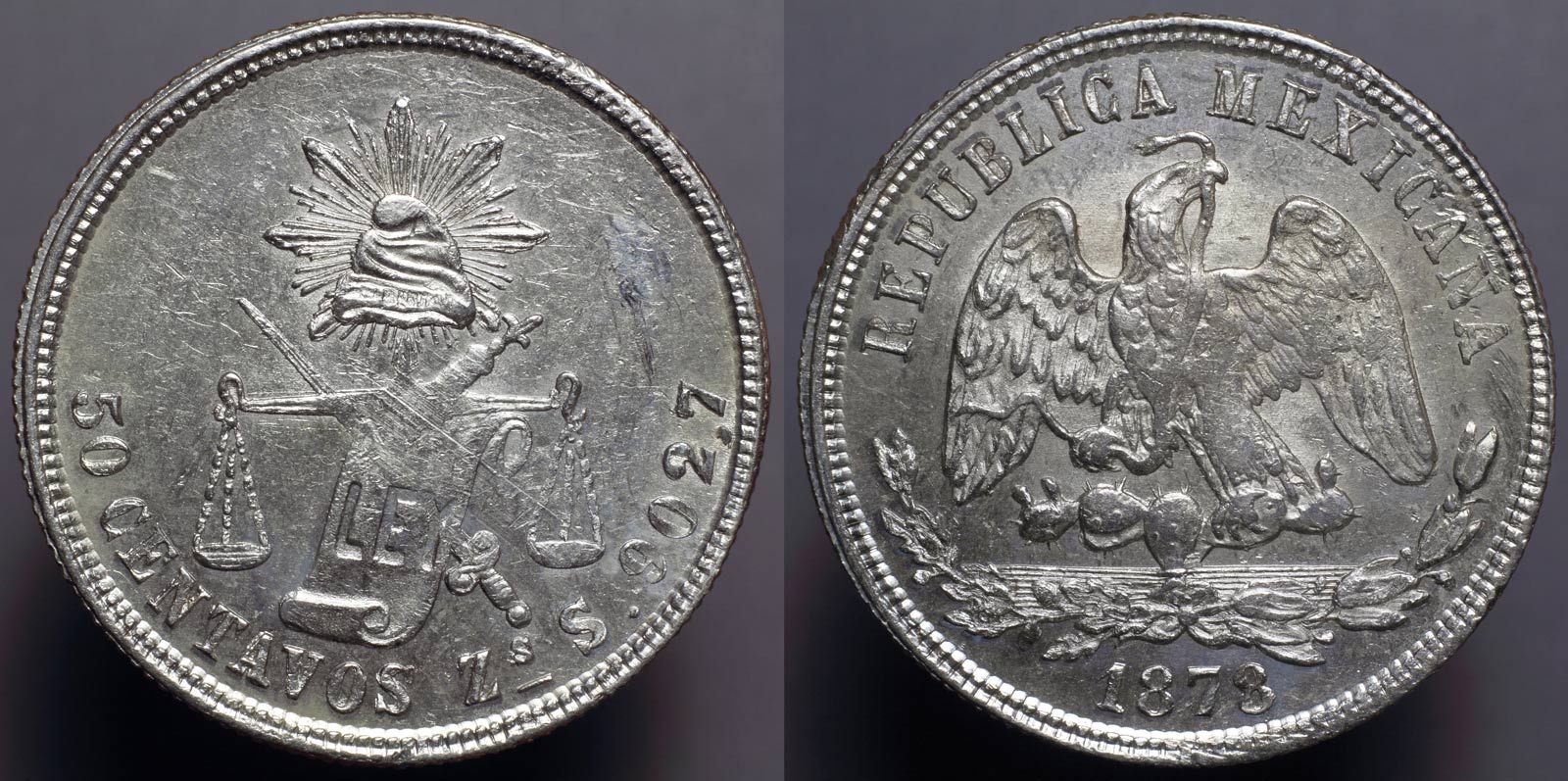 |
|
Pillar of the Community
United States
5362 Posts |
It has the look of damage from lamination - in my opinion.
Edge filing does not work on blanks that will be edged in a two die edger (casting machine). It would cause slippage and delay the process.
|
| |
Replies: 7 / Views: 1,442 |
|






 Posted 02/12/2017 8:06 pm





