First Page


 Posted 02/17/2017 8:57 pm


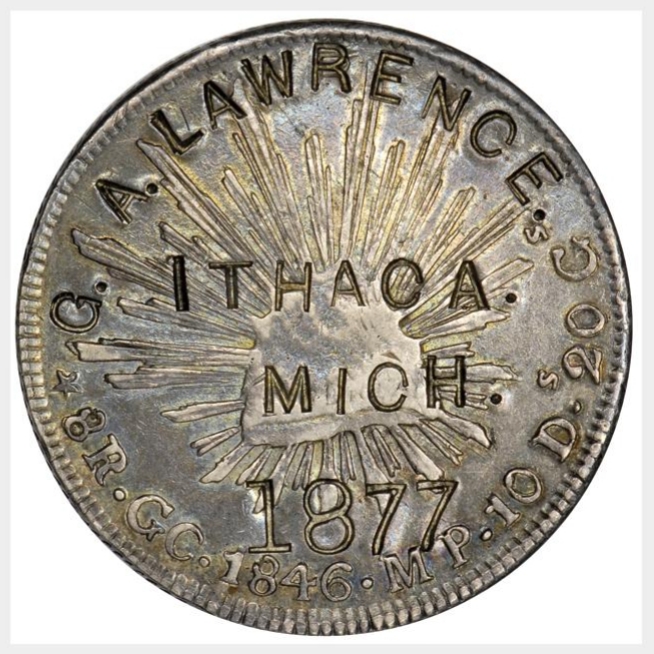
realeswatcher Great detective work. The clincher in my opinion are the posts with the normal ray matrix and the questionable reverse. You also found a round cap version - the earliest 1846 matrix using the same eagle design.
This clearly indicates that the matrix for the "eagle with the hole in the elbow" was already in use at GC in early 1846 and that it represents an actual variant missed by Dunigan entirely. It also means that the Masonic version is present on a rather rare type.
That is actually not an accurate portrayal of my suspicions.
Actually, I was most concerned that the variant could date to the 1870-1930 time frame when it would have made sense to make a counterfeit from silver if there was a place to pass the coin "current at face value". This type of counterfeit creates profit not from debasing the alloy (which is often discovered relatively easily) but rather creates a profit from the difference between the actual intrinsic value of the metal and the legal value of the coin when placed into circulation. In 1885 the Cap and Ray 8R passed current in the Philippines, some parts of Malaysia and I believe Sumatra. These are the Class 2 silver counterfeits. They existed in the monetary supplies of many countries and persisted being produced into the 1930s. Some of these Class 2 coins are just being discovered today.
A numismatic forgery produced for the collector market is possible as long as the numismatic market for forgeries exists and is large enough to support a low margin per unit sold. I am not sure that such a market existed before 1950 - 1960. I mentioned 1950 as an earliest possible date for a numismatic forgery because that is the earliest that 8Rs were becoming collectable. Prior to that many 8Rs now seen as very valuable could still be found for well under $1.
This clearly indicates that the matrix for the "eagle with the hole in the elbow" was already in use at GC in early 1846 and that it represents an actual variant missed by Dunigan entirely. It also means that the Masonic version is present on a rather rare type.
Quote:
The working theory for jdmern's specimen should be that several decades back
The working theory for jdmern's specimen should be that several decades back
That is actually not an accurate portrayal of my suspicions.
Actually, I was most concerned that the variant could date to the 1870-1930 time frame when it would have made sense to make a counterfeit from silver if there was a place to pass the coin "current at face value". This type of counterfeit creates profit not from debasing the alloy (which is often discovered relatively easily) but rather creates a profit from the difference between the actual intrinsic value of the metal and the legal value of the coin when placed into circulation. In 1885 the Cap and Ray 8R passed current in the Philippines, some parts of Malaysia and I believe Sumatra. These are the Class 2 silver counterfeits. They existed in the monetary supplies of many countries and persisted being produced into the 1930s. Some of these Class 2 coins are just being discovered today.
A numismatic forgery produced for the collector market is possible as long as the numismatic market for forgeries exists and is large enough to support a low margin per unit sold. I am not sure that such a market existed before 1950 - 1960. I mentioned 1950 as an earliest possible date for a numismatic forgery because that is the earliest that 8Rs were becoming collectable. Prior to that many 8Rs now seen as very valuable could still be found for well under $1.
Edited by swamperbob
02/17/2017 9:02 pm
02/17/2017 9:02 pm