Coin Community Family of Web Sites Join Thousands of Coin, Bullion, & Money Collectors
Join Thousands of Coin, Bullion, & Money Collectors Royal Canadian Mint products, Canadian, Polish, American, and world coins and banknotes. 300,000 items to help build your collection! Specializing in Modern Numismatics Shop for APMEX Bullion on eBay!Vancouvers #1 Coin and Paper Money Dealer Coin, Banknote and Medal Collectors's Online Mall


Username:
Password:
Save Password
Forgot your Password?


This page may contain links that result in small commissions to keep this free site up and running.

Welcome Guest! Registering and/or logging in will remove the anchor (bottom) ads. It's Free!

Interesting Masonic Counterstamped 8 Reales

To participate in the forum you must log in or register.
Author Previous TopicReplies: 18 / Views: 4,401Next Topic
Page: of 2
Pillar of the Community
Learn More...
jdmern's Avatar
United States
1949 Posts
 Posted 02/14/2017  6:23 pm Show Profile   Bookmark this topic Add jdmern to your friends list Get a Link to this Message Number of Subscribers
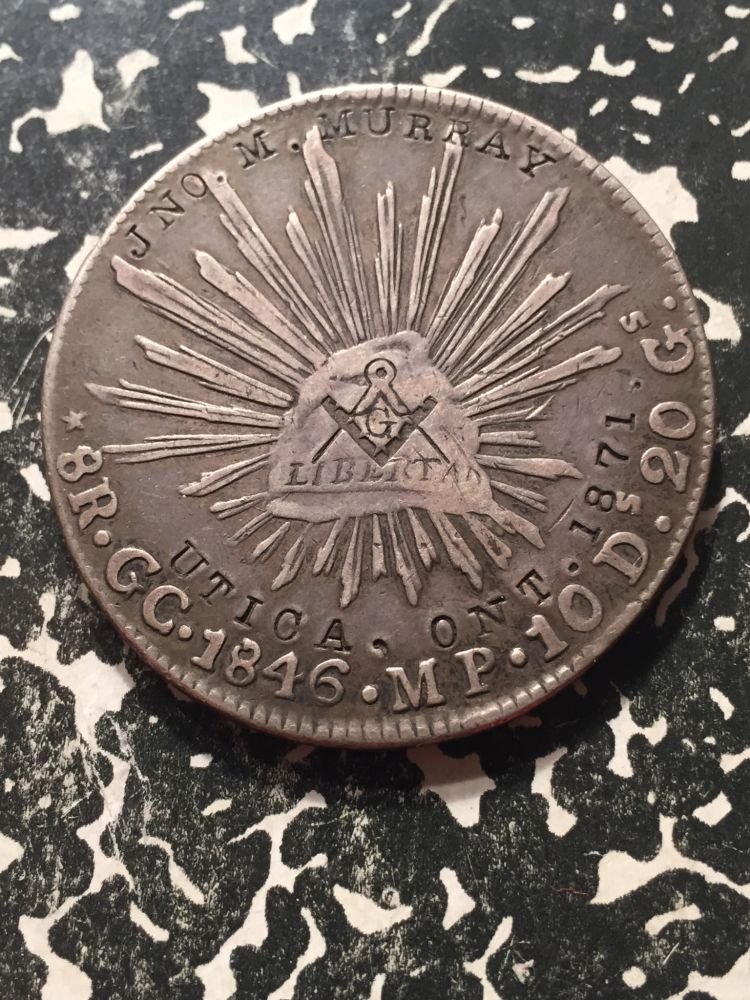
Recently purchased a nice set of Masonic exonumia, and this was among the collection:


Interesting-Masonic-Counterstamped-8-Reales

I thought it particularly interesting that this Mexican piece was apparently counterstamped in Canada in 1871... Were 8 reales still circulating alongside other coinages in Northern North America at that point in time?

Does anyone else know of any other Masonic counterstamped 8 Reales?
Pillar of the Community
Lucky Cuss's Avatar
United States
4883 Posts
 Posted 02/14/2017  7:50 pm  Show Profile   Bookmark this reply Add Lucky Cuss to your friends list Get a Link to this Reply
I've seen a "Cap & Rays" 8 reales with a personal dedication in English engraved upon it, but never anything like this.

With an otherwise ordinary date & mint mark, I'd say this might actually enhance the coin's value, but the distressing reality is that an 1846 GC (Guadalupe y Calvo) is a pretty scarce issue that would've been best spared from this defacing.

You might consider communicating with either or both of the follwing organizations to see if your 19th century Mason was a prominent person:

http://www.censusfinder.com/ontario...-society.htm

http://navalmarinearchive.com/colle...history.html

The first website also has an extensive list of links to historical societies in the province, one or more of whom may also be willing to help.

Colligo ergo sum
Edited by Lucky Cuss
02/14/2017 11:25 pm
Pillar of the Community
Learn More...
jdmern's Avatar
United States
1949 Posts
 Posted 02/15/2017  10:55 am  Show Profile   Bookmark this reply Add jdmern to your friends list Get a Link to this Reply
You are correct, it is quite unfortunate it was done on a tougher date... I will certainly look into the sites you've linked, thanks for those!
Pillar of the Community
swamperbob's Avatar
United States
5362 Posts
 Posted 02/15/2017  6:29 pm  Show Profile   Bookmark this reply Add swamperbob to your friends list Get a Link to this Reply
jdmern The coin is unique because it was obviously punched individually. The Mexican 8Rs were not circulating in the US much after 1857 and I suspect the same was true in Canada because of the date of confederation. So you have to ask why was this host used?

Could you post a photo of the obverse of the coin. Based on the cap die design I have some suspicions that the host is not genuine. This is neither the "normal cap" nor the "round cap" shown in Dunigan's book. There are die details (at least 4 major ones that I can see) that are not seen on any other genuine 1846 GC 8R. If genuine it is a third major die configuration and a major find.

I could be incorrect but I suspect this could be a counterfeit coin. Perhaps a contemporary circulating counterfeit (also a rare find for GC). Being a counterfeit it would have been a great candidate for re-use as a masonic coin. Has the owner's name been traced? Was he a banker? If he was a contemporary counterfeit could make sense.

However, being a student of human nature and a highly suspicious one at that, I would lean toward a more recently made numismatic forgery (even 1950s) and that the Masonic details were added to throw people off. A genuine 1846 GC is worth a significant amount and if you do not bother looking closely at the details - the likelihood that the host is simply not genuine might be easily overlooked.
Pillar of the Community
Learn More...
jdmern's Avatar
United States
1949 Posts
 Posted 02/15/2017  8:44 pm  Show Profile   Bookmark this reply Add jdmern to your friends list Get a Link to this Reply
I did a bit of additional research, and was able to discover the existence of a John M. Murray, married to a Jane A. Kendall in Utica, Ontario. According to records, Mr. Murray lived from Dec. 26, 1849 until November 5, 1915.

It would seem that this would indeed be the same man, as Utica, Ontario, according to some cursory research is:


Quote:
Utica is a "dispersed rural community", no more than a crossroads, but with two churches and three cemeteries. It is located about 10 kilometres west of Port Perry in the former township of Reach, Ontario, Canada. It is now located in Scugog Township in Durham Region.


The likelihood of there being two men, of relatively the same age, in such a small area, is quite low, so I will be operating under the assumption that this is the person.


Quote:
However, being a student of human nature and a highly suspicious one at that, I would lean toward a more recently made numismatic forgery (even 1950s) and that the Masonic details were added to throw people off. A genuine 1846 GC is worth a significant amount and if you do not bother looking closely at the details - the likelihood that the host is simply not genuine might be easily overlooked.


Based off of the aforementioned information, as well as the patina and provenance of this piece, I think it extraordinarily unlikely that this is a recently made numismatic forgery. I can provide more information and evidence if further questions arise, but I think going forward, I think it most likely this piece either different die pairing or a contemporary circulating counterfeit.

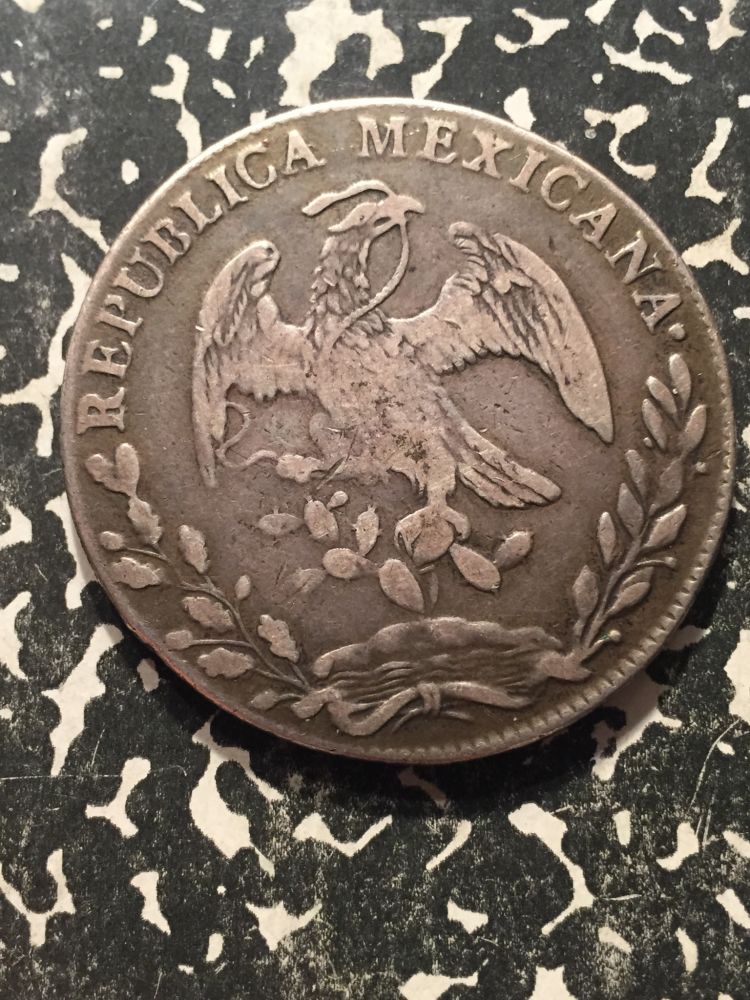
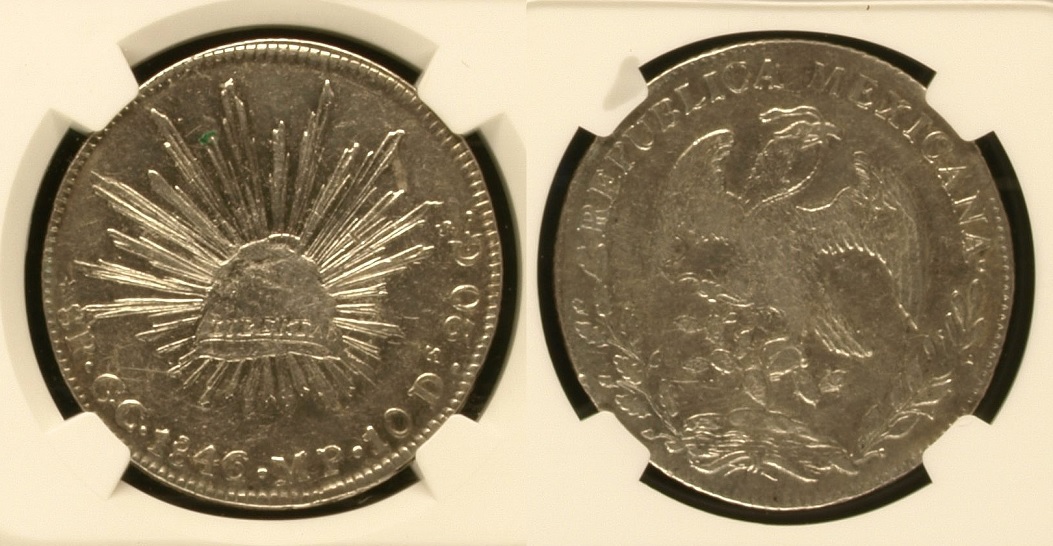
Here is the other side:


Interesting-Masonic-Counterstamped-8-Reales

I look forward to thoughts on this piece, this is one of the more interesting specimens I have come across in quite a while...
Pillar of the Community
Lucky Cuss's Avatar
United States
4883 Posts
 Posted 02/15/2017  8:47 pm  Show Profile   Bookmark this reply Add Lucky Cuss to your friends list Get a Link to this Reply

Quote:
Based on the cap die design I have some suspicions that the host is not genuine.


Good eyes, I hadn't been even considering that possibility. Comparing it to genuine examples of the 1846 GC (even though they're hardly consistent in all respects) I can see what you're talking about. Another detail that seems wrong is that the star looks undersized.

The eagle side (for which there were various renditions) actually seems to be a pretty good match to one specimen I see catalogued.

Regardless, we might want to get an accurate weight on this, which right off may reveal it to be a phony.

Colligo ergo sum
Edited by Lucky Cuss
02/15/2017 8:57 pm
Pillar of the Community
swamperbob's Avatar
United States
5362 Posts
 Posted 02/16/2017  02:27 am  Show Profile   Bookmark this reply Add swamperbob to your friends list Get a Link to this Reply
Lucky Cuss - The star is undersized.

I guess you checked Dunigan's book too. This is clearly a third cap design so I agree weight and specific gravity are rather critical to tell if it is genuine or a contemporary counterfeit for certain.

jdmern Thank you for sending the obverse photo. It is a type eagle that was actually used at Guadeloupe Y Calvo beginning in 1847 according to Dunigan once again. It is not an exact match for the Dunigan obverse for 1846, but this could be his error (see below).

So I looked at all of the entries in the Heritage archive for 1846 GC MP and there are only 12 after you exclude duplicate entries of which there are several.

Dunigan lists two variables for the reverse die
(1) pointed or normal cap and
(2) round cap.
These distinctions are recognized by the TPGs, but not always indicated on every holder.

Dunigan lists three possible variables for the obverse
(1) Square tailed eagle (a very crude die)
(2) A round tail or normal eagle of 1846 and
(3) A round tail eagle type of 1847 (omitted under 1846.)
I am listing this 3rd alternative because it exists in TPG slabs listed on Heritage. So I am presuming Dunigan missed it.

There are 4 examples in the Heritage archive of the Round Tail cap with the Square tail eagle. These do not enter the actual discussion because they are different types, but I wish to not that all of the round cap varieties show the same ray orientation as is seen on the pointed cap variety - one long ray slightly above the star - a second long ray pointed directly at the star - a third shorter ray pointed directly at the 8. There are no other ray arrangements for the round cap style. Also note that there is a large star present before the denomination.

Before proceeding it must be stated that Dunigan also mentions a mule of the two primary styles a round cap and a normal or round tail eagle. That combination is represented in the Heritage archive by a single example. Dunigan considers the mule to be very rare on a par with the reversed s superscripts variety.

Regarding the normal or round tail eagle Dunigan illustrates the normal or round tail eagle as having a high headed snake as in the 1846 type. The 1847 eagle type also is round tailed eagle but it has a low headed snake present. Once again it is possible that Dunigan did not notice that it constitutes a 3rd eagle type for 1846.

The mule noted above in the Heritage archive has a low headed snake present so it would be the 1847 type. Unfortunately Dunigan did not illustrate his mule. I believe that it is likely the same coin however.

The Heritage archive contains 3 examples of the Normal or pointed cap with the standard ray arrangement for each of the low head snake (1847) and the high head snake (1846) varieties. The designs of the eagles appear to be the same within each group of three coins but these two eagles do not match each other.

So with the mule included that accounts for 11 of the 12 Heritage examples.

The final example is an oddity. When I first saw it I was tempted to call it a counterfeit. It was at the time raw. I listed it as "dispute" in my records. I noticed that the same coin has reappeared on Heritage more recently and again raw. (For the record I have to note that counterfeits do get slabbed even by the big three TPGs.)

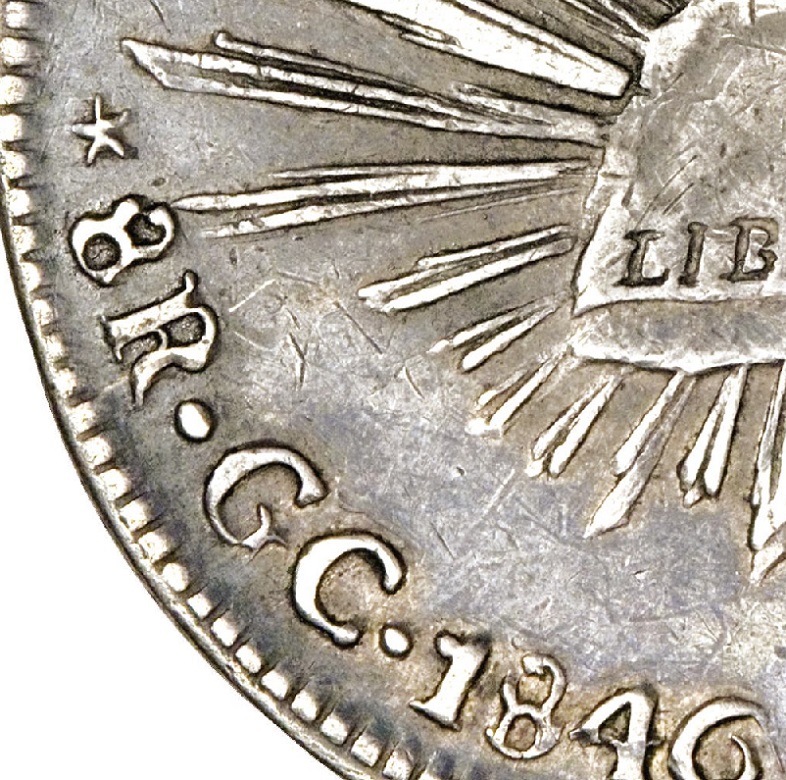
That specific coin has an eagle with a low headed snake and it also has an odd ray arrangement but NOT exactly the arrangement seen on the Masonic coin. The top ray is correctly positioned just above the star - it has the same curved minor tip seen on the Masonic coin. The second long ray points squarely at the 8 not the star - also identical to the Masonic coin. The difference between the masonic coin and this Heritage coin is in the two shorter rays. It also must be noted that both coins use a small poorly drawn star.

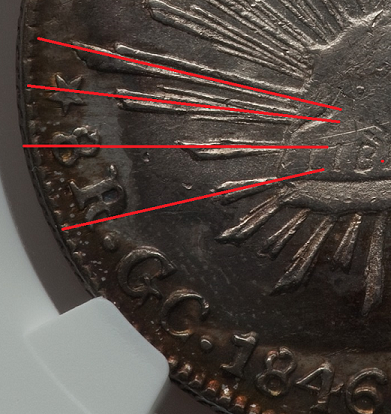
So to illustrate the differences seen only on one coin in the Heritage archive (which I never believed was genuine) I enlarged the portion of the Cap where the serious differences are seen;

This first view is of one of the coins I consider to have the standard spacing and angles for the rays. I placed a red line down the center of each ray to highlight the differences. Note also on the top long ray above the star that the thin line running alongside the ray is straight and does not curve at the tip. Finally note the size and shape of the star.
Interesting-Masonic-Counterstamped-8-Reales

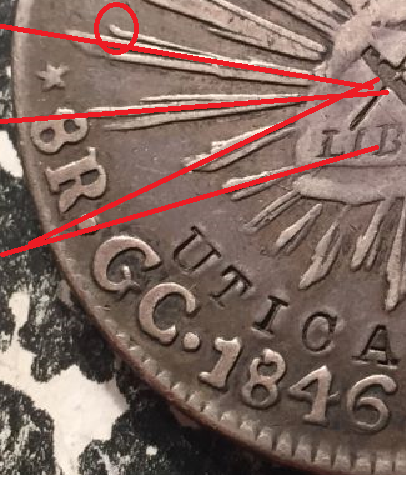
The next illustration is the same view of the Masonic coin. The red lines show that the ray positions are not the same. Also note the small upward curve at the tip of the line above the top long ray and the size and shape of the star.
Interesting-Masonic-Counterstamped-8-Reales


Thirdly here is the Heritage coin that I disputed when it first appeared. Here I did not draw in the red lines but I did circle in red the tip on the line above the top ray and the small star.
Interesting-Masonic-Counterstamped-8-Reales

I did something similar with the eagle. This next picture is of the Dunigan "Normal eagle" of 1846 with the high head snake.
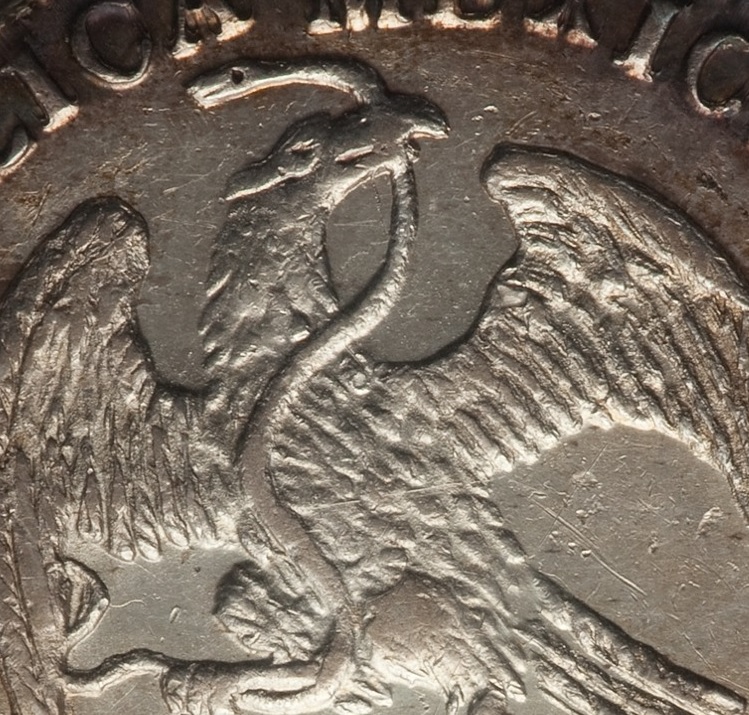
Interesting-Masonic-Counterstamped-8-Reales

Next is the eagle from the Masonic coin.
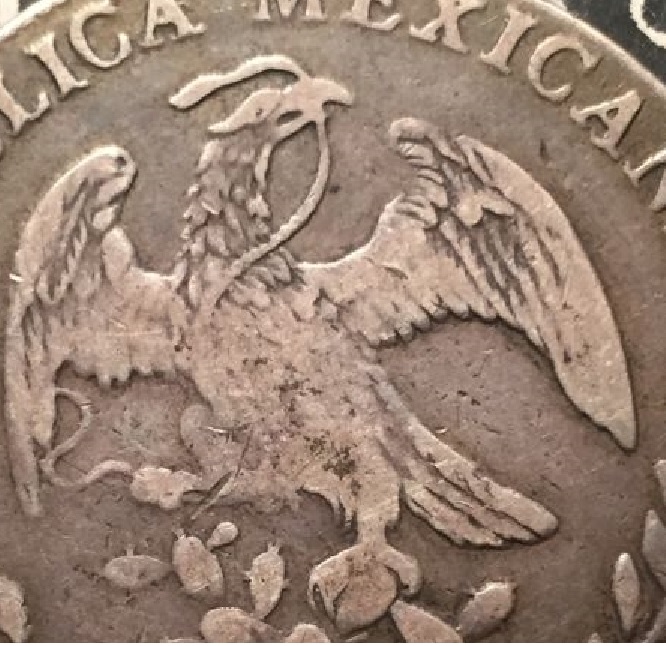
Interesting-Masonic-Counterstamped-8-Reales

Next the eagle from the raw Heritage coin which I disputed
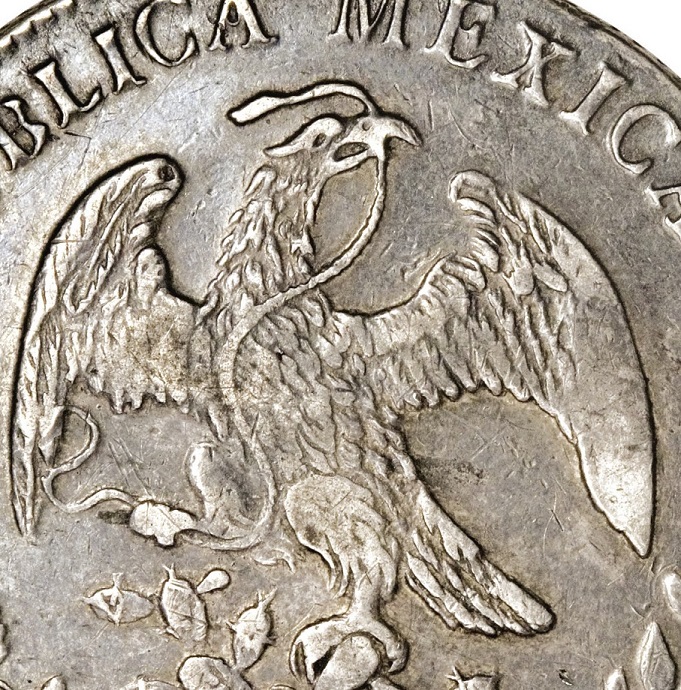
Interesting-Masonic-Counterstamped-8-Reales

These last two are in my opinion identical designs - note the round depression in the eagle's right wing - right at the elbow bend and the missing outline and feathers directly under the eagle's left wing elbow. These are identical punches if not the identical die.

Almost finally, here is the low head snake variety seen on the graded versions of the coin using Dunigan's omitted variety the low head style of 1847.
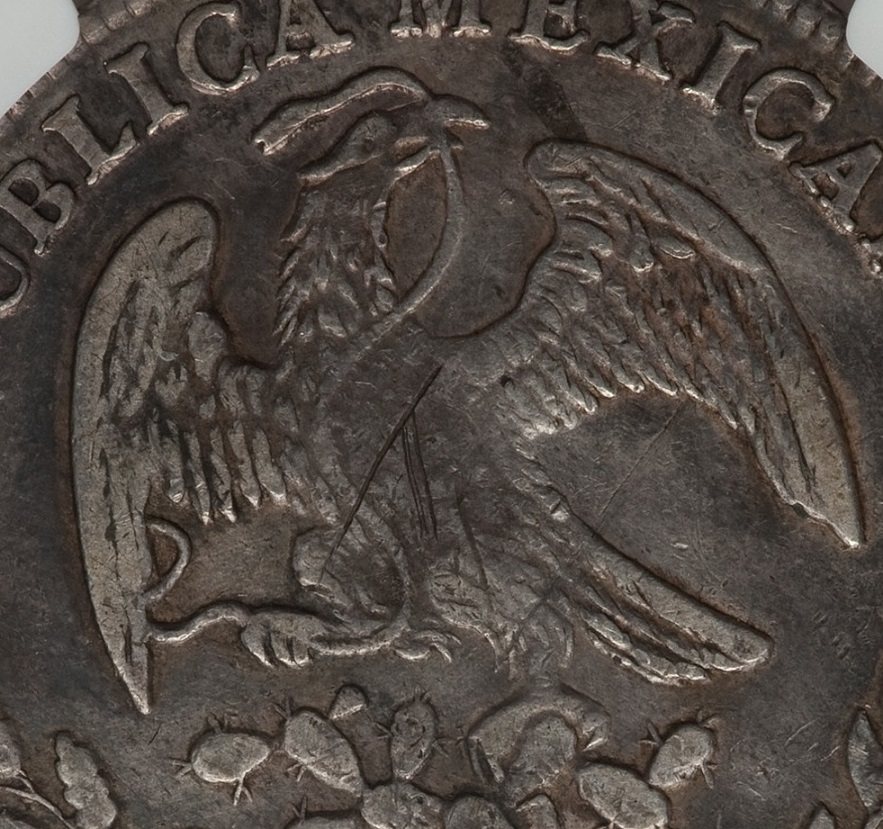
Interesting-Masonic-Counterstamped-8-Reales

Notice this is NOT the eagle seen on the Masonic coin nor on the other raw Heritage coin that I dispute. The eagle has no recessed hole in the right elbow and the feathers are clear along with a clear outline of the right wing below the elbow.

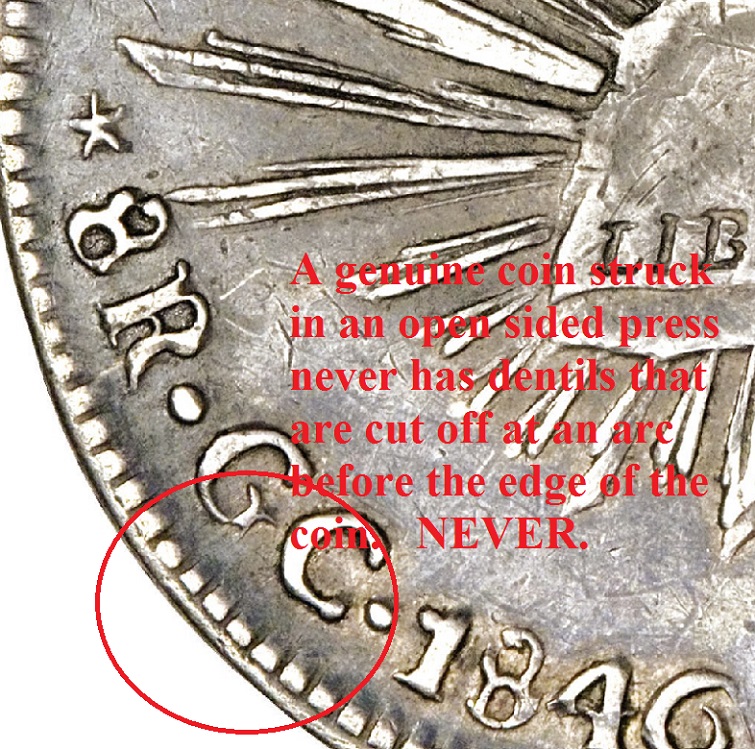
As a final concluding point I want to show for a second time a picture that appeared above of the Heritage raw coin that I disputed as genuine. It is the prima fascia proof in m opinion that the Heritage coin is a forgery. Here is the picture once again.

Interesting-Masonic-Counterstamped-8-Reales

Now the same picture with the problem marked in RED.
Interesting-Masonic-Counterstamped-8-Reales

Those of you who know me realize exactly what an arc that stops short of the edge of a coin means. For those who do not here is an explanation.

In an open sided press the die faces used to strike an 8R were larger than the planchets that were placed on them. The dentils were cut on the die as lozenge shaped figures which tapered to a roundish end at both ends. When a coin was struck on center the dentils run all around the coin but only half of them show. On an off center strike the full dentils may show on the one side but the other edge will have them missing. When a person copies an existing coin and makes a die - they often do not add the extra piece of the dentils. A strike using this under diameter die gives itself away whenever a planchet is placed eccentrically on the small die. The edge of the die shows as cut off dentils falling along an arc exactly as seen on the Heritage coin that I disputed.

So since the Masonic coin matches the Heritage disputed coin in nearly every particular (the exception being the two oddly placed short rays - which could have been recut) is the Masonic host coin Genuine or Not?

Pillar of the Community
Lucky Cuss's Avatar
United States
4883 Posts
 Posted 02/16/2017  08:27 am  Show Profile   Bookmark this reply Add Lucky Cuss to your friends list Get a Link to this Reply
I don't think I can add much of anything to the detailed analysis above except to mention that there are also multiple useful photographs of 1846 GC's in the Ponterio Sale #142 catalog.

Colligo ergo sum
Edited by Lucky Cuss
02/16/2017 7:30 pm
Pillar of the Community
Learn More...
jdmern's Avatar
United States
1949 Posts
 Posted 02/16/2017  09:07 am  Show Profile   Bookmark this reply Add jdmern to your friends list Get a Link to this Reply

Quote:
So since the Masonic coin matches the Heritage disputed coin in nearly every particular (the exception being the two oddly placed short rays - which could have been recut) is the Masonic host coin Genuine or Not?


After reading your analysis, if I understood correctly, based off of the dentils, you believe the piece cannot be genuine?


Quote:
In an open sided press the die faces used to strike an 8R were larger than the planchets that were placed on them. The dentils were cut on the die as lozenge shaped figures which tapered to a roundish end at both ends. When a coin was struck on center the dentils run all around the coin but only half of them show. On an off center strike the full dentils may show on the one side but the other edge will have them missing. When a person copies an existing coin and makes a die - they often do not add the extra piece of the dentils. A strike using this under diameter die gives itself away whenever a planchet is placed eccentrically on the small die. The edge of the die shows as cut off dentils falling along an arc exactly as seen on the Heritage coin that I disputed.


Could you elaborate a bit more on open sided presses? I am not sure I understand completely this part of your analysis?
Pillar of the Community
United States
1962 Posts
 Posted 02/16/2017  1:53 pm  Show Profile   Bookmark this reply Add realeswatcher to your friends list Get a Link to this Reply
A 3rd example of this observe (the only other I find at the moment) - that one ray pointing straight into the "8" is of course an easy tell, as it's markedly different than any others. Same reverse as well, it appears. Better grade piece, nice ring toning...
https://auctions.stacksbowers.com/l...view/3-21VQJ

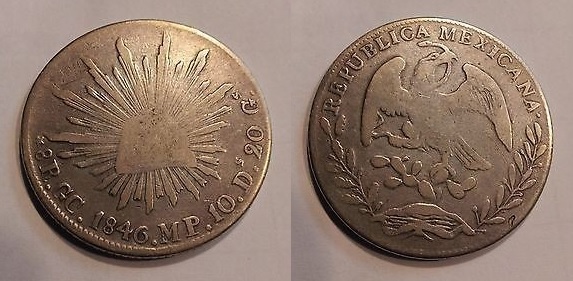
And FYI, this is the Heritage piece Bob's referring to:
https://coins.ha.com/itm/mexico/rep...ction-120115
Edited by realeswatcher
02/16/2017 2:33 pm
Pillar of the Community
United States
1962 Posts
 Posted 02/16/2017  2:55 pm  Show Profile   Bookmark this reply Add realeswatcher to your friends list Get a Link to this Reply
Also, the "6" of 1846 is quite different on the Masonic C/S piece vs. the Heritage piece Bob's showing... with the Ponterio piece being something between the two. However, aside from that and the difference in the first "short" ray (going counterclockwise) after the long ray pointing to "8"... the rest of the positioning (at least) seems to match exactly.

Curious... but, disregarding minutia for a minute:

-- The Masonic C/Sed piece is clearly old (a period piece). That patina is deep and honest, and the stamping seems legit as well.
-- The Heritage piece - just observing the surfaces, the blobs/sloppy legends - looks sketchy. The Ponterio piece seems more honest.
Pillar of the Community
United States
1962 Posts
 Posted 02/16/2017  9:35 pm  Show Profile   Bookmark this reply Add realeswatcher to your friends list Get a Link to this Reply
Not the same dies, but since I'm looking... here's another "odd" 1846-GC as well...

***EDIT - I see this piece was a Heritage piece as well, which I did not notice that at first - sorry about that.

Interesting-Masonic-Counterstamped-8-Reales
Edited by realeswatcher
02/17/2017 04:15 am
Pillar of the Community
swamperbob's Avatar
United States
5362 Posts
 Posted 02/16/2017  10:05 pm  Show Profile   Bookmark this reply Add swamperbob to your friends list Get a Link to this Reply
jdmern You say;


Quote:
After reading your analysis, if I understood correctly, based off of the dentils, you believe the piece cannot be genuine?


Simply stated yes. The reason goes beyond the dentils alone. The coin was made using a non-standard matrix at a point when King Punches were already used by this branch. A King punch is a large punch containing the central details of the design on each die. It is pressed into the prepared die face and makes it unnecessary to add individual details like the rays on the cap. By 1844 Mexico City was already using these and a matrix set was delivered to GC from Mo.

After the King Punch is set into the die face all that is needed is the perimeter lettering and minor details. In some cases, if all of the King Punch details do not set fully the missing elements are added by engraving or punching. The GC mint was actually a state of the art facility operated by British interests under a lease arangement. The matrix used from 1844 to 1846 was from Mexico City. This is why there are only a few alternatives to the standard shapes and why Dunigan refers to a normal cap and eagle (as seen on Mo issues).

As Dunigan notes Guadaloupe y Calvo was the first branch mint to use a steam press in late 1847 only 11 years after Philadelphia. So the technology in use should not produce random variants in the overall design. The adoption of King Punches and a specific matrix was one of the tools used to identify counterfeits in the 1840s or anytime prior to the introduction of full hubs.

So the fact that there are two alternative ray patterns in use on only a handful of copies dated 1846 makes those copies far more likely to be forgeries that it is for there to be a third or fourth King Punch matrix in use in 1846. Remember that in 1847 a new matrix set from Culiacan was adopted at GC. This is the eagle seen on the coins with the "normal" 1847 eagle.

Coupled with the fact that these variants are far less common than the Crude square tail eagle version which is rare makes the variants more difficult to explain.

The technology used prior to the 1847 introduction of a steam powered press consisted of an open sided manually operated screw press. One die was fixed on the base of the screw (anvil die) and the other die was fixed to the traveling screw. The screw was moved up and down by rotating a cross beam (roughly 10-12 feet long) with counterweights that could weigh as much as a few tons each. The 8R press was the largest screw at the mint and required 4 men to turn it normally. The fifth man sat in a small pit in front of the screw and removed struck coins and replaced them with a planchet by hand. There was no collar.

The collar on a modern press adds the edge design to the coin. Older presses did not have this feature. The edge was added using a castang machine before the planchet was struck. The addition of the edge design upset the perimeter of the blank turning it into a planchet and allowing the coin to strike-up properly at the perimeter.

With no collar to hold the planchet in place each strike could (would or could be partially off center). The die faces were purposely made larger than the planchet so that there would be NO blank area beyond the dentils. These features were introduced to prevent clipping of the edge to steal silver.

The transition to a steam press in 1847 likely meant the first introduction of a "close collar". The close collar allowed some degree of centering of the planchet but still did not contain the edge design. This style press will allow for a die face reduction and in some cases could potentially produce a blank space outside an arc, however, there is no direct proof when or even if a reduced face die was every used at GC.

A closed collar is a tight collar that imparts the design to the edge. In a closed collar system the die face and the collar are matched sizes with very little space in between. This creates pressure in three directions and the coin requires significant added pressure to make.

So at GC there is a potential that in late 1847 there was a transition that could have allowed the arc to exist. However, since the steam press was not NOT used in 1846 but became operational in late 1847 postulating this variety as a steam press issue is NOT possible.

In all respects the coin appears to be a coin that simply should not exist with the details as shown.

realeswatcher You say:


Quote:
-- The Masonic C/Sed piece is clearly old (a period piece). That patina is deep and honest, and the stamping seems legit as well.


This is an example of the "obviously error" a form of logical fallacy that argues from the conclusion to force fit the facts. In authentication, using science, there are no obviously answers based on appearance. Forgery can in fact duplicate a "deep and honest patina" it is in fact done all the time and is the reason why museums employ scientific laboratories to authenticate their collections rather than simply using expert to verify based on appearance.


Pillar of the Community
United States
1962 Posts
 Posted 02/17/2017  03:15 am  Show Profile   Bookmark this reply Add realeswatcher to your friends list Get a Link to this Reply
OK, sooooo... The working theory for jdmern's specimen should be that several decades back (when Cap & Rays by date and mint were not NEARLY the market they are today), a forger produced a batch of slightly variant copies of the 1846GC... and he or a distributor who knew its true nature took this example - a fake of the most common date GC 8R, which was probably an $8-10 coin back then? - masterfully applied (significant) wear and perfect circ cameo patina... AND procured correct-for-the-time punches to stamp Masonic symbols and the name of an actual obscure Canadian guy... in a complex effort to fool Cap & Ray collectors (who would surely gobble up a worn piece with distracting non-Mexican stampings on it)...

And certainly, all that effort for a not-super-expensive-at-the-time piece would have been needed to fool Jose the Average Peso Collector... you know, despite at least (3) examples having fooled major numismatic auctions and/or professional graders as a now $500+ coin in our day, Jose would have sniffed it out.

Seems plausible.

The quirks with the devices (detail), the oddness with the denticles... I can see that this ray poking the "8" style has a good chance of in fact being contemporary counterfeit... AND you could sell me on that Heritage piece even being a modern fake OF this contemporary counterfeit... but the totality of what we see/know says the OP's piece is simply NOT a latter-day concoction.

P.S. - It is also implausible to think, conversely, that this was a concoction targeted towards Canadian Masonic buffs - using (a fake of) a rare date 8R host to make it sexier. I would very highly doubt that - perhaps even to this day, let alone some decades ago - such collectors would at all care what obscure variety of Mexican peso was used as the host coin.
Pillar of the Community
United States
1962 Posts
 Posted 02/17/2017  03:31 am  Show Profile   Bookmark this reply Add realeswatcher to your friends list Get a Link to this Reply
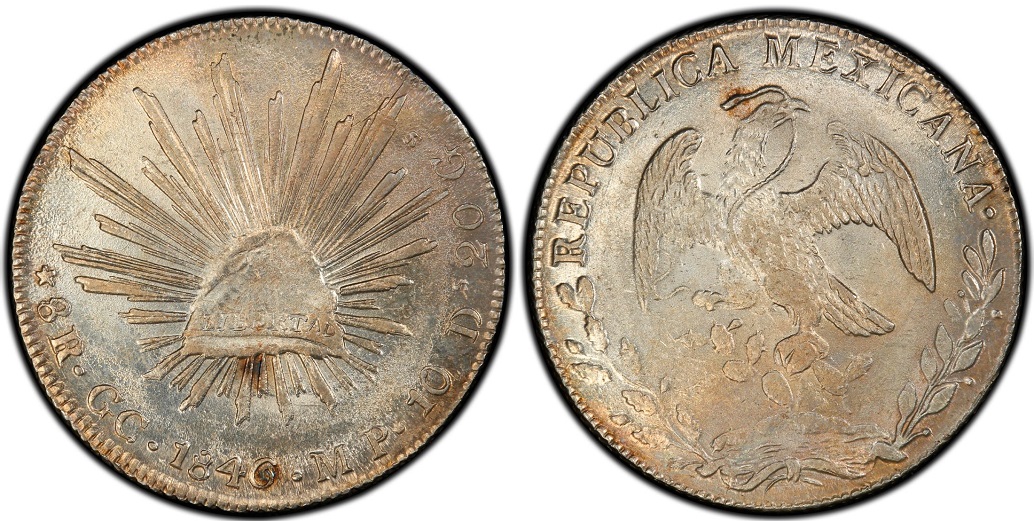
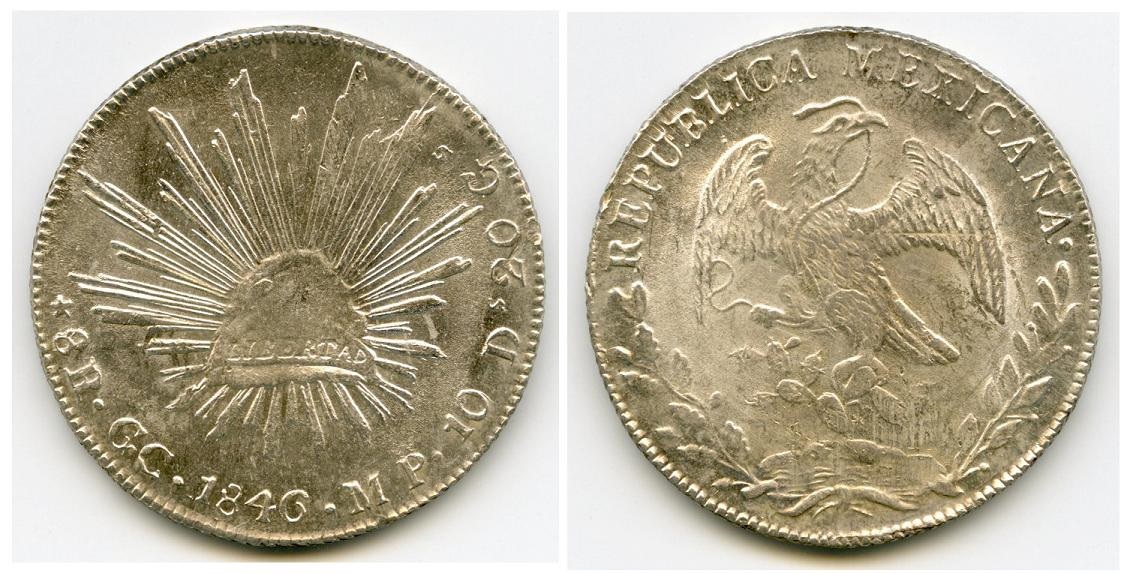
Digging some more... On the PCGS Census page is a pic of this sparkling MS63:
http://www.PCGS.com/pop/valueview.aspx?s=408724

Pic here for reference, sides switched (b/c, seriously, the rays side is "the front").

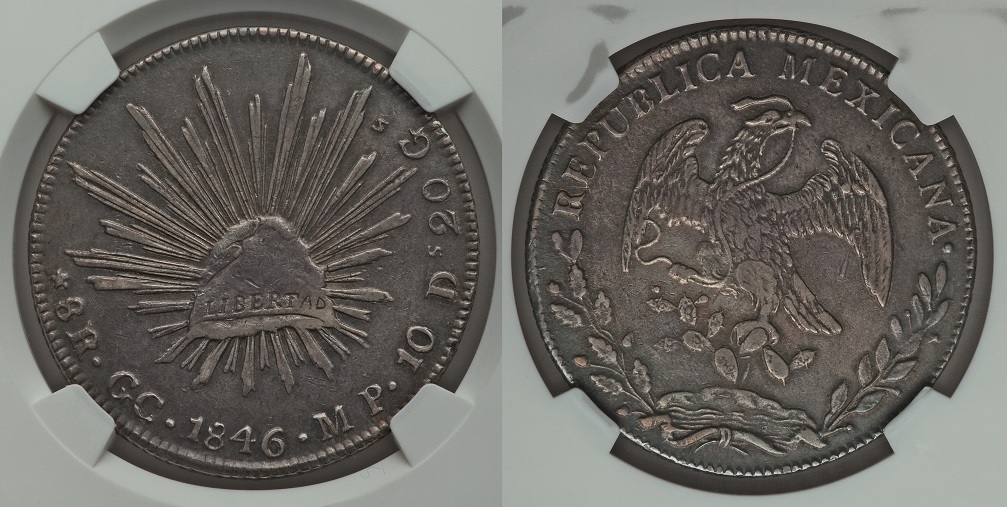
Rays side is "typical" as discussed above... BUT the eagle is clearly the same as the Masonic C/S piece and its friends! Same round divot in his elbow (his right/our left)... and the same weak/missing detail near the elbow of the other wing (his left/our right).
Interesting-Masonic-Counterstamped-8-Reales

AND ANOTHER AMENDMENT!! -
I missed it the first time, but this recent Heritage piece (pic below) is another one w/the "normal" rays side but with the eagle like the coin in question (with the wing issues):


https://coins.ha.com/itm/mexico/wor...ption-071515

***PLUS... now going through Ponterio's archives one by one (which is how you have to open them on their site!!)... THREE more examples of "normal" rays side paired with the flawed-wing eagle as seen on the OP's coin, etc.

https://auctions.stacksbowers.com/l...view/1-1AH58
https://auctions.stacksbowers.com/l...view/3-20AU9
https://auctions.stacksbowers.com/l...view/3-224R6

At this point, there is little doubt that at the very least, this eagle style WAS a confirmed regal device. Whether it could have been copied/carried over to a contemporary counterfeit... ?

Interesting-Masonic-Counterstamped-8-Reales

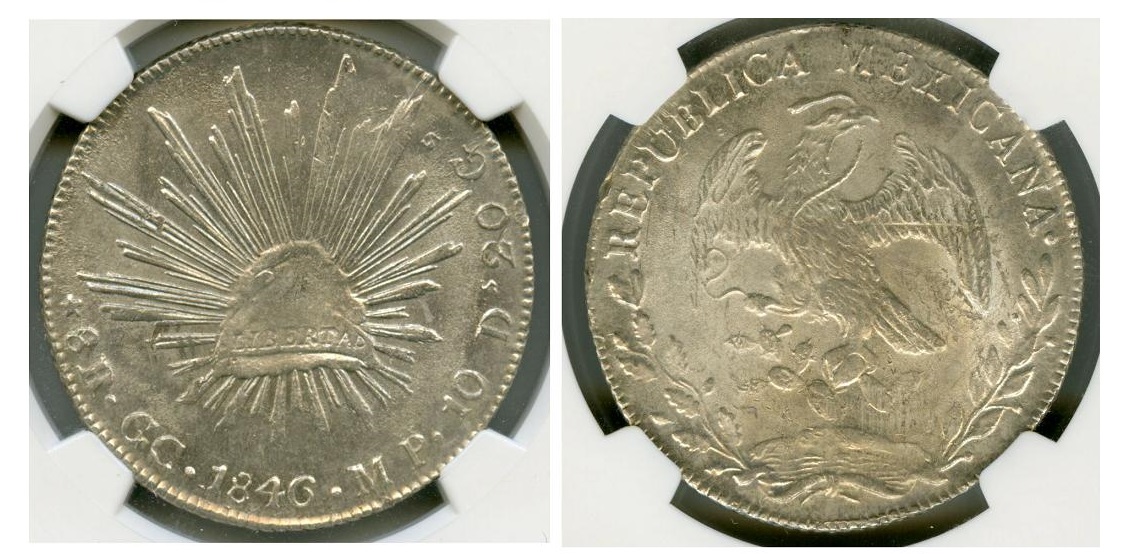
Was going through my files and if only to amuse myself, I'll add one more "normal" rays side paired with indented wing eagle. Forgot about this piece... I actually almost (and should have) bought this raw from Mex. Coin Co. After a bit of time in their inventory they apparently thought better of it and sent it off to NGC... and surprisingly (to me, from the pics... and I'm guessing to them, too) it came back UNC details, hairlined. And yet the price still IIRC doubled... almost tripled? Forget exactly, but they still jacked it despite the bodybag.

Before, and then in slab:
Interesting-Masonic-Counterstamped-8-Reales

Interesting-Masonic-Counterstamped-8-Reales
Edited by realeswatcher
02/17/2017 8:31 pm
Pillar of the Community
United States
1962 Posts
 Posted 02/17/2017  04:16 am  Show Profile   Bookmark this reply Add realeswatcher to your friends list Get a Link to this Reply
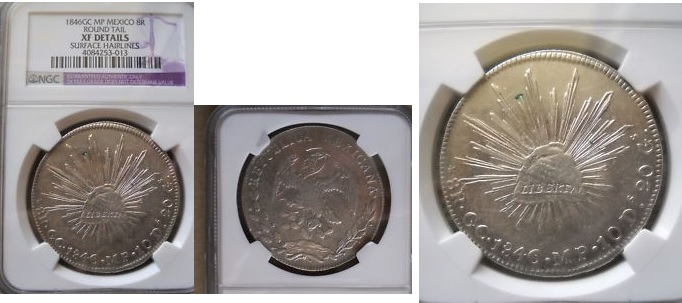
Found one more of this type... small pics though. Note around 12-1 o'clock of the rays side, there's a bit more of the cut-off denticle phenomenon... BUT, in this case, it sort of looks less questionable as the denticles look to continue after the interruption (more like a "split rim" that can occur on genuine pieces).
Interesting-Masonic-Counterstamped-8-Reales

EDIT ON THIS - Looked at the NGC cert page for this piece... and despite NGC's "eh" pics, CAN clearly see that the denticles DO NOT continue after that cutoff split. I think of pieces like the Lima portrait 8R that have similar voids, but not quite presenting like this, so... I don't know.

FWIW, though cleaned, you can sort of perceive that the obverse of this piece retains a bit of the semi-PL surface that high-grade 1846GC often display.


https://www.NGCcoin.com/certlookup/4084253-013/


Interesting-Masonic-Counterstamped-8-Reales
Edited by realeswatcher
02/17/2017 04:40 am
  Previous TopicReplies: 18 / Views: 4,401Next Topic
Page: of 2

To participate in the forum you must log in or register.


Disclaimer: While a tremendous amount of effort goes into ensuring the accuracy of the information contained in this site, Coin Community assumes no liability for errors. Copyright 2005 - 2026 Coin Community Family- all rights reserved worldwide. Use of any images or content on this website without prior written permission of Coin Community or the original lender is strictly prohibited.
Contact Us  |  Advertise Here  |  Privacy Policy / Terms of Use

Coin Community Forum © 2005 - 2026 Coin Community Forums
It took 0.65 seconds to rattle this change. Forums