OK. I Think that it's time for the reveal on this one.
Coin 3 is the classic Rome style from A.D. 193. Most people seemd to agree on that one.
Coin 1 generally confused people. And I set it here as an example of something different to think about. Just because things aren't the same as the normal style doesn't necessarily mean that they are from a different mint. In this case it is also Rome mint. It would appear that a few very early dies were created without adopting all the attributes for the emperor. In this case he was depicted with straight har. These early dies were replaced with curly haired examples very soon on. So this coin is odd for a different reasson but is still Rome mint. Here is a similar bust that I bought with a legionary reverse.

Coin 2 is Alexandrian.
The style of engraving is much cruder and less refined than that of Rome. Look at Victory on the reverse. The folds of the dress are much more subtly engraved. Another "tell" is the eye. The Alexandrian eye is typically within an almond shaped recess. This is less obvious on my example above but is clearer on the following coin.
Obv:- IMP CAE L SEP SEV PERT AVG, Laureate head right
Rev:- FIDEI LEG TR P COS II, Fides standing left holding Victory and standard
Minted in Alexandria. A.D. 194
Ref:- RIC 349
Despite the end of the reverse legend being off flan we know that Alexandria only produced COS II whereas Rome coins of this type end with COS.

Rome example:-

Many Alexandrian reverses make no sense in traditional terms in dating them as we do with coins from Rome. We suspect that coins were sent to be copied and they were copied verbatim leading to reverse legends that make no chronological sense.
Obv:- IMP CAE L SEP SEV PERT AVG, Laureate head right
Rev:- TR P IIII IMP II COS, Mars standing right, resting on spear and shield
Minted in Alexandria, A.D. 194
References:- BMCRE -, RIC -, RSC -. cf. RIN (Rivista Italiana di Nvmismatica Vol. XCVI (1994/1995)

This type was clearly struck in 194, when Septimius was TR P II and IMP III or IIII, so TR P IIII IMP II in the rev. legend is an error, the origin of which is obvious: the type is a rote copy of the identical type and legend on denarii of Lucius Verus of 164, Cohen 228-9. The titles apply to Lucius in 164, not Septimius in 194!
These coins have been allocated to Alexandria based on find information and also the eye being so close in style to that on Alexandria Tetradrachms of the time.
The following example (not mine unfortunately but gtom Gemini LLC) illustrates this similarity.
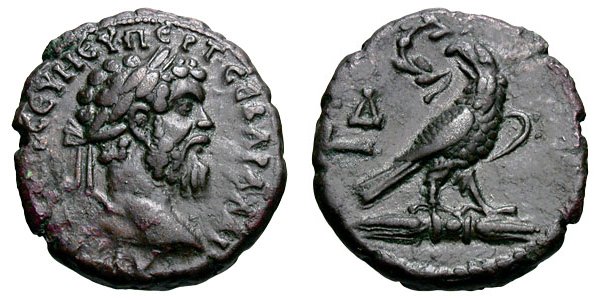
This stylistic information can allow us to match other rare Alexandrian coins for other emperors too.
Clodius Albinus Denarius
Obv:- D CLOD SEPT ALBIN CAES, Bare head right
Rev: FECILITAS COS II, Felicitas standing half left, caduceus in right and scepter in left
Minted in Alexandria. A.D. 194
RIC -. Same devices and legends as RIC 4 but with the disctinctive Alexadrian style

Commodus denarius
Obv:- M COMM ANTO - N AVG PIVS BRIT, Laureate head right
Rev:- LIR AVG R M TR P - XVII COS VII P P, Libertas standing left folding pileus and sceptre
Minted in Alexandria. A.D. 192
Reference:- BMCRE -. RIC -. RSC -.
Holed but sufficiently rare for it to be a highlight in my collection.

If this thread was useful then I am happy to do the same exercise with other mints. Let me know.
Martin





 with echizento


 Posted 03/04/2017 8:54 pm





