| Author |
 Replies: 480 / Views: 54,484 Replies: 480 / Views: 54,484 |
|
|
|
Valued Member
United States
333 Posts |
Good stuff, good stuff. ebay is my poison of choice, though lately I've been looking at other places too. As I collect whatever I can find, I've ended up looking at a lot of tokens lately and foreign coin shops that have them almost never show up unless I have a specific token in mind already and they have it. It's fairly frustrating, actually and I tend to find new things in groups. Here are the apparently three different pieces in the vein of those Austrian Mattighofen series. I only came across this recently: http://banknoteindex.com/browse.mht...browse=70970That info on the antimony coin is good to know -- I am looking a bit and see that they tend to sell for more than catalog value. It's something I can consider in due time. |
|
Valued Member
Belgium
186 Posts |
There were also Japanese pattern coins made in 1945 from white porcelain, which cost a couple hundred dollars to buy. These are only known as patterns, actual circulating coins of this type were made from red baked clay.
|
|
Pillar of the Community
United States
6130 Posts |
At the risk of straying off topic, I wonder to what extent the clay sen actually circulated? I have read that the government contracted to a local construction materials company for their manufacture, and they were getting ready to approve and release them. I have also read that they were never officially approved, although some were issued in "limited areas" due to dire coin shortages, and circulated "for a few days" before the war was over.
|
|
Pillar of the Community
 United States
574 Posts |
The only reference that I have found in regards to the clay sen actually circulating is in the Krause catalog under the catalog reference for Japan KM# 110 it says "Note: Circulated unofficially for a few days before the end of WWII in Central Japan, varieties of color exist". So, that makes me think that you are right and that they weren't officially approved but did have some very limited circulation.
|
|
Pillar of the Community
United States
574 Posts |
Nautilator, Yeah, I also collect whatever I can find too and I didn't start to think about putting together this set until I had about half of the pieces in my regular collection. Most of the items I got off of ebay but I did use two other sites: MA Shops (kind of like an online German competitor to ebay) in Germany is pretty good for finding some of the really obscure Notgeld but everything is written entirely in German so I needed to use googles' German to English translator and do a lot of copying and pasting to read the descriptions and search for items. Sometimes you have to go really far off the grid. I actually bought the Ancient Indian Copper Arsenic coin from a small auction house in India and that turned out to be a real hassle. It took five months for me to receive the item since they just kept giving excuses on why they hadn't shipped it and only shipped it after I brought a paypal case against them about four months after I paid for the item. I'm pretty sure that they were trying to run out the six month clock in which I could file a paypal case but it was the only place that I could find that kind of coin anywhere on the internet and it did eventually arrive. I know this kind of research can be rather frustrating. It's a lot easier to find a particular item for sale if you know specifically what you are looking for since the listing for an item for sale may not even list the material that it is made of. Meaning if that is what you are basing your search criteria on you will never find that item regardless of how hard you're looking. Right now I am trying to find any reference that says/shows that any kind of tokens/coins were made of either "Bois Durci" or "Hemacite". They were both early predecessors to plastics made of fine sawdust and various kinds of animal blood heat treated and molded which gave it the consistency of hard wood. I know Boris Durci was used to make all types of art medals starting in the 1860's to about 1920 but I can't seem to find any reference to it being used for tokens or coins which surprises me since it was a cheap strong material at the time that was easy to make/mold so I would be surprised that it wouldn't have been used for at least tokens at one time or another. Boris Durci: http://plastiquarian.com/?page_id=14216Hemacite: https://en.wikipedia.org/wiki/HemaciteI have also come across a mentioning that there was Notgeld made of sulfur. So, I have been looking into that too but haven't found anything yet. Edited by casualcoincollector
11/07/2017 04:11 am
|
|
Pillar of the Community
 United States
1950 Posts |
I think many of the more unusual materials circulated in limited geographical areas, for brief periods of time. The very nature of some of the compositions makes survival rates quite low, and quite susceptible to damage that would not effect coins make of other materials. For example, I have yet to come across any Lodz aluminum magnesium pieces without any spotting. With the Coal Dust Notgeld pieces, ther edges (especially on the 1000 mark and 500 mark issues) are extremely susceptible to chipping. Pieces without any edge chips are worth a significant premium. Another issue you come across in unusual material coinage is the issue of manufacturing flaws. Some of the porcelain pieces which were intended for circulation had flaws in the firing or glazing process, which comes across as damage. This was also an issue with some of the municipal Notgeld pieces, and if you see enough of these pieces, you will realize how common serious die cracks and Cuds are on many of these. While most of the unusual materials have already been covered in this thread, there are several unusual combinations that occur in some Notgeld with plating. Off the top of my head, the Solingen issues come to mind, with their issues featuring iron plated with copper or nickel, as well as the gilt issues of Westphalia Edited by jdmern
11/07/2017 05:32 am
|
|
Pillar of the Community
United States
655 Posts |
Some unusual material for coinage, sans metals, for sure. "Cardboard" really struck me! Great work, casualcoincollector.
|
|
Pillar of the Community
United States
574 Posts |
@ jdmern
Thanks for the info!
|
|
Pillar of the Community
United States
574 Posts |
|
|
Valued Member
United States
333 Posts |
I came across hemacite when digging around for this sort of thing, and it doesn't seem like any sort of money was made from it. That would be pretty interesting, no? You might check if anybody is good with French exonumia. The token catalog is only documenting 857 French tokens out of their nearly half million entries. Surely there are more we're not seeing out there. I'm kind of curious where that rumors of elemental sulfur notgeld bit is coming from. At the moment it seems that all references to it are coming from wikipedia and those copying it. I personally enjoy manufacturing flaws, because they end up showing things that you'd simply never see in a coin otherwise. Here's a personal favorite. 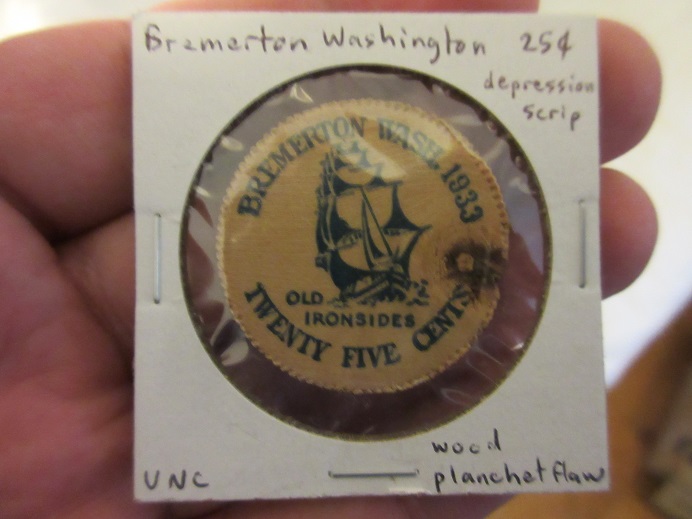 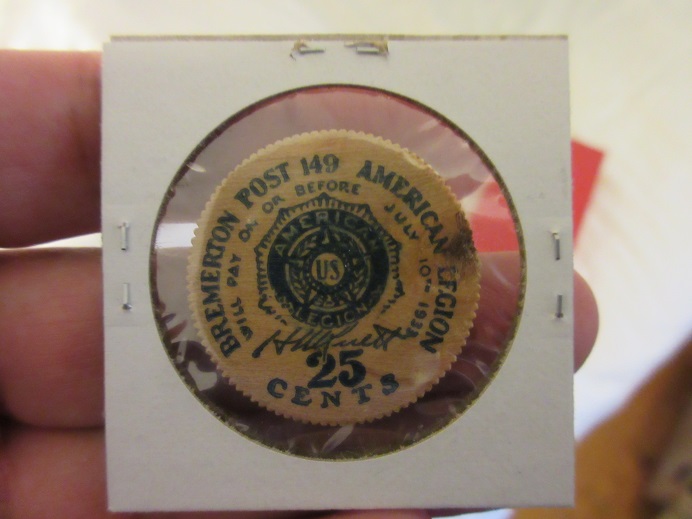 Are either of you familiar with tin? I was looking at some of the Thai tin coins on ebay and it seems that while those that are unc look like white metal, but many of the circulated either were a solid, dark gray or had a silvery white appearance to them. Is that normal and/or unique to tin? |
|
Pillar of the Community
United States
574 Posts |
@nautilator
I'm starting to run the theory that there are most likely several more materials were used for circulating coins/tokens throughout history but the info/records may not exist written in English anywhere. So, it's not going to be particularly easy to find any additional info.
I see what you mean in regards to the manufacturing flaws. It really gives that token a unique quality. Thanks for posting it.
Unfortunately, I'm not particularly familiar with the corrosion properties of tin. But I would assume that the silvery white circulated examples that you spoke of were most likely cleaned but I would have to see some photos to take a better guess.
Edited by casualcoincollector
11/10/2017 03:31 am
|
|
Valued Member
United States
333 Posts |
After taking a better look around, I got ahold of the wax notgeld. It appears to be cardboard coated in wax, rather than strictly wax. For some reason, they're not only glued onto a sheet, but the sheet itself is worth 200 while the ones individually add up to 160. 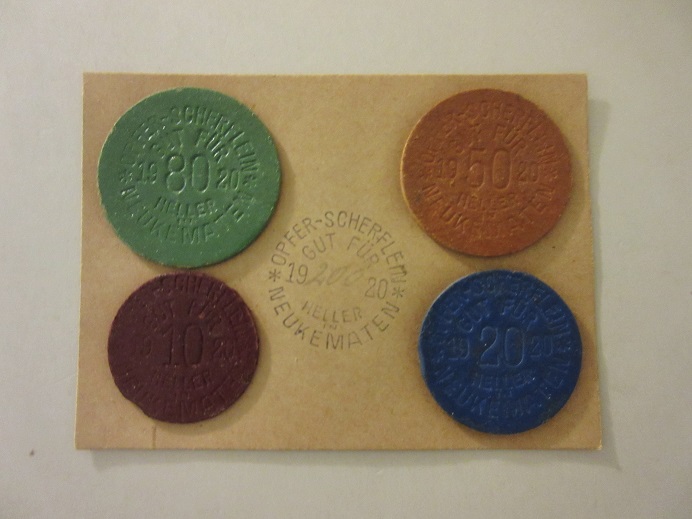 |
|
Pillar of the Community
Australia
3841 Posts |
With regards to the Japanese 'clay' coinage, they are technically classified as patterns. The 1 sen is the only one that did circulate perhaps as an experiment.
There are at least six different types as far as I am aware and there are 5 and 10 sen in red clay. The other three in white porcelain are significantly rarer and do not appear on the market. The last time I saw a set of such white porcelain - they sold for more than four figures. I think it was around 2-3000USD?
|
|
Pillar of the Community
United States
574 Posts |
@nautilator
Thanks for the information on the wax Notgeld.
Based on the fact that the wax covered cardboard pieces are physically glued to the card and the fact that the card has its own face value, it makes me wonder if these wax Notgeld pieces were actually meant for circulation or were just a fund raising tool like some of the later hyperinflation Notgeld coins.
Were you able to find any records that stated whether or not the wax Notgeld were actually meant for circulation or actually circulated?
|
|
Pillar of the Community
United States
574 Posts |
Edited by casualcoincollector
11/21/2017 05:42 am
|
| |
Replies: 480 / Views: 54,484 |





 First Page


 Posted 11/05/2017 5:22 pm


