Coin Community Family of Web Sites Join Thousands of Coin, Bullion, & Money Collectors
300,000 items to help build your collection! Shop for APMEX Bullion on eBay!Coin, Banknote and Medal Collectors's Online Mall Join Thousands of Coin, Bullion, & Money Collectors Royal Canadian Mint products, Canadian, Polish, American, and world coins and banknotes. Specializing in Modern Numismatics Vancouvers #1 Coin and Paper Money Dealer


Username:
Password:
Save Password
Forgot your Password?


This page may contain links that result in small commissions to keep this free site up and running.

Welcome Guest! Registering and/or logging in will remove the anchor (bottom) ads. It's Free!

Why Is This Half Dollar...

To participate in the forum you must log in or register.
Author Previous TopicReplies: 7 / Views: 1,494Next Topic  
Pillar of the Community
Justinokay's Avatar
United States
564 Posts
 Posted 04/04/2017  11:35 pm Show Profile   Bookmark this topic Add Justinokay to your friends list Get a Link to this Message Number of Subscribers
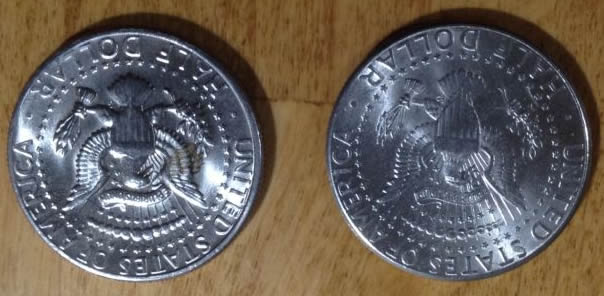
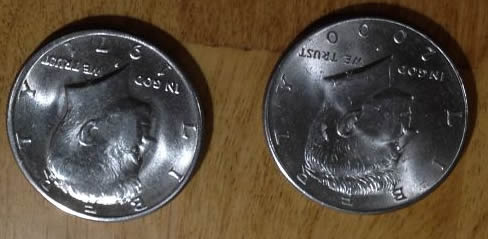
Why is the half dollar on the right having a higher relief than the left?


Why-Is-This-Half-Dollar... Why-Is-This-Half-Dollar...

*** Edited by Staff to crop images. Please crop images before uploading. If you do not have software to do this you can use the free image optimizer. ***
Pillar of the Community
thedollarman's Avatar
Canada
4911 Posts
 Posted 04/04/2017  11:39 pm  Show Profile   Check thedollarman's eBay Listings Bookmark this reply Add thedollarman to your friends list Get a Link to this Reply
as the hub they use to make the dies gets used more, it slowly wears down, therefor the design needs to be redefined, this results in a lower relief as the design is worked over again and again..the same can be noted easily on your cent, nickel quarter if you compare say a 1932 Washington to a 1999.
Feel free to call me Will.
Pillar of the Community
United States
1000 Posts
 Posted 04/05/2017  12:30 am  Show Profile   Bookmark this reply Add Druu to your friends list Get a Link to this Reply
Unless you have the pictures upside down, right appears to have a lower relief than the right. Over the years, the obverse and reverse designs were changed slightly (intentionally). This does not have to do with wear on the master hub or die. You'll see this change in other denominations as well.
Moderator
Learn More...
John1's Avatar
United States
56855 Posts
 Posted 04/05/2017  04:38 am  Show Profile   Bookmark this reply Add John1 to your friends list Get a Link to this Reply
When comparing coins, you need to use the same dates,mint marks and conditions. Apples to apples not apples to oranges.
John1
Rest in Peace
T-BOP's Avatar
United States
18456 Posts
 Posted 04/05/2017  07:52 am  Show Profile   Bookmark this reply Add T-BOP to your friends list Get a Link to this Reply
With John . And I also believe you have the two Halves backwards .
Valued Member
United States
424 Posts
 Posted 04/05/2017  08:26 am  Show Profile   Bookmark this reply Add Oldephriam to your friends list Get a Link to this Reply
Over the years the Mint has developed methods to expand production without expanding facilities. One of the most notable ways of doing this is to produce low relief coins. The Mint produces billions of coins each year and must be ultra efficient in doing this, it helps to keep expenses down. The high relief coin you have is from 1971 when production numbers and expenses were lower. The low relief coin is from 2000, higher demand and higher expenses. With the low relief and high speed presses the mint can produce six one cent coins per second on each press. It is amazing to watch so if you get a chance to tour a Mint Do Not pass it up. During the tour they explain the how, why and when of the low relief coins.
Bedrock of the Community
Conder101's Avatar
United States
17884 Posts
 Posted 04/05/2017  10:46 am  Show Profile   Bookmark this reply Add Conder101 to your friends list Get a Link to this Reply
Relief was lowered deliberately in order to allow for longer die life and higher production speeds. When the 1971 half was struck they were using a vertical striking press that ran around 100 strikes per minute or 5 coins every three seconds. Today they use a horizontal strike Schuler press that runs at 750 strikes per minute. That's about 12 coins per second or one coin every 8/100th of a second, Now coinage metal, being a somewhat plastic solid, will flow under pressure but it takes time for it to flow. And it it can't flow very far in .02 seconds (The total cycle time for the press per coin is .08 seconds but the actual striking portion of that is about .02 seconds) so the relief has to be a lot lower than back when it had .42 seconds.

Moderator
Learn More...
jbuck's Avatar
United States
187702 Posts
  Previous TopicReplies: 7 / Views: 1,494Next Topic  

To participate in the forum you must log in or register.


Disclaimer: While a tremendous amount of effort goes into ensuring the accuracy of the information contained in this site, Coin Community assumes no liability for errors. Copyright 2005 - 2026 Coin Community Family- all rights reserved worldwide. Use of any images or content on this website without prior written permission of Coin Community or the original lender is strictly prohibited.
Contact Us  |  Advertise Here  |  Privacy Policy / Terms of Use

Coin Community Forum © 2005 - 2026 Coin Community Forums
It took 0.27 seconds to rattle this change. Forums