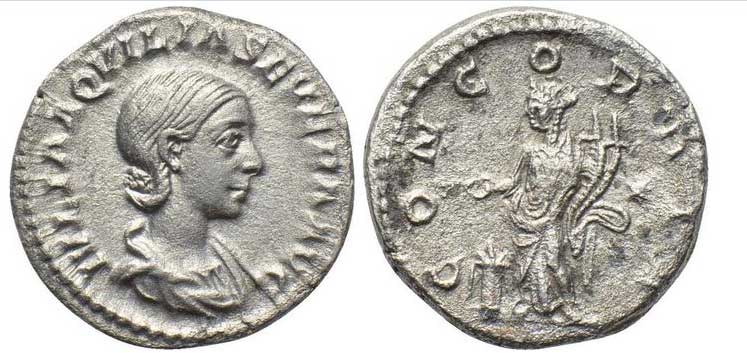
Coins allow us to touch history, and this particular coin means a lot to me because of what it must have symbolized to the Roman who held it.
Again, it's difficult to describe the importance of vestal virgins to the Romans to a modern audience. The Vestals were the goddess protectors of Rome, kind of like the living embodiment of the American flag, the Super bowl, and a house, car and 2 kids for Americans. There is no modern equivalent, but the Romans took their vestals very, very seriously.
After the Romans lost at Cannae in 216 BC, the Republic was on the verge of collapse. The Roman religion is more like a set of superstitions than a religion in the modern sense. The ancient historian Livy provides a list of bad omens before the battle. From Livy's History of Rome, book 22:
To add to the general feeling of apprehension, information was received of portents having occurred simultaneously in several places. In Sicily several of the soldiers' darts were covered with flames; in Sardinia the same thing happened to the staff in the hand of an officer who was going his rounds to inspect the sentinels on the wall; the shores had been lit up by numerous fires; a couple of shields had sweated blood; some soldiers had been struck by lightning; an eclipse of the sun had been observed; at Praeneste there had been a shower of red-hot stones; at Arpi shields had been seen in the sky and the sun had appeared to be fighting with the moon; at Capena two moons were visible in the daytime; at Caere the waters ran mingled with blood, and even the spring of Hercules had bubbled up with drops of blood on the water; at Antium the ears of corn which fell into the reapers' basket were blood-stained; at Falerii the sky seemed to be cleft asunder as with an enormous rift and all over the opening there was a blazing light; the oracular tablets shrank and shrivelled without being touched and one had fallen out with this inscription, "MARS IS SHAKING HIS SPEAR"; and at the same time the statue of Mars on the Appian Way and the images of the Wolves sweated blood. Finally, at Capua the sight was seen of the sky on fire and the moon falling in the midst of a shower of rain. Then credence was given to comparatively trifling portents, such as that certain people's goats were suddenly clothed with wool, a hen turned into a cock, and a cock into a hen.
So it should be no surprise that vestal misbehavior was perceived as a bad omen by the Romans.
Livy writes, "For, over and above these serious disasters, considerable alarm was created by portents which occurred. Two Vestal virgins, Opimia and Floronia, were found guilty of unchastity. One was buried alive, as is the custom, at the Colline Gate, the other committed suicide."
Elagabalus marrying a vestal not once but twice would be like a new US president taking a wee on the Constitution and setting the Smithsonian on fire. I can't imagine what the average Roman must have thought being handed this coin. Was receiving one viewed as a bad omen?
If only the coin could talk...






 Posted 04/12/2017 12:20 pm





